



by Emanuela Zanon 28/07/2026



Categories: Exhibition reviews / Disclaimer
Cao Fei’s exhibition at the Prada Foundation transforms drones, artificial intelligence, and smart agriculture into a visual narrative about the posthuman world, as China seeks to redefine contemporary art. Here’s what the exhibition is like: a review by Emanuela Zanon.

While in recent decades the center of gravity of the global contemporary art world has consistently gravitated toward New York—where multinational galleries such as Gagosian, Pace Gallery, David Zwirner, and Marian Goodman Gallery, and institutions capable of determining the certified symbolic capital of artists within high-stakes collecting circles—such as MoMA or the Guggenheim Foundation—there are many signs suggesting that everything is about to change. In line with the recent decline of U.S. geopolitical primacy, countries outside the Euro-Atlantic axis are also stepping forward with growing determination and resources to assume this leadership role within the global art system, as demonstrated by the 61st International Art Exhibition of the Venice Biennale currently underway, where the Global South takes center stage. Among these, China appears to be one of the most motivated, by virtue of its status as the world’s second-largest economy and the recent systematization of a new artistic orientation—one that is conceptually and stylistically detached from Western precedents, which were initially regarded as an indispensable point of reference. As Aria Yang, Program Director of Gallery Weekend Beijing, explains in an interview, in recent years the Chinese art world has stopped looking to the West and has achieved full self-determination in defining its own histories, narratives, and unique terms of reference, to the point of developing the capacity to assert itself as an autonomous voice. The most representative defining feature of Chinese art today lies in an osmotic conception of the relationship between human beings and technology, understood as a condition of shared existence and a foundational anthropological reality. This vision is rooted in the fact that Taoist and Confucian philosophy is alien to the Western dichotomy between nature and artifice, and sees every expression of technological mediation as the natural extension of a millennia-old cultural continuity.

A paradigmatic artist in this regard is Cao Fei (Guangzhou, 1978), who in 2025 ranked 29th on the Power 100 list of the British monthly *ArtReview*, the benchmark ranking in the art world, and among the 100 most influential people in the world according to *Time* in 2026, with a profile describing her as one of the artists best able to analyze the contemporary world in all its contradictions. From the very beginning, her work has focused on exploring how technology has transformed daily life in China for her generation, and she examines what utopia and dystopia mean in the digital age, who works and what is meant by work, the role of China in global contexts, and how brand fetishism shapes the nation’s collective identity. Confirming her established status within the global art world, the artist is now the focus of *Testimonies to the Near Future* at the Kunstmuseum Basel | Gegenwart, a comprehensive retrospective that brings together works created over three decades of practice into a multi-layered, navigable universe, and *Dash* at the Prada Foundation in Milan, which instead centers on a single ambitious multimedia project—produced by the foundation itself—that explores posthuman geographies and the anthropological implications of smart agriculture on a global scale.


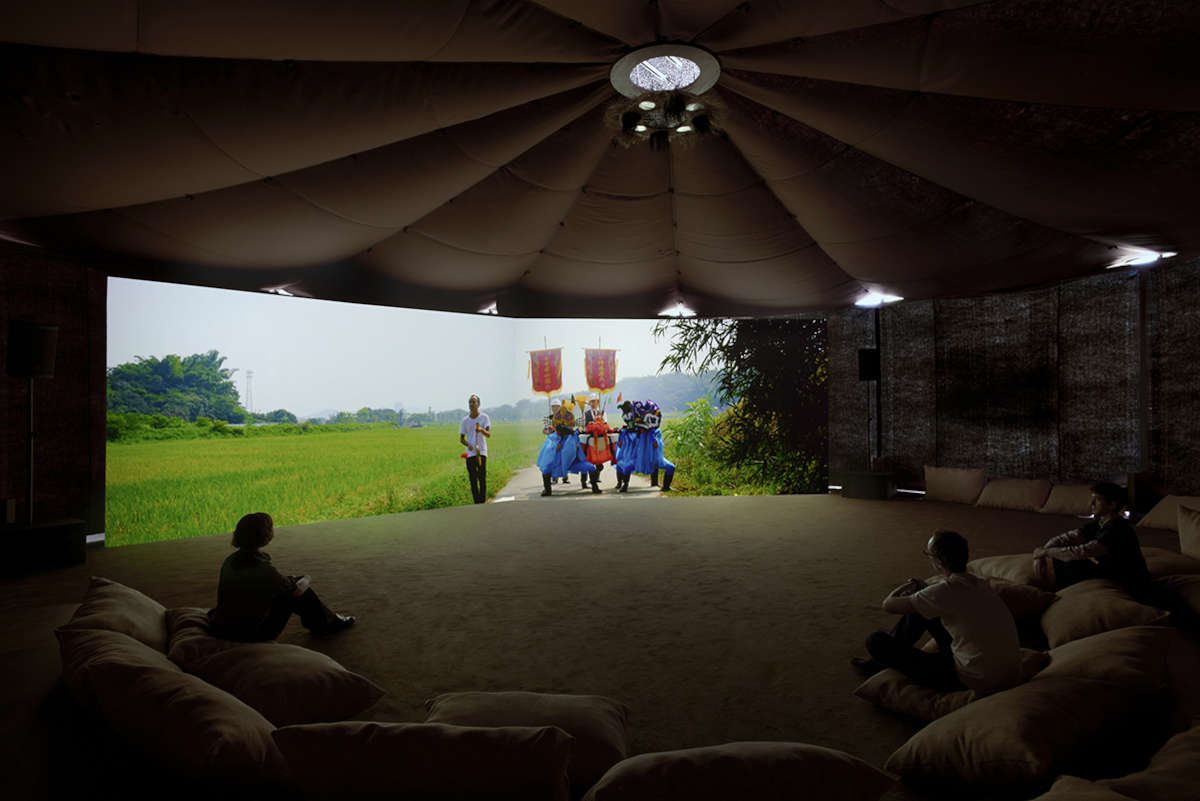
The centerpiece of the installation—arranged in the usual layout of Prada’s temporary exhibitions across the two floors of the Podium—is the eponymous film projected onto two giant screens inside a rice-harvesting barn tent. The video was produced over the course of three years during which the artist followed the work of XAG, a world-leading company in agricultural robotics based in Guangzhou. Traveling to various production sites in China and Southeast Asia, he documented the rise of new technologies—such as agricultural drones and artificial intelligence algorithms—in optimizing farm work and cultivation processes. The footage is impeccable, rendered in a style strongly reminiscent of one of his most famous works, *Whose Utopia* (2006)—now part of the collection at the Solomon R. Guggenheim Museum in New York—which focused on the mechanized tasks of workers at the Osram lighting factory in Foshan, Guangdong. While in that case the machinery of the production line—filmed by alternating between close-ups and evocative wide shots—evoked the idea of a self-sufficient macro-organism overwhelming the human workforce, in *Dash*, the same aesthetic approach is used to highlight the unsettling perfection of the landscape of agricultural techno-globalization. The infrastructure whose allure the artist both experiences and magnifies is no longer the hardware of large production-line machinery, but rather the largely software-based infrastructure of agritech, where drones and other remotely controlled automated vehicles perform all agricultural tasks—from sowing, to irrigation, to the application of pesticides and fertilizers, to harvesting, and even to monitoring crops and implementing any corrective actions devised by specialized artificial intelligence. The drone, whose panoramic view the viewer sometimes takes on, is presented as an enigmatic chthonic deity—benevolent yet stern—and is the recipient of both the maintenance efforts of farmer-workers and propitiatory rites of ancestral devotion, the assimilation of which is implied. While in *Whose Utopia* the workers appeared to be entirely subordinate to an unflinching system alien to their dreams, in *Dash* any longing for individualism dissolves into a hyperconnected ecosystem where equipment, people, and plants communicate through a sentient network that makes no distinction between the organic and the artificial. The video is beautiful: poetic, dreamlike, and aesthetically evocative, yet at the same time surgically precise in documenting the processes of smart agriculture; it captivates us by making us marvel at the progress technology has already made and by revealing, where the Western gaze continues to perceive an irresolvable tension between humans and their technical prostheses, the hypothesis of an interconnected world order that still struggles to enter our imagination, even though it is in all likelihood the future that awaits us. But for the Chinese, who since the first decade of the 2000s have taken up the Western baton of technological innovation, this mental horizon is already a given and, in mature artists such as Cao Fei, has been formalized into a visual language of compelling conceptual and stylistic coherence. And it is precisely this language—which processes the global technological present through deeply Chinese cultural categories—that is the winning formula China is presenting on the international art scene as a radically innovative contribution.
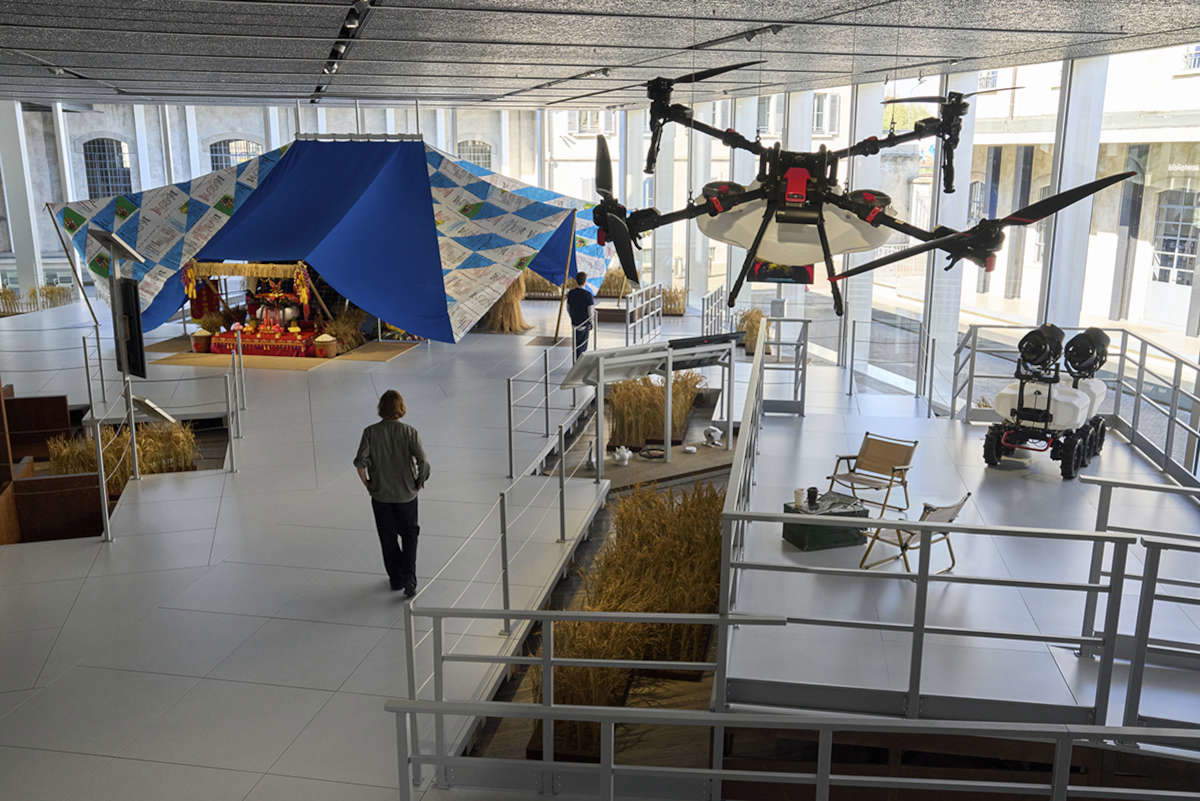
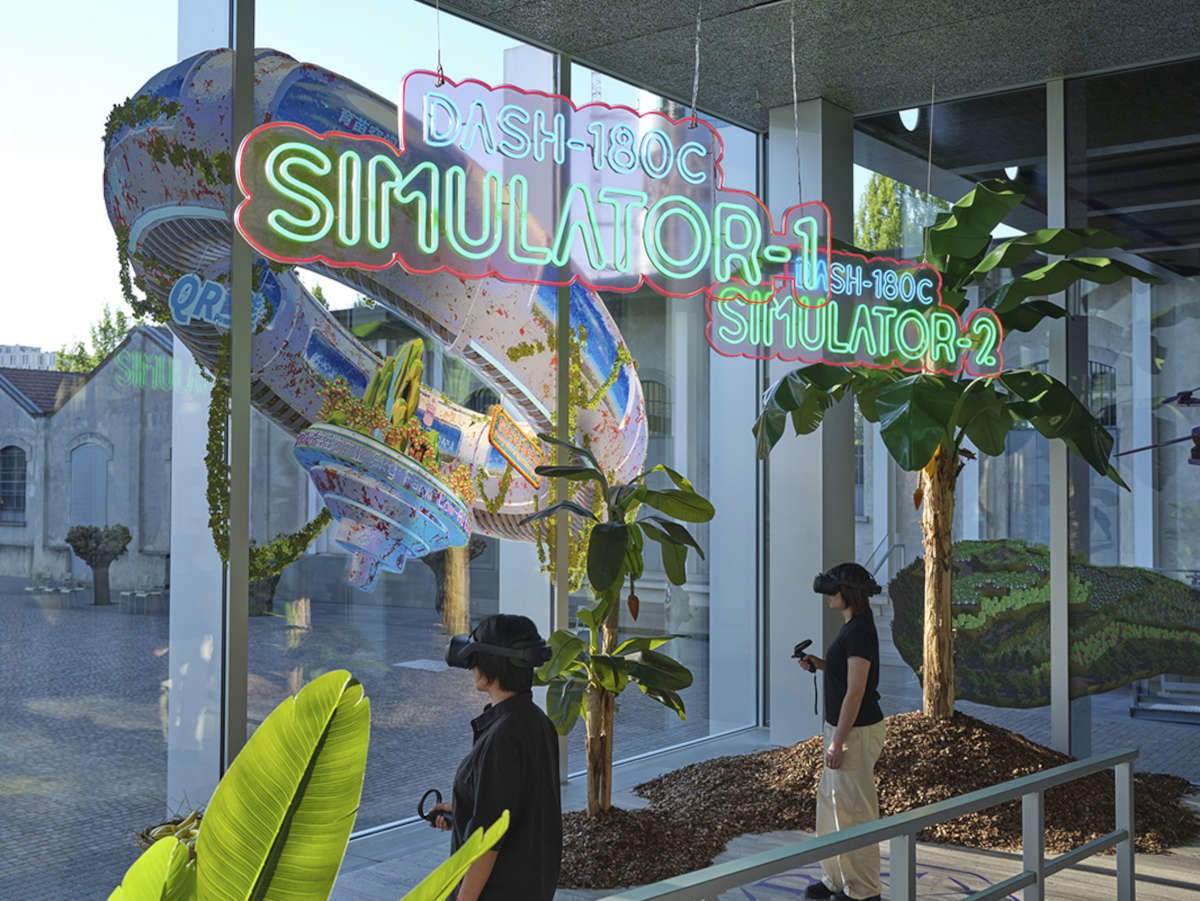
But let’s now turn to the rest of the exhibition, which, arranged around the main projection like a redundant didactic apparatus, ultimately undermines the evocative power of the film. The ground floor of the Podium—at the center of which stands the tent where the screening takes place—has been set up as if it were the walkway of an archaeological site dedicated to contemporary agriculture and is dotted with video stations illustrating the scope of application and operation of the agricultural drone. The drone itself (as well as other equipment) can be viewed as a sculpture in two different versions, both taken from the film: one adorned like an idol to which consumer goods are burned as sacrifices, and another in working order, ready for display at a trade show. All around, further evoking the idea of a luxury corporate showroom, are weather stations, solar panels (in which some experts might recognize niche details), and synthetic “furnishings” of rectangular prisms with embedded standardized ears of wheat to indicate the presence of video stations.
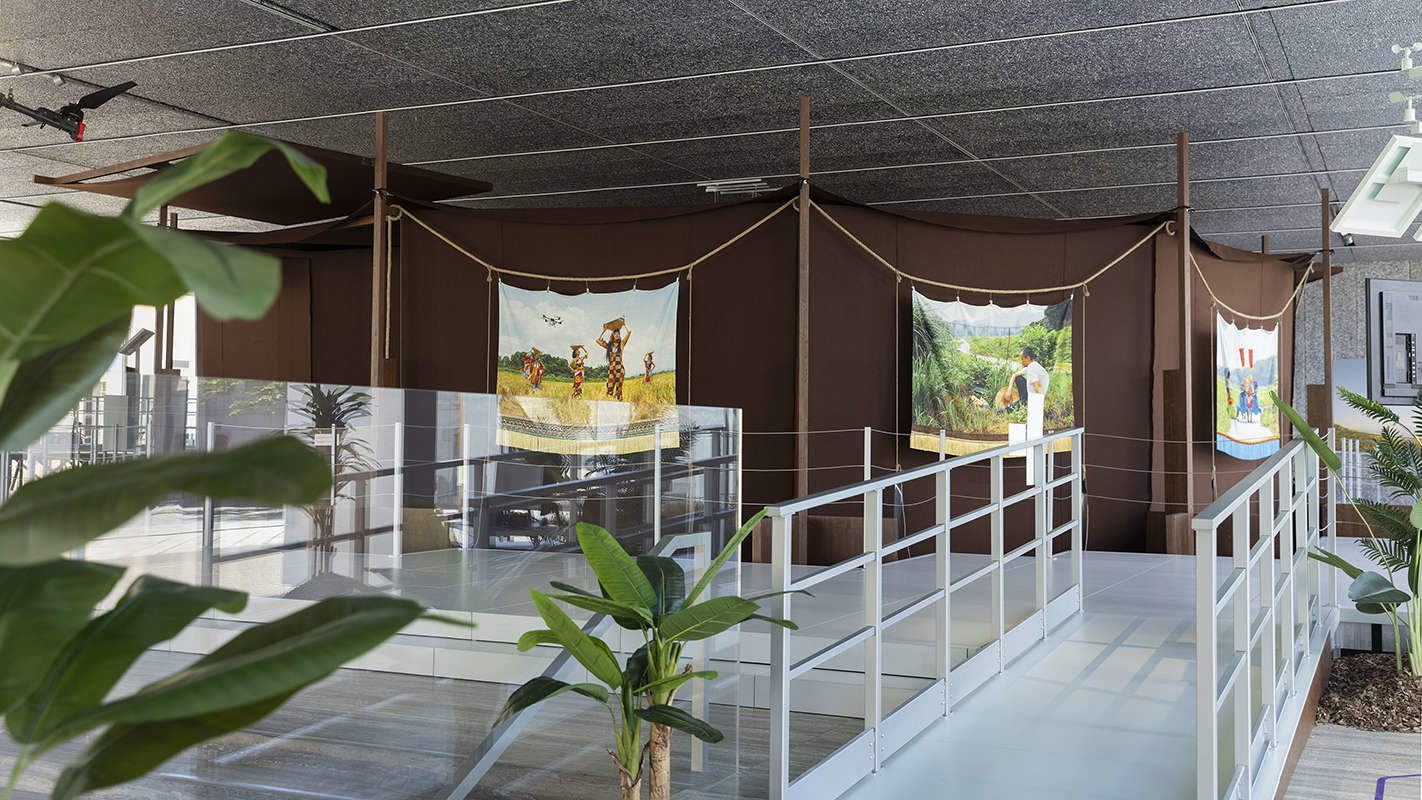
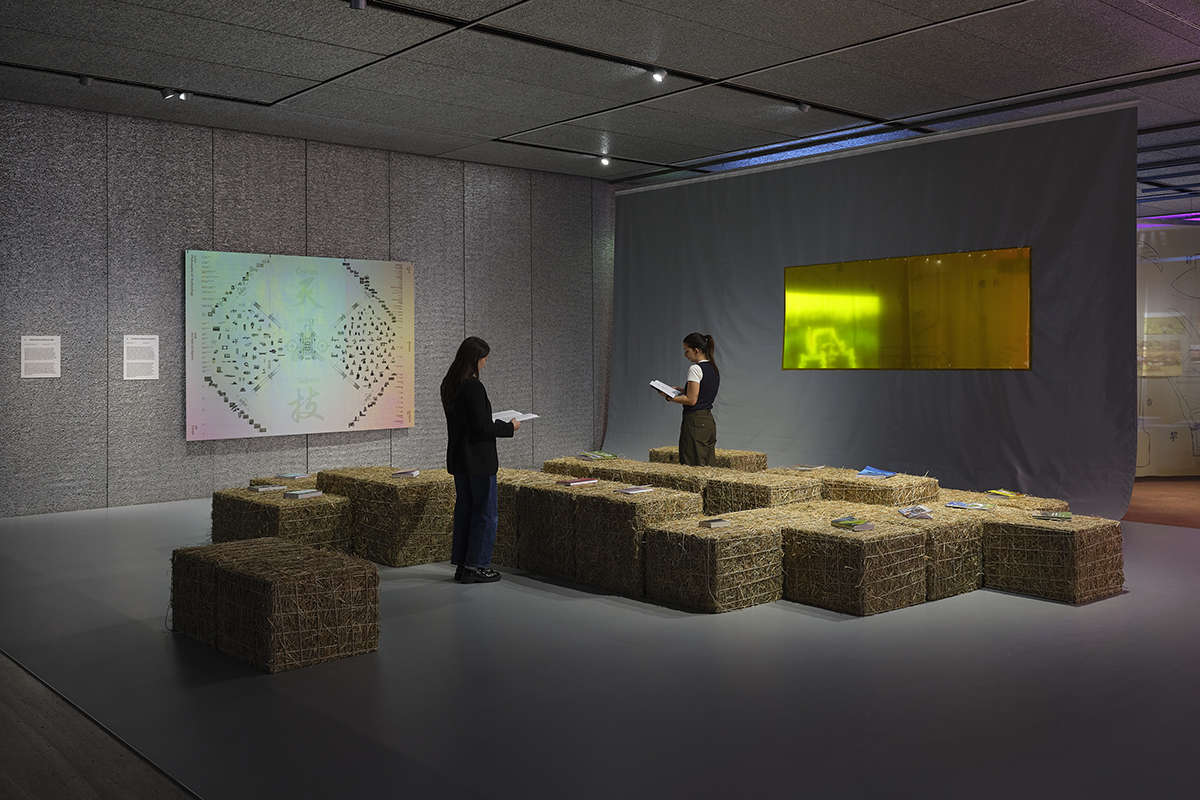
On the upper floor, however, a documentary exhibition has been set up, contextualizing Cao Fei’s work by making available the materials she collected to structure the project, such as documentaries, video interviews, photographs, slides, movie posters, books, and other archival documents. It begins with a concept map—which is difficult to read—that frames the technology-mediated connection to the land within the triad of Cosmos, Human, and Technics, and continues with a reading area where visitors are invited to consult a selection of international publications on precision agriculture. It seems unrealistic to expect that the average visitor (or even the most avid and meticulous contemporary art enthusiasts) would find the motivation to delve beyond the covers, despite the fact that the bales of hay to which each book is secured are intended as an invitation to linger. But perhaps those capable of evaluating the technological showcases on the lower level from a technical standpoint might find themselves jotting down some useful information. Non-experts—who in this case are not art novices but rather those unfamiliar with technology—may instead notice that the cover photographs, where present, are very reminiscent of the style of the images in the video *Dash*. Next comes a series of panels displaying historical documents related to agriculture dating back to the decades following the founding of the People’s Republic of China (between 1949 and the 1980s), once used as tools to promote the communist government’s development policies and strategies, revealing how agricultural science was one of the central themes of propaganda imagery. Cao Fei, too, seems to position herself in an ambiguous continuity with this tradition, given the substantial stylistic similarity between the graphics extolling mechanized farm work and the tapestries that surround, on the lower level, the granary tent, where the film’s characters appear as new national icons of high-tech progress.
The promotional intent then seems to escalate with the subsequent proliferation of videos, in which the drone’s uses and operating instructions are once again presented—here with the manufacturer’s logo always prominently displayed, even on the internal components shown in what appear to be actual tutorials. As further confirmation that using it is truly within everyone’s reach, several interviews with farmers show how even vulnerable individuals who might seem ill-suited for this profession—such as the chronically unemployed or women with long, manicured nails—have become successful farmers thanks to it. This “grassroots” acclaim is reinforced and substantiated, at the end of the video, by a series of video segments featuring scholars, researchers, and experts in various fields—from anthropology to agronomy— on the far-reaching social, economic, and environmental consequences of automation in agriculture, including a segment featuring Tong Wei, XAG’s director of international sales, who explains, among other things, how drone settings can be calibrated to comply with different national regulations for export purposes. The exhibition concludes with an automated vertical hydroponic greenhouse designed for growing herbs and leafy greens, operating day and night for the duration of the exhibition, which exemplifies a local application of smart agriculture within the Italian ecosystem.
If, at this point, you don’t have a plot of land to cultivate and haven’t yet rushed out to buy the drone to maximize its yield—abandoning the artistic perspective—interesting questions arise about how free art truly is to be art in this context. A partial answer can be found by crossing the Tese delle Vergini at the Arsenale, where the Chinese Pavilion at the 61st Venice Biennale—which opens with a massive gaming station and ends with the writing desk of a calligraphy robot in action—dispels any remaining ambiguity. Titled *Dream Stream* and curated by a large group of artists, it feels less like a group exhibition and more like a trade show aimed at promoting Chinese contemporary technology in all its forms—not necessarily artistic ones. The imprint is unmistakably corporate: individual authorship is sacrificed in favor of a systemic image, and the integration of art, science, and industry is not questioned but showcased as a national strength. Within this framework, Dash reveals the limits of its autonomy vis-à-vis a broader direction and, in the exhibition design surrounding the film, proves perfectly functional to a narrative orchestrated from above: that of a China promoting its technological supremacy through art as well, just as it has learned to do on the geopolitical and economic fronts. The suspicion—one that is difficult to shake off upon leaving the Prada Foundation—is that the line between visual expression and an instrument of soft power is, in this case, much thinner than the beauty of the images would suggest.
Warning: the translation into English of the original Italian article was created using automatic tools. We undertake to review all articles, but we do not guarantee the total absence of inaccuracies in the translation due to the program. You can find the original by clicking on the ITA button. If you find any mistake,please contact us.