




by Redazione 21/06/2026



Categories: Exhibitions / Disclaimer
Palazzo Te in Mantua is hosting a solo exhibition by Marco Palmieri. Set up in the Camera delle Cariatidi, the exhibition features a photographic series created specifically for the spaces of Palazzo Te.

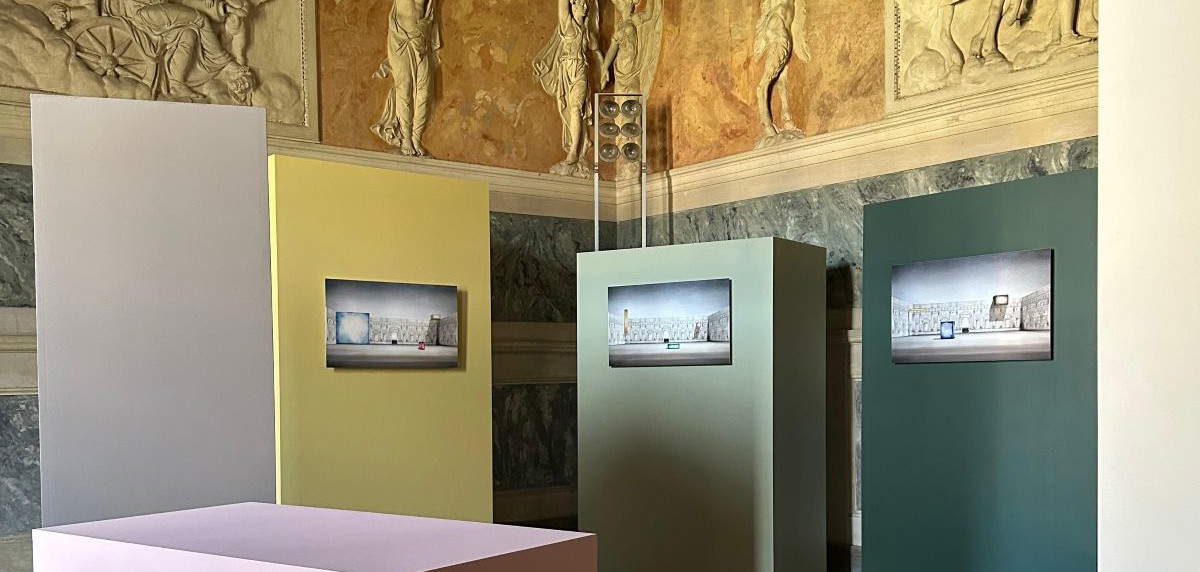
From June 24 to September 13, 2026, Palazzo Te in Mantua will host *Cinque Quinte*. “Omaggio a Palazzo Te,” a solo exhibition by Marco Palmieri. Set up in the Camera delle Cariatidi, the exhibition presents a photographic series conceived specifically for the spaces of Palazzo Te and inspired by the historical and artistic value of the monumental complex, with particular attention to the Cortile d’Onore. The project is part of the artist’s broader body of work, developed through various expressive media such as drawing, watercolor, scale models, and photography—a medium that synthesizes and unifies the different components of his creative practice.
The series *Cinque Quinte* originated from the construction of a miniature scenic set, entirely painted in watercolor, which was subsequently photographed in five different architectural configurations. Through this process, Palmieri highlights the theatrical nature of the Cortile d’Onore. The images evoke a metaphysical stage composed of perspective wings and colored volumes arranged along a central axis, giving rise to enigmatic and evocative presences.
Organized by the Fondazione Palazzo Te and realized with the support of Molino Pasini SPA Società Benefit, Antonia Jannone Disegni di Architettura, and Paola Sosio Contemporary Art Gallery, the exhibition marks Palmieri’s return to a major institutional venue following the recent presentation of the Passaggi series at the Italian Cultural Institute in Paris. The exhibition is accompanied by a catalog published by Corraini Edizioni, featuring a critical essay by Stefano Baia Curioni that explores the themes and inspirations underlying the artistic project.


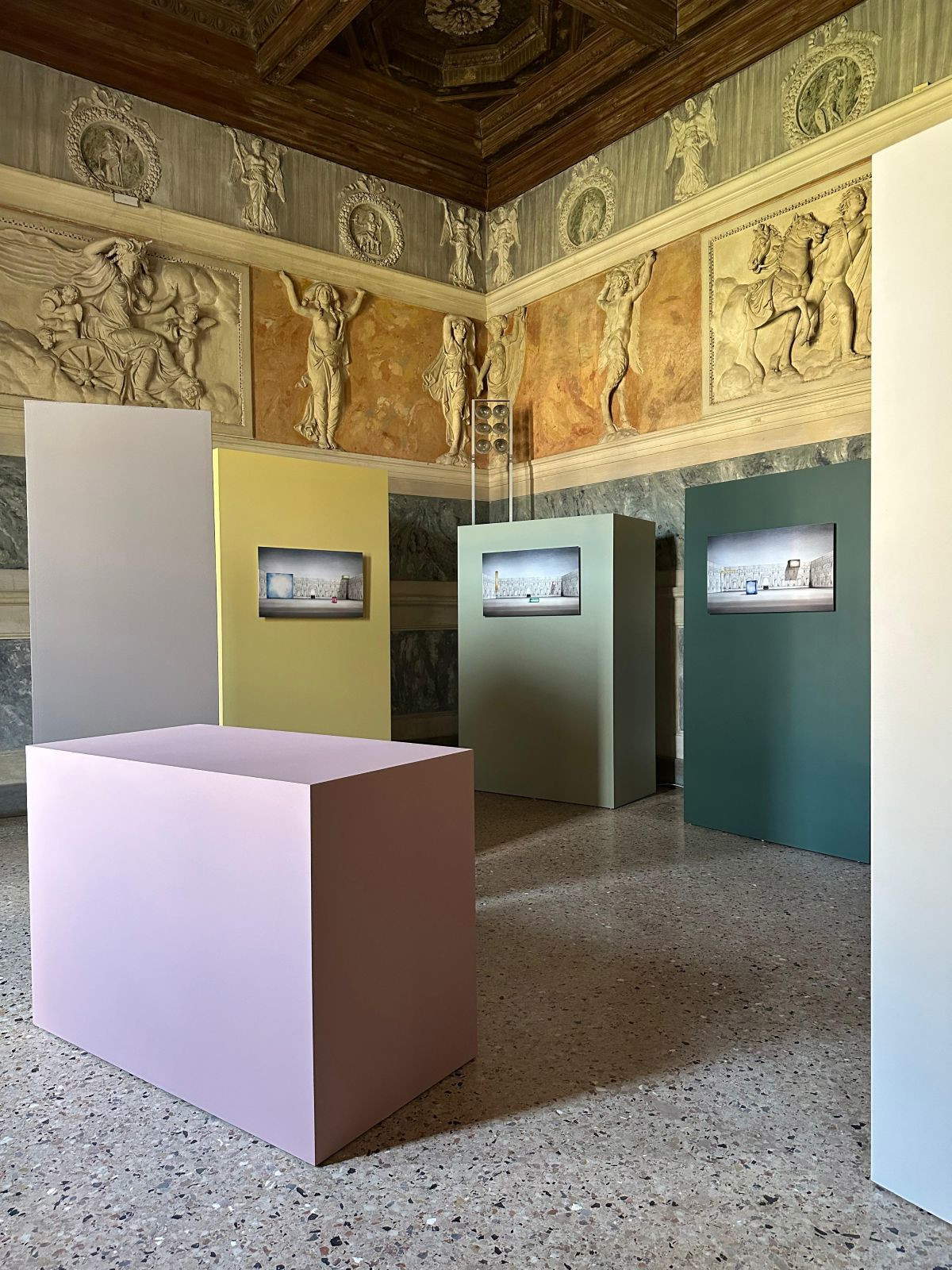
“Palazzo Te is a theater of the Ancient that breaks through into the Modern,” explains Stefano Baia Curioni, director of the Fondazione Palazzo Te. “The Courtyard of Honor at Palazzo Te is the final outcome of the project, the culmination, the definitive setting of a journey that begins in the Chamber of Ovid, winds through the Horses and Cupid and Psyche, and culminates in the Giants. Marco Palmieri has interpreted the Te—and the Courtyard of Honor in particular—as a metaphysical theater that, through its playful and tragic redundancies, sustains even the purest geometries: the wings of a stage waiting to be filled. In doing so, he captures an important point: the Te was once a court theater, but today it hosts us, citizens of diverse backgrounds. It hosts us and invites us to participate in its play; its halls transform us into spectators and then into actors. Nature and the gods dance in strangeness, and we, after a while—almost out of aesthetic compulsion—must join them.”
“My work on Palazzo Te stems from the urgency to trace analogies, ideas, and mirror-like references between contemporary complexity and the historical-artistic period of Mannerism,” says the artist. “Today’s fluid world, marked by the collapse of grand narratives, the loss of traditional paradigms, and a necessary interdisciplinarity, outlines a scenario in which Giulio Romano’s work proves to be extremely contemporary and inspiring. At Palazzo Te, the separation between disciplines dissolves. Giulio Romano, who trained in Raphael’s workshop, embodies an era in which architecture was an integral part of drawing. Art, set design, sculpture, and architecture coexisted in a fluid synthesis, before the modern world imposed specialization and the consequent loss of a holistic overview.”
 |
| Mantua: Marco Palmieri Pays Homage to Palazzo Te with a Site-Specific Photography Project |
Warning: the translation into English of the original Italian article was created using automatic tools. We undertake to review all articles, but we do not guarantee the total absence of inaccuracies in the translation due to the program. You can find the original by clicking on the ITA button. If you find any mistake,please contact us.