




by Redazione 08/07/2026



Categories: Exhibitions / Disclaimer
From July 4 to October 18, 2026, the Museo Alto Garda in Riva del Garda presents a unique exhibition exploring the development of Lake Garda’s tourist image, analyzing the evolution of visual and promotional language, from the elegant charm of the Belle Époque to the fast pace of modernity.

For over a century, Lake Garda has represented, for a vast audience of travelers, an experience lived through the lens of the imagination even before it was experienced in physical reality. Before it was actually traversed or explored, this body of water was longed for, contemplated, and constructed through a sophisticated array of representations that shaped its collective perception. Posters, picture postcards, informational brochures, travel guides, vintage photographs, and later film footage have, over time, shaped a shared visual repertoire, transforming a geographical landscape into one of the most recognizable and celebrated icons of European tourism. The exhibition titled “Visit Lake Garda: Graphic Design and Promotion from the Belle Époque to Modern Tourism, on view at the Museo Alto Garda in Riva del Garda (Trento) from July 4 to October 18, 2026, and curated by Matteo Rapanà and Anna Zunino, aims to provide an in-depth analysis of this process: the historical, cultural, and visual origins of Lake Garda’s tourist image spanning the late 19th century to the present day. The project was conceived to mark the centennial celebrations ofthe Azienda Autonoma di Soggiorno e Turismo di Riva del Garda, now known as Garda Dolomiti, and is based on a rich collection that the museum has expanded over the years through targeted acquisitions, donations, and loans, as well as rigorous research conducted in various museums, archives, and institutions specializing in the subject.
The initiative is not intended as a simple exhibition of vintage advertising materials, but rather as an investigation into the semiotics of the territory. It is a detailed analysis of the ways in which a geographical location is translated into an image, making it communicable and transforming it into a premier destination. In this context, the tourism poster—in its original, ephemeral form intended for public display—emerges as a cultural device of crucial importance. The poster is not limited to the mere promotion of a place but actively contributes to the definition of its identity, recording with extreme precision the evolution of taste, changes in artistic techniques, social aspirations, and radical shifts in transportation infrastructure.


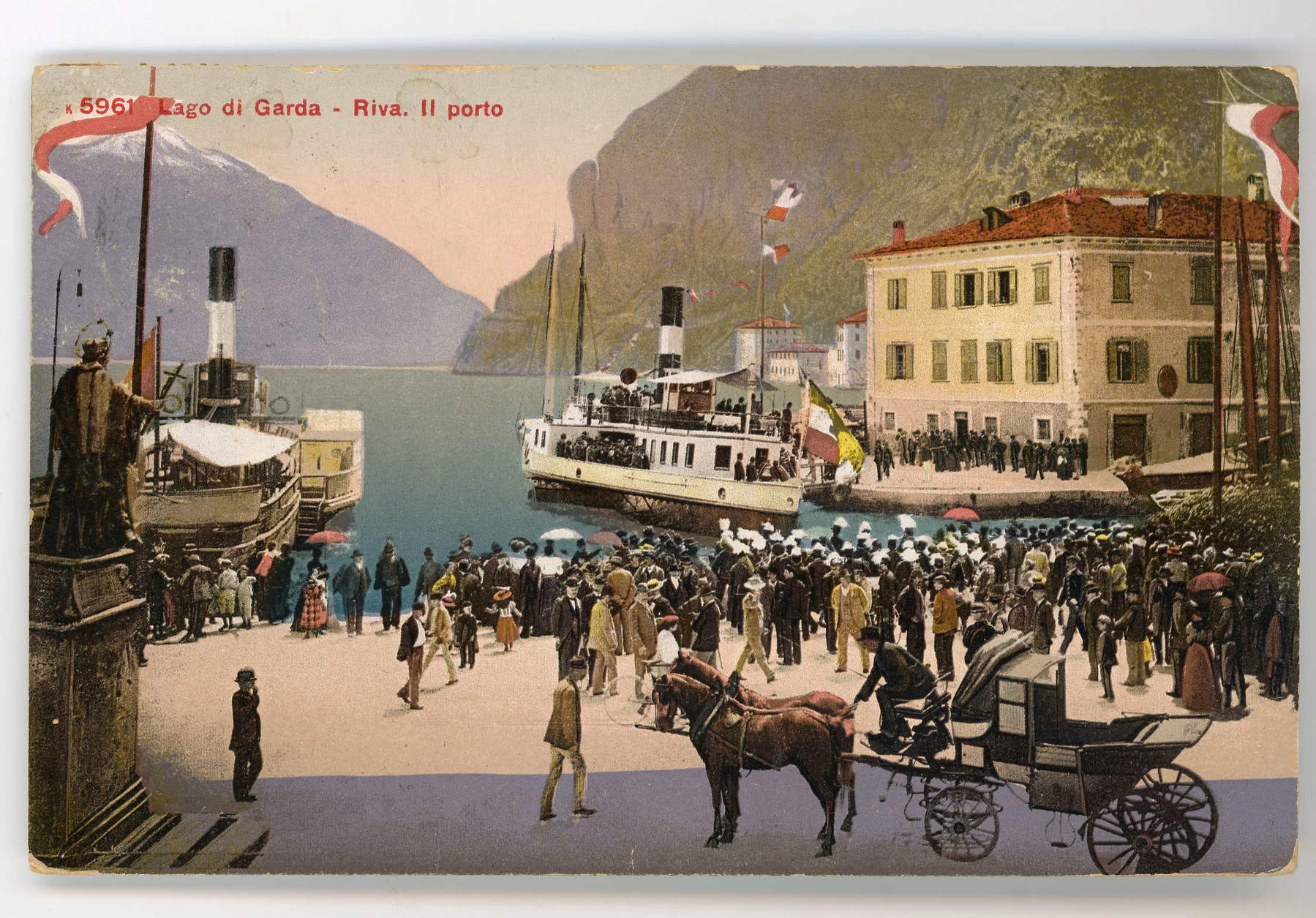
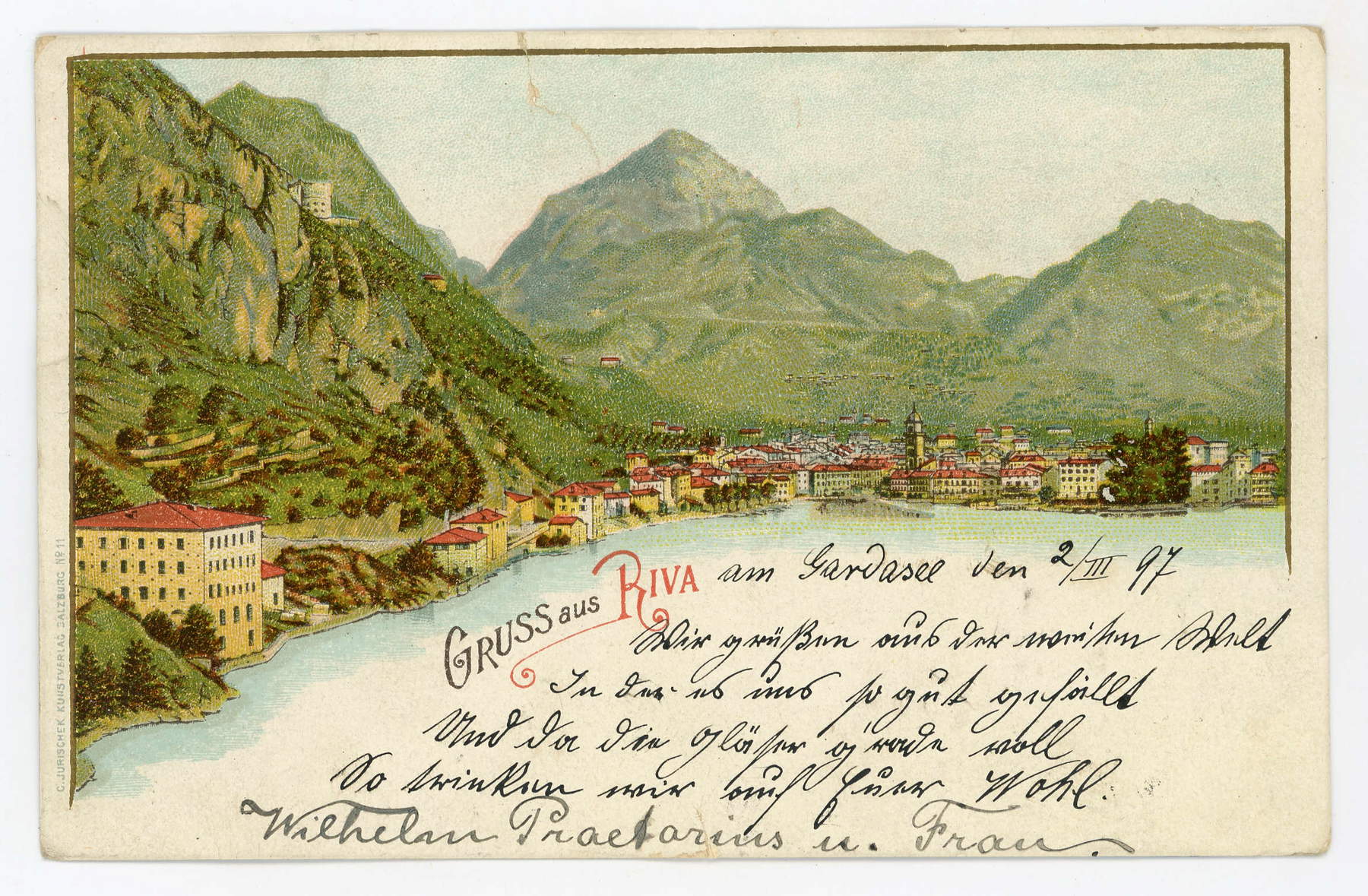
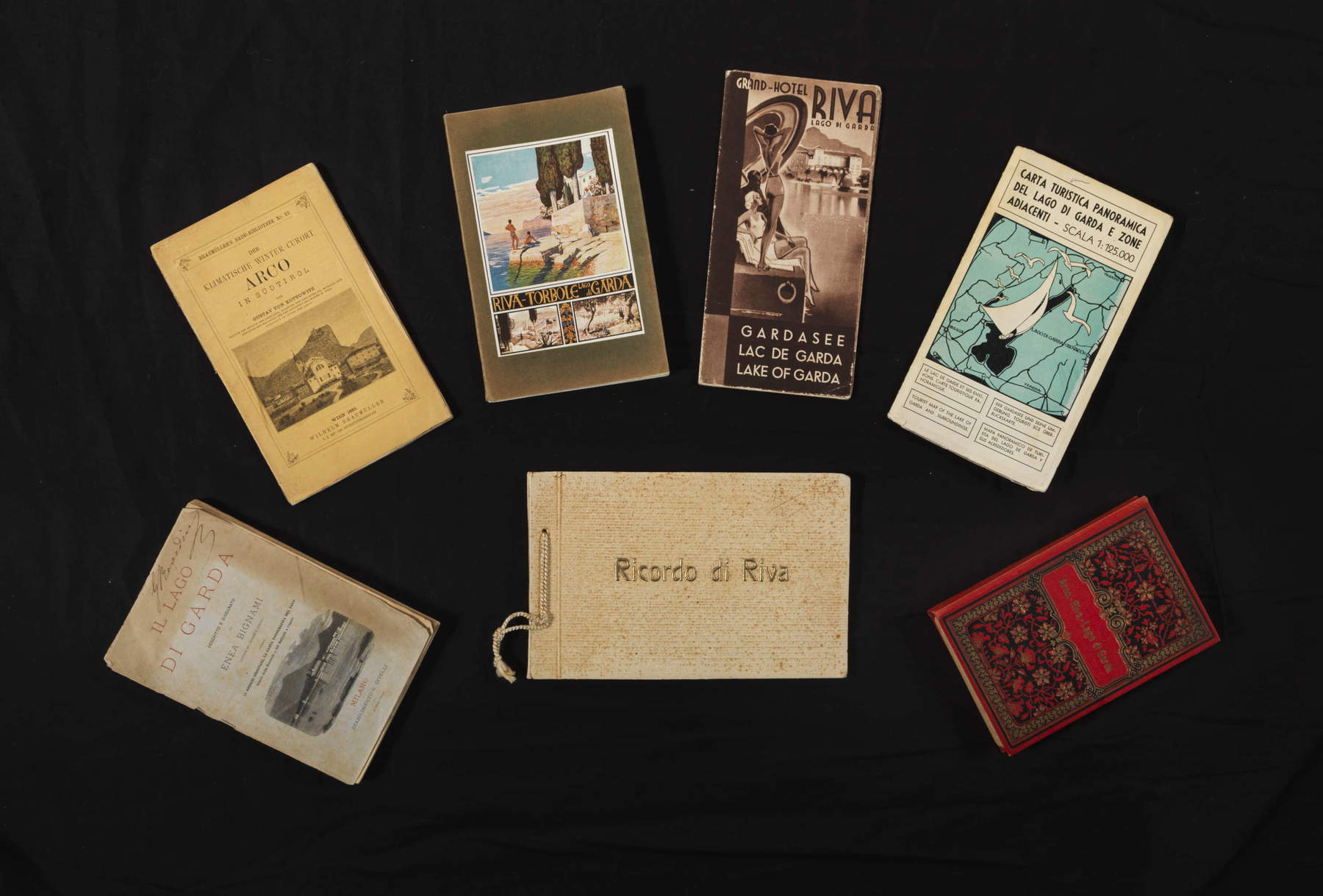
The first section of the exhibition, dedicated to Mediterranean charm amidst the Alps, focuses on the long period leading up to the outbreak of World War I, when Lake Garda officially entered the continent’s tourist imagination. Thanks to its unique geographical location, suspended between the harshness of the Alps and the mildness of the Mediterranean, the lake quickly established itself as a favored destination for travelers from Central and Northern Europe. In this initial phase, tourism promotion sought to build an image of Lake Garda as a place characterized by exceptional climate and scenery, defining it as the “Mediterranean of the North,” distinguished by diffused light, exotic vegetation, and the atmosphere typical of an elegant and aristocratic resort.
The first posters and illustrated printed materials of that period employed a visual language still closely tied to nineteenth-century models, where descriptive composition and a mosaic-like narrative structure organized the landscape into visual sequences designed to maximize its recognizability. It was at this juncture that some of the earliest experiments in modern tourism communication took place, in which realistic elements and decorative motifs intertwined with an increasingly conscious use of graphic design as a powerful tool of persuasion. Posters, postcards, and published materials all contributed to the creation of a veritable world on paper, a realm in which tourism promotion established itself as an autonomous and codified language.
Advances in transportation infrastructure marked a decisive turning point for the economy and the perception of the region. The development of railroads, steamship navigation, and, later, the road network helped drastically redefine the relationship between the landscape and its accessibility. The journey itself became an integral part of the tourist experience and, consequently, of its visual representation. Train schedules, lake connections, and illustrated itineraries became a prominent part of the iconographic repertoire, transforming Lake Garda into a modern, interconnected, and perfectly organized destination.
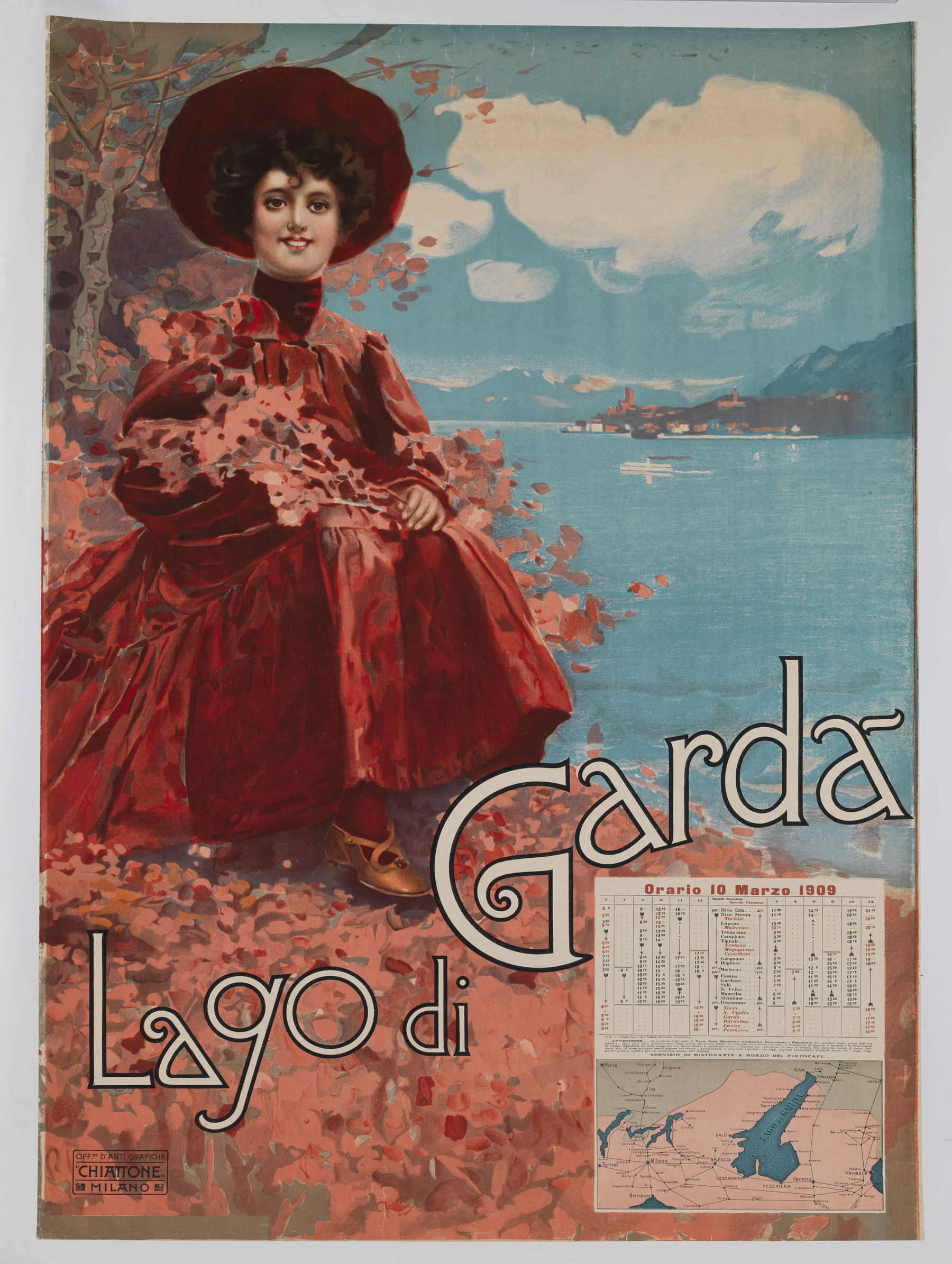
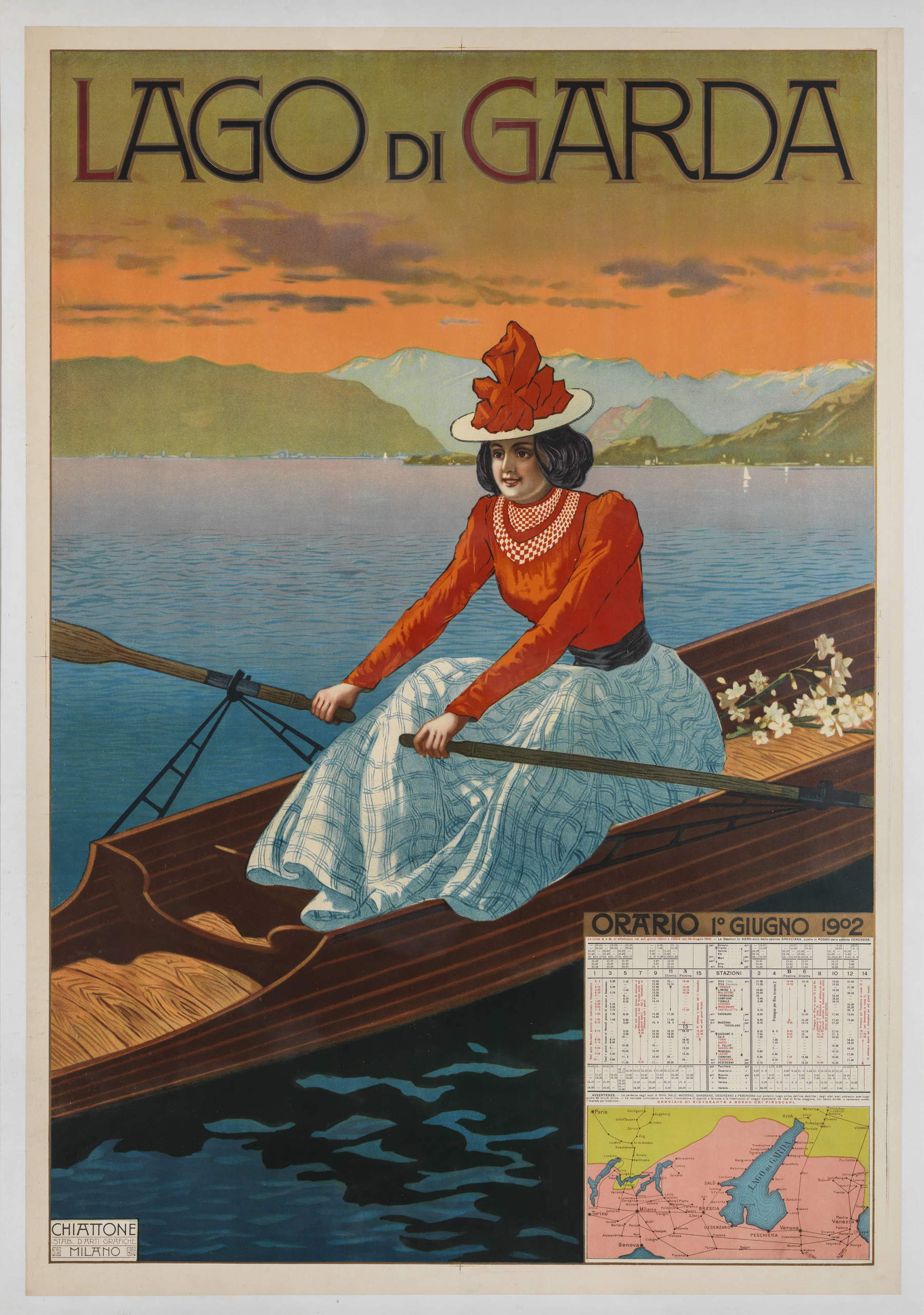
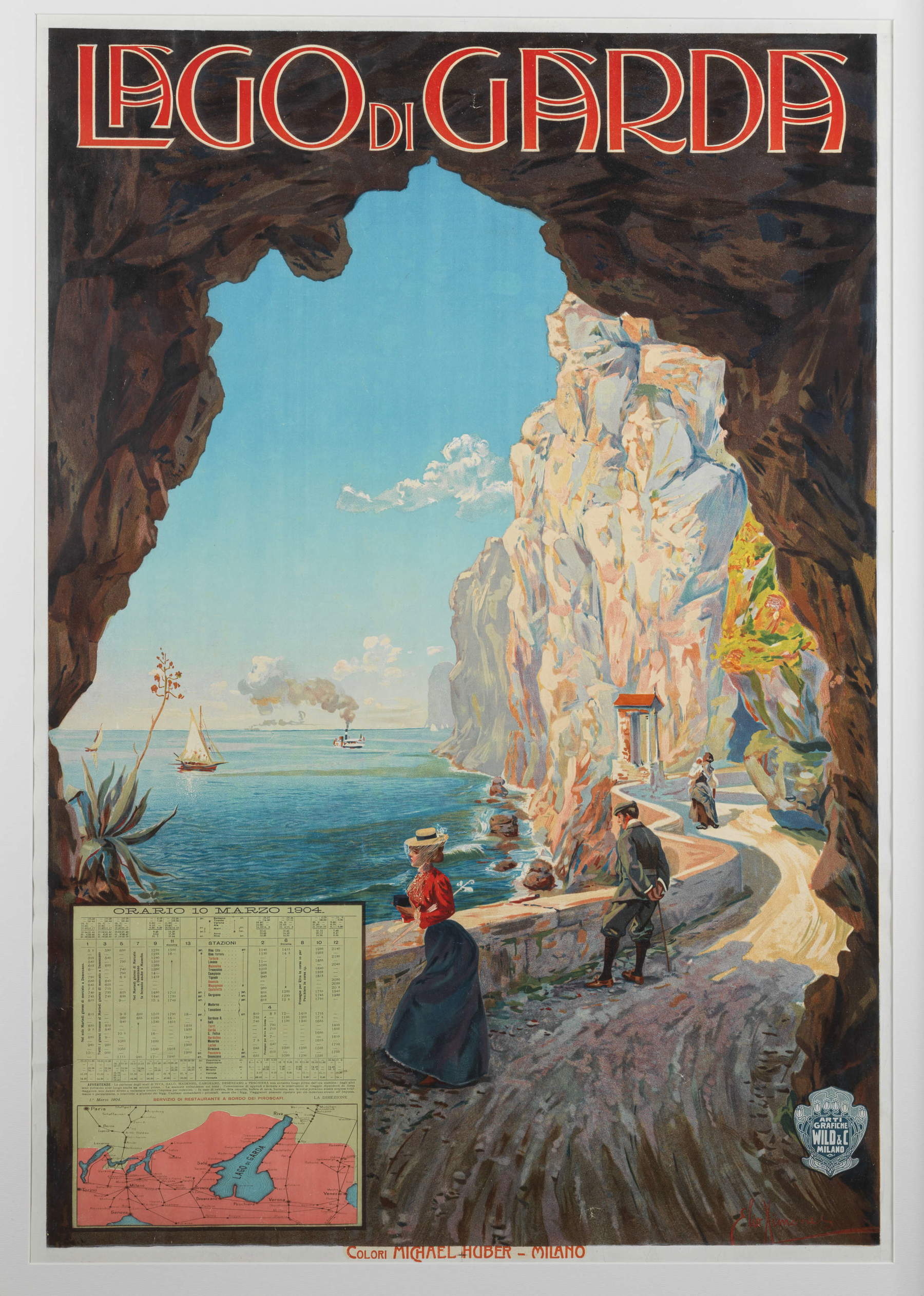
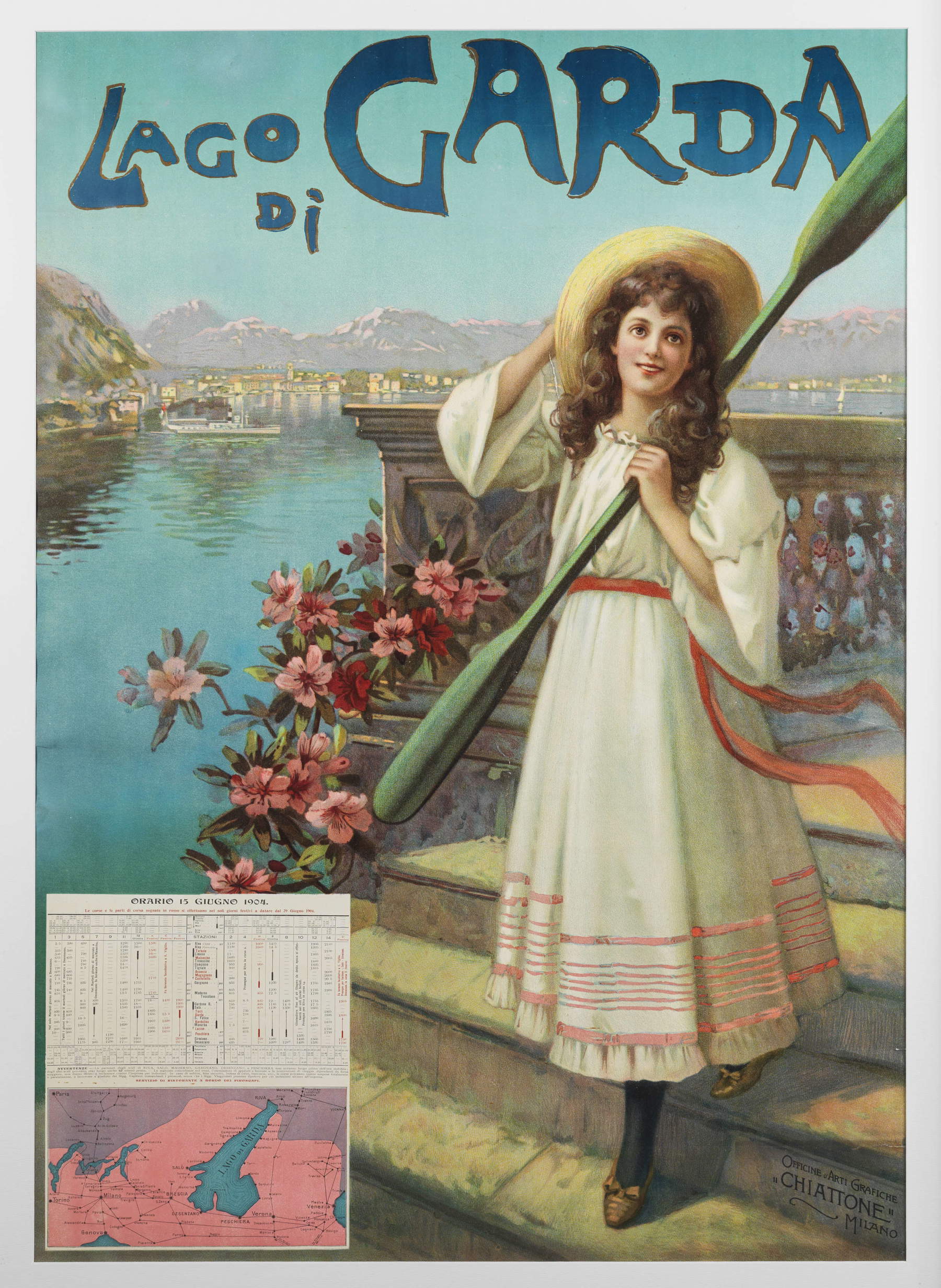
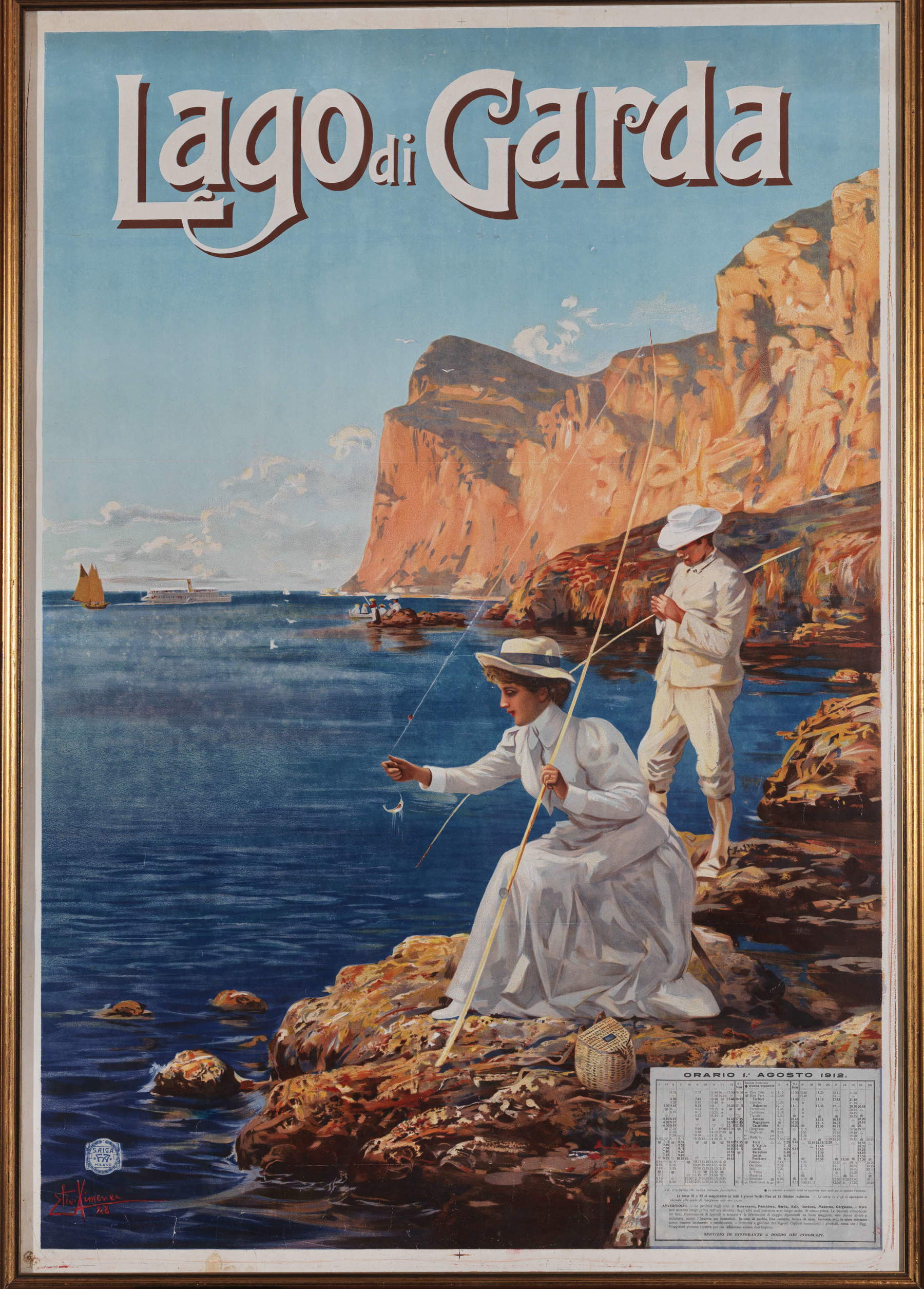
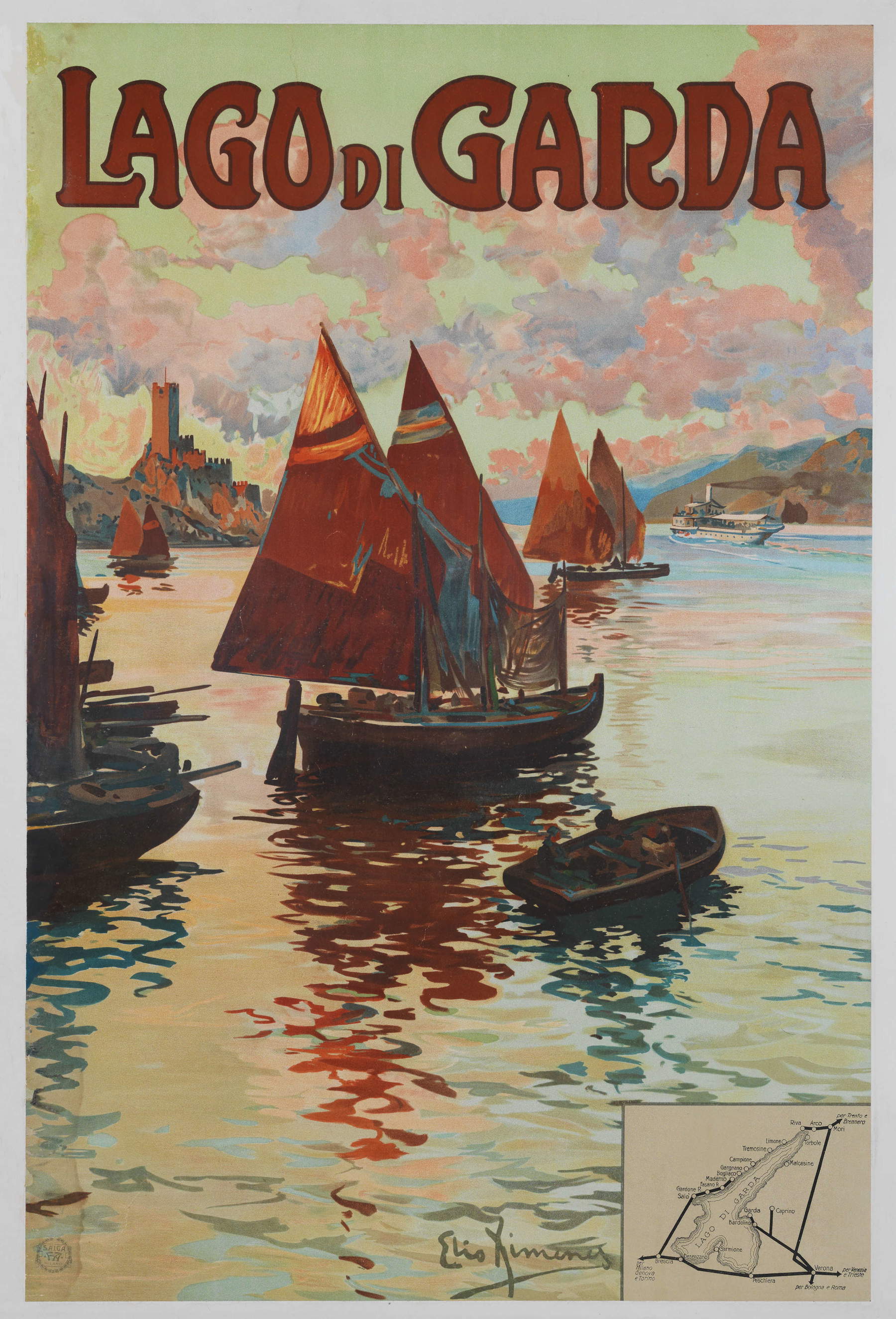
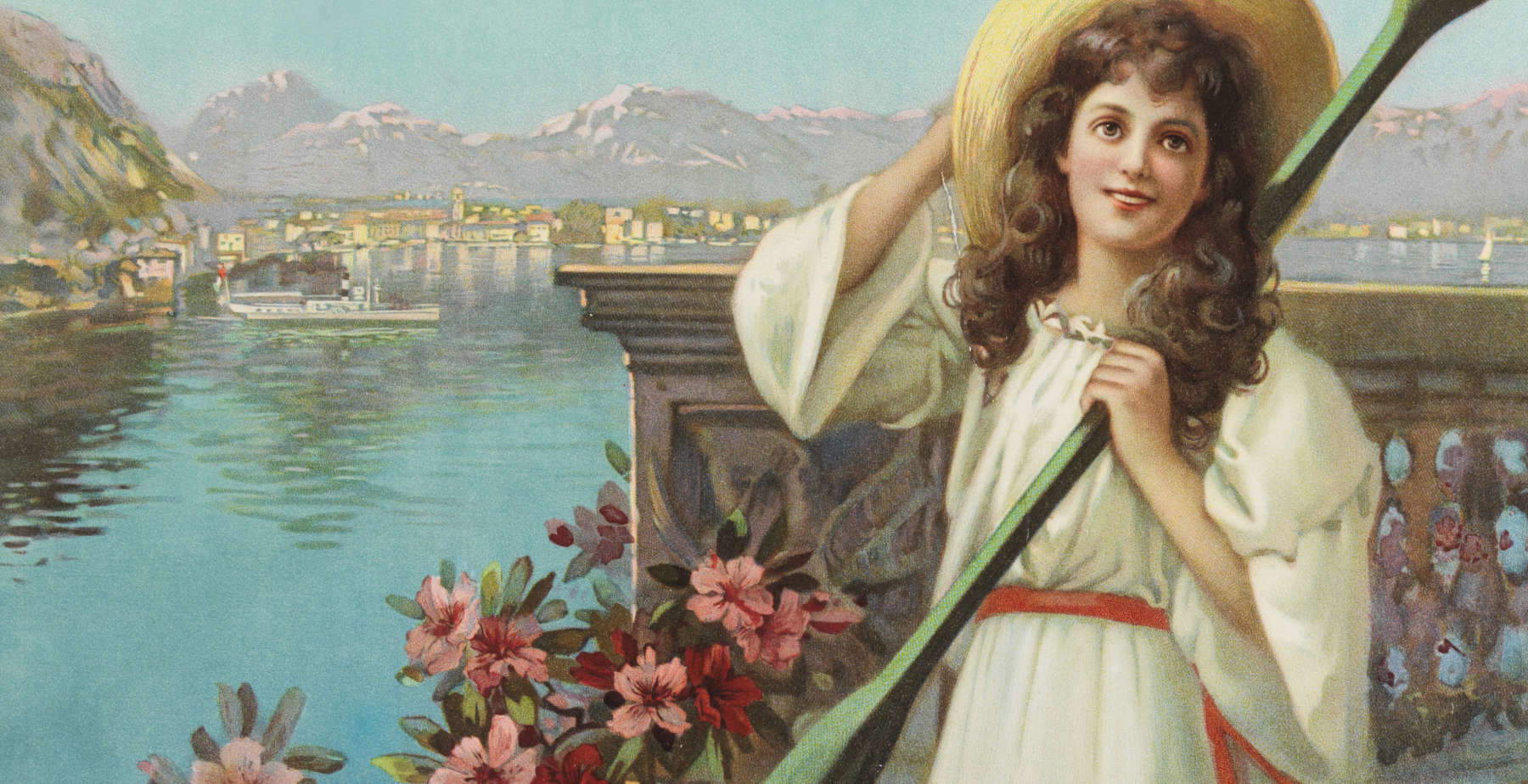
Alongside promotional works—often anonymous or produced by illustrators affiliated with publishing houses—the first distinctive artists began to emerge, capable of interpreting the region with a higher level of artistic awareness. Among these, Elio Ximenes stands out; he is featured in the exhibition with numerous works, including the famous *Lake Garda* from 1904, in which the Garda landscape is imbued with an evocative and theatrical dimension—still deeply rooted in classical painting but already moving toward a modern synthesis. In these depictions, Lake Garda appears as a universe suspended between reality and the ideal. The elegant female figures that populate these compositions are not merely decorative elements; rather, they embody a model of international bourgeois tourism, where travel was still a refined, leisurely, and deeply contemplative experience.
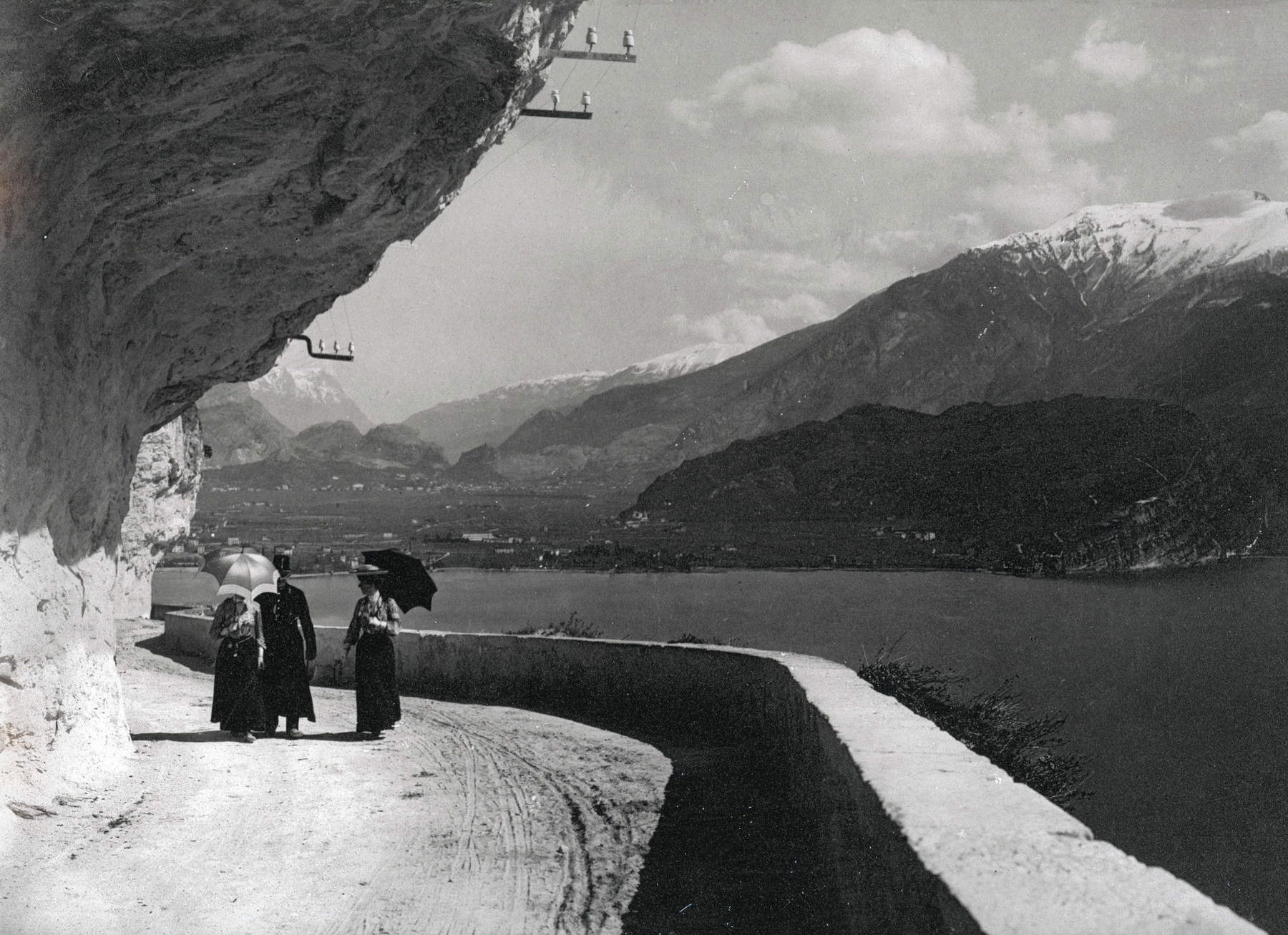
The second section of the exhibition is dedicated to the themeof the thrill of speed and documents the profound transformation of the visual language between the 1920s and 1940s, which closely coincided with the political and infrastructural redefinition of the territory that took place in the immediate postwar period. Lake Garda’s integration into the Italian national landscape and the construction of major highways—in particular, the Gardesana Road—brought about a radical change in the lake’s overall image. Unmistakable symbols of this progress are the Eastern and Western Gardesana highways, christened by Gabriele D’Annunzio as “the quintessentially Italian lakeside road.” These spectacular engineering feats made it possible to travel the entire length of the lake by car, ushering in a new travel experience based on mobility, speed, and individual freedom of movement.
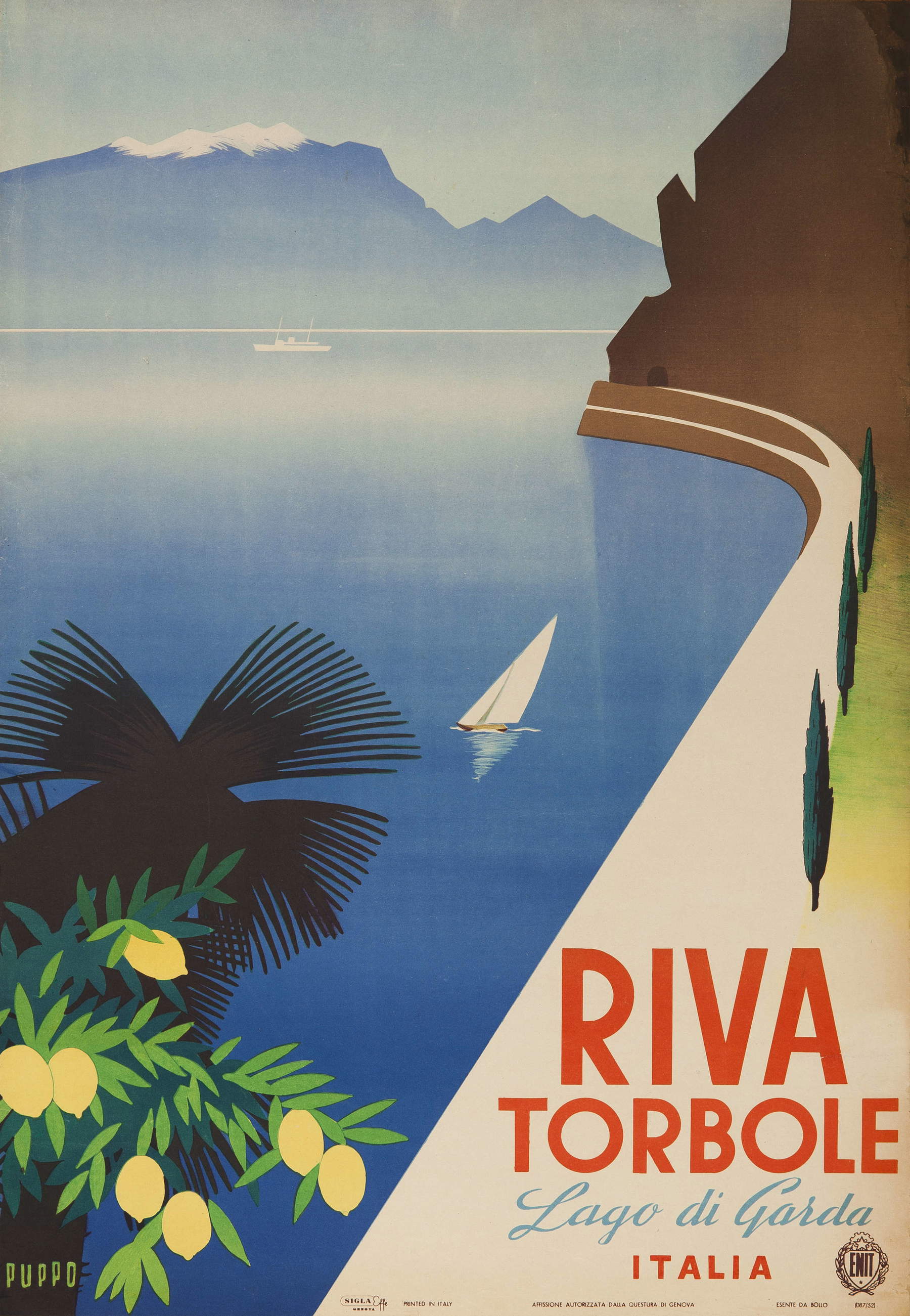
Although graphic design studios continued to play a primary role in production, a more concise and dynamic style gradually emerged. The compositions became minimalist, influenced by the artistic avant-garde movements and the new culture of motion. The impact of Futurism translated into images that celebrated speed and technical progress, transforming travel into a modern, exciting, and spectacular experience. Among the most notable works are posters related to automobile travel and tourist circuits, such as Arduino Cola’s *Circuito del Garda. Autolinee di Gran Turismo* (1930) and Arturo Panni’s *Gardone am Gardasee* (1933). In these works, the landscape is reduced to a few fundamental elements—such as roads, water, and mountains—creating an iconography that would become firmly established in the decades that followed, as evidenced by the splendid poster *Riva Torbole Lago di Garda*, created in 1952 by the Genoese artist Mario Puppo.
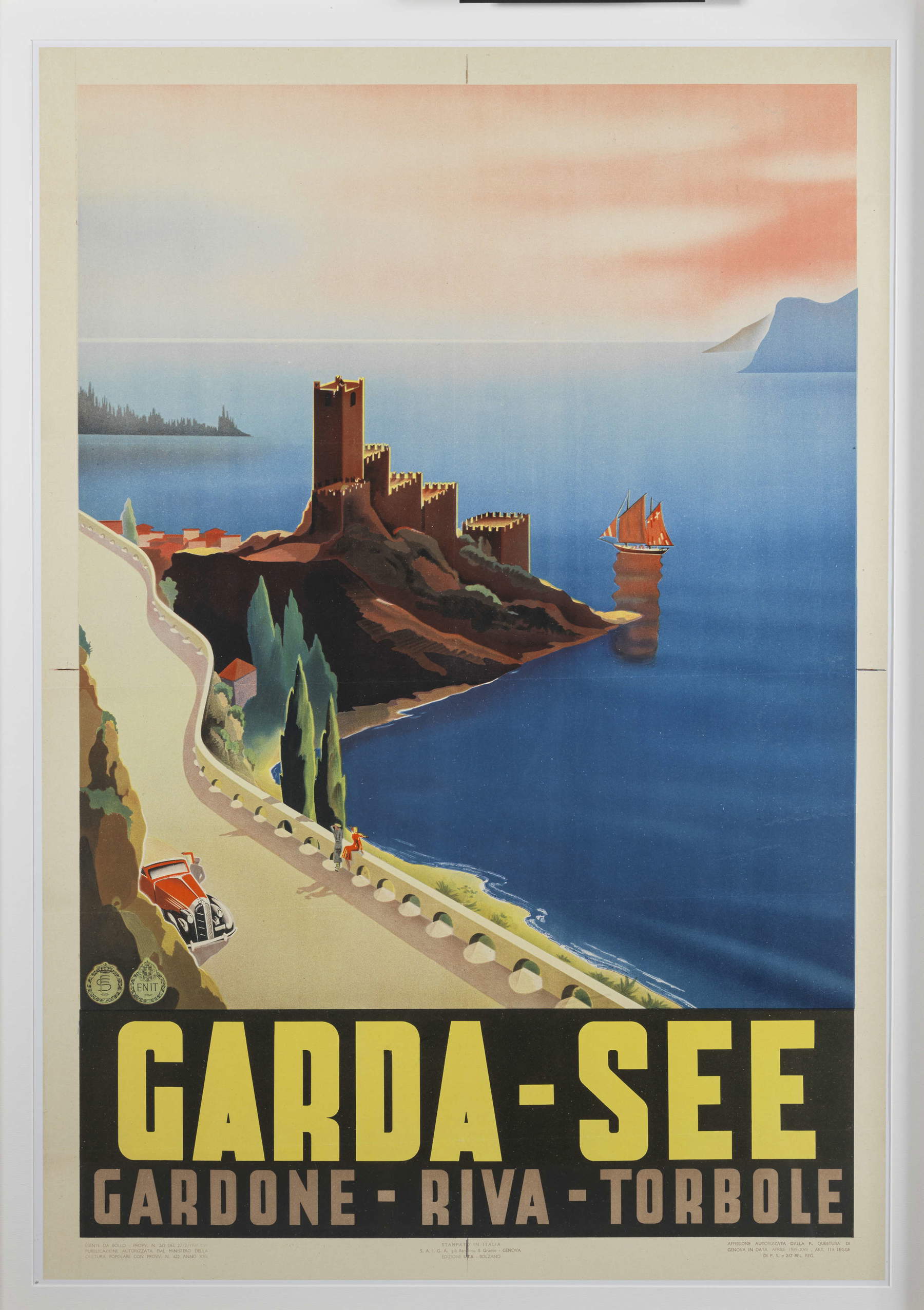
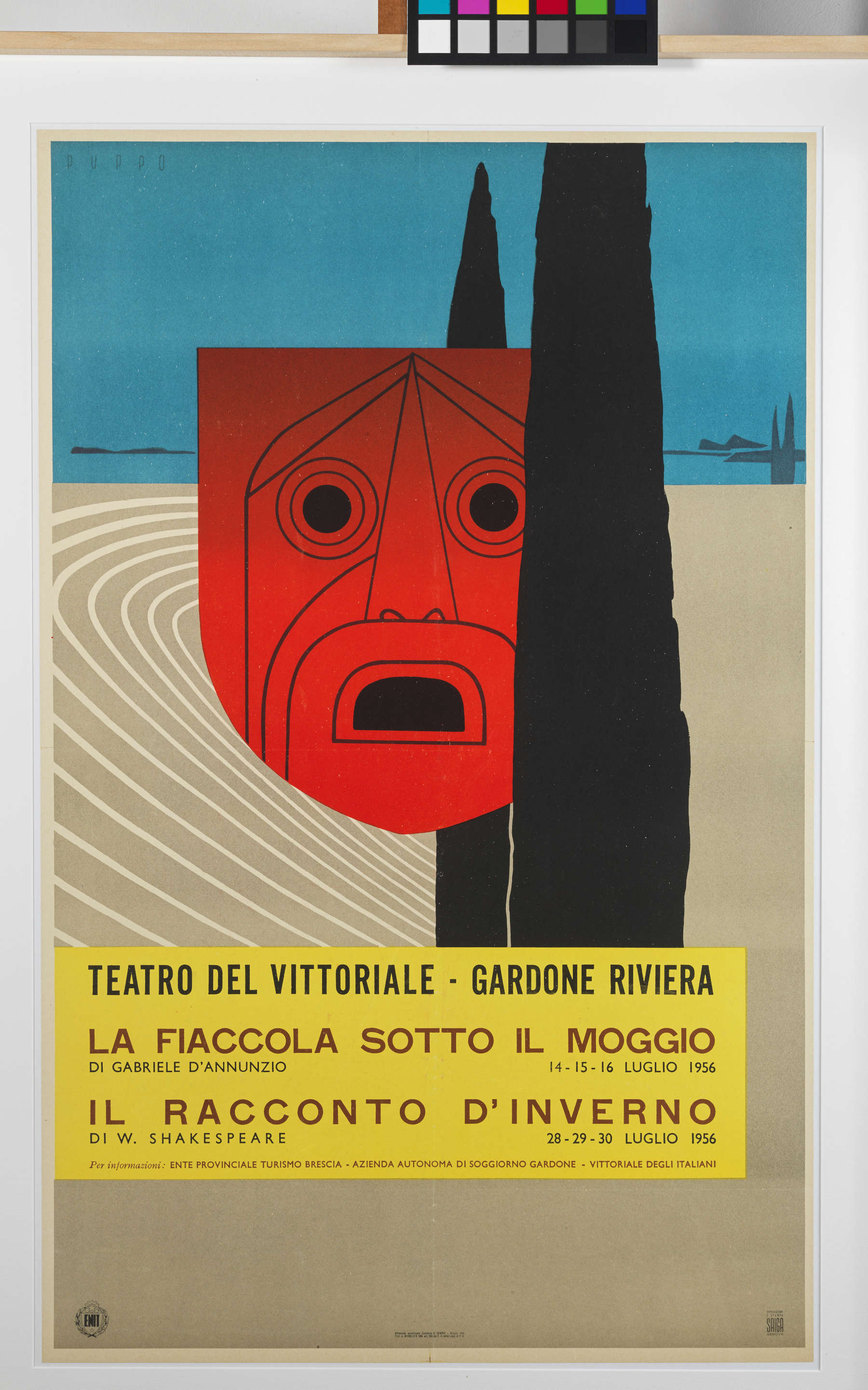
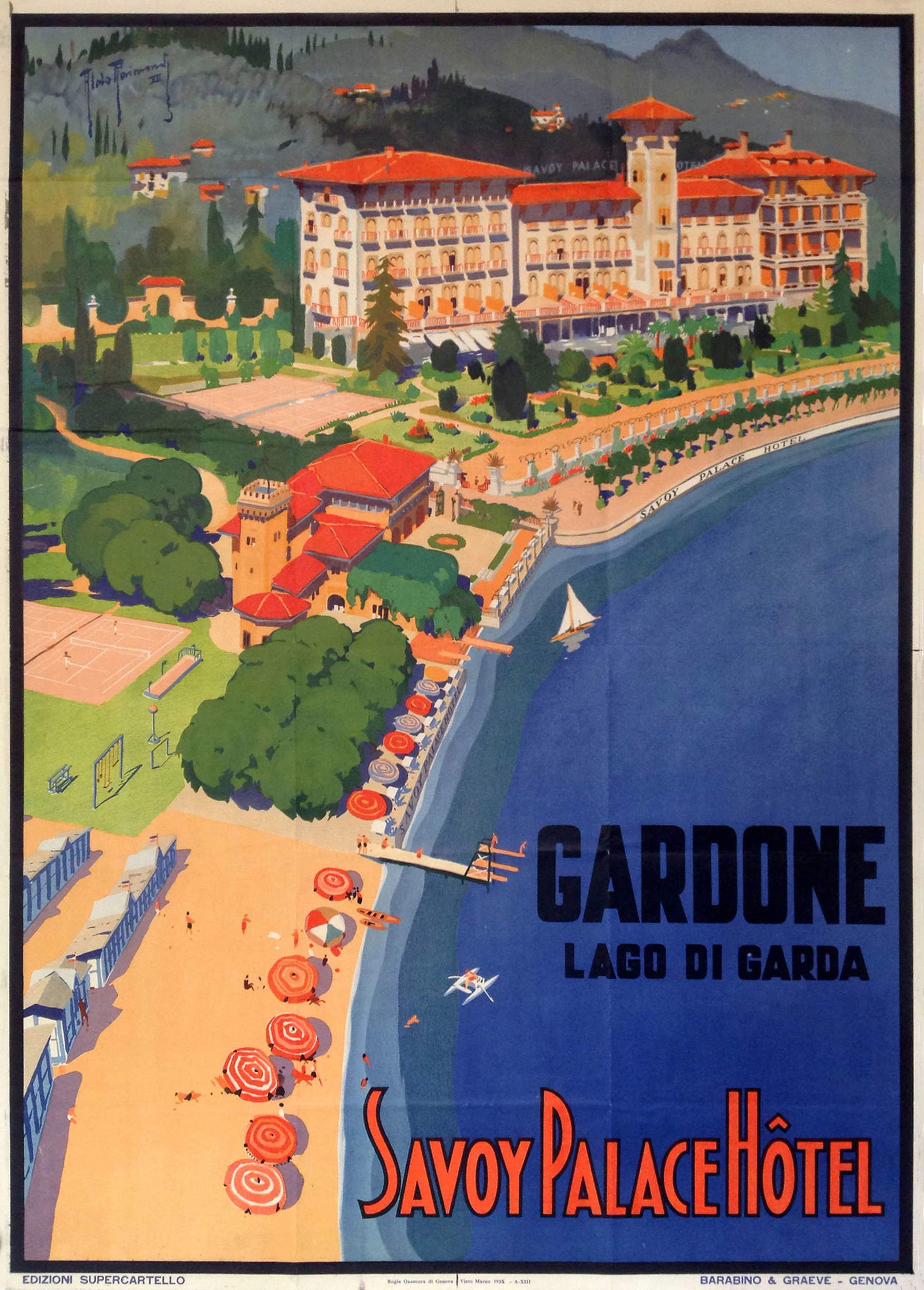
The third section explores the transition to modern tourism that took place in the 1920s and 1930s. Despite the significant economic difficulties of the immediate postwar period, the tourism sector regained momentum and took on new dimensions. Gardone Riviera strengthened its international reputation thanks to the constant presence of Gabriele D’Annunzio, while Riva del Garda consolidated its status as a seaside resort, and the town of Arco converted most of its historic and prestigious hotels into specialized health facilities. At the same time, the target audience also changed: no longer exclusively Nordic visitors, but the growing Italian middle class, to whom Lake Garda was presented as a modern destination, a symbol of a rediscovered national identity.
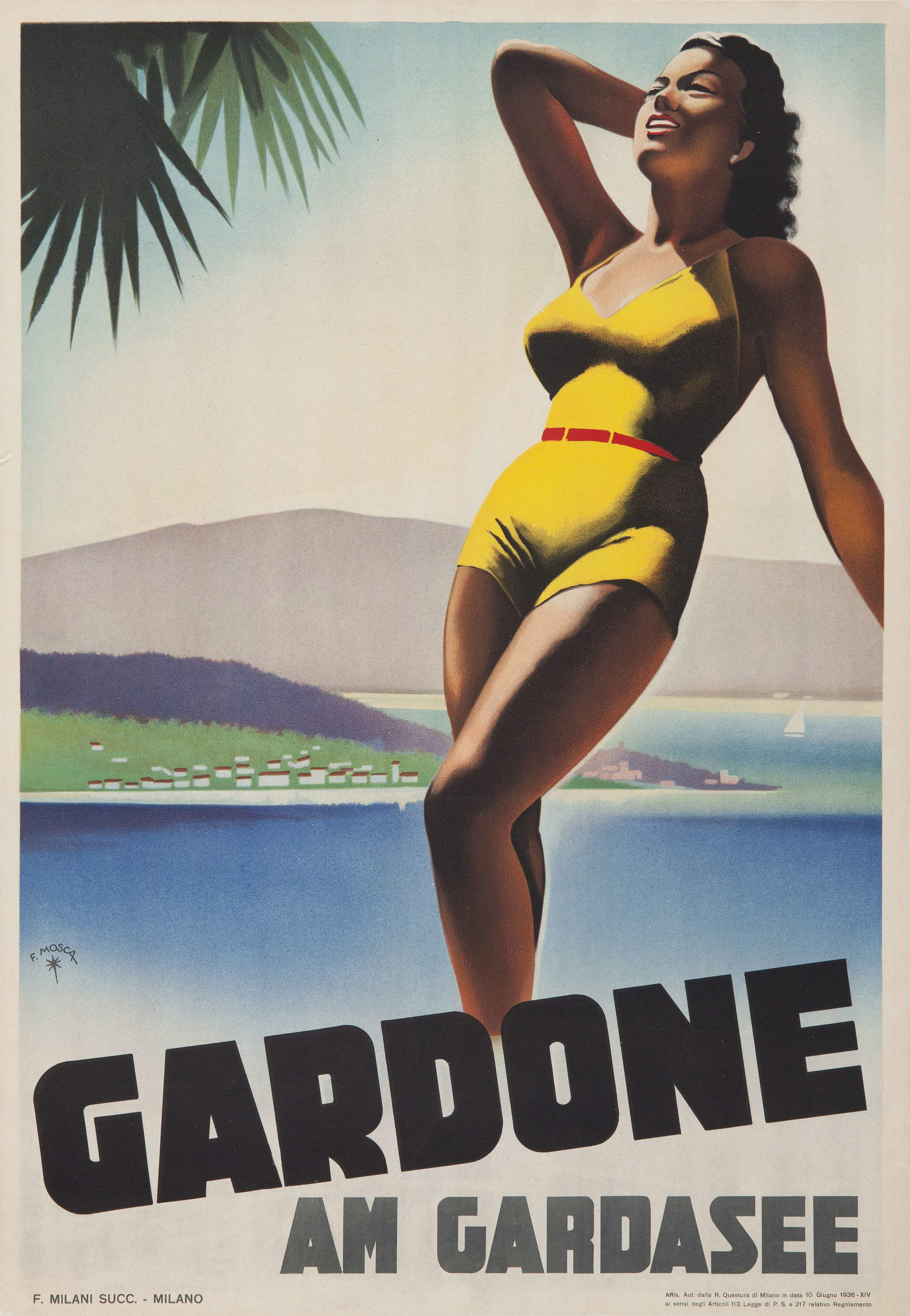
Another significant change was the democratization of tourism: from an experience reserved for a select international elite, it became a widespread and socially inclusive phenomenon. Consequently, the portrayal of the traveler also underwent a profound transformation. The elegant, static female figures of the Belle Époque gradually gave way to dynamic, athletic, and self-assured bodies, reflecting a new relationship with leisure, physical well-being, and modernity. An emblematic example is Franco Mosca’s 1936 work *Gardone. Lake Garda*, which almost embodies the ideology of health promoted by the regime. Through these images, a new conception of tourism takes shape—no longer understood merely as travel to a destination, but as the pursuit of a modern lifestyle, where the body and the management of leisure time take center stage.
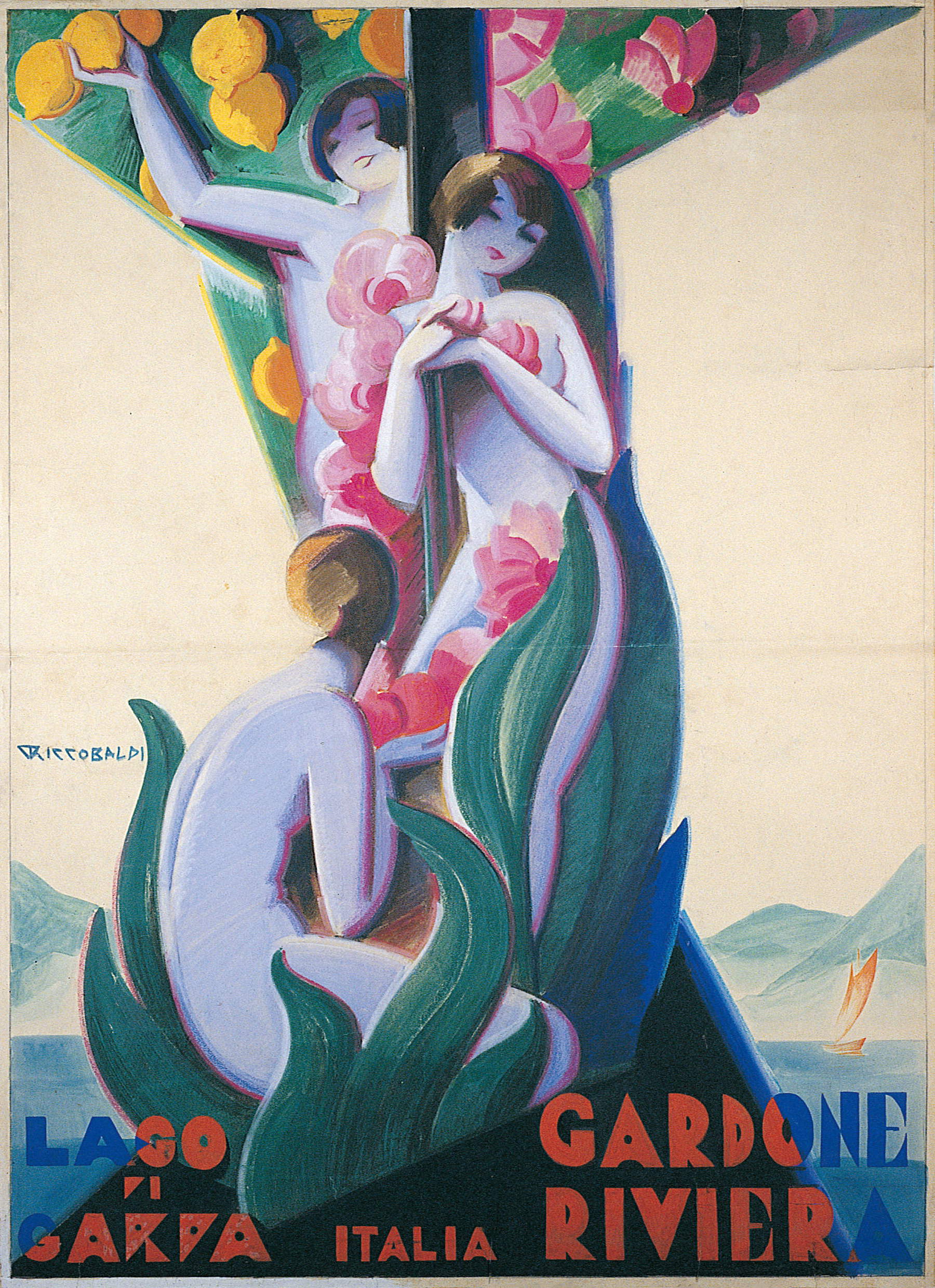
This transformation is also clearly evident in advertising graphics, where images shifted toward greater communicative immediacy. The visual language becomes simpler and more concise, influenced by the compositional rules of the artistic avant-garde and the demands of modern communication. Examples of this change can be found in works such as *Riva Torbole. *Lake Garda* ( 1927), *Spring on Lake Garda* (1935), and, in particular, *Lake Garda: Gardone Riviera* (1929) by the Florentine artist Giuseppe Riccobaldi del Bava, an extremely prolific creator of works dedicated to the Lake Garda region.
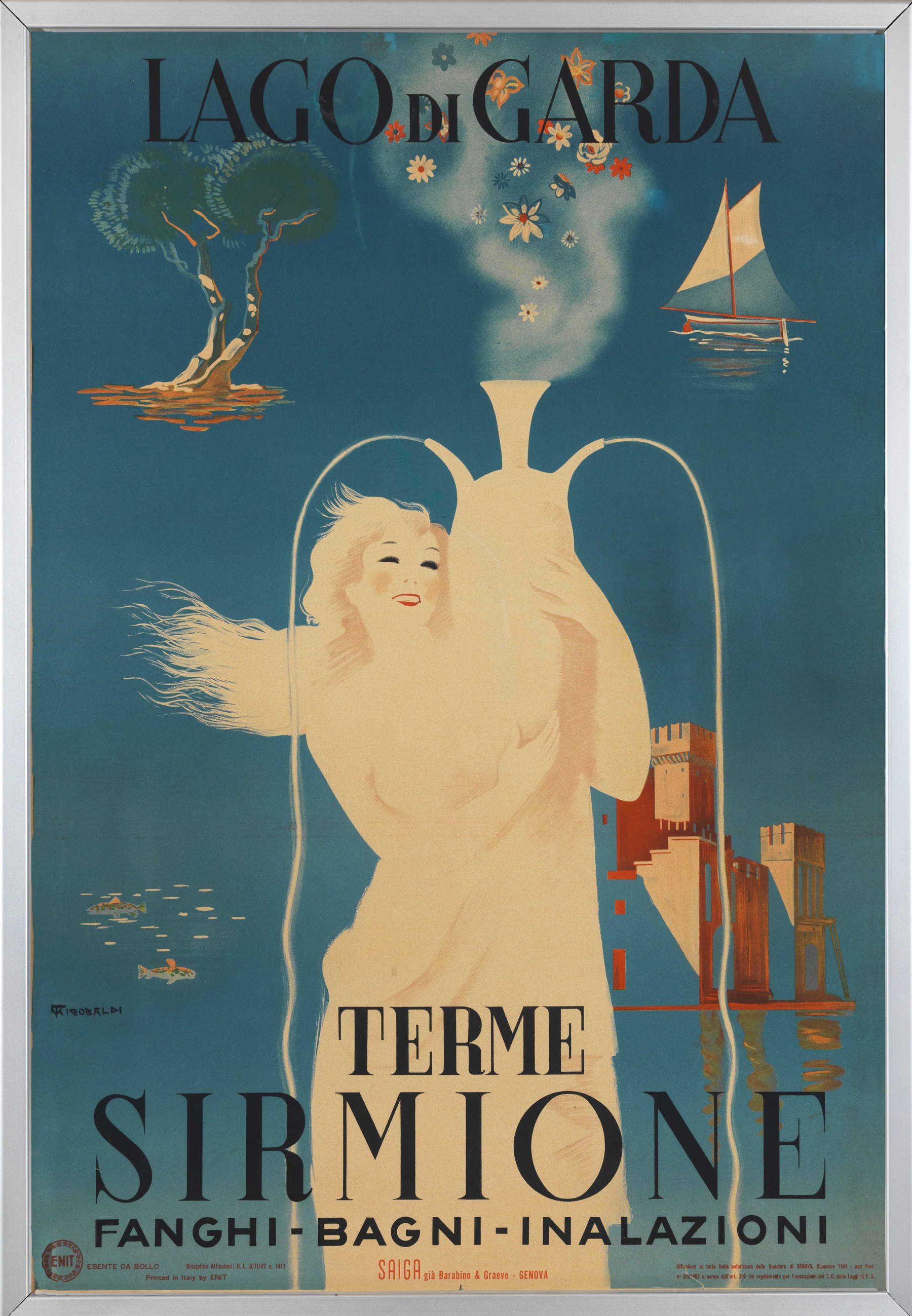
In this complex process, not only posters but the entire apparatus of tourism communication plays a leading role. The exhibition highlights the existence of an integrated system that includes picture postcards, brochures, guidebooks, photographs, and a variety of published materials. These tools contribute to the construction of a coherent and widespread visual narrative, capable of consolidating Lake Garda’s identity as a world-class destination. A fundamental role in this regard is played by printing houses and graphic design studios, which constituted the productive heart of communication between the late nineteenth and twentieth centuries. Companies such as Officine Chiattone, Arti Grafiche Wild, S.A.I.G.A., and Barabino & Graeve did not act merely as technical executors, but as true cultural mediators between the clients, the artists, and the final audience.
With the advent of cinema, the system of communication was enriched with a new dimension: moving images. Footage fromthe Istituto Luce, screened within the exhibition, introduces a dynamic perception of the landscape, in which Lake Garda is no longer merely represented statically but experienced as it unfolds over time. This sense of dynamism is further emphasized by period music played in the exhibition halls, which helps visitors fully immerse themselves in the atmosphere of the past.
The exhibition aims to convey the complexity of a long historical process in which Lake Garda is presented not merely as a geographical location, but as a layered cultural construct. The tourist image cannot be considered neutral: it selects, interprets, and amplifies certain aspects of the territory, contributing decisively to defining its public and international identity. The tourist poster, therefore, reveals itself not only as a promotional tool but as a historical and cultural document of primary importance. After all, telling the story of Lake Garda through its posters and promotional materials means recounting the history of a landscape that was first imagined and then inhabited, and it means recognizing that a territory’s identity is not a fixed given, but rather the result of a continuous negotiation between perception, representation, and reality.
 |
| Visit Lake Garda: An Exhibition on the Evolution of Lake Garda’s Image as a Tourist Destination |
Warning: the translation into English of the original Italian article was created using automatic tools. We undertake to review all articles, but we do not guarantee the total absence of inaccuracies in the translation due to the program. You can find the original by clicking on the ITA button. If you find any mistake,please contact us.