





The career of Giovanni Antonio Bazzi, better known as Sodoma (Vercelli, 1477 – Siena, 1549) is undoubtedly one of the most fascinating and complex chapters of the High Renaissance, that transitional period between the 15th and 16th centuries, a journey that produced art characterized by a compositional intelligence capable of blending geographically distant influences. Born in Vercelli around 1477, the young Bazzi trained in the workshop of Giovanni Martino Spanzotti, where between 1490 and 1497 he learned the rudiments of a style still deeply rooted in the Piedmontese and Lombard traditions. The exhibition Giovanni Antonio Bazzi, known as Sodoma. Conquering the Renaissance ( Turin, Fondazione Accorsi Ometto, March 31–September 6, 2026, curated by Serena D’Italia, Luca Mana, and Vittorio Natale), shedding light on the years in which this important artist’s artistic language, taste, and culture took shape.
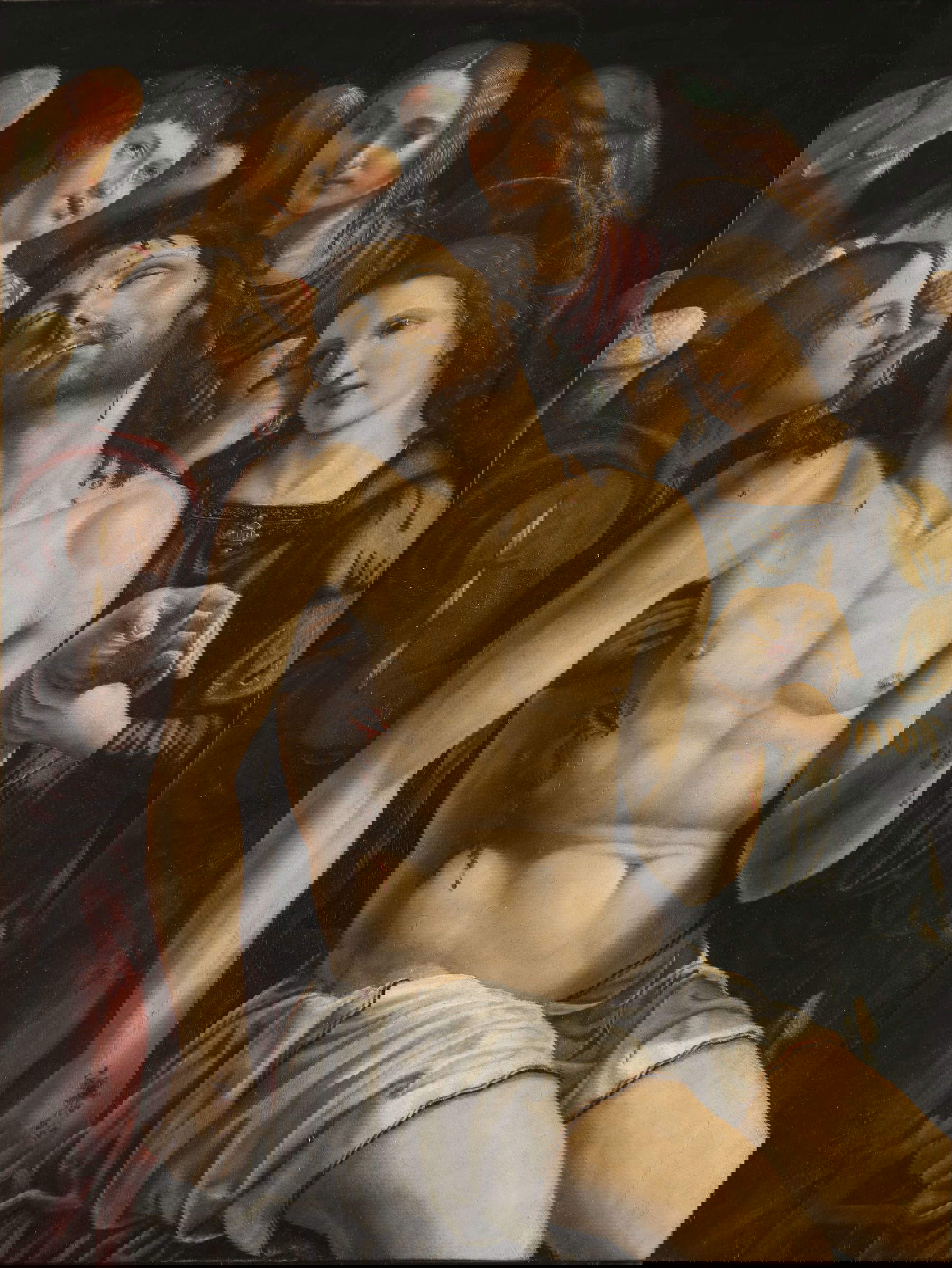
His seven-year apprenticeship in Spanzotti’s workshop, far from being a period of provincial isolation, allowed Sodoma to absorb a sensitivity to light and detail that would remain a constant undercurrent throughout his mature work; however, the young artist’s intellectual curiosity soon propelled him beyond the borders of his native region, leading him to engage with the great centers of figurative culture of the time, on a journey that took him to Milan and, at an early stage, to the Rome of Alexander VI. The exhibition at the Accorsi Ometto Foundation took stock of this journey, noting moreover that recent scholarship—thanks to the discovery of documents attesting to his presence in the capital as early as 1497—has had to reconsider the entire chronology of his early works, and it has emerged that his artistic maturation occurred through a voracious assimilation of different models, among which the influence of Andrea Mantegna (Isola di Carturo, 1431 – Mantua, 1506) stands out for its intensity and precision. The work that best encapsulates this moment of extraordinary cultural fertility is the Lamentation over the Dead Christ, now in a private collection, a panel that stands as a true watershed in Bazzi’s oeuvre, a fundamental piece for understanding the complex artistic personality of the artist from Vercelli. This work, painted on panel but transferred to canvas over time for conservation reasons, emerged from critical obscurity only relatively recently, and since its initial attribution to Sodoma, it has done nothing but raise further questions about the training of a painter whom art historians have often struggled to classify with precision. The history of its attribution, though brief, is interesting in itself: in 1974, on the occasion of an exhibition in Mantua, the painting was even presented as a work by Andrea Mantegna, backed by a “contemporary” opinion by Adolfo Venturi. It was not until 1988 that the Tuscan scholar Alessandro Bagnoli, analyzing a promotional photograph from the exhibition catalog, recognized Bazzi’s hand, thereby restoring the painting to the catalog of the Vercelli-born master. This attribution back-and-forth between a 15th-century giant and Sodoma is no coincidence, but reveals the depth of the dialogue the young artist maintained with northern models during his formative years.
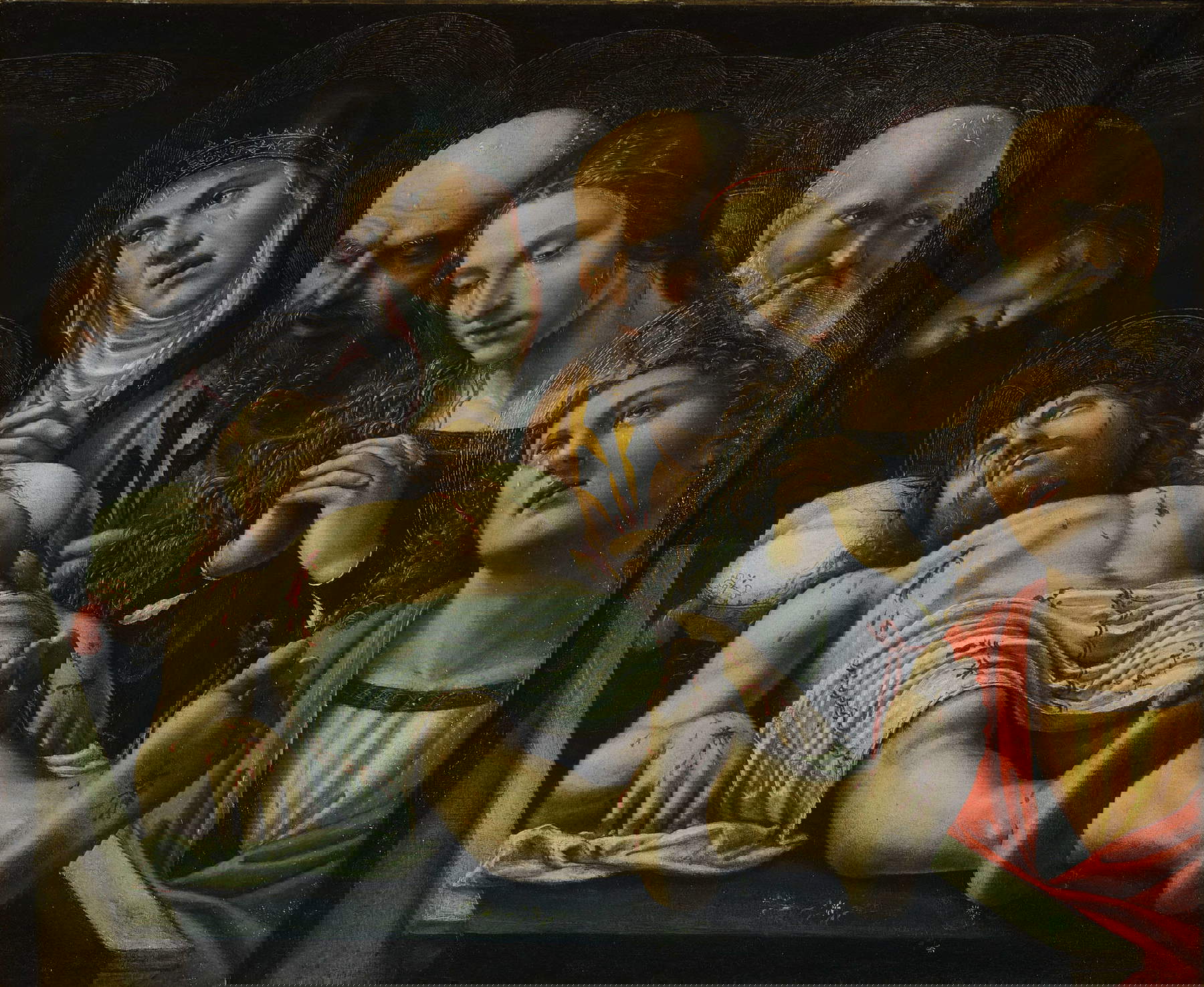
The compositional structure of the Lamentation revolves around the figure of Christ, lying on a marble slab with his feet pointing directly toward the viewer in an extremely bold perspective. Christ’s head, delicately resting on a cushion adorned with intricate embroidery, serves almost as a pivot for the arrangement of the other figures. On the left of the panel, in a solitude that underscores the dignity of her grief, appears the Virgin Mary, isolated and silent in her anguish. On the right, however, the composition becomes denser: a compact group of mourners, consisting (starting from the right) of John, Mary Magdalene, Joseph of Arimathea, Nicodemus behind them, and another of the Marys, crowds around the lifeless body. Each expression is designed to represent a different nuance of human despair, ranging from the deepest despondency (the figure of one of the Marys) to despair (Joseph of Arimathea). Behind this foreground of grief, the figure of Nicodemus emerges, characterized by an “accusatory gaze” (as Vittorio Natale puts it), while another female presence is barely discernible, covered by a red cloak.
The debt to Andrea Mantegna in this work is more than a mere suggestion: it is a direct and almost astonishing reference, as evidenced by the fact that in the past the work was mistaken for a painting by Mantegna. Sodoma does not merely reference the use of foreshortening in the famous Dead Christ preserved at the Pinacoteca di Brera, but he reproduces subtle details that demonstrate an almost analytical knowledge of the original or, at the very least, a familiarity with the highest-quality graphic material from Mantegna’s workshop in Mantua. Particularly significant, according to Vittorio Natale, is the treatment of Christ’s right hand, with the little finger slightly extended, and the position of the head rendered in profile—elements that faithfully follow the model of the Paduan master. This profound spatial harmony has fueled debate regarding the possibility of the painter’s trip to Mantua, a hypothesis that cannot be ruled out a priori, whether it occurred before or after his arrival in Rome in 1497.
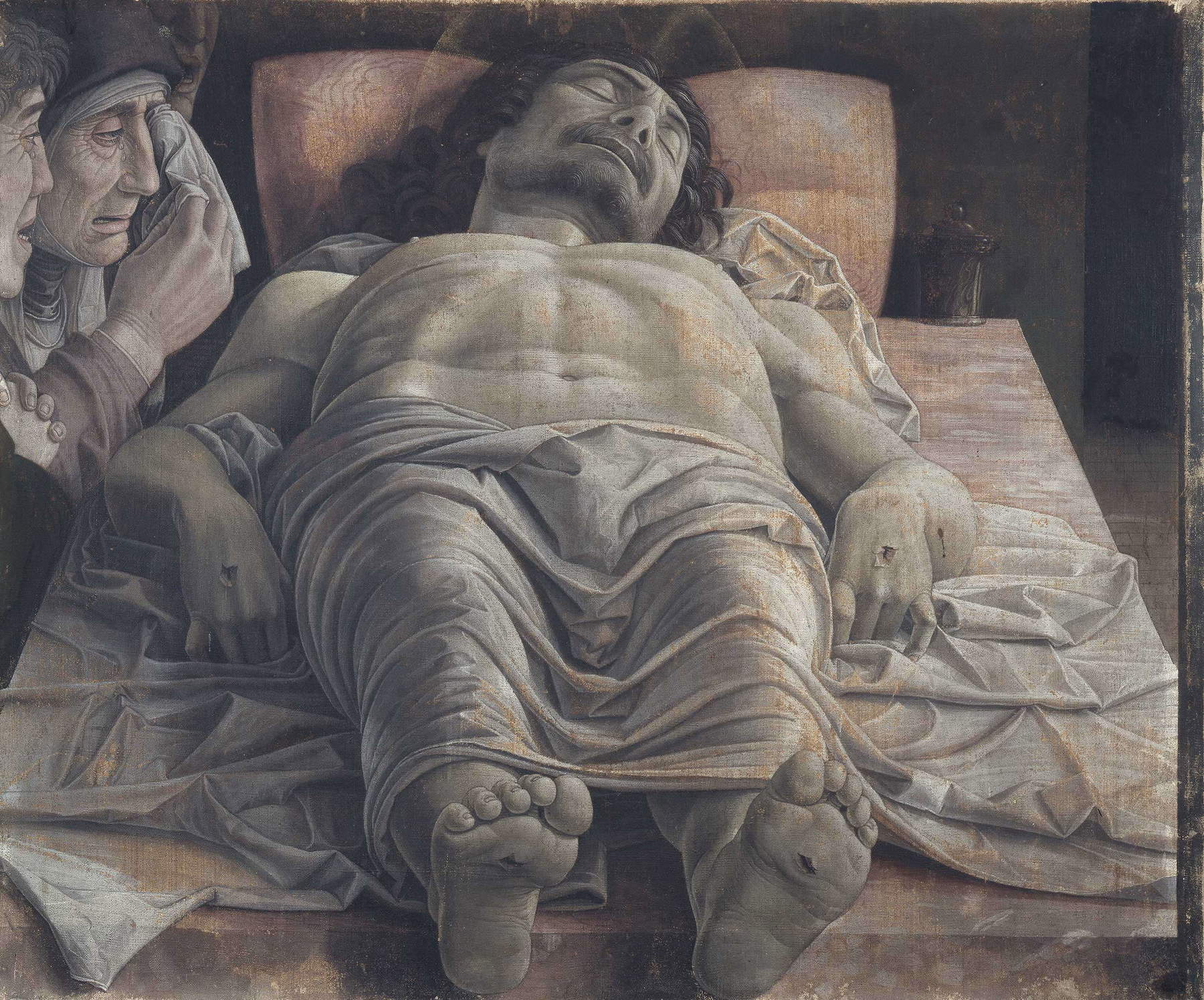
However, the Lamentation is not a purely Mantegnesque work either. Sodoma applies to it that “compositional-combinatorial” process through which geographically and stylistically distant influences find a well-balanced synthesis. Thus, while the perspective framework looks to Mantua and the rigor of Bramantino, the rendering of the faces and the treatment of light speak a decidedly Milanese language. In particular, the full faces, caressed by a raking light—clearly derived from da Vinci—recall the work of Giovanni Antonio Boltraffio and the Leonardesque culture that flourished at the Sforza court in the early 1490s. Furthermore, there are clear links to his first Piedmontese master, Giovanni Martino Spanzotti, particularly evident in the way the bearded faces of the male figures are rendered and in the treatment of the drapery, which in some areas still retains that rugged, corrugated quality typical of the northern tradition. A further element of complexity is provided by the figure of St. John in the foreground, which shows a clear influence from Perugino’s style. This detail is of extreme chronological importance, as it would confirm, according to Vittorio Natale, that the painting was executed when Sodoma had already moved to central Italy, likely during his first documented stay in Rome in 1497. The work’s provenance from the prestigious Roman Massimo collection (though it does not appear in the collection’s inventory drawn up in 1677) further reinforces the idea of a date falling within the period between 1500 and 1503. This period saw the artist actively absorbing ideas from the great masters working in Rome, such as Perugino and Pintoricchio, without ever severing the umbilical cord connecting him to his Lombard-Piedmontese roots.
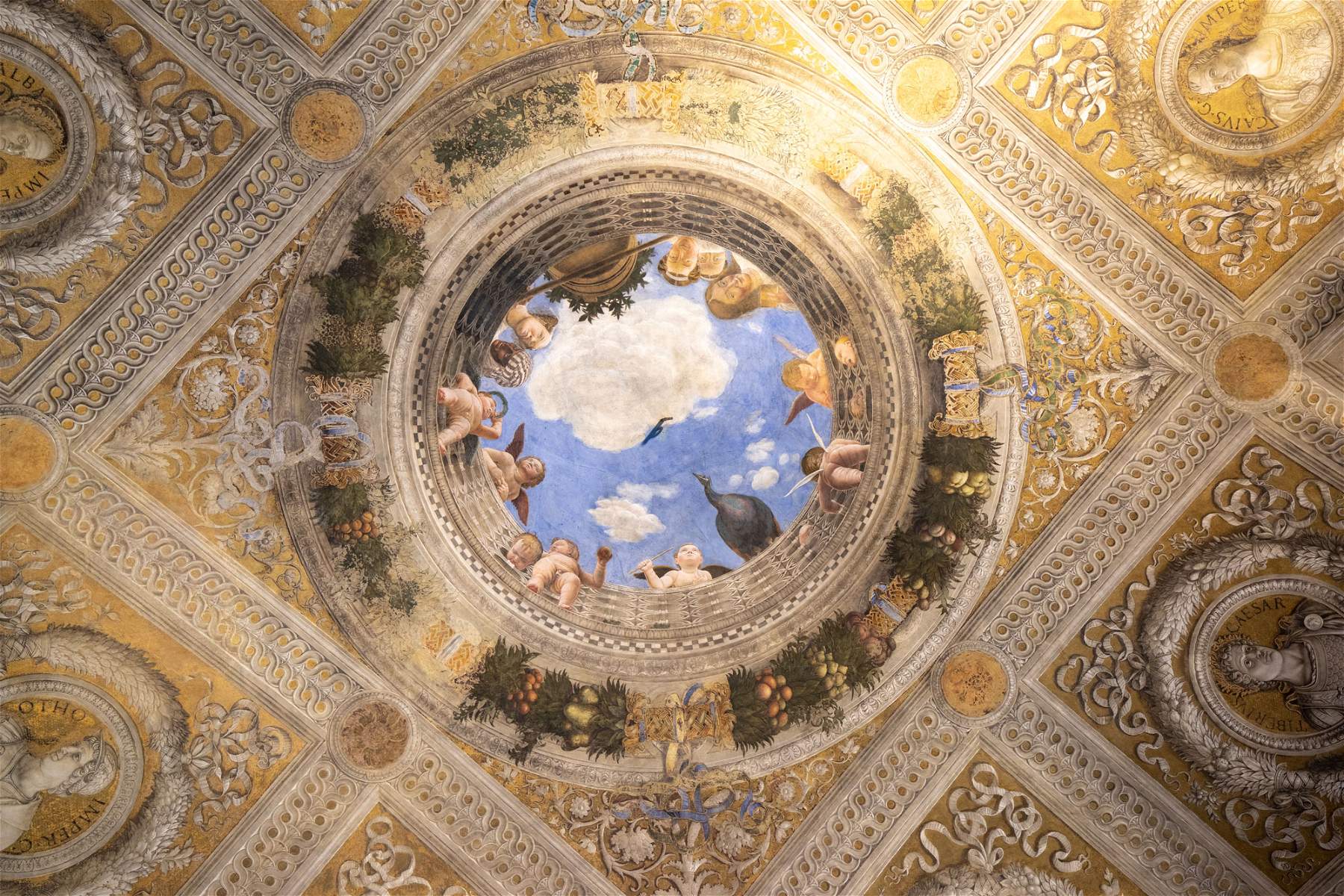
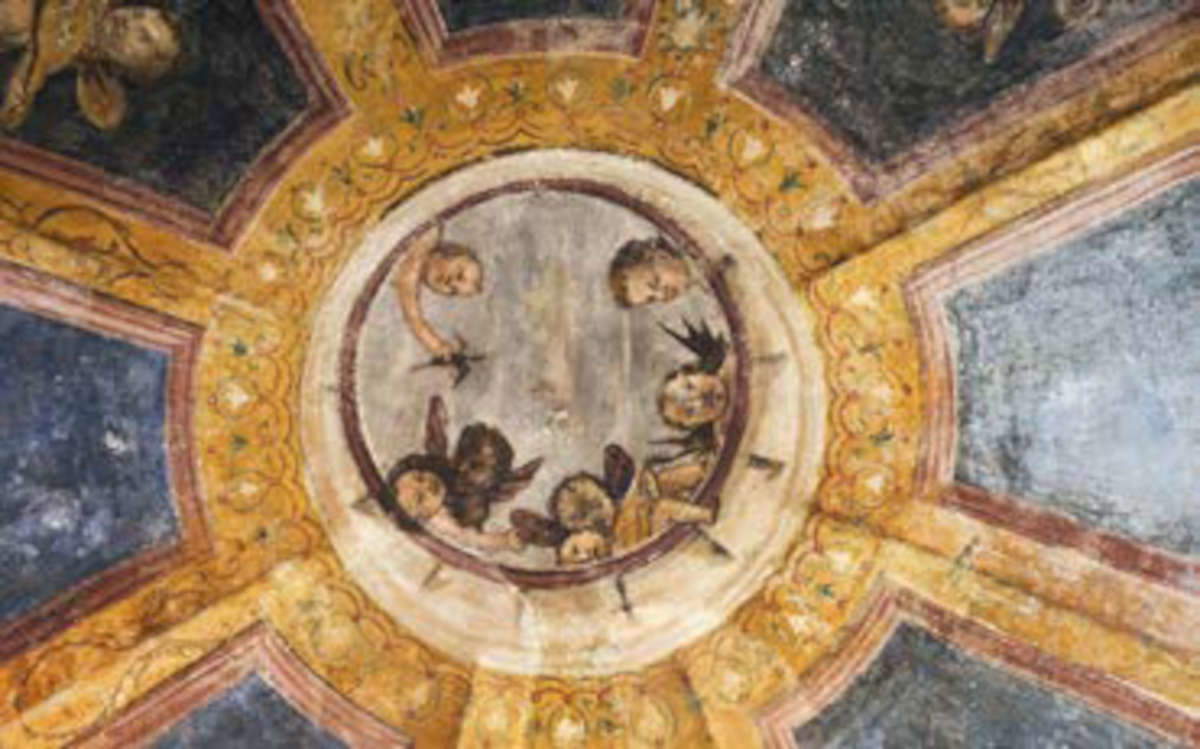
The Lamentation thus stands as a qualitative high point of this transitional phase, finding precise parallels in other decorative works by Bazzi. Numerous scholars have highlighted how many elements of the Milanese panel are found in the frescoes of the monastery of Sant’Anna in Camprena, near Pienza, executed between 1503 and 1504, and even earlier in the cycle of St. Francis at Subiaco. The connection with Mantegna does not end, however, with the invention of the foreshortened perspective of Christ, but extends to a conception of space that finds a significant culmination precisely in the frescoes of Subiaco: on the vault of this pictorial cycle, the artist in fact inserts an oculus from which small angels peer out, a direct and almost philological reference to the famous Camera Picta in Mantua (indeed, Sodoma, who was involved in the design of the Stanza della Segnature in the Vatican Rooms, would have envisioned an oculus with peering angels for that space as well, albeit octagonal rather than circular in shape). This reference further supports the possibility—as yet undocumented but stylistically plausible—of a trip by the painter to Mantua or his familiarity with graphic material from the Mantua area. “Above all,” writes Edoardo Villata, “the decorative elements are striking: spandrels, sub-arches, and the plinth, painted illusively in monochrome as a sort of predella in faux relief. The sub-arches introduce the novelty of grotesques on a yellow background, which could indicate an initial contact with the antiquarian culture surrounding Pintoricchio, if not a direct visit to the Domus Aurea, though not yet with the imagination and freedom that Sodoma would unleash at Monte Oliveto Maggiore. The faux marble panels of the spandrels around the windows are more generic, but it is worth noting that similar ones can still be glimpsed, for example, in the cloister of Sant’Andrea in Vercelli.” There are further parallels: for example, the face of Joseph of Arimathea in The Lamentation finds an almost exact counterpart in the figure of Saint Mark on the vault at Subiaco, while the Magdalene in the painting shows clear affinities with the female figures populating the scene of the Nativity of the Virgin. Even the treatment of light, which begins to take on a translucent and almost oily quality, anticipates that “modern style” that would characterize Sodoma’s mature work and profoundly influence the development of Sienese painting in the sixteenth century, including an artist of the caliber of Domenico Beccafumi.
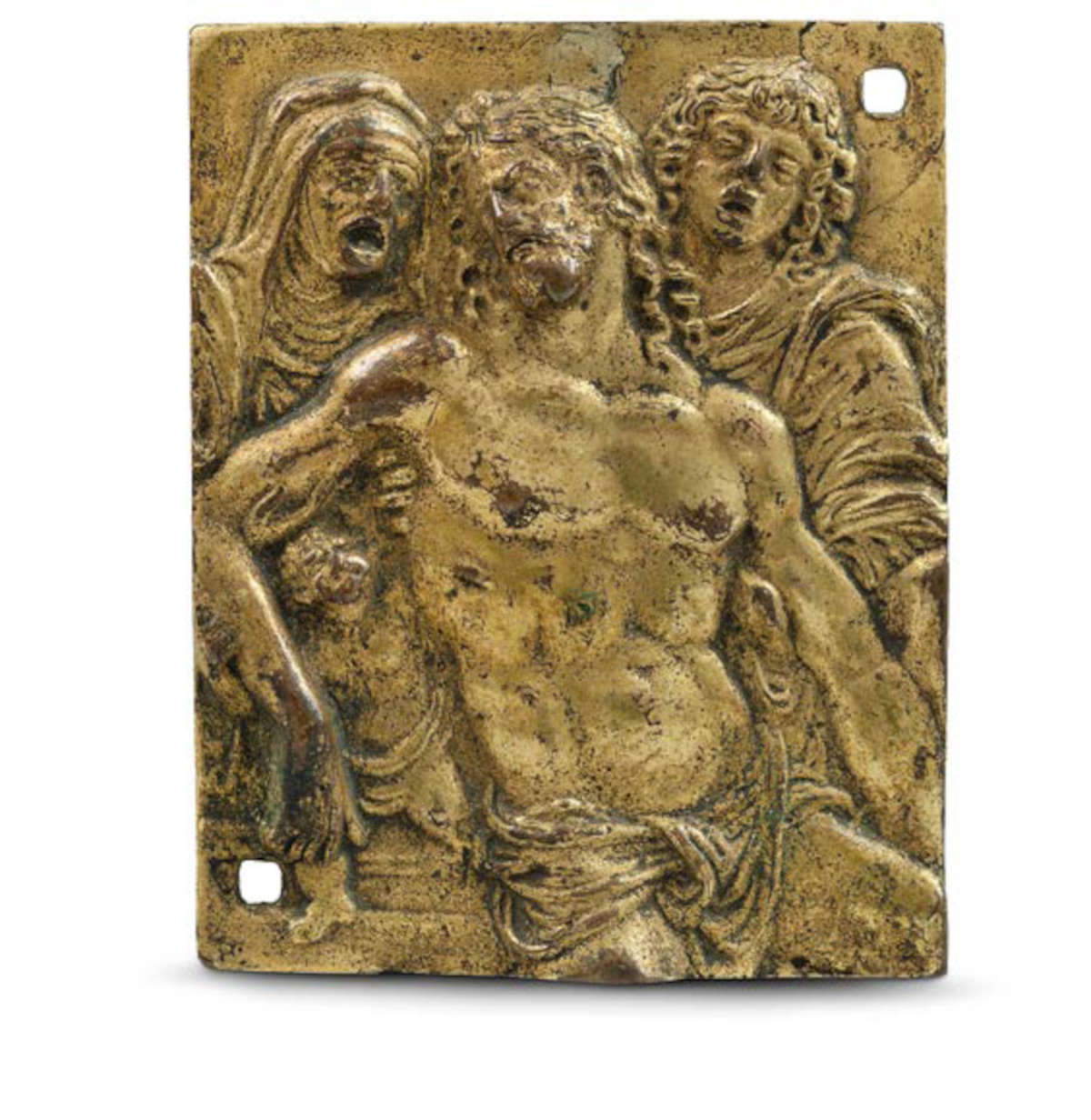
The complexity of the Lamentation finds echoes and confirmation in other works from the Roman period and, more generally, from the years preceding Sodoma’s move to Milan, such as the Pietà preserved at the Archconfraternity of Santa Maria dell’Orto in Rome. Here too, the painting reveals roots that run deep in the artist’s northern experiences, with the bust of Christ appearing to derive directly from sculptural models, particularly from a celebrated bronze plaque by Galeazzo Mondella, known as “the Modern.” Although the composition shows the influence of Perugino in the arrangement of certain figures, the rendering of the drapery—still harsh and wrinkled— and the dramatic use of light constantly bring to mind the mastery of Spanzotti and the influence of Zenale, as well as the sculptural volumes of Mantegna.
The absence of direct references to classical antiquity—which would instead appear prominently in the Subiaco cycle—should not mislead regarding the dating: such references are also absent in Mantegna’s Dead Christ, and their omission in the Lamentation may have been a deliberate choice to adhere to the model. The work remains a pivotal testimony to a moment when Giovanni Antonio Bazzi—who at the time was not yet known by the nickname that would secure his place in art history—was defining the parameters of a visual language destined to leave an indelible mark on the Italian Renaissance. The Lamentation thus reveals the portrait of an artist who, while looking to masters such as Mantegna and Leonardo, never ceased to be the artist from Vercelli who carried with him the concreteness and rigor of the artistic language he had developed at the foot of the Alps.

Warning: the translation into English of the original Italian article was created using automatic tools. We undertake to review all articles, but we do not guarantee the total absence of inaccuracies in the translation due to the program. You can find the original by clicking on the ITA button. If you find any mistake,please contact us.


























 IT
IT FR
FR DE
DE ES
ES CN
CN


