




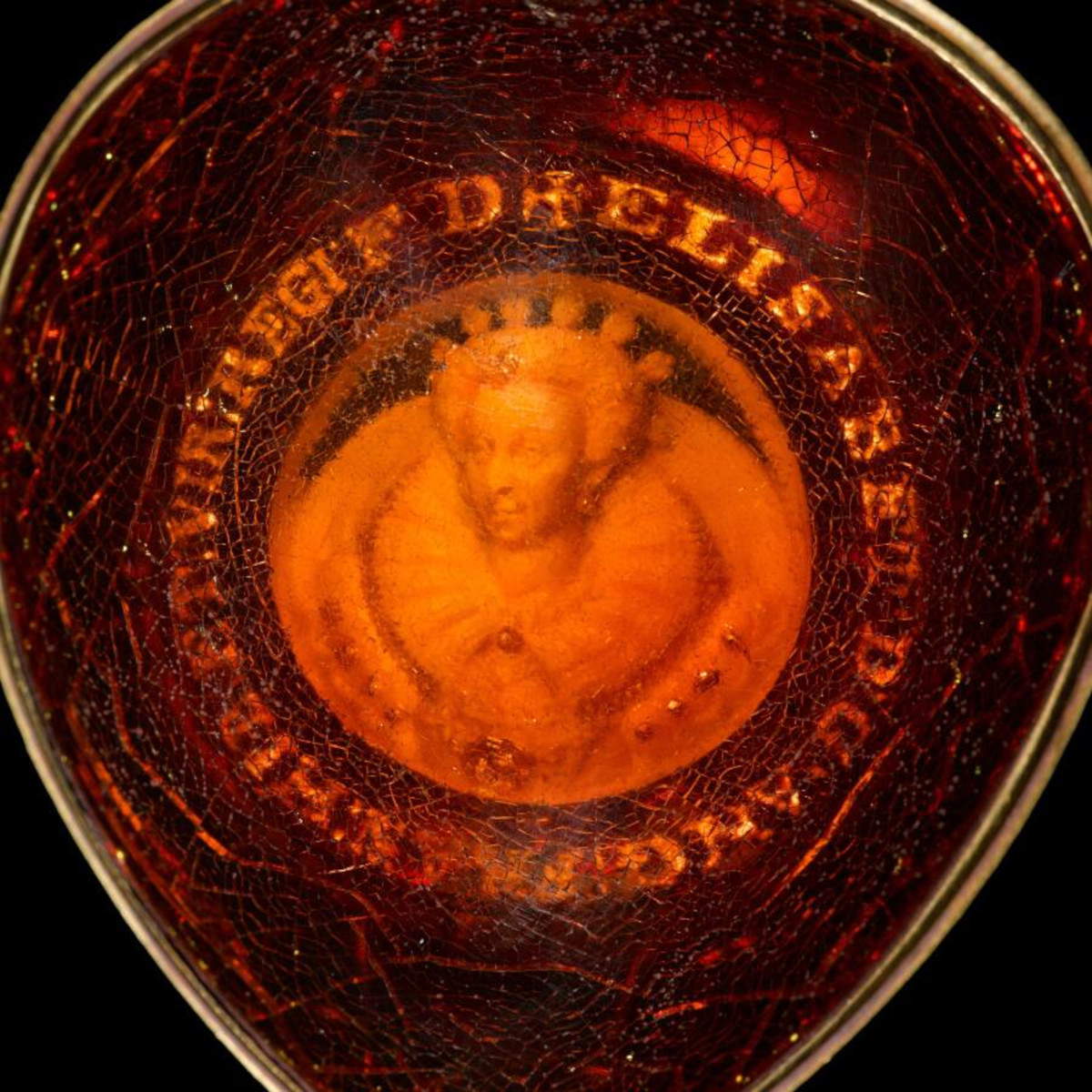
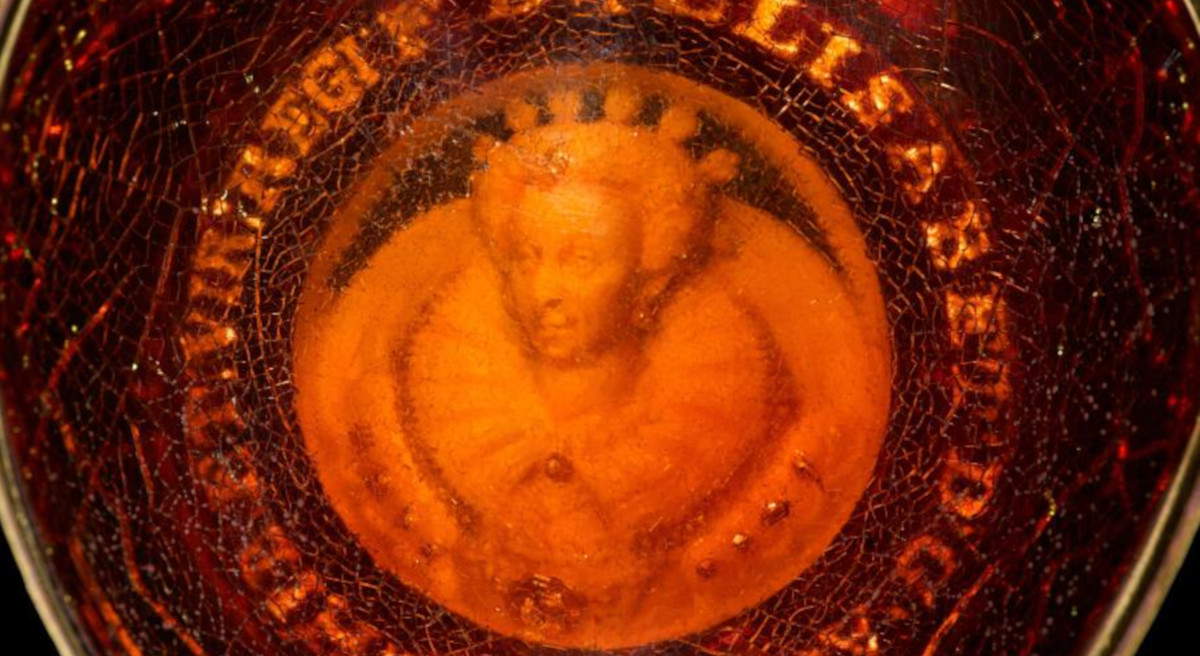
An extremely rare pendant depicting Queen Elizabeth I will be the highlight of an auction organized by Sotheby’s in London on July 1. Dating from around 1600—the final years of the English monarch’s reign—the jewel is one of the rarest known examples of Renaissance-era amber craftsmanship. Amber was considered an extremely precious material at the time and was known throughout Europe as “Baltic gold.” At the center of the heart-shaped pendant is an exquisite miniature portrait of the queen, carved from white amber with extraordinary attention to detail. The image is based on a famous engraving by Crispijn de Passe the Elder, which in turn was based on a portrait painted from life by Isaac Oliver between 1590 and 1592. Although the face follows the official conventions of royal portraiture of the time, the cameo conveys an authoritative and mature image of Elizabeth I, highlighting her distinctive features and the richness of her attire through a striking three-dimensional rendering.
The quality of the micro-carving attests to extraordinary technical mastery. The precision of the details and the clarity of the surfaces suggest that the work was crafted entirely by hand, setting it apart as one of the most refined amber objects produced in the early 17th century.
One of the most surprising aspects of the pendant is the sophisticated optical device employed. A concave cavity has been carved into the back of the amber heart, which, combined with the material’s convex and translucent surface, produces a natural magnifying effect. The portrait of the sovereign thus appears magnified and suspended within the amber, creating a visual illusion that, in some respects, foreshadows later experiments with magnifying lenses.
Between the late sixteenth and early seventeenth centuries, amber enjoyed enormous prestige not only for its beauty but also for the beneficial and protective properties attributed to it. According to the beliefs of the time, it was said to promote physical well-being and even to signal the presence of harmful substances by emitting specific scents. For this reason, objects made of amber were highly sought after in European courts, where they were treasured as luxury items and often used as precious diplomatic gifts. Scholars attribute the pendant to the finest master carvers working in Königsberg, an important center for amber craftsmanship on the Baltic coast. The technical and stylistic similarities to a famous amber chessboard that belonged to Charles I of England have led scholars to link the piece to the court goldsmiths Hans Klingenberg or Georg Schreiber, with several elements suggesting that the latter is the likely creator.
The jewel also holds strong symbolic significance. At the time, encasing a portrait in amber was seen as a way of preserving its memory. The figure of Elizabeth I, enveloped in the golden radiance of the material, thus appears eternally preserved, as if to safeguard the memory of the Elizabethan era. On the reverse side is a depiction of a parrot, a symbol traditionally associated with the Virgin Mary and purity—a clear reference to the image of the “Virgin Queen” that Elizabeth promoted throughout her reign.
The piece also boasts a prestigious provenance. It once belonged to John Malcolm, 1st Baron Malcolm of Poltalloch, one of the most important British collectors of the 19th century. Passed down to his heirs, the pendant eventually came into the possession of its current owner.
The jewel will be auctioned by Sotheby’s in London on July 1, 2026, as part of the “Master Sculpture from Four Millennia” auction, with an estimate of 100–150 thousand pounds.
 |
| A very rare amber pendant featuring a portrait of Elizabeth I is up for auction at Sotheby’s London |

Warning: the translation into English of the original Italian article was created using automatic tools. We undertake to review all articles, but we do not guarantee the total absence of inaccuracies in the translation due to the program. You can find the original by clicking on the ITA button. If you find any mistake,please contact us.




























 IT
IT FR
FR DE
DE ES
ES CN
CN


