





Two paintings by Claude Monet that have been hidden from public view for decades, a collection of works by some of the leading figures in modern art, and a story of women in art collecting. On October 22, 2026, during Art Basel Paris, Sotheby’s will auction “Le Temps Retrouvé: The Schlumberger Collection,” one of the most important private collections of Impressionist and modern art ever to be auctioned in France.
The collection, estimated at a total of over 40 million euros ($45 million), includes works by Monet, Paul Cézanne, Pierre Bonnard, Gustave Moreau, Gustave Courbet, Camille Claudel, Eugène Delacroix, and Chaïm Soutine, among others. Many of the works have remained hidden for decades—in some cases since their creation—and come from the collection assembled over more than forty years by Jeanne Schlumberger (1889–1983). Before going under the hammer in Paris, the works will be showcased on an international tour that will stop in Hong Kong and New York. The spotlight is on two paintings by Monet, which are set to reignite interest in the final phase of his career, coinciding with the centennial of his death.
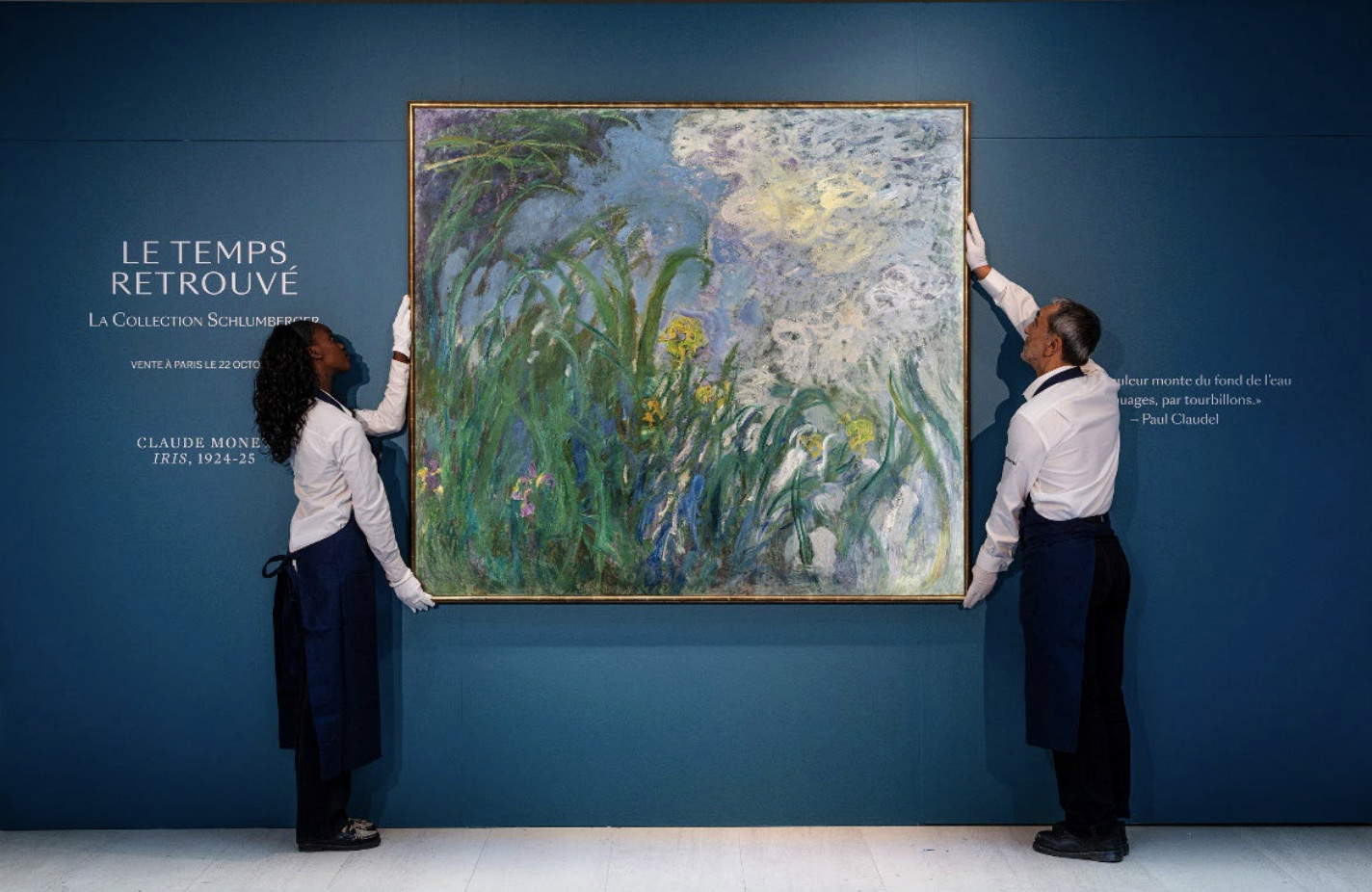
The highlight of the sale is *Iris* (1924–1925), a monumental painting created by Monet during his final years in Giverny. With an estimate ranging from 22 to 30 million euros, it is the most important work from this famous series ever to appear on the market and the largest example remaining in private hands. Considered one of the most ambitious and innovative works of the artist’s final period, *Iris* has never been exhibited to the public and is known only through black-and-white photographs. Its history is linked to that of the gallery owner Katia Granoff (1895–1989), who acquired it with the support of Jeanne Schlumberger. Both recognized Monet’s late works not merely as an epilogue to Impressionism, but as an exploration destined to open new paths toward Modernism and abstraction.
Alongside *Iris* will be *Saule pleureur*, also known as *L’Arbre de feu*, with an estimate of between 9 and 12 million euros. The painting belongs to the series dedicated to the weeping willows in the garden at Giverny, one of the most significant subjects in Monet’s late work.
The histories of the two paintings follow a common path: both passed directly from the artist to his son Michel Monet, were later acquired by Katia Granoff, and eventually became part of the Schlumberger collection. Their appearance on the market takes on special significance in the year that French and international museums are celebrating the centennial of the painter’s death.
The Schlumberger collection extends beyond Monet’s paintings. *Le Temps Retrouvé* brings together a collection of works that document the transformations in painting between the 19th and 20th centuries, through some of the leading figures of modern art. Among the most significant works is a rare mural by Paul Cézanne, from the Jas de Bouffan, the artist’s family home in Aix-en-Provence, which was also one of his primary venues for creative experimentation. The collection also includes the luminous compositions of Pierre Bonnard and the Symbolist visions of Gustave Moreau, as well as works by Gustave Courbet, Camille Claudel, Eugène Delacroix, and Chaïm Soutine. The exhibition thus traces a history of artistic innovation through works that helped redefine the language of painting and sculpture, demonstrating how the artists’ explorations between the 19th and 20th centuries paved the way for subsequent experiments.
"Great collections are born of taste. The most extraordinary ones, perhaps, are born of conviction. The history of the Schlumberger Collection is, ultimately, the story of those who were able to see what others missed. Jeanne Schlumberger and Katia Granoff understood the revolutionary genius of these works at a time when many still overlooked them. One collected, the other promoted their value: both knew how to trust their instincts precisely when the world seemed to have already passed its judgment,” said Thomas Bompard, co-head of the Modern and Contemporary Art department at Sotheby’s France. “Today, as this Impressionist treasure makes its debut on the market, it does so as the legacy of two women who changed the fate of the artists in whom they had believed. Just as Jeanne Schlumberger and Katia Granoff helped rewrite the history of Impressionism, *Le Temps Retrouvé* will mark a pivotal chapter for Sotheby’s Paris, for the art market, and for a new generation of collectors.”
At the heart of the collection’s history are, in fact, two women: Jeanne Schlumberger and Katia Granoff, united by a bond of friendship, trust, and a shared artistic vision. For decades, the works adorned the walls of the Schlumberger family’s private mansion on Rue Las-Cases in Paris, the home of Jeanne and her husband Marcel. Although the Schlumberger name is associated with one of the great industrial dynasties of the 20th century, it was Jeanne who built and nurtured the family’s artistic legacy. Beginning in the 1950s and for over forty years, the collector worked closely with Katia Granoff, an art dealer and gallery owner who was able to recognize the value of artists who had not yet achieved full recognition. Jeanne provided resources, support, and patronage; Granoff contributed her expertise, connections, and ability to identify works of particular significance. Throughout her career, the gallerist supported artists such as Pierre Bonnard, Chaïm Soutine, Georges Rouault, Othon Friesz, and Pierre Laprade, helping to promote their works among collectors and institutions.
A decisive moment in their partnership came in 1958, when Jeanne Schlumberger provided financial support for Granoff’s acquisition of works from Michel Monet’s studio. This transaction enabled the art dealer to secure an exceptional collection of the artist’s paintings at a time when his later work was still drawing limited interest in France. Granoff recognized the innovative significance of those works and committed herself to promoting them, facilitating their entry into major U.S. museums—including the Museum of Modern Art in New York, the Cleveland Museum of Art, and the Art Institute of Chicago—as well as into private collections. Their interpretation foreshadowed a view that is now well established: Monet’s large late compositions did not merely mark the conclusion of the Impressionist era but constituted a transition toward the explorations of Modernism and abstraction. This legacy would find further development in the works of artists such as Mark Rothko and Joan Mitchell.
Jeanne Schlumberger was among the first private collectors to share this vision. Thanks to her relationship with Granoff, she was able to acquire important works by Monet before they achieved their current recognition, preserving them for decades in her own collection. Before the Musée Marmottan Monet became, in 1966, a key institution for the preservation and promotion of the painter’s legacy, it was primarily the Musée de l’Orangerie, the Galerie Katia Granoff, and the Schlumberger collection in Paris that fostered awareness of his late works.
Today’s Sotheby’s auction brings a part of this history to light, returning long-hidden paintings to the public and highlighting the role of two women in the rediscovery of one of the most innovative periods in Monet’s painting.
|
| Sotheby’s Paris: The Schlumberger Collection Goes Up for Auction—Monet’s Monumental “Iris,” Valued at 30 Million Euros, Stands Out |

Warning: the translation into English of the original Italian article was created using automatic tools. We undertake to review all articles, but we do not guarantee the total absence of inaccuracies in the translation due to the program. You can find the original by clicking on the ITA button. If you find any mistake,please contact us.
























 IT
IT FR
FR DE
DE ES
ES CN
CN


