





For over thirty years, the catalog of Claudio Ridolfi’s works in the Marche region has remained essentially unchanged. Today, however, an exhibition in Corinaldo compels us to reevaluate attributions, contexts, and even the role that the Veronese painter played in the artistic culture of the Marche region during the 17th century. Four new attributions, four identified workshop pieces, and the recovery of a complex 17th-century wooden structure: these are the most significant findings to emerge from the exhibition *Mirabilia Marche: Masterpieces, Fusions, and Hybridizations Between the Public and Private Spheres in the Age of Claudio Ridolfi*, on view at the art collection dedicated to the painter in Corinaldo. These findings now allow us to reevaluate the role of Claudio Ridolfi (Verona, c. 1570 – Corinaldo, 1644) in the Marche region through new documentary and attributional discoveries.
More than thirty years after the last comprehensive survey dedicated to the artist, published in 1994, numerous works preserved in the Corinaldo area were still awaiting systematic verification. This need gave rise to the project that accompanied the exhibition, launching a comprehensive review of the local Ridolfi corpus. The exhibition thus became a true research laboratory, bringing works, archival sources, and field investigations into dialogue with one another. What emerges is a picture of a particularly vibrant artistic context and a deep relationship between the painter and his local patrons during the long period he spent in the Marche region, from 1615 until his death. The working method integrated archival research, direct examination of the works, and an assessment of their state of preservation, demonstrating how an exhibition can yield concrete results even in terms of the preservation and promotion of cultural heritage.
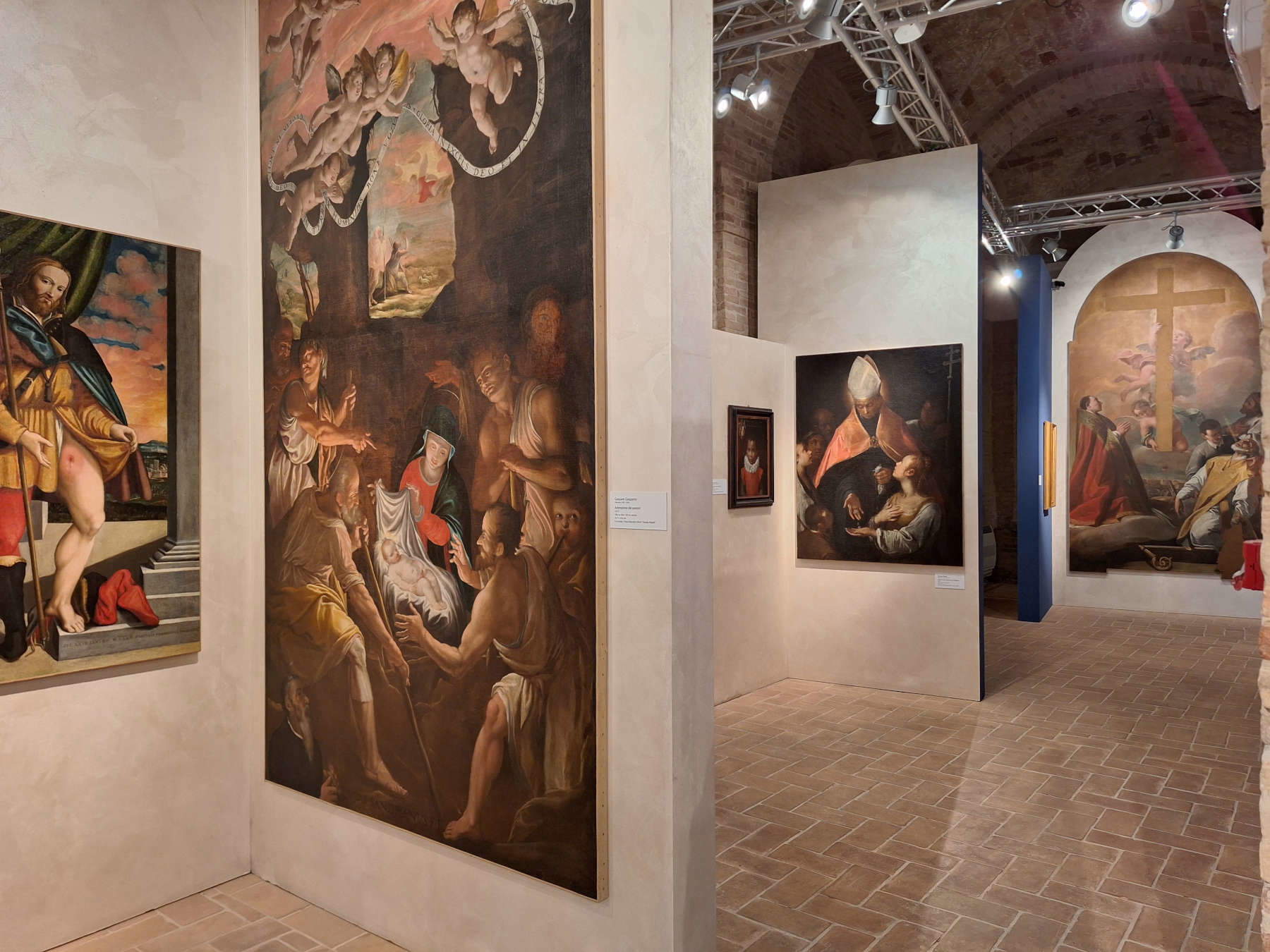
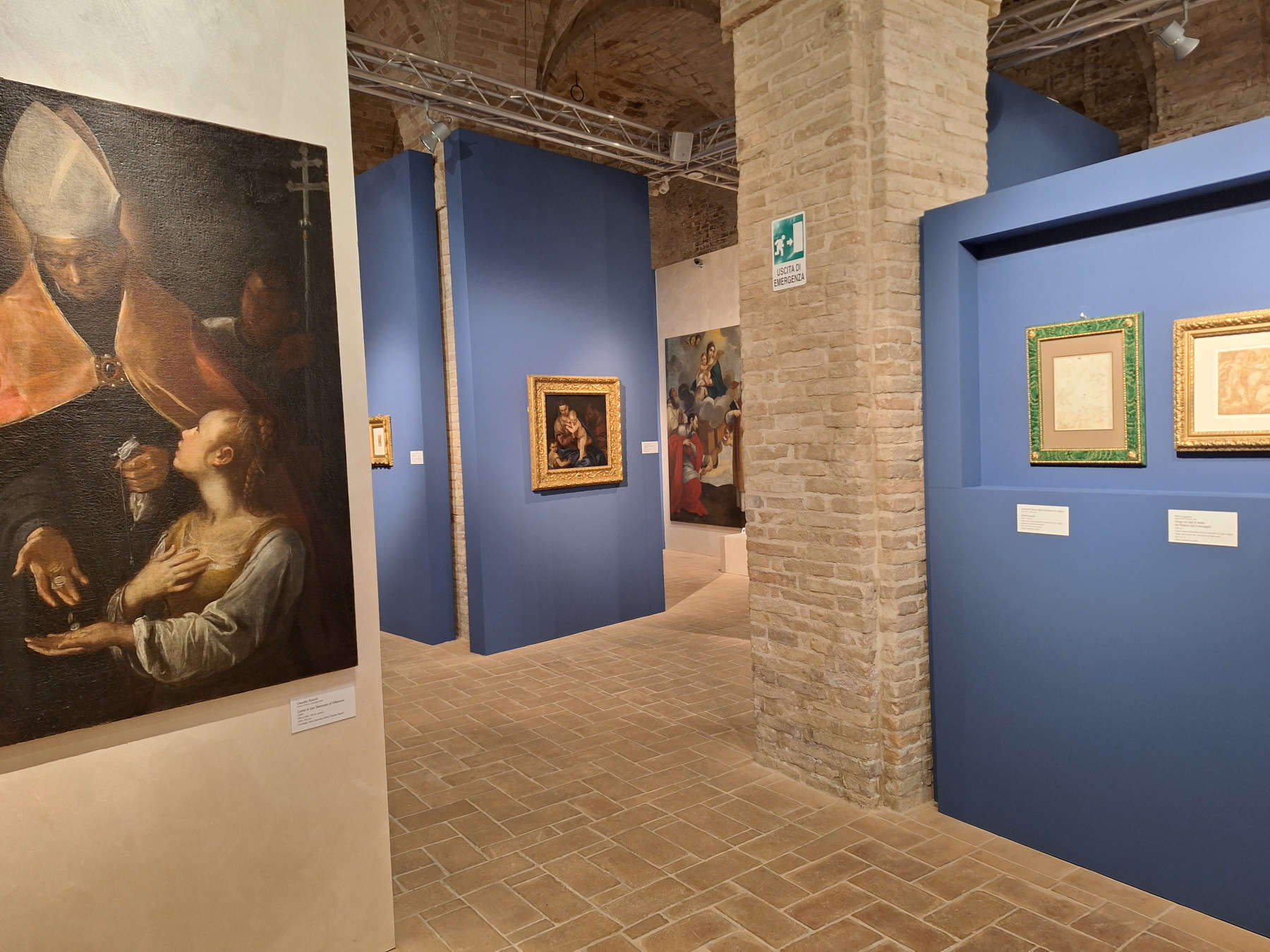
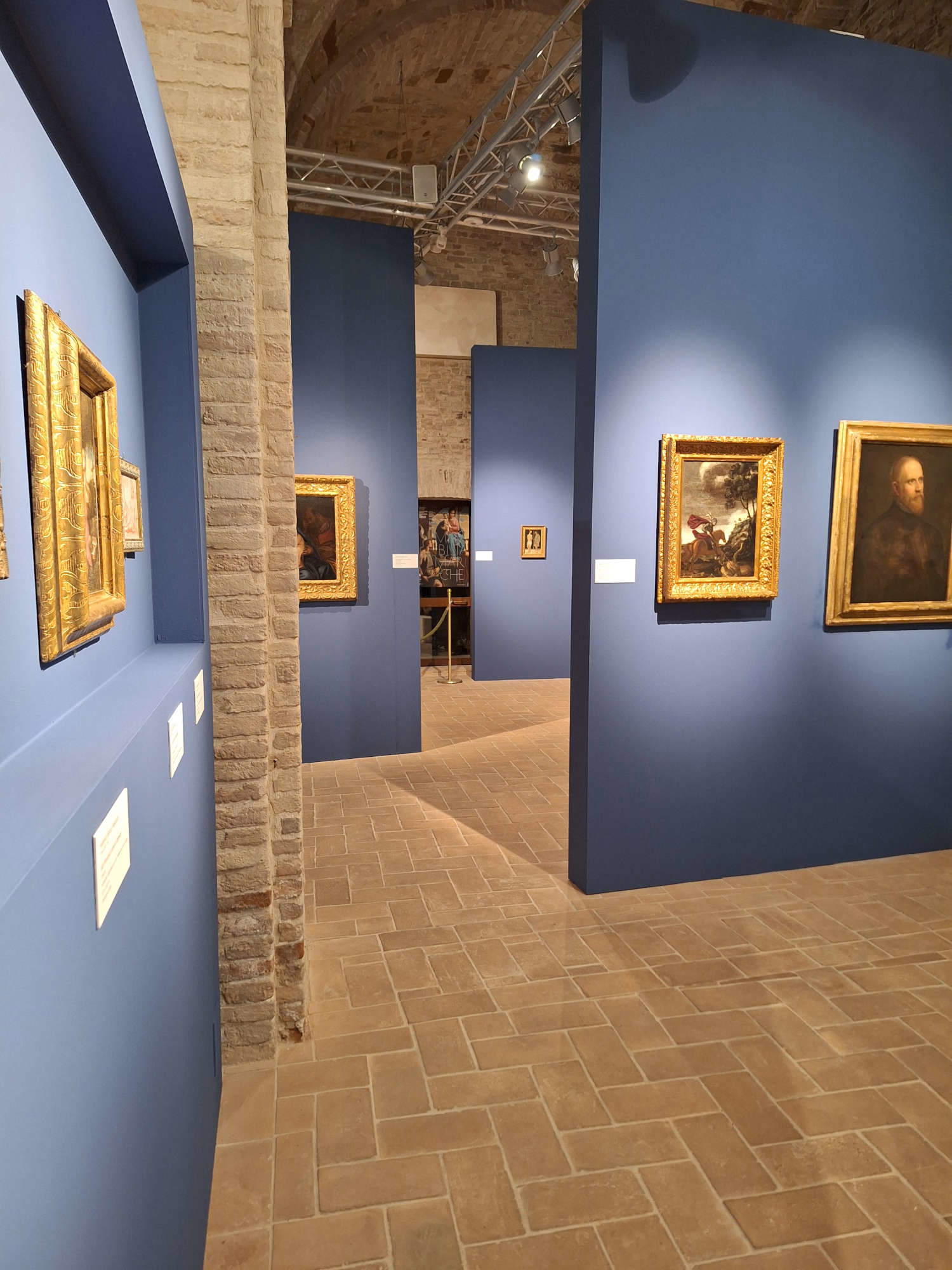
Important documentary evidence helps trace Ridolfi’s presence in the region, including a Napoleonic register from 1813 and the “List of Notable Paintings and Portraits” compiled by the Government of Corinaldo on July 1, 1851. These sources attest to the historical existence of at least eleven paintings that can be definitively attributed to the artist or his circle, revealing a widespread presence within the city’s religious and civic fabric.
The survey also had to account for missing works. Some pieces recorded in nineteenth-century sources can no longer be traced, such as the *Sant’Anna*, formerly in the Church of San Francesco, or the double-sided banner of San Pietro. Their disappearance underscores the extent of the dispersal that has affected the city’s cultural heritage over the centuries and necessitated a process of documentary reconstruction to reintegrate them into the local art history.
Among the most significant recoveries is the wooden altarpiece from the church of Santa Maria del Piano, dating from around 1629. Originally located in the apse area, the structure housed a revered 14th-century Madonna and Child, now preserved at the National Gallery of the Marche. The altarpiece is a significant example of the integration of architecture, sculpture, and painting. It is no coincidence that it can be compared to those “vague altarpieces and exquisite paintings” with which Vincenzo Maria Cimarelli celebrated Claudio Ridolfi’s work in 1642.
From a formal standpoint, the structure is organized according to a precise decorative hierarchy. The lower section retains a predominantly architectural function, while the upper pediment features a freer and more refined style of painting. In this area, the two angels at the very top stand out in particular, characterized by soft and luminous colors. It is precisely these angels that offer some of the most interesting clues for attribution. Their characteristics, in fact, bear convincing similarities tothe Announcing Angel in the Castelvecchio Museum and tothe Coronation of the Virgin in Morro d’Alba—works that confirm the connection to Ridolfi’s figurative style.
The iconographic program also continues to spark interest among scholars. Gabriele Barucca has proposed identifying the figures as allegories of Faith and Charity, thus interpreting them within the framework of the theological virtues. More recently, however, Dario Cingolani has suggested an interpretation linked to Marian devotion, identifying a supplicant and an allegory of fertility in the painting. The commission of the work appears to date to the rectorship of Andrea Veronica, a central figure in the religious and cultural life of seventeenth-century Corinaldo.
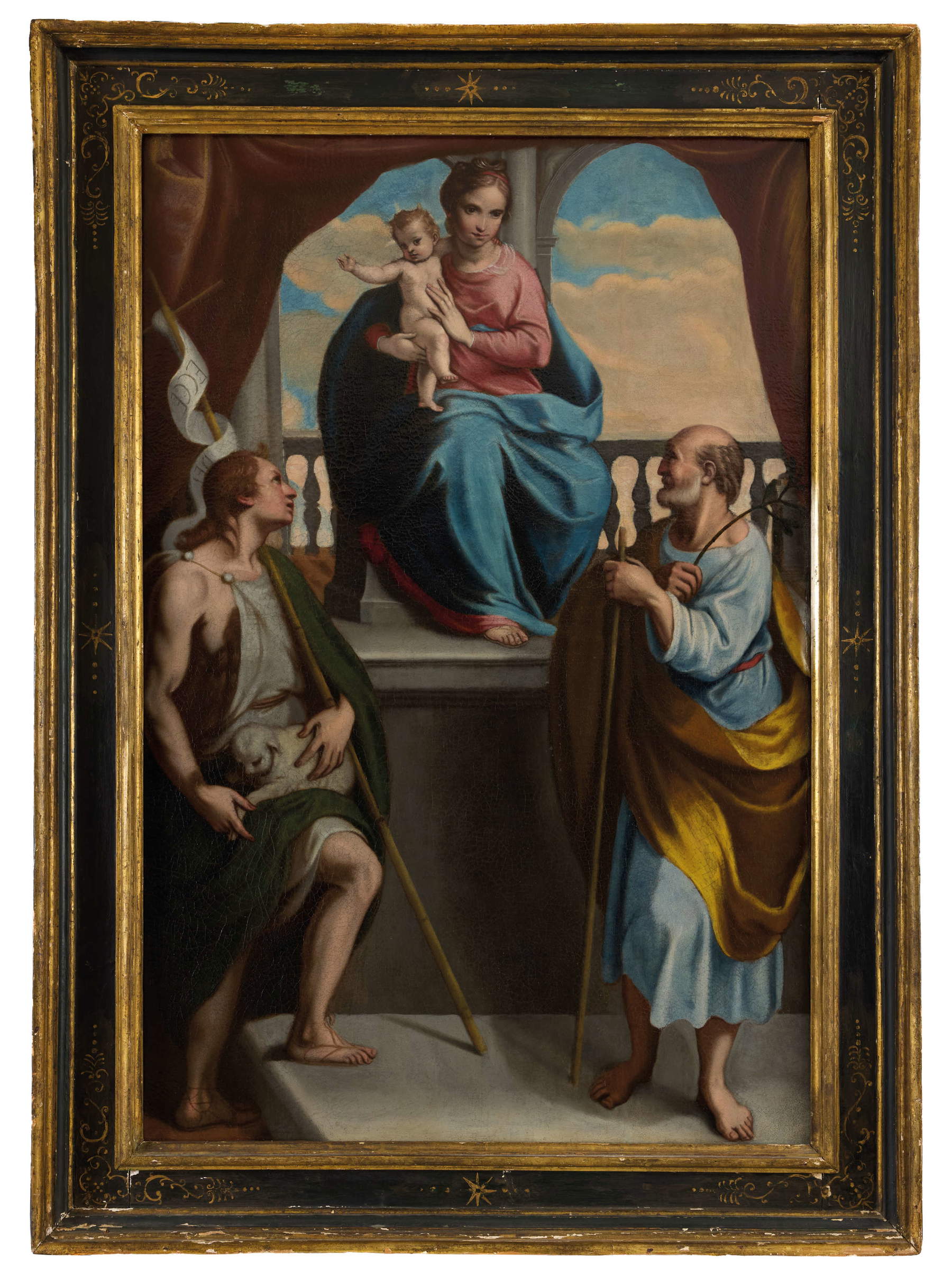
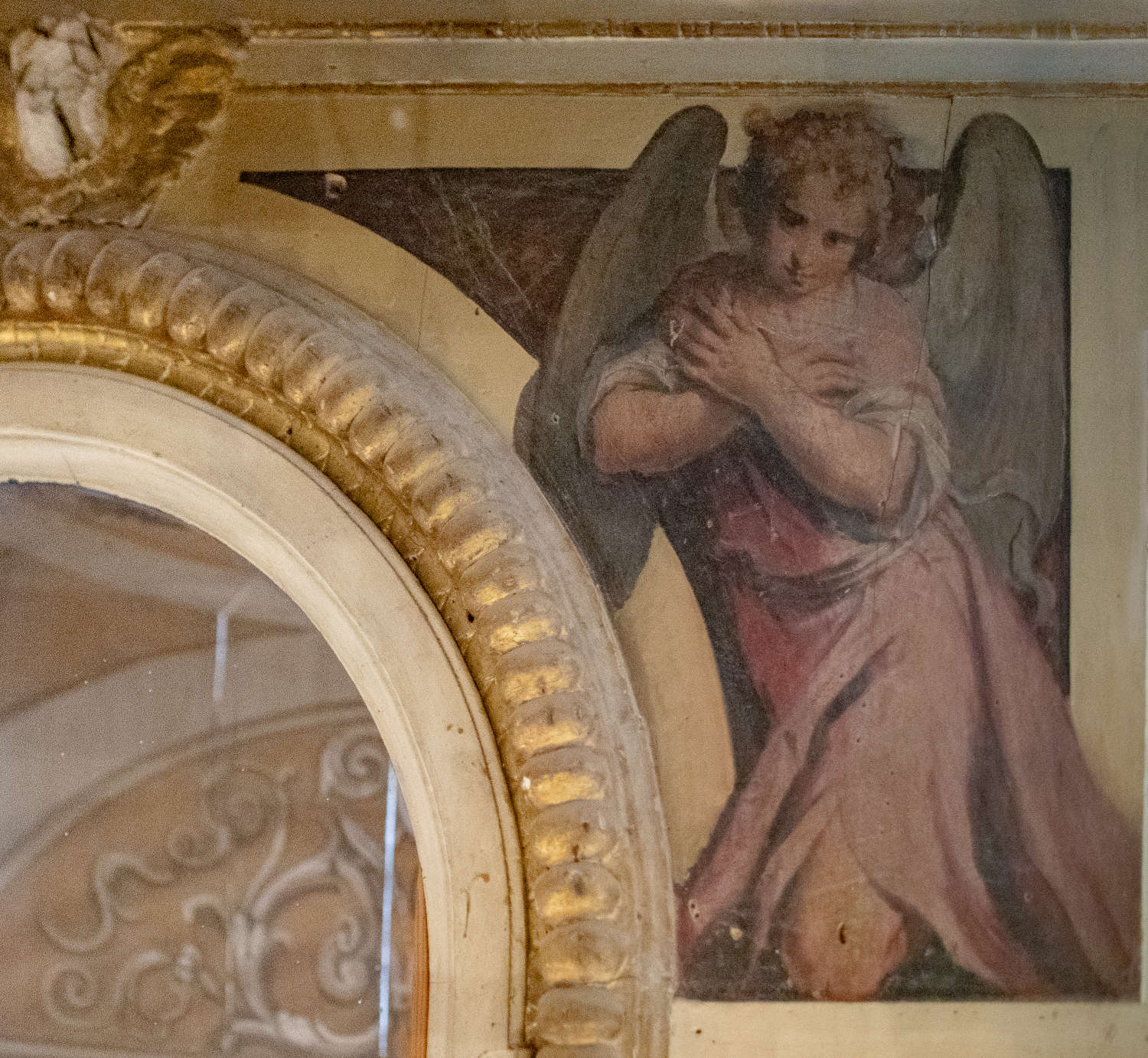
Another significant example is the fragment preserved in the sacristy of the Church of Sant’Anna, a remnant of a larger Madonna of the Rosary painted in the second decade of the 17th century. Despite its precarious state of preservation—which necessitated a restoration project initiated thanks to the exhibition—the painting retains considerable historical and documentary value.
A comparison with the versions painted in Arcevia in 1614 and in Candelara between 1627 and 1628 demonstrates how Ridolfi drew on established models without ever limiting himself to mechanical repetition. Each work was, in fact, adapted to the client’s needs and the characteristics of the space intended to house it, producing different results even within the same iconographic scheme.
One of the most significant findings in terms of attribution, however, concerns the “Breathing Crucifix” in the church of San Francesco, datable to around 1615. Already attributed to Ridolfi by Marisa Baldelli in 1977, the painting now plays a central role in understanding the artist’s stylistic evolution.
The work reveals a direct engagement with the models of Federico Barocci, particularly with the crucifixes housed at the Prado Museum and in the Church of the Crucifix in Urbania. Ridolfi, however, simplifies the composition by eliminating the landscape and isolating the figure of Christ against a dark background, focusing attention on the emotional and spiritual significance of the scene. The luminous rendering of the flesh and the delicate chromatic modulation attest to a full assimilation of Barocci’s artistic legacy.
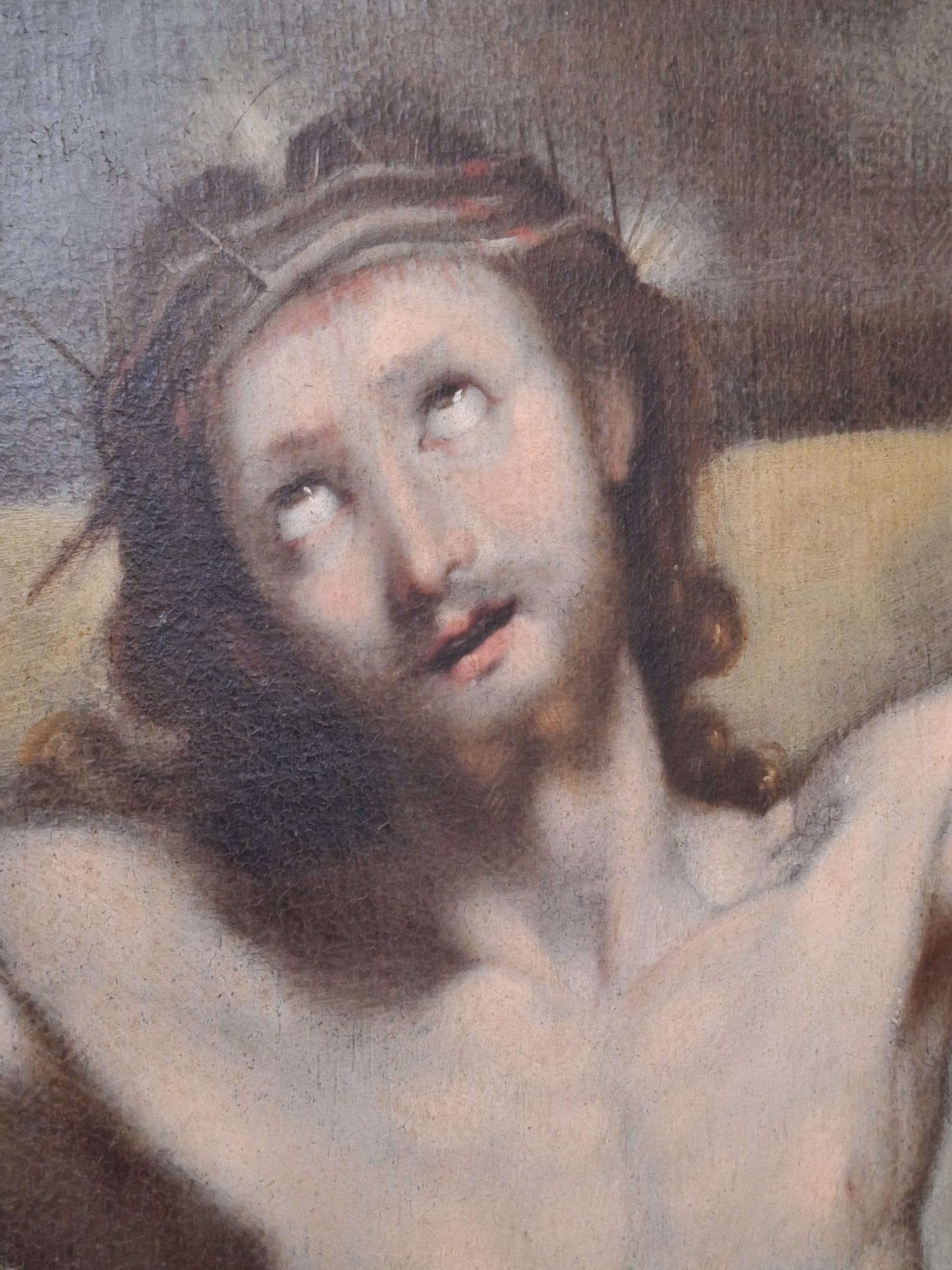
It was precisely during the comparative analysis undertaken for the exhibition that the possibility arose to re-examine a small Crucified Christ Exhaling, housed in the Pinacoteca Civica of Corinaldo. A close analysis of the work, compared with the far more monumental “Crucifix Exhaling” at San Francesco, revealed a series of stylistic and technical affinities sufficient to allow its attribution to Ridolfi. Dated to the second decade of the 17th century, the work stands out for the quality of its execution and the refined rendering of the landscape.
Alongside this core group of autograph works, the research has also identified four paintings attributable to the workshop, which offer valuable insights into the organizational structure of Ridolfi’s workshop and the spread of his figurative models throughout the Marche region.
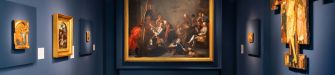
One of the most tangible outcomes of the exhibition also concerns the fate of the *Madonna and Child with Saints John the Baptist and Joseph* ( third decade of the 17th century). The work, displayed as the centerpiece of the exhibition, is now the focus of an initiative aimed at its acquisition by the public sector. Its inclusion in the civic collection would help strengthen the permanent exhibition dedicated to 17th-century painting, offering a new point of reference for interpreting Ridolfi’s work in Corinaldo.
The experience of the exhibition demonstrates that Ridolfi’s body of work cannot be considered a definitively closed collection. On the contrary, new attributions, recovered works, and unresolved questions confirm the importance of local research as an essential tool for historical and artistic understanding.
From this perspective, Claudio Ridolfi emerges as a figure bridging Venetian tradition, Urbino culture, and the devotional traditions of the Marche region. At the same time, Corinaldo is no longer seen merely as the place that preserves these works, but as the context that fostered their creation, dissemination, and, today, their new interpretation. It is in this relationship between heritage, research, and the local area that the Corinaldo project finds its broader significance.

The author of this article: Andrea Bruciati
Andrea Bruciati (Corinaldo, 1968), storico dell'arte, critico d'arte e curatore, si è laureato in conservazione dei beni culturali presso l'Università degli studi di Udine con una tesi su Lucio Fontana e Piero Manzoni e da allora ha indirizzato le sue ricerche sull'arte del Novecento e sull'arte contemporanea. Nel 2002 è stato nominato direttore della galleria comunale d'arte contemporanea di Monfalcone[1] e dal 2009 al 2012 è stato ideatore del format On Stage all'interno della rassegna scaligera ArtVerona di cui diviene direttore artistico dal gennaio 2013 al febbraio 2017. Dal marzo 2017 al maggio 2025 è stato alla guida dell'istituto autonomo del Ministero della Cultura "Villæ" (nome che lui stesso ha dato all'ente nel 2018), e che include, tra gli altri siti, Villa Adriana e Villa d'Este a Tivoli. A Tivoli ha organizzato convegni su Leonardo da Vinci, Adriano, Nerone, la natura antiquaria del giardino storico, ha ideato il Villae Film Festival, Extravillae.Warning: the translation into English of the original Italian article was created using automatic tools. We undertake to review all articles, but we do not guarantee the total absence of inaccuracies in the translation due to the program. You can find the original by clicking on the ITA button. If you find any mistake,please contact us.























 IT
IT FR
FR DE
DE ES
ES CN
CN


