





For nearly two thousand years, the charred papyri of Herculaneum have preserved a wealth of knowledge that remained inaccessible. Having survived the eruption of Vesuvius in 79 A.D., these precious manuscripts could not be opened without risking their destruction. Today, thanks to the international Vesuvius Challenge project, this limitation has been overcome.
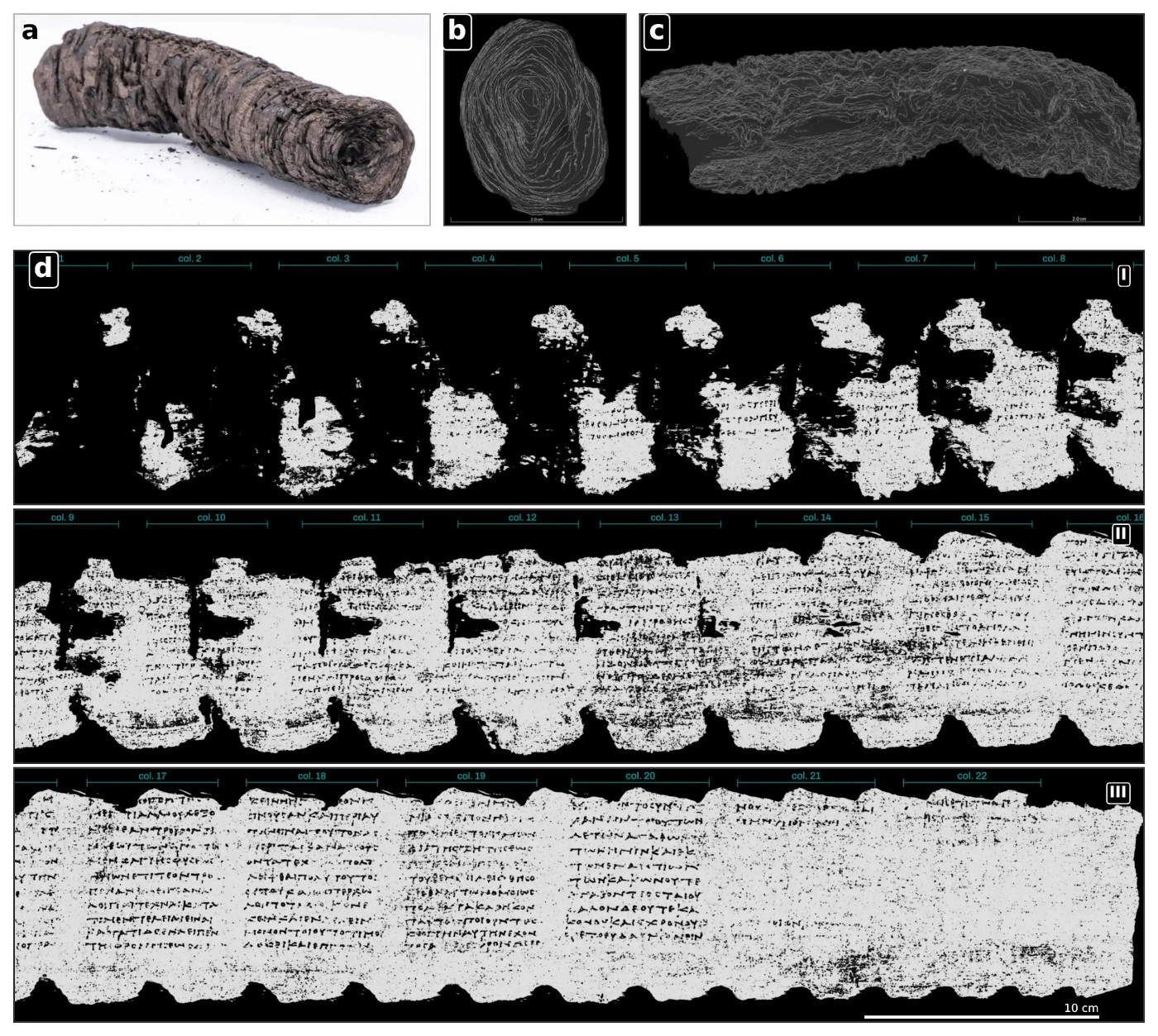
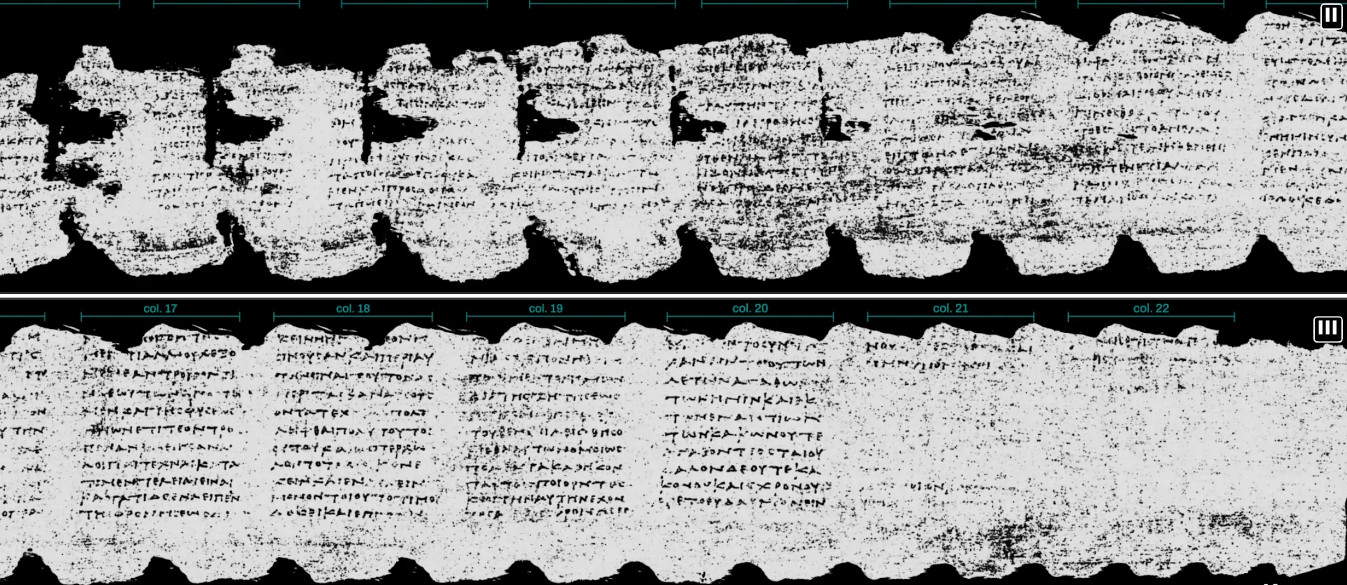
In fact, for the first time, the scroll from the famous Herculaneum library, PHerc. 1667 (also known as Scroll 4), has been completely unrolled digitally and read virtually, without the fragile papyrus ever being physically opened, making it available for scientific study. This result was achieved through a combination of ultra-high-resolution X-ray tomography, three-dimensional reconstruction, and artificial intelligence algorithms capable of distinguishing the faintest traces of ink from the charred papyrus. After digitally reconstructing the scroll’s inner layers, the surfaces were virtually “flattened” to produce legible pages, which were then transcribed and verified by papyrologists.
PHerc. 1667 represents what remains of a much larger manuscript. Attempts made between the 19th century and the 1980s to open it manually had, in fact, destroyed most of the outer layers, leaving only a compact core about eight centimeters high, down from the original 19–24 centimeters. Despite this damage, scholars were able to recover the preserved text, consisting of approximately twenty-two columns.
The work has been identified as a philosophical treatise on ethics belonging to the Stoic tradition. The text addresses themes such as human nature, impulses, knowledge, and moral progress. The last surviving column quotes Aristocreon, nephew and disciple of the philosopher Chrysippus—a detail that, together with the language and content, allows the manuscript to be attributed to the Stoic circle of the 2nd century B.C. Among the recovered passages are reflections on self-knowledge and the pursuit of wisdom.
The research has also yielded significant results regarding other papyri in the library. In the PHerc. Paris 4 scroll, thanks to a new imaging technique, scholars were able to directly visualize the ink inside the manuscript in the three-dimensional data obtained via X-rays, independently confirming the readings obtained during the 2023 Vesuvius Challenge.
Further progress concerns papyrus PHerc. 139, in which the title of the work was identified even before its virtual opening: it is Book VIII of *De gli Dei* by Philodemus, an Epicurean philosopher whose works constitute an important part of the Herculaneum library. The ability to identify the contents of a still-sealed scroll represents a significant step forward for papyrological studies.
The scans were performed atthe European Synchrotron Radiation Facility (ESRF) in Grenoble using phase-contrast X-ray microtomography, in collaboration with the “Vittorio Emanuele III” National Library of Naples, which houses the Herculaneum papyri. The data obtained were processed using machine learning models, while the final transcription was entrusted to specialists.
One of the most innovative aspects of the project is its open-source nature. The scans, 3D models, surface reconstructions, transcriptions, and the software used have been made publicly available under a Creative Commons license, allowing researchers worldwide to analyze the data, improve the tools, and apply the same methodology to the hundreds of other scrolls that remain unopened.
The initiative stems from the workof EduceLab, led by Professor Brent Seales, who in 2023 made the technologies developed by the lab available to the Vesuvius Challenge—an international competition co-founded with Nat Friedman and Daniel Gross to accelerate the reading of papyri through collaboration among computer scientists, researchers, and scholars.
 |
| A papyrus from Herculaneum has been digitally unrolled and read: the Vesuvius Challenge project reveals it |

Warning: the translation into English of the original Italian article was created using automatic tools. We undertake to review all articles, but we do not guarantee the total absence of inaccuracies in the translation due to the program. You can find the original by clicking on the ITA button. If you find any mistake,please contact us.























 IT
IT FR
FR DE
DE ES
ES CN
CN


