





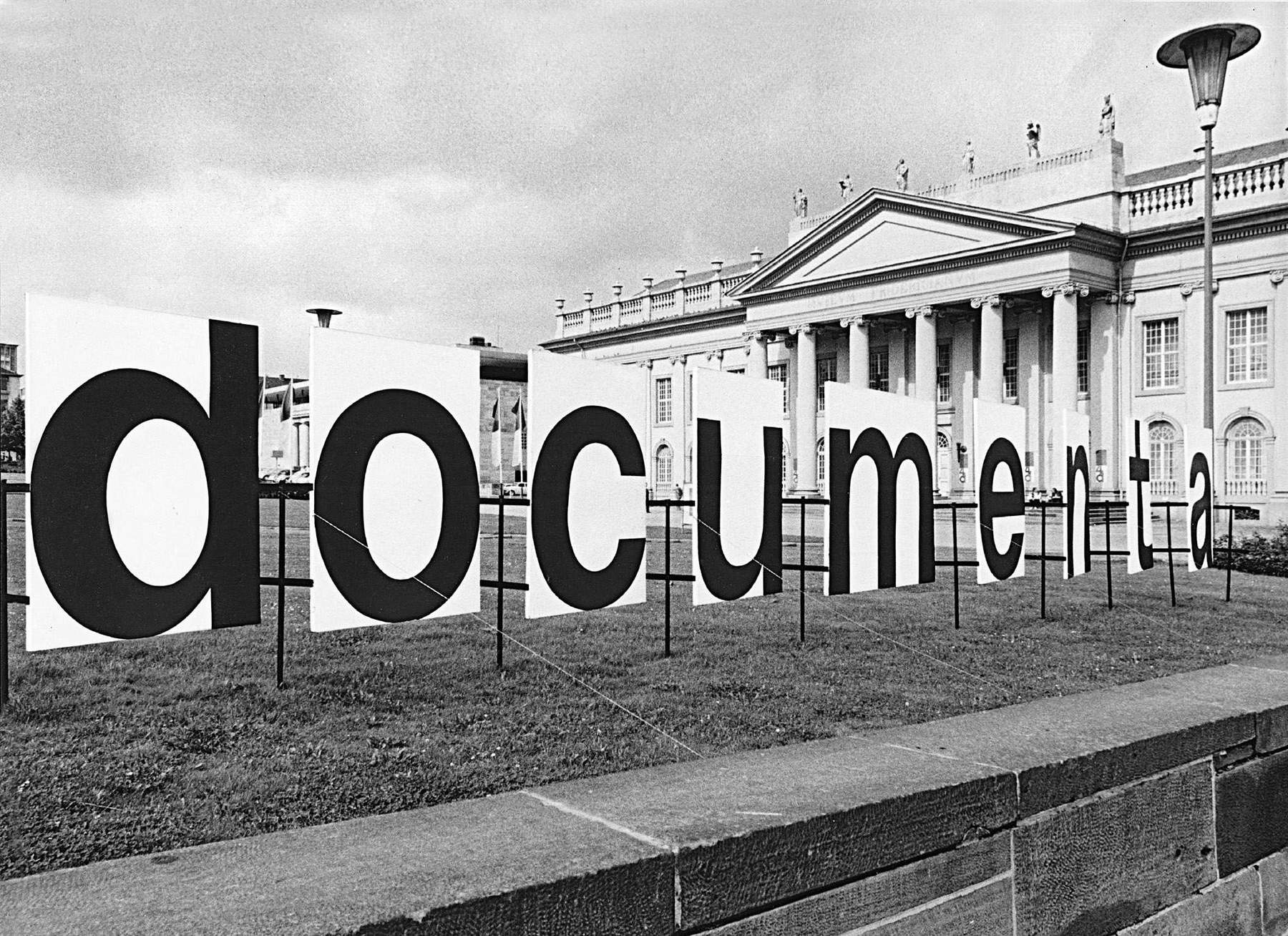
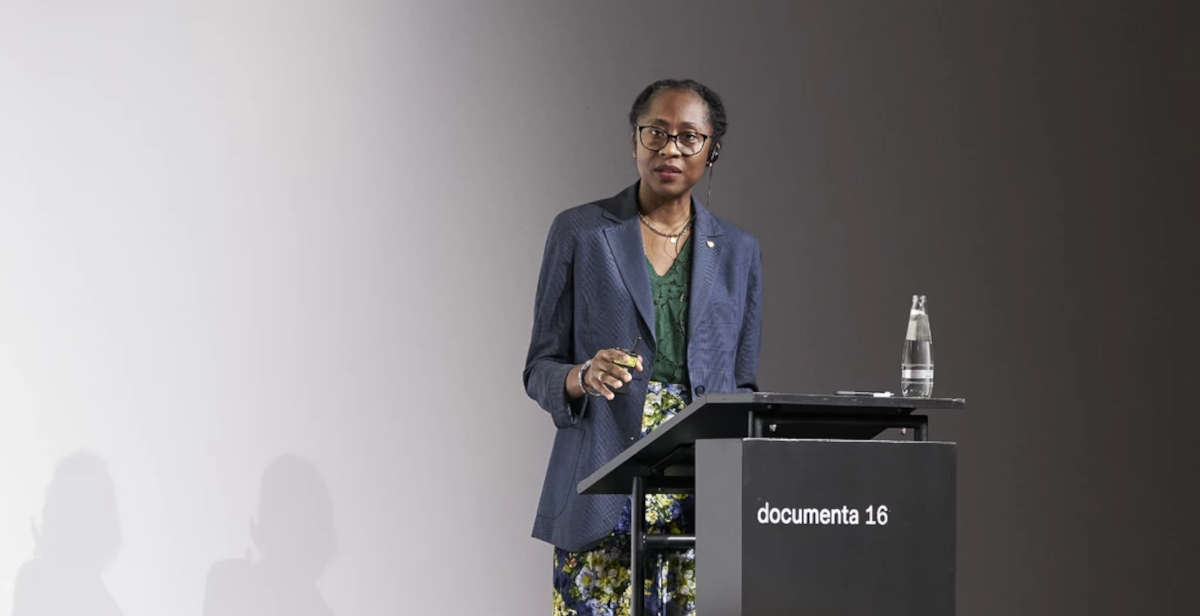
Some artists have already refused to participate in the upcoming 16th edition of Documenta, which will be held in Kassel from June 12 to September 19, 2027, due to Germany’s stance on Israel’s war in Gaza. Curator Naomi Beckwith revealed this in a lengthy interview published on September 16 in the German newspaper Die Zeit. Documenta, the art exhibition held every five years in Kassel, is one of the most prestigious and long-running events in the world of contemporary art, but since the controversy that engulfed the 2022 edition (a participating collective had been accused of anti-Semitism), the event has been the subject of harsh criticism. The controversy also had repercussions on the 16th edition of Documenta, whose entire curatorial selection committee resigned en masse in 2023. Beckwith, deputy director and chief curator of the Guggenheim Museum in New York, was chosen to organize Documenta 16 in 2024.
In an extensive interview with the German publication, Beckwith spoke at length about the process of putting together her edition of the exhibition, whose theme has not yet been announced. The curator explained that she had received several withdrawals from artists invited to participate, noting that some of them feel they are not free in Germany to show what they would like to exhibit, while others openly criticize the country’s stance on the conflict in Gaza. “Some,” the curator specifically stated, “feel they are not free in Germany to show what they want. Others criticize Germany’s stance on the war in Gaza.” When asked about her personal stance on the conflict, Beckwith declined to comment, preferring instead to shift the focus to the need to move beyond divisive thinking and find ways to reopen dialogue. She added that while she understands the need for solidarity and support, she believes that rigid positions prevent progress.
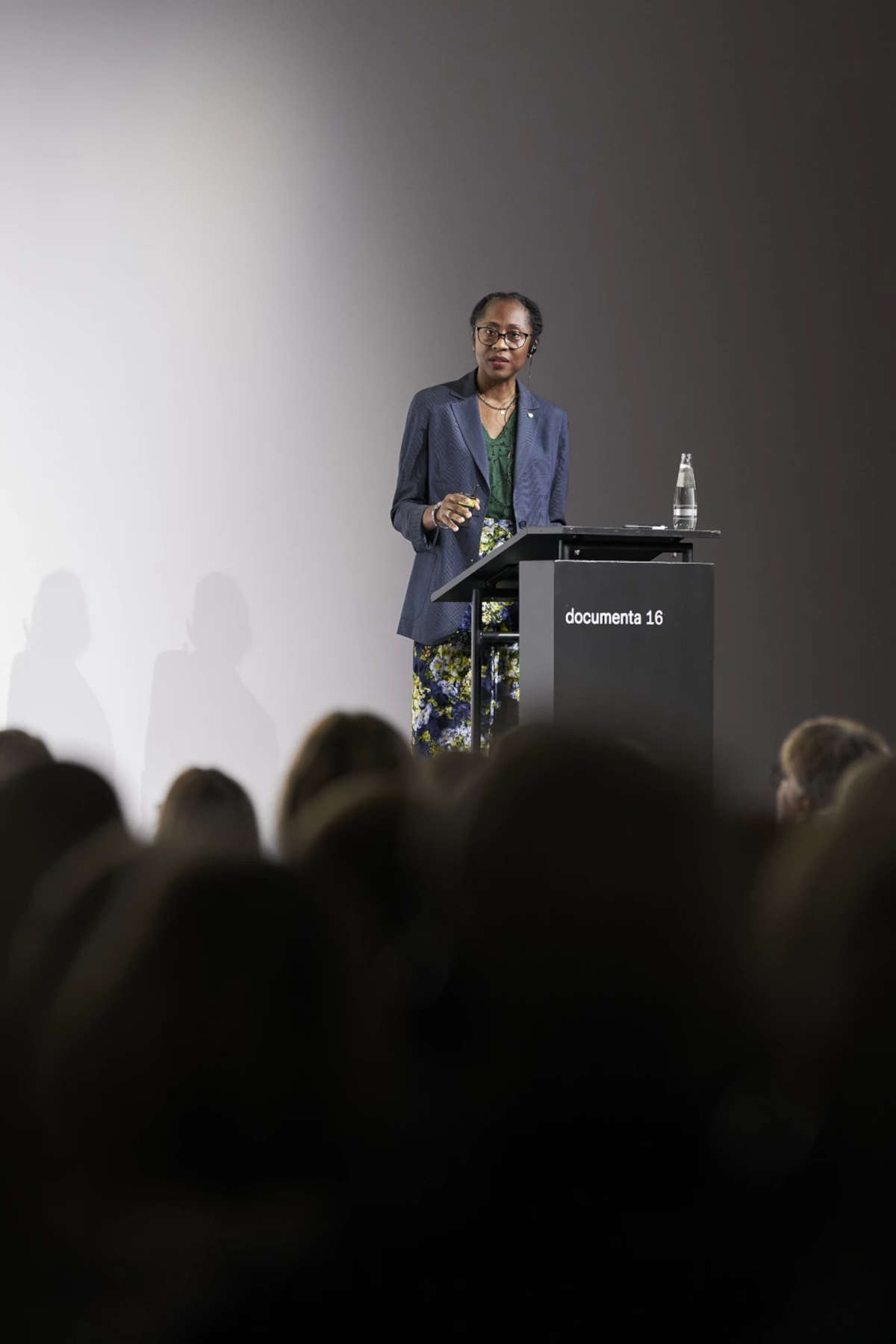
During the interview, Beckwith also revisited the controversial work exhibited at Documenta 15 by the Indonesian collective Taring Padi—a large mural featuring an anti-Semitic caricature of a Mossad agent. The work, one of the most prominent pieces in that edition, was first covered up and later removed entirely. Describing her path to the position, Beckwith admitted that she hesitated for a long time before accepting, even though she had always dreamed of one day directing Documenta: aware of the tight timeline—just over two years—she initially turned down the offer, only to accept it after a second call, for which she now says she is deeply grateful. The curator acknowledged that the controversies surrounding the last edition had also weighed on her hesitation, and that it had not been easy for her to fully understand what had happened at the time, nor why such entrenched positions had emerged.
Beckwith also noted that, although several people close to her had likely thought that accepting the position was not a wise choice, few told her so openly; to one of them, the curator responded by emphasizing that Documenta’s mission extends far beyond the current geopolitical context, citing the deeper reasons that led her to become a curator and study art history—namely, her interest in a broader horizon.
When asked about the possibility that protesters opposed to Israel’s policy toward Gaza might also appear at her edition of the exhibition, Beckwith replied that she does not believe such an eventuality can be avoided, nor that one should attempt to prevent it, acknowledging people’s right to protest and express their opinions without this causing her concern.
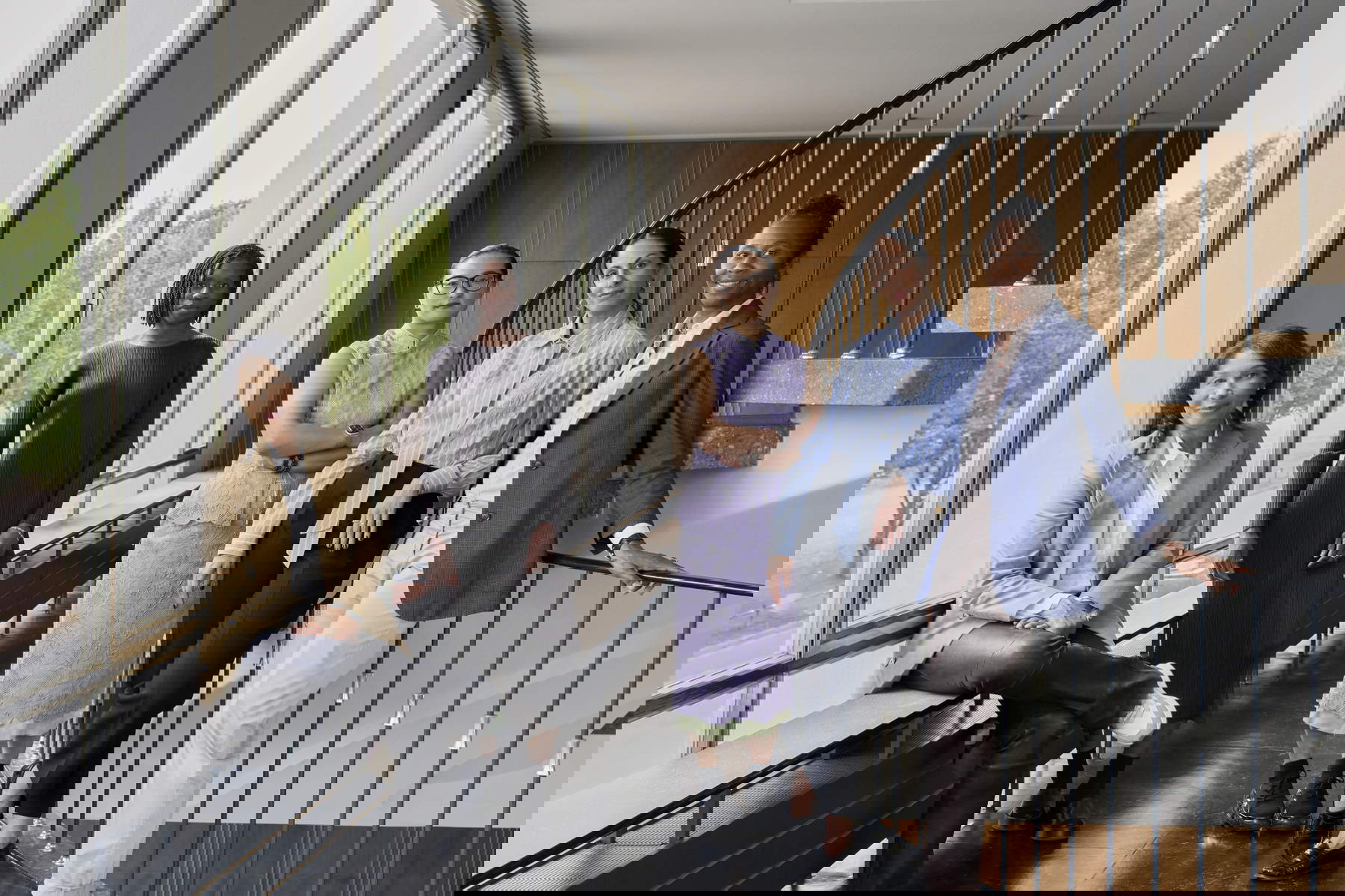
On the subject of the code of conduct introduced after the last edition to prevent incidents of antisemitism and racism, Beckwith clarified that she had not signed it because she had not been asked to do so. The newspaper then replied that she could have signed it anyway. This was the curator’s response: “The code of conduct applies to Documenta’s management, not to the artistic director or the artists. Why? Because art in Germany is free. And we must avoid at all costs the impression that politicians have any influence over Documenta’s content. We must protect the exhibition’s reputation. At the same time, there is an agreement between me, my team, and every artist participating in Documenta that we will conduct ourselves as respectfully as possible, in a spirit of nonviolence.” When asked how she intends to ensure that invited artists do not pursue potentially anti-Semitic activist agendas, Beckwith replied that she could not guarantee this and did not wish to do so, noting that artists, too, are free citizens entitled to their own opinions; she added that she does not conduct background checks on participants and that, as a curator, she evaluates the works and not the people, upholding artistic freedom as a principle that will be reflected throughout the entire event.
On the topic of provocation in art—historically central to the history of modern art—Beckwith stated that the current moment does not lend itself to this type of approach: “I do not appreciate provocative art that aims solely to elicit an emotional reaction from people. This is not the time. We have far too many politicians resorting to provocation. The question Documenta aims to ask is: what else is possible in the world? What sparks debate?” While not wishing to speak explicitly of harmony, the curator emphasized the concept of safety—understood as the possibility of being in a space where difficult conversations can be held with mutual trust, both toward one’s interlocutors and toward the artists themselves. Regarding the theme of healing, a recurring motif in many contemporary exhibitions, Beckwith expressed respect but also some skepticism, as the concept risks reducing art to a sort of service designed to make the individual feel better.
Describing her broader mission, Beckwith explained that she wanted to reflect on what is still possible in a world where the rules and structures that have hitherto governed collective life are breaking down. Among the themes at the heart of her edition are the skills needed to navigate a time of disintegration—an experience migrants know well when everything that held their lives together suddenly vanishes—and a reflection on the technological future, at a turning point where artificial intelligence is beginning to dominate every sphere: whereas humans once saw themselves as consumers of technology, today it seems that technology is consuming them, raising questions about what defines a human being and how to navigate this new era devoid of fixed points of reference. In this context, according to Beckwith, techniques developed by artists—such as improvisation, understood as the practice of moving without a predetermined script or fixed rules—become central, a model that the curator intends to place at the heart of Documenta 16, comparable to the artist’s gesture before a blank canvas or the practice of improvised jazz, where there are no predefined tempo, rhythm, or melody.
 |
| Some artists will boycott Documenta because of Germany's stance on the war in Gaza |

Warning: the translation into English of the original Italian article was created using automatic tools. We undertake to review all articles, but we do not guarantee the total absence of inaccuracies in the translation due to the program. You can find the original by clicking on the ITA button. If you find any mistake,please contact us.



























 IT
IT FR
FR DE
DE ES
ES CN
CN


