




by Mario Bigetti 08/09/2026



Categories: Works and artists / Disclaimer
A painting purchased by Angelo Cecconi in 1922 sparked a controversy with Roberto Longhi. For decades, his *St. Francis* was considered a copy, until restorations, diagnostic tests, and new studies reaffirmed its authenticity as a Caravaggio. An article by Mario Bigetti, an antiquarian who contributed to the rediscovery of the painting.

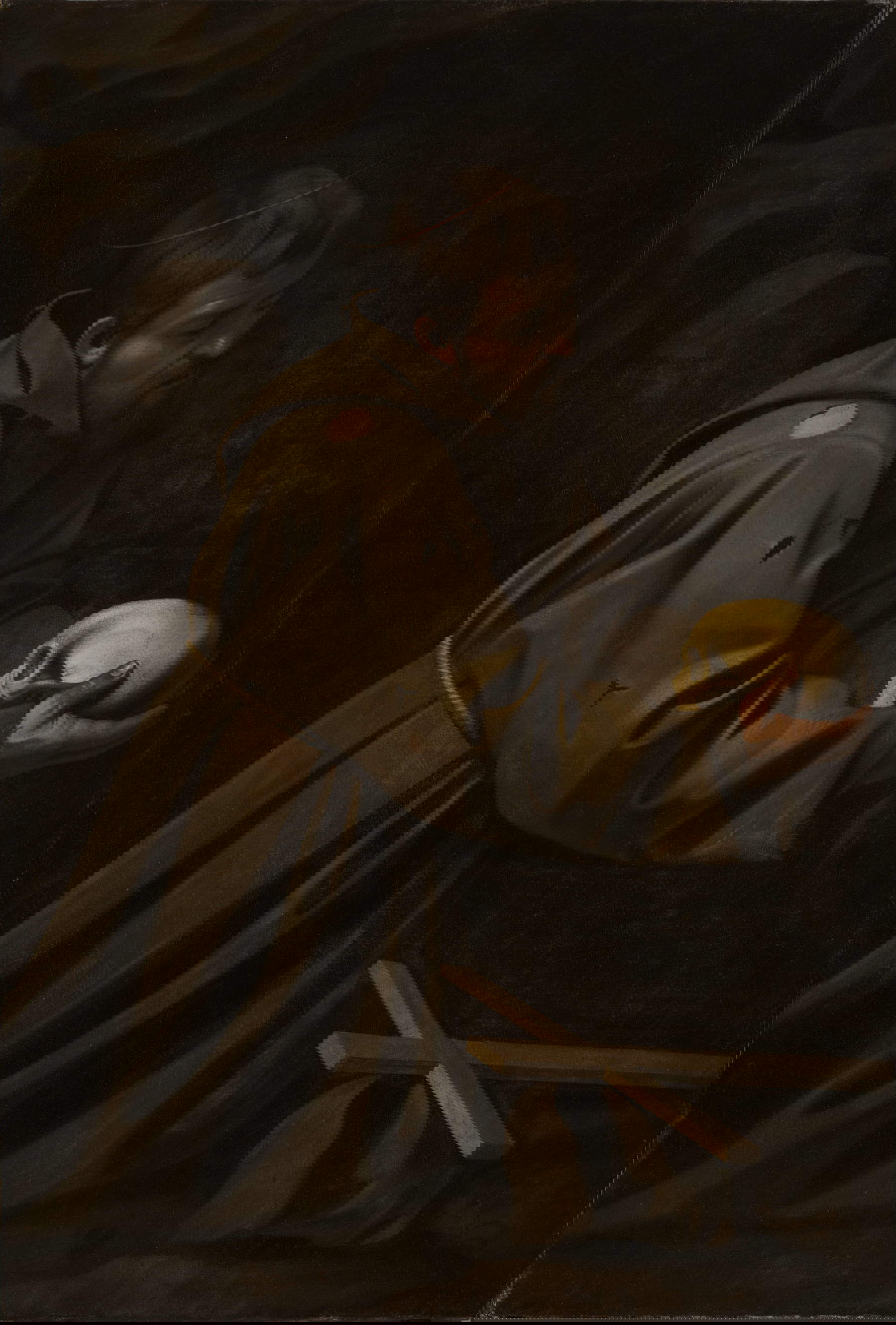
Consider the complex, tumultuous history of *St. Francis in Meditation*. It was the year 1922 when attorney Angelo Cecconi (an eccentric Tuscan collector who had made Rome his home, a man with a keen eye and himself the author of insightful essays on Rembrandt and Merisi) came across a painting on the market that was destined to cause a stir among critics. The purchase was not an isolated stroke of luck for the lawyer: behind the scenes, the antiquarian Aldo Briganti—a frequent and shrewd visitor to the halls of the only two major auction houses in Rome at the time, L’Antonina, established in 1890, and Sangiorgi, founded in 1892 by the antiquarian Giuseppe Sangiorgi. In those post-war years, the Roman aristocracy, battered by the hammer blows of forced legal disputes with the Italian tax authorities, was capitulating; the cultural heritage authorities, at times complicit in a tacit bureaucratic tolerance, authorized the fire sale of even assets that had been duly registered. Masterpieces changed hands, sometimes on the auction block, but more often in the hushed shadows of private negotiations orchestrated by dealers.
In 1922, Matteo Marangoni (1876–1958), then newly appointed as honorary inspector of the Florence Superintendency, intervened to legitimize Cecconi’s operation. Marangoni, in publishing the first pioneering modern monograph on Caravaggio in that very fateful year of 1922, emphatically highlighted a superb replica of *Saint Francis* already known to be in the Capuchin monastery on Via Veneto. The public celebration took place in the imposing setting of Palazzo Pitti, during the famous Exhibition of Italian Painting of the 17th and 18th Centuries: there, Marangoni exhibited the former Cecconi painting, attributing it unequivocally to Caravaggio.


Longhi maintained that the version held by the Capuchin friars of Santa Maria della Concezione—discovered by Giulio Cantalamessa in 1908—was the original Caravaggio; at the time, the scholar held the position of director of the Borghese Museum in Rome. In 1922, Longhi refused to accept that verdict, steadfastly defending the version at Santa Maria della Concezione, and during the exhibition at the Palazzo Pitti, he downgraded the Cecconi canvas to a work—albeit a fine one—“of good hand.” A theoretical disagreement? No: the roots of the conflict between Longhi and the lawyer ran much deeper in time. But this time, the expert opinion of Marangoni—a bitter rival of the young Longhi in the field of Caravaggio studies—and Marangoni’s presentation of the *Saint Francis in Meditation* as a Caravaggio at the 1922 Palazzo Pitti exhibition brought the young Longhi on a collision course with Cecconi. Longhi believed he had suffered his first affront in 1913, while preparing his debut essay on Mattia Preti for publication in *La Voce*: the scholar had discovered that the lawyer was secretly hoarding masterpieces by the “Cavaliere Calabrese” on the Neapolitan art market, without his knowledge. The roles between Longhi and Cecconi, as revealed by the recent 2023 documentary analysis in the journal *Storia dell’Arte*, were ambiguous: they were friends, confidants, scholars, and even business partners in lucrative art deals, but Longhi resented Cecconi’s intellectual autonomy regarding the acquisition of Mattia Preti’s works. The rift became an irreparable fissure in 1916, when the lawyer purchased, without his prior consent,the *Crowning with Thorns* now in Prato. Longhi dismissed the*Crowning with Thorns* as a late copy, and this caused the conflict between them to escalate: It was a harsh judgment, though Longhi himself later acknowledged his mistake, presenting the work at the 1951 Milan exhibition as a Caravaggio, recognizing its pictorial quality after careful restoration and including it in the Merisi catalog.
Giada Policicchio’s essay, published in the journal *Storia dell’Arte* (2023), confirms that the relationship between the two was not merely that of an intellectual and a consultant, but one in which they alternated roles (as close friends, erudite colleagues, and true “business partners,” who shared profits or jointly participated in buying and selling transactions on the antiquities market). The discovery of the Mattei inventories by Francesca Cappelletti and Laura Testa at the Antici Mattei archive in Recanati in 1989 would certainly have allowed Roberto Longhi to revise his position on the version of *St. Francis in Meditation* at Santa Maria della Concezione tracked down by Cantalamessa, which he himself had attributed to Caravaggio in 1908—a judgment that stood in stark contrast to the version of *Saint Francis* that Marangoni and Cecconi exhibited at the “Italian Painting from the Seventeenth to the Eighteenth Century” exhibition at Palazzo Pitti as a replica of the version held by the Capuchins of Santa Maria della Concezione. Had Longhi, as late as 1951, been aware of the Mattei inventory from 1802—which mentions a “St. Francis by Caravaggio, 500 scudi”—and, above all, been able to consult Marco Pupillo’s 2007 essay “Caravaggio’s St. Francises in Meditation,” he would have downgraded the version owned by the friars of the church of Santa Maria della Concezione—donated by Francesco de Rustici before his death in 1617 to the friars of the Monte Cavallo convent as an ex-voto (in a note found on the back of the canvas, glued to the wooden stretcher, Francesco de Rustici donates this painting “not to be given to anyone”), and he would not have published it in the catalog of the 1951 Milan exhibition as a Caravaggio.
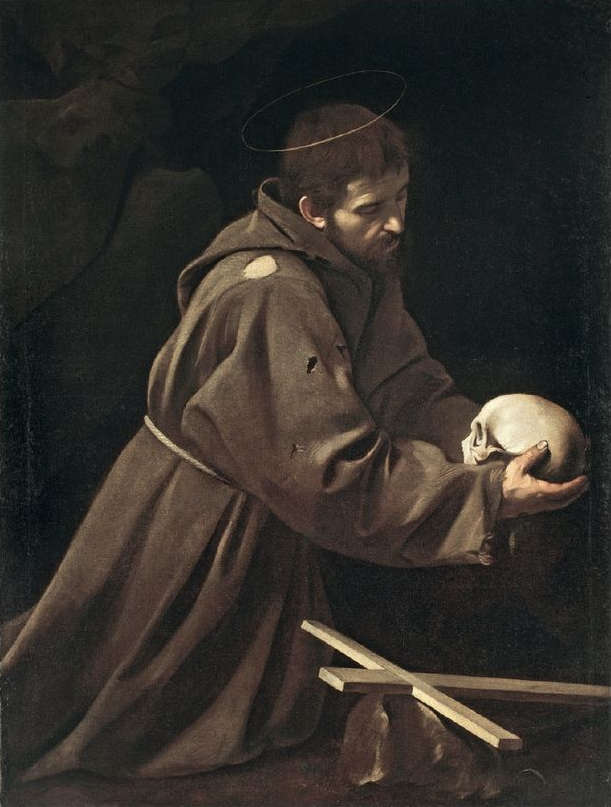
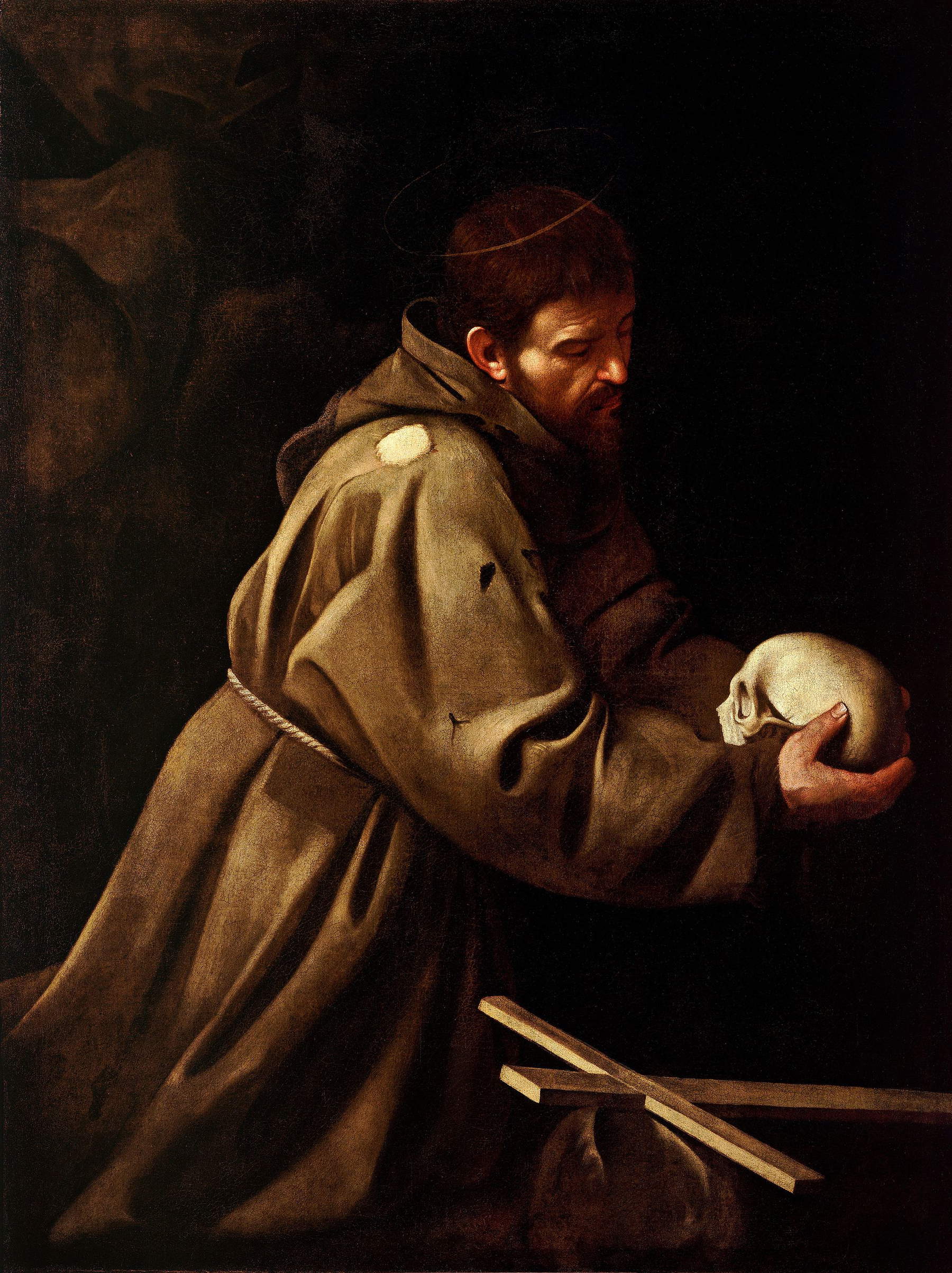
But time is kind to painting. In 2006, diagnostic analyses and restorations conducted by Clovis Whitfield and presented to Sir Denis Mahon prior to that year’s exhibition in Düsseldorf on Caravaggio and his copies—where the Cecconi version was confirmed by the commission as a Caravaggio—overturned long-held academic assumptions. The former Cecconi canvas, analyzed down to its innermost fibers, revealed structural pentimenti significant enough to lead Mahon and Whitfield to declare it the true, absolute prototype from which both the Capuchin and Carpineto versions derived. This positive assessment has been endorsed by a great many Caravaggio scholars, from Mina Gregori to Claudio Strinati, who have rightly traced the stylistic thread back to the influence of Orazio Gentileschi. It was Gentileschi himself, in his famous court testimony of 1603, who recalled how, in that year, he had lent Merisi a Capuchin friar’s habit so that Merisi could use him as a live model in his studio. That rough garment shapes the light in the former Cecconi painting. Claudio Strinati identified the Cecconi Saint Francis as the finest of the known versions to be included in an exhibition on vanitas, from Pompeii to Hirst at the Musée Maillol. Professor Strinati included it in the catalog on the Saint Francis of the friars of Santa Maria della Concezione as a masterful version attributed to Caravaggio, closely linked to Orazio Gentileschi. But above all, the quality and the analyses of the Cecconi version of Saint Francis have convinced modern scholars (from Sergio Rossi to Emilio Negro, from Pierluigi Carofano to Vittorio Sgarbi and Fabio Scaletti) to include the painting as an authentic masterpiece in their monographs and in the catalogs of major international exhibitions curated by Whitfield and Pierluigi Carofano. The Mattei inventory of 1802, moreover, speaks for itself: it valued a *St. Francis* by Caravaggio at the astronomical sum of 500 scudi, confirming that nineteenth-century appraisers did not undervalue that name at all, but recognized its economic and artistic primacy. Contrary to the claims of some scholars (such as Maurizio Marini), who argued that Caravaggio’s paintings were undervalued in the nineteenth century compared to those of the Dutch: in the same 1802 inventory we find “The Arrest of Our Lord with its gilded frame by Gherardo delle Notti, 80 scudi,” the very same painting by Paolo Mattei that would end up in Dublin in 1802. And, in the same inventory, Pietro da Cortona, valued at 500 scudi, and Valentin de Boulogne, 600 scudi.
Warning: the translation into English of the original Italian article was created using automatic tools. We undertake to review all articles, but we do not guarantee the total absence of inaccuracies in the translation due to the program. You can find the original by clicking on the ITA button. If you find any mistake,please contact us.