




Disturbing. Everything is extremely disturbing: that is the adjective I would use to describe George Grosz’s*Solar Eclipse *. Despite its title, the painting has nothing to do with the extraordinary and extremely rare astronomical phenomenon (the last total solar eclipse visible in Italy occurred in 1961, while the most significant partial solar eclipses in Italy in recent times date back to 1999 and 2005) that occurs when the Sun, the Moon, and the Earth are (almost) perfectly aligned, so that the Sun’s disk is partially or completely covered—depending on whether it is a partial or total solar eclipse—by the Moon’s shadow. Why, then, did Grosz decide to give his work a title closely linked to astronomy but which, in reality, has nothing to do with astronomy? And why is the Sun’s disk in the painting completely obscured not by the Moon, but by the U.S. dollar? And the questions could go on: why is there a donkey with blinders on the table in the center of the scene? And the bloodstained sword? And why do all the men around the table—with the exception of the general with the ruddy face and the man whispering something into the general’s ear while holding weapons under his arm—appear headless?
What seems clear at first glance is that the painting’s theme is not astronomical, but political: the general, the weapons, the macabre meeting-like setting, and the dollar sign on the Sun are the main elements that lead the mind toward this interpretation, but to understand its true meaning, some reference to the historical context is necessary.
George Grosz ( Berlin, 1893 – 1959) created his *Solar Eclipse* in 1926, during the Weimar Republic, which was established in Germany in the aftermath of World War I and lasted, de facto, until 1933, the year Adolf Hitler was appointed chancellor; its Constitution, drafted in the city of Weimar by the German National Constituent Assembly, sought to establish a liberal democracy in postwar, defeated Germany. A key figure in Germany’s relative economic recovery—considered the golden age of the Weimar Republic—was Gustav Stresemann, foreign minister from 1923 to 1929, who, in order to restore the nation’s finances after the hyperinflation crisis, decided to open a dialogue with foreign powers, especially the United States, from which, in fact, most of the funding came to restart German industry and pay off the debts incurred during World War I, thereby increasing the Republic of Germany’s dependence on the United States. The President of the Weimar Republic, on the other hand, was Paul von Hindenburg, who served from 1925 to 1933; a field marshal during World War I and the Republic’s second president; it was Hindenburg himself who, in 1933, appointed Hitler as chancellor, effectively marking the beginning of the rise of Nazism. It was against this backdrop of Germany’s apparent economic recovery —in which the United States played a fundamental role (though the crisis of 1929 marked the beginning of the decline and subsequent collapse of the Weimar Republic) and of governmental and social decay that Grosz painted one of the most famous works of political criticism of that era. Through his deeply committed and satirical art, Grosz denounced those in power and their leading representatives—and above all, the economic interests that governed their actions. His painting belongs to the artistic movement that spread throughout Germany in the 1920s, known as Neue Sachlichkeit (New Objectivity), which was based on a return to a more objective and raw depiction of reality and the world compared to the earlier Expressionist art that had dominated the art scene before World War I. In favor of an art that sought to objectively depict, without sentimentality, post-war German society—its corruption and moral decay, the relationship between those in power and money, and the economic hardship of the population— the artist therefore abandoned the Dadaist movement—of which he had been one of the leading figures in 1920s Berlin—in favor of a style of painting that employed well-known political figures, unsettling situations and settings, and satire as tools for criticism and denunciation. As can be seen in*Solar Eclipse*, now housed at theHeckscher Museum of Art in Huntington, New York.
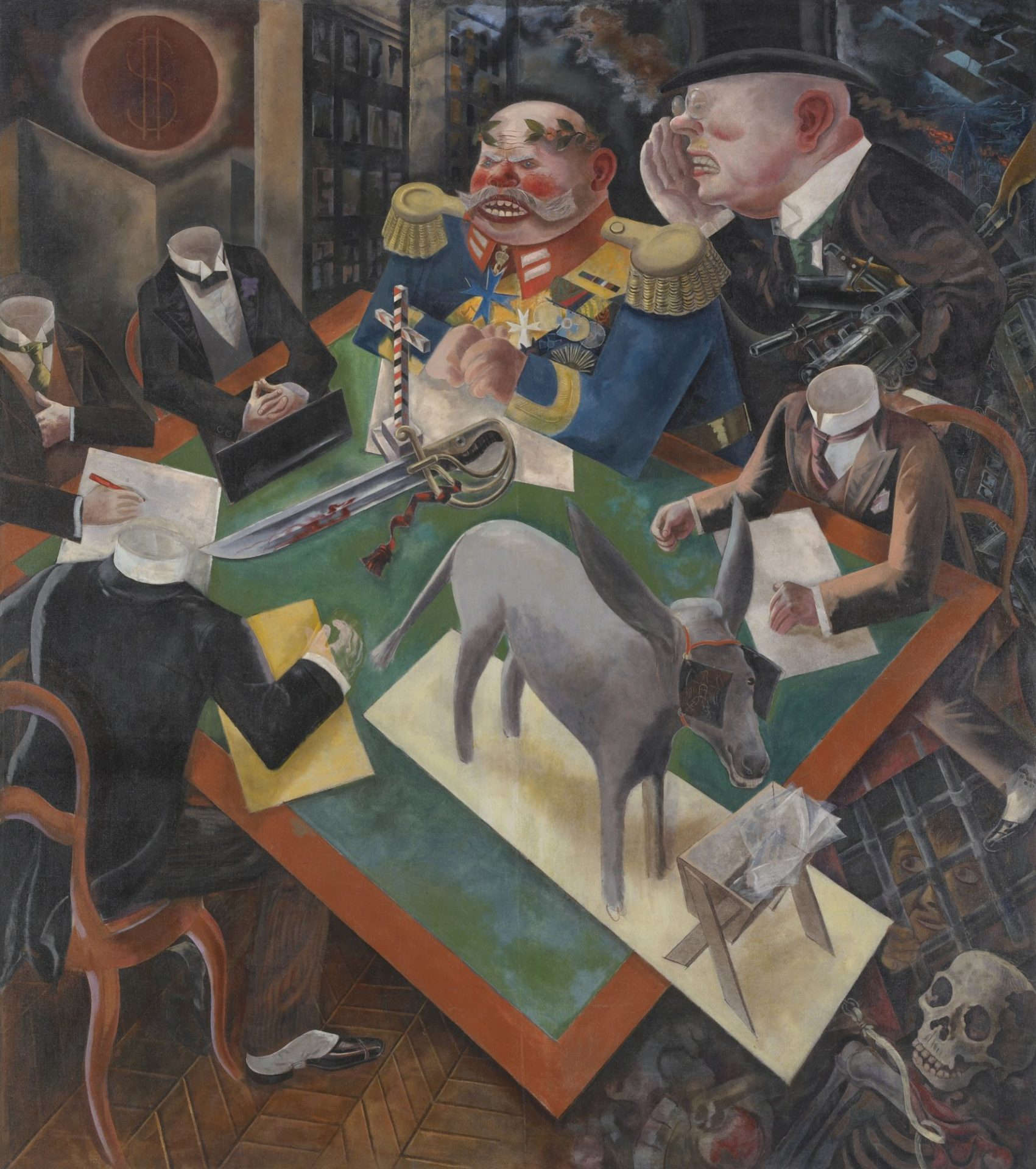
Taking center stage is none other than the aforementioned Paul von Hindenburg, depicted in military uniform with numerous medals pinned to his chest; his red, ruddy face displays a set of large, mastiff-like teeth topped by a pair of gray, upturned mustaches that extend outward from his massive face, and his bald head is crowned with a sprig of laurel. He is seated at a table resembling a card table alongside four men in elegant suits, but deliberately depicted without heads, signifying their lack of judgment and thus their subordination to dominant interests. They represent the German political and financial class, concerned above all with defending their own privileges. A man wearing a top hat and carrying small weapons and a miniature train under his arm approaches Hindenburg and whispers in his ear: he is likely an industrialist, whose gesture suggests the influence exerted by big business on institutions, underscoring the close relationship between industry, economic power, and political and military authority. On the table, a bloodstained sword and a cross evoke the toll of the victims and the consequences of war, which, however, seem to be ignored by the protagonists gathered around the table—just as the warplanes visible in the sky and the city burning, engulfed in flames, are ignored.A somber and unsettling setting that directly evokes World War I. Particularly curious is the presence of a donkey on the table, wearing blinders decorated with the German eagle and facing some newspapers, as if they were its feed. The animal is said to represent the German people, unable to see what is really happening around them. The blinders suggest a limited view of reality, while the newspapers allude to the passive acceptance of information disseminated by public opinion and the media. The figure thus takes on a satirical meaning: the population suffers the consequences of decisions made by those in power without fully understanding the mechanisms behind them.
The scene is enriched by an additional dramatic element: in the lower right corner, a skeleton and a young man appear, confined behind prison bars, upon which one of the headless men rests his feet. These two elements can be interpreted as symbols of the new German generations (the young man), forced to live in a reality determined by the choices of the ruling class, and of the fallen of World War I (the skeleton), evoking a disturbing link between the past and the future: the death of a generation risks becoming the prelude to new suffering. The entire composition thus takes on the character of a political and social indictment, in which power appears concentrated in the hands of a few, while the population—and especially the young—are trapped by the consequences of those decisions. The satire, the absurdity of the situations, and the contrast between the elegance of the clothing and the drama of the scene make the artist’s critique of post-World War I Germany all the more incisive. And what of the sun’s disk obscured by the dollar sign? It is a solar eclipse caused by U.S. funding, on which Weimar Republic Germany—represented as seated around the table—was increasingly dependent.
From Germany, the painting’s story continued in the United States, where George Grosz emigrated in 1933, shortly before Hitler’s rise to power. The artist took the work with him, even when he moved to a cottage in Huntington in 1947, where he lived until 1959, the year he returned to Berlin; however, after his death that same year, all traces of the painting were lost. It was rediscovered several years later on Long Island, hidden in a garage; it was immediately exhibited at the Harbor Gallery in Cold Spring Harbor. In 1968,Grosz’s *Solar Eclipse* was purchased for $15,000 by the Heckscher Museum of Art, where it remains on view today, thanks to a major fundraising campaign led by the museum’s first professional director: hundreds of local residents, students, and even then-Governor Nelson A. Rockefeller participated. This heartfelt initiative made it possible to acquire an important work of New Objectivity, one of the masterpieces of 20th-century political art. The painting is now on display in the very country that Grosz had depicted in the dollar sign.
A hundred years after its creation ,*The Eclipse of the Sun* seems to have retained a surprising ability to speak to the present, as the mechanisms depicted by Grosz are not confined to 1926. The relationship between political and economic power, the influence of financial interests on public decisions, propaganda, the manipulation of information, and a population often relegated to the role of spectator are issues that continue to challenge contemporary democracies. Today, instead of newspapers devoured by a donkey, there are screens and an incessant flow of information in which distinguishing truth from falsehood becomes increasingly difficult. And if in the 1926 painting it is the dollar that obscures the sun, a century later, what is obscuring our ability to see?


The author of this article: Ilaria Baratta
Giornalista, è co-fondatrice di Finestre sull'Arte con Federico Giannini. È nata a Carrara nel 1987 e si è laureata a Pisa. È responsabile della redazione di Finestre sull'Arte.
Warning: the translation into English of the original Italian article was created using automatic tools. We undertake to review all articles, but we do not guarantee the total absence of inaccuracies in the translation due to the program. You can find the original by clicking on the ITA button. If you find any mistake,please contact us.























 IT
IT FR
FR DE
DE ES
ES CN
CN


