



by
Federico Giannini  @federicogiannini1
17/02/2016


Categories: Works and artists / Disclaimer
Fourth installment of our history of art criticism: we discuss the Vienna School and some of its most important exponents (Eitelberger, Wickhoff, Riegl and Dvořák)
In the last episode of our history of art criticism, we had talked about Julius von Schlosser (1866 - 1938) and introduced the Vienna School, the important group of scholars, of which Schlosser was one of the youngest exponents, who contributed to the radical renewal of the discipline of art history study. And since the contribution of the Vienna School was fundamental, it is only fitting that we devote an appointment in this series of articles of ours precisely to this group of art historians, whose “founder” (we put the word in quotation marks because, as we had said in the article on Schlosser, the group actually had no official character) was recognized by Schlosser in the figure of Rudolf Eitelberger von Edelberg (1817 - 1885).


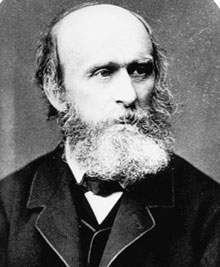 |
| Rudolf Eitelberger von Edelberg |


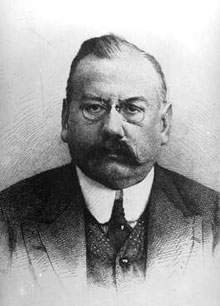 |
| Franz Wickhoff |


Thus considering art history to be a scientific discipline, Wickhoff began to reject certain patterns that were taken for granted, causing certain moments in art history to be read from a more objective perspective: for example, Wickhoff attributed considerable originality toRoman art and believed that Roman art had been enriched with new elements compared to Greek art. Wickhoff, in essence, went against the assumption of Johann Joachim Winckelmann (1717 - 1768), who considered Roman art to be a kind of imitation of Greek art-a prejudice that had conditioned historiography for more than a century. It has even come to be concluded that the history of Roman art began in 1895, the year in which Wickhoff published one of his major works, Die Wiener Genesis (“The Vienna Genesis”), in which the scholar, analyzing the illuminated codex known, precisely, as the “Vienna Genesis” (which Wickhoff considered to be from the fourth century A.D., but which has now been moved two centuries forward), proposed an original vision of Roman art: To the latter, the scholar credited the introduction of original motifs, which he identified as the elaboration of a natural space, the realism that connoted the portraits, and the continuity of the narrative (as was the case, for example, in the reliefs of Trajan’s Column). It is worth pointing out, however, how Wickhoff in no way considered the contribution ofHellenistic art to which, according to more recent views, the innovations that Wickhoff ascribed to Roman art should instead be attributed. Although Wickhoff’s assumptions about Roman art are considered outdated today, it is thanks to him that Roman art became the subject of in-depth study.
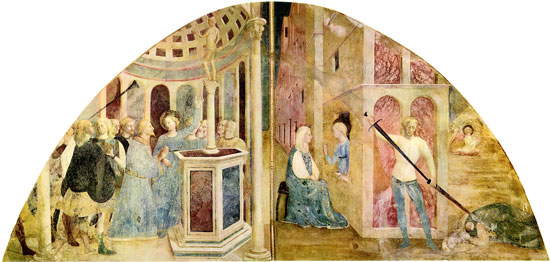 |
| Masolino, Scenes from the Life of Catherine of Alexandria: the saint refuses to worship idols, St. Catherine meets in prison with Empress Faustina, Faustina is beheaded (c. 1428; Rome, San Clemente) |
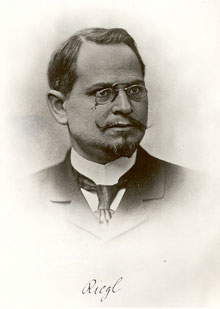 |
| Alois Riegl |
By studying in more detail the reasons why ornamental motifs experience evolutions over time, Riegl came to introduce the fundamental concept of Kunstwollen (literally, “will of art”), first enunciated systematically in the introduction to the 1901 work Die spätrömische Kunstindustrie nach den Funden in Ã?sterreich (“The Late Roman Art Industry According to Findings in Austria”). With this term, Riegl intended to explain the evolutions of style on the basis of the creative power that would connote each individual artistic civilization (and not on the basis of a simple development of artistic technique): thanks to Kunstwollen, each civilization produces its own artistic manifestations, discernible in any artistic product. Among other things, through the assumptions of this theory, Riegl came to establish that all art forms should have equal dignity since they were all products of the same Kunstwollen, and this insight led him to attribute to the so-called “minor” arts (such as goldsmithing, miniature and medallistics) the same importance that was accorded to the arts considered “major” (painting, sculpture and architecture): another prejudice was thus overcome. The limitation of Riegl’s thinking consisted in the fact that, for him, Kunstwollen (which we could, moreover, also translate as"taste," although the concept has undergone evolutions throughout the history of art criticism) was the main factor determining the creation of a work of art, and this led the scholar to underestimate the historical and social basis for explaining why a certain artistic expression was made: nonetheless, Riegl was credited with initiating the reappraisal of artistic civilizations (such as Late Antiquity) that had hitherto enjoyed little consideration.
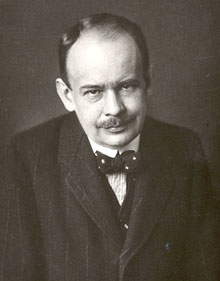 |
| Max DvoÅ?ák |
To give an example, DvoÅ?ák, in his seminal 1918 work Idealismus und Naturalismus in der gotischen Skulptur und Malerei (“Idealism and Naturalism in Gothic Sculpture and Painting”) believed thatRomanesque art could not be considered as an evolution of the classical tradition, but as an expression of a period in which new ideas and concepts were being developed. Although his method attracted criticism (there were those who said that DvoÅ?ák’s theories applied well to the content of works of art, but not to their form), DvoÅ?ák is credited with reevaluating entire periods of art history (such as Mannerism) and figures of artists who had hitherto been neglected by historiographies and who are now considered central to art history: the example is that of El Greco, whose rediscovery is due precisely to the work of Max DvoÅ?ák. The scholar also went so far as to establish in Tintoretto’s art the beginnings of modern art: in particular, in the last Tintoretto (in that, for example, of theLast Supper for San Giorgio Maggiore), DvoÅ?ák identified a visionariness that would have had more to do with the artist’s intuition and sensibility than with the conventional patterns of the style of his era. A visionariness that constituted an irremediable reason for a break with previous art and in fact sanctioned the birth of an artistic experience that was the result of a new idea, one that would therefore not have been possible previously.
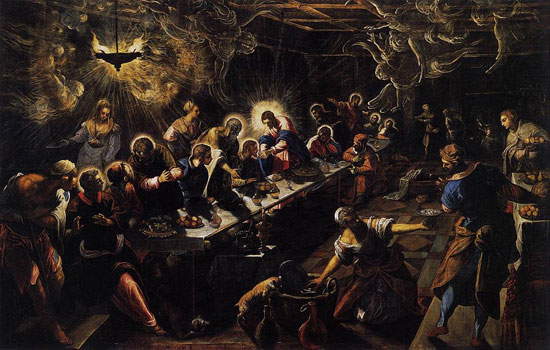 |
| Tintoretto, Last Supper (1592-1594; oil on canvas, 365 x 568 cm; Venice, San Giorgio Maggiore) |
Reference bibliography
- Diana Reynolds-Cordileone, Alois Riegl in Vienna 18751905: An Institutional Biography, Ashgate Publishing, 2013
- Matthew Rampley, The Vienna School of Art History: Empire and the Politics of Scholarship, 1847-1918, Pennsylvania State University Press, 2013
- Michael Gubser, Time’s Visible Surface: Alois Riegl and the Discourse on History and Temporality in Fin-de-Siècle Vienna, Wayne State University Press, 2006
- Ricardo de Mambro Santos, Viennese Viaticum: the critical historiography of Julius von Schlosser and the philosophical methodology of Benedetto Croce, Apeiron, 1998
- Eugene Kleinbauer, Modern Perspectives in Western Art History: An Anthology of 20th-century Writings on the Visual Arts , University of Toronto Press, 1989
- Richard Brilliant, Roman art from the Republic to Constantine, Phaidon Press, 1974
- Max DvoÅ?ák, Kunstgeschichte als Geistesgeschichte: Studien zur abendländischen Kunstentwicklung, Mäander Kunstverlag, 1973
- Alois Riegl, Die spätrömische Kunstindustrie, Druck und Verlag der Osterreichischen Staatsdruckerei, 1927
- Erwin Panofsky, Ã?ber das Verhältnis der Kunstgeschichte zur Kunsttheorie in Zeitschrift für Ã?sthetik und allgemeine Kunstwissenschaft, 18 (1925)
- Max DvoÅ?ák, Idealismus und Naturalismus in der gotischen Skulptur und Malerei, Oldenbourg, 1918
- Alois Riegl, Stilfragen: Grundlegungen zu einer Geschichte der Ornamentik, Verlag von Georg Siemens, 1893
- Franz Wickhoff, Die Wiener Genesis in Jahrbuch der kunsthistorischen Sammlungen des Allerhöchsten Kaiserhauses (15/16), 1895
- Franz Wickhoff, Die Fresken der Katherinenkapelle in S. Clemente zu Rom in Zeitschrift für bildende Künst, 25 (1889)
Warning: the translation into English of the original Italian article was created using automatic tools. We undertake to review all articles, but we do not guarantee the total absence of inaccuracies in the translation due to the program. You can find the original by clicking on the ITA button. If you find any mistake,please contact us.