



by Redazione 11/11/2026


Categories: Ancient art / Disclaimer
On November 28, the Hôtel des Ventes de Monte-Carlo will auction a rediscovered work by Guercino: the preparatory study for the famous painting of Erminia and Tancredi from the Doria Pamphilj Gallery, painted around 1618–1620. It comes from the collection of art historians Mellini and Rudolph. Estimate: 800,000–1.2 million euros.


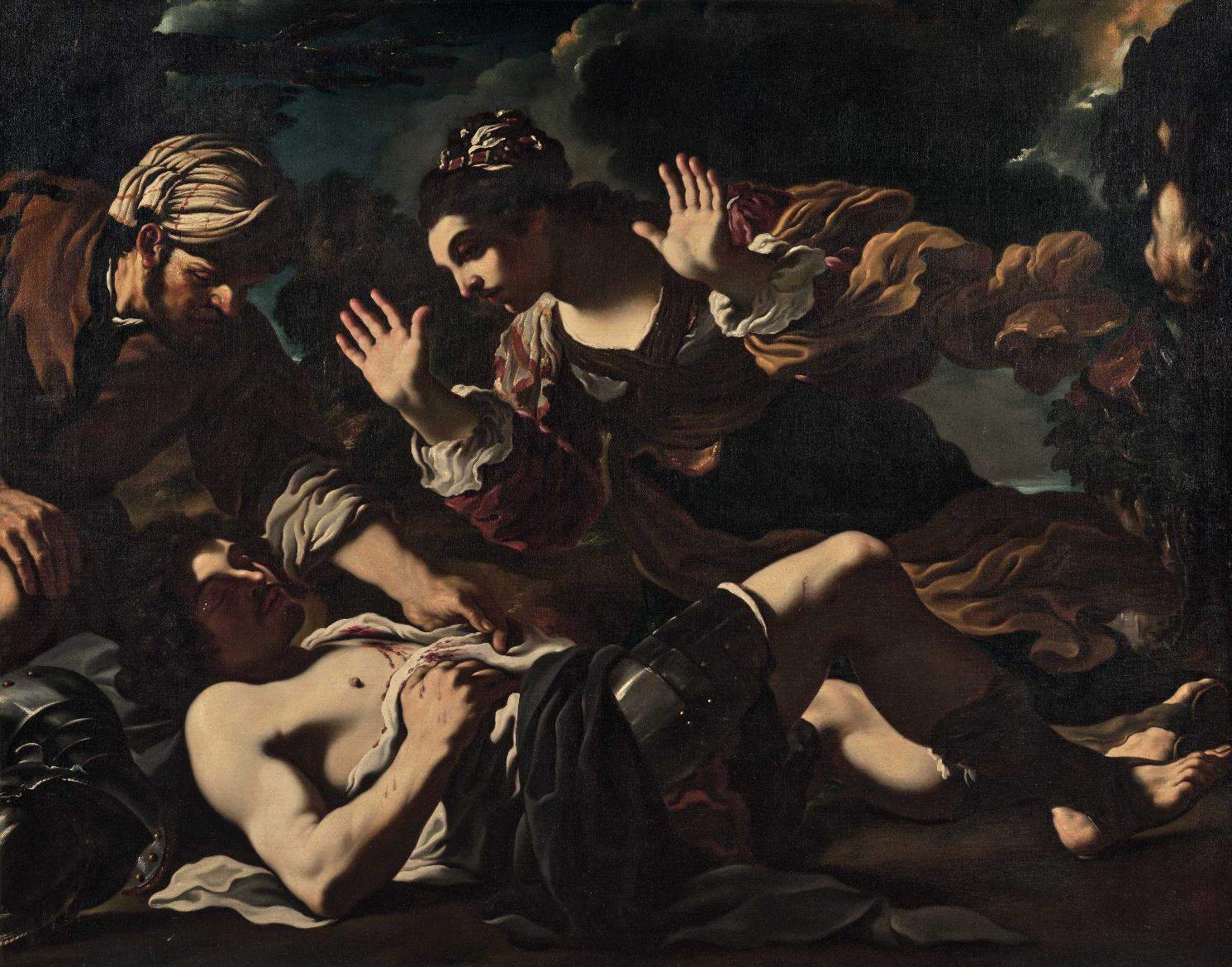
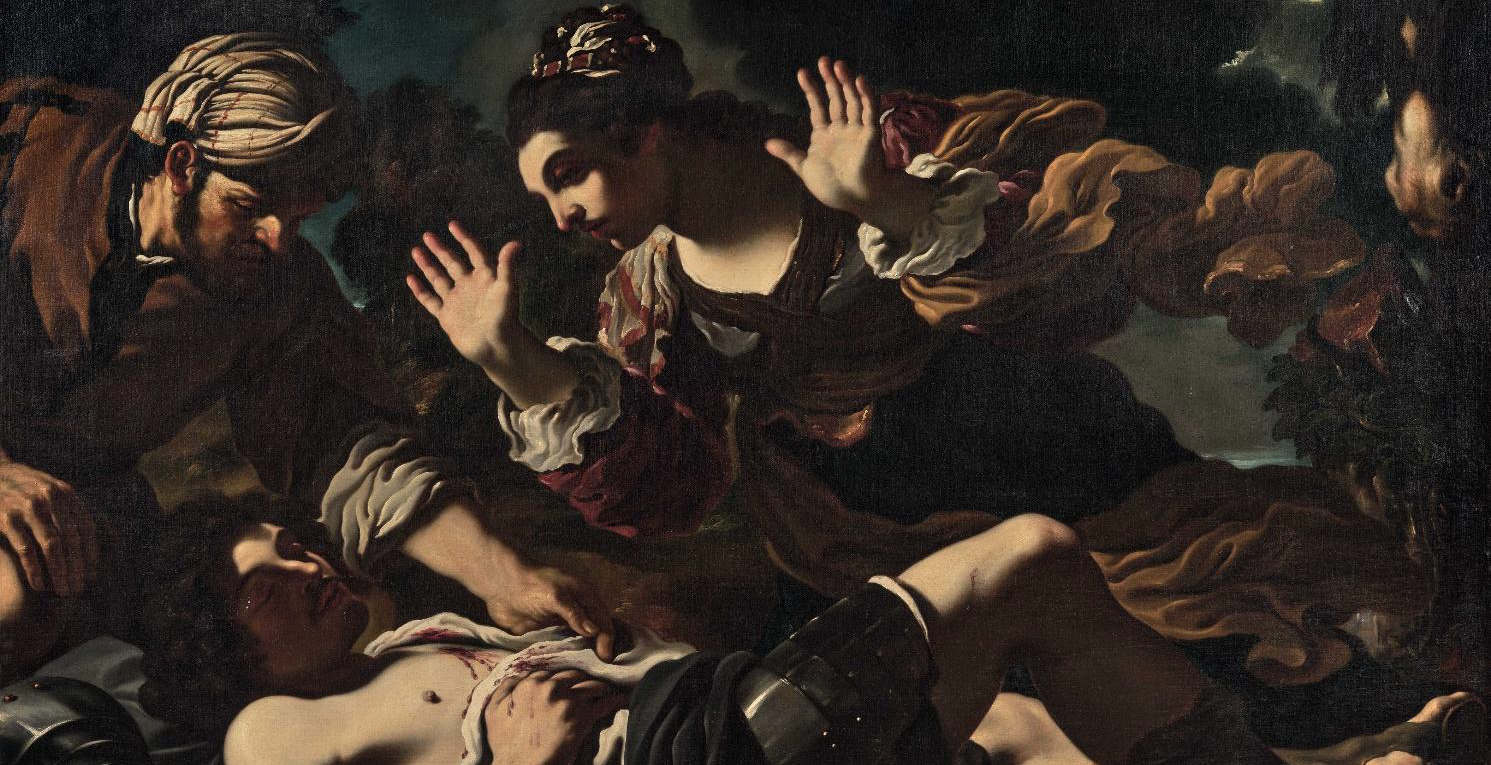
One of the most important works from Guercino’s early career ( Giovanni Francesco Barbieri; Cento, 1591 – Bologna, 1666): it is *Erminia Finding the Wounded Tancredi*, which, according to scholar Nicholas Turner—one of the leading experts on Guercino—represents the earliest conception of one of the most famous compositions from the early phase of the Cento-born painter’s career (the final version is housed at the Doria Pamphilj Gallery in Rome). The painting will be auctioned bythe Hôtel des Ventes de Monte-Carlo on Saturday, November 28, 2026, at 2:30 p.m., as part of a sale dedicated to furniture, objets d’art, and antique paintings, with an estimate ranging from 800,000 to 1,200,000 euros. It measures 148.5 by 188 centimeters, nearly the same size as the Roman painting, which is three centimeters smaller in both height and width. It is not a quick sketch but an advanced draft, in which Guercino had already decided on the composition, the poses of the figures, and the distribution of light. The auction catalog dates its creation to around 1618–1620.

The subject is taken from Torquato Tasso’s *Jerusalem Delivered*, published in 1581, in which the epic tale of the First Crusade is interwoven with the romantic adventures of young Christian and Saracen heroes. In seventeenth-century Italy, the poem served as an inexhaustible source of inspiration for painters, as it combined the grandeur of history with the intimacy of a romantic tale. Guercino chose one of the most dramatic episodes, from Canto XIX, stanzas 103–110: the Saracen princess Erminia, secretly in love with the Christian knight Tancredi, finds his lifeless body after his duel with Argante. Tasso describes her rush: merely hearing Tancredi’s name is enough to send her dashing forward, almost beside herself, and instead of dismounting, she throws herself from the saddle. On the left, wearing a turban, the squire Vafrino points out the hero’s wounds to her. In the poem, the scene continues with one of the story’s most famous moments: Erminia cuts her hair to bandage Tancredi’s wounds. This is the moment that artists such as Pier Francesco Mola and Nicolas Poussin, among others, would have chosen to depict. Guercino, however, paints the preceding moment—that of the discovery. The horse still present, Tancredi’s abandoned body, and Erminia’s outstretched hand encapsulate the rush, the fear, and the compassion in a single image.


A comparison of the two versions reveals how the painting came to be: Turner superimposed an image of the Doria canvas onto that of the painting up for sale, which comes from the Mellini collection. The figures match in size, suggesting that one was derived from the other by tracing. The auction catalog implies that the canvas in question predates the Roman one and served as a preparatory study for its execution. The differences are few but significant: Erminia’s left hand is slightly shifted, Tancredi’s legs are positioned differently, and the horse’s head and ears, in the upper right, have been redrawn. Elsewhere, minor revisions to the outlines are visible. According to Turner, it is precisely these retouches that are revealing, because they recur constantly in Guercino’s drawings—not only in the period preceding his stay in Rome but throughout his entire career.

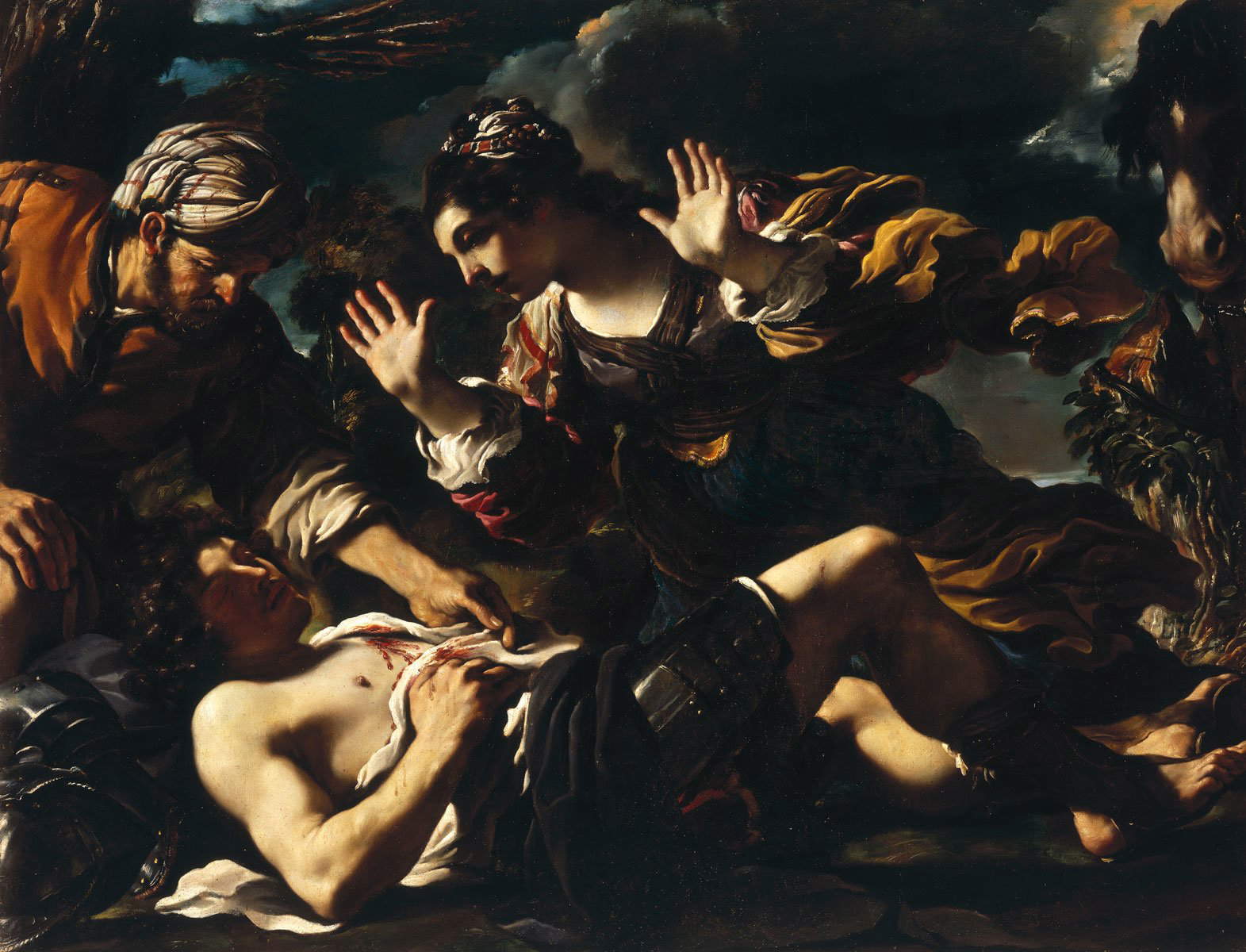
Even the way the canvas is painted betrays its preparatory function: the faces of Tancredi and Erminia are rendered more roughly, some shadows do not yet have the luminous highlights that, in the Doria Pamphilj canvas, enliven the princess’s neck and profile, and the streaks of light in the sky—where they touch the figures’ outlines—are barely hinted at, for example behind Erminia’s left forearm. According to Turner, Guercino must have considered it unnecessary to refine these details in a full-scale sketch, since the final touches were applied only to the definitive version. At this stage, what mattered was the composition of the forms and the essential lighting. The scholar thus also explains the occasional use of less expensive pigments. In short, the painting shows the artist searching for a solution before he has found it. “In my opinion, all the visual elements point to Guercino’s authorship of the Mellini painting,” Turner concludes in a letter published in the auction catalog.
This way of working characterized Barbieri’s early years. To prepare for important commissions, the painter often created what have been called “bozzetoni”: large-format preliminary versions on which he tested the composition before finalizing it. According to Sir Denis Mahon, the term “bozzetoni” was coined by him: the English scholar had long considered the Saint Jerome Sealing a Letter, from the National Gallery of Palazzo Barberini and dated around 1618, to be a copy. He became convinced it was an autograph when an X-ray revealed significant revisions in the drapery. Several of these pairs of paintings have survived to the present day: *Saint Sebastian Rescued by Two Angels* exists in one version in a private collection and another at the Fitzwilliam Museum in Cambridge. The *Vision of Saint Jerome* is in a private collection and at the Louvre. Turner has identified about fifteen similar cases, which he calls “trial versions,” and included the Monte Carlo canvas in the revised edition of his catalog raisonné, *The Paintings of Guercino*, published in 2017 by Ugo Bozzi Editore, under number 69.I. He wrote about it again in 2018 in an essay on *About Art Online* dedicated to replicas, copies, duplicates, and large-scale studies by Caravaggio and Guercino.
According to the scholar, before moving to Rome, Guercino often painted one or two versions of the same composition. After so much preparatory work, producing only one version might have seemed like a waste to him. There must also have been a local market for these rough drafts, which the painter, understandably, did not want to sell to his most important patrons. After settling in Cento, Guercino ordered canvas from a supplier in Bologna, and if he was in the habit of painting two versions of a subject, he may have requested enough canvas for multiple paintings.
The history of the final version—the one preserved in Rome—is well documented. Carlo Cesare Malvasia, a biographer of Bolognese painters, recounts in his 1678 work *Felsina pittrice* that it was painted for Marcello Provenzale, a famous mosaicist born in Cento like Guercino and a close associate of Pope Paul V Borghese. The commission dates back to 1618. Provenzale later gave the canvas to Cardinal Stefano Pignatelli. Upon the cardinal’s death in 1623, the painting passed to Donna Olimpia Maidalchini Pamphilj, who kept it in her palace in San Martino al Cimino. In 1657, it entered the Pamphilj family’s collection, where it remains to this day.
The painting now up for sale, however, has a more recent and private history. It was purchased in a castle in the 1960s by Gian Lorenzo Mellini and Stella Rudolph, two art historians for whom collecting was an extension of their research. In 1982, they co-founded the journal *Labyrinthos*, dedicated to the history of the visual arts. Rudolph studied 17th- and 18th-century Roman painting—particularly Carlo Maratti—and the history of collecting. Mellini wrote an essay on Guercino, published in *Labyrinthos* in 1987 under the title *Guercino d’après lui-même*, exploring the painter’s relationship with his own inventions. He kept the canvas in his Roman studio—a sign, as the catalog notes, of his affection for that rediscovery. In the text written for the auction, Mario Guderzo, former director of the Civic Museums of Bassano del Grappa and the Antonio Canova Gypsotheca Museum in Possagno, describes the Mellini-Rudolph collection as “the reflection of a shared cultural project.” The catalog also notes that the painting was granted, on an exceptional basis, authorization to leave Italy by the cultural heritage authorities, precisely because the second version is located in Rome.
The painting should be viewed within the context of Guercino’s career on the eve of his success in Rome. Born in 1591 in Cento, between Bologna and Ferrara, Barbieri was largely self-taught. He studied the altarpieces left in his hometown by Ludovico Carracci, Carlo Bononi, and Scarsellino, and drew from them the dynamic compositions, a very fluid style of painting, and a Venetian-inspired use of light. His trip to Venice in 1618, where he came into contact with Titian and Jacopo Bassano, reinforced this artistic sensibility. After 1609, he settled in Bologna, within the circle of Ludovico Carracci and the pupils of Annibale. For nearly ten years, he painted interior scenes for collectors and his first altarpieces, and his fame soon spread beyond the borders of Emilia. In 1621, the election to the papal throne of the Bolognese Alessandro Ludovisi—Pope Gregory XV—brought him to Rome. There he established himself with large religious and mythological canvases and, above all, with the fresco of *Aurora* in the Casino Ludovisi. According to the catalog,*Erminia* was created just as this recognition was taking hold. It retains the freshness and poetic sensibility of his Emilian years, but also reveals his ambition to attract the attention of Roman patrons connected to the papal court—to which the commissioner of the final version belonged.
With its strong chiaroscuro contrasts, the painting is fully representative of Guercino’s early style. The figures emerge from the twilight, touched by a moonlight that unites the characters with the nocturnal landscape. That light makes the scene more dramatic while also lending it a poetic melancholy, faithful to the spirit of Tasso. The contrasts still echo Caravaggism, though this influence begins to fade in favor of a broader sensibility, already distinctly Baroque. Placed alongside the Doria Pamphilj painting, the Monte Carlo *Erminia* thus becomes a rare artifact: a transitional work that helps us understand how one of the most famous paintings of Baroque Rome came to be.
*Erminia Finds the Wounded Tancredi* will be on public display at the Hôtel des Ventes de Monte-Carlo, located at 10–12 Quai Antoine Ier in Monaco, from November 24 to 27 (from 10 a.m. to 1 p.m. and from 2 p.m. to 6 p.m.) and on the morning of the auction. The auction will take place on Saturday, November 28, at 2:30 p.m. and can also be followed online on the Invaluable, Drouot, and Interenchères platforms.
 |
| An Important Early Work by Guercino Has Been Rediscovered: "Erminia and Tancredi" to Be Auctioned in Monte Carlo |
Warning: the translation into English of the original Italian article was created using automatic tools. We undertake to review all articles, but we do not guarantee the total absence of inaccuracies in the translation due to the program. You can find the original by clicking on the ITA button. If you find any mistake,please contact us.