




An unpublished early masterpiece by Luca Giordano ( Naples, 1634–1705), *TheCalling of Saints Peter and Andrew to the Apostolate*, a large canvas measuring 192 by 252 centimeters by the Neapolitan painter, will be on public view for the first time from October 24 to November 29, 2026, at the MarteS Museo d’Arte Sorlini in Calvagese della Riviera ( Brescia), near Lake Garda. Coming from a private collection, the painting is the centerpiece of the exhibition *Luca fa’ presto. An Unseen Conversion by Luca Giordano*, designed to place the work in dialogue with several paintings already in the museum’s permanent collection.
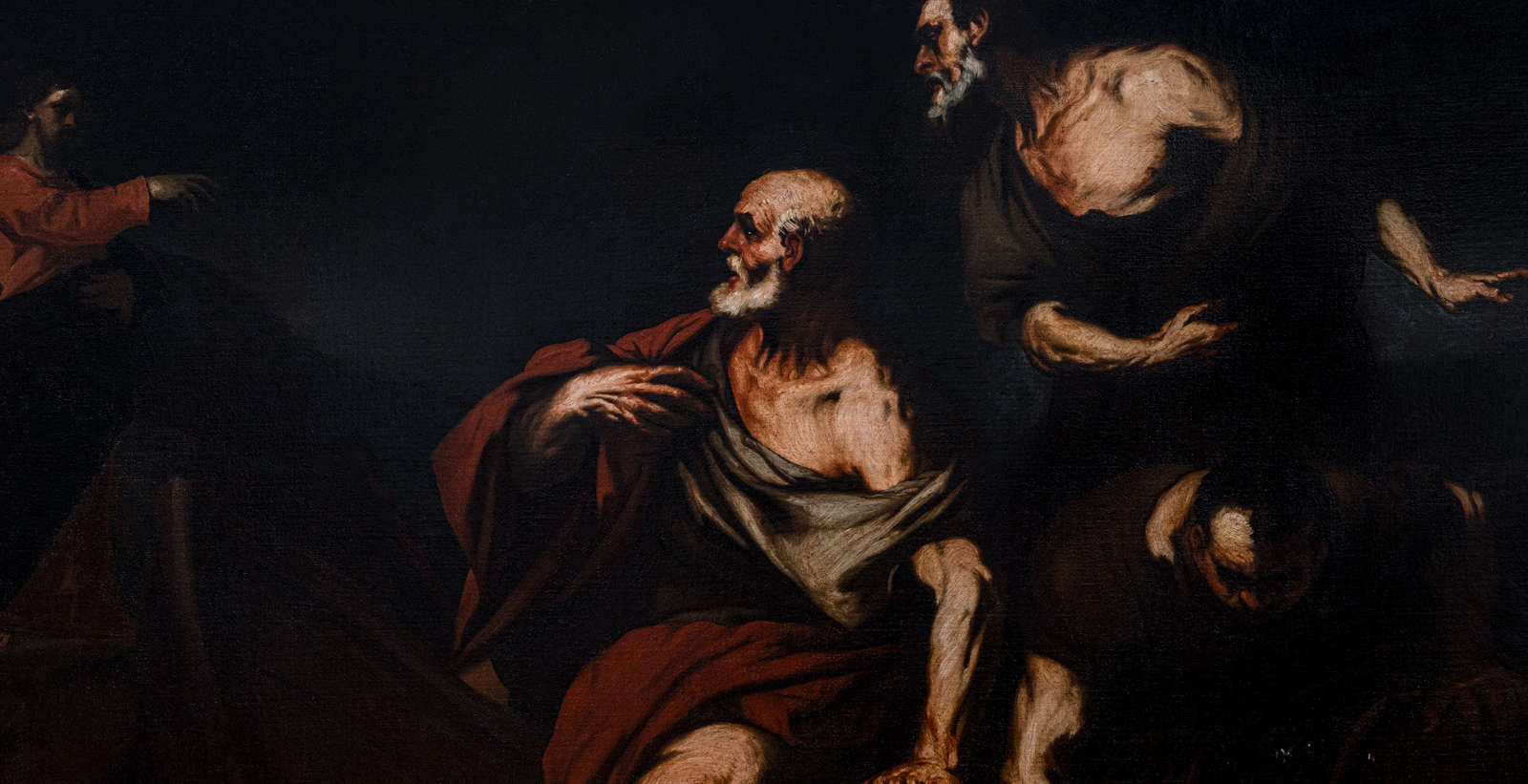
Above all, this comparison allows visitors to closely examine a key phase in the artistic development of Giordano, a Neapolitan artist destined to become one of the leading figures of Italian Baroque painting. The canvas on display at MarteS dates back to the years of the painter’s first stay in Venice, between 1664 and 1665, and clearly illustrates the convergence of two fundamental elements of his artistic language: on the one hand, the dramatic naturalism he learned from the paintings of Jusepe de Ribera; on the other, the chromatic richness and compositional grandeur of the Venetian tradition. It is precisely in this combination that *The Calling* derives its significance: Giordano does not construct the scene solely through the contrast between light and darkness, nor does he merely replicate a Caravaggesque model. The physical strength of the fishermen, the light that defines their bodies, and the drama of the episode coexist with a broader and more spectacular conception of composition, linked to the Venetian pictorial tradition, and the result is a scene in which the religious moment is translated into an image of powerful theatrical impact. In this painting, the light strikes the two fishermen before they can even comprehend what is happening: Simon Peter and Andrew are bathed head-on in intense light, which highlights their physical strength and makes the contrast with the scene’s dark background even more evident. Before them stands Christ, set back on the left, who with a broad and solemn gesture points out to the two brothers the new path they are about to embark upon. It is a scene of calling, but also of sudden apparition: the two men seem suspended between disbelief and fear in the face of a presence that bursts into their daily lives.
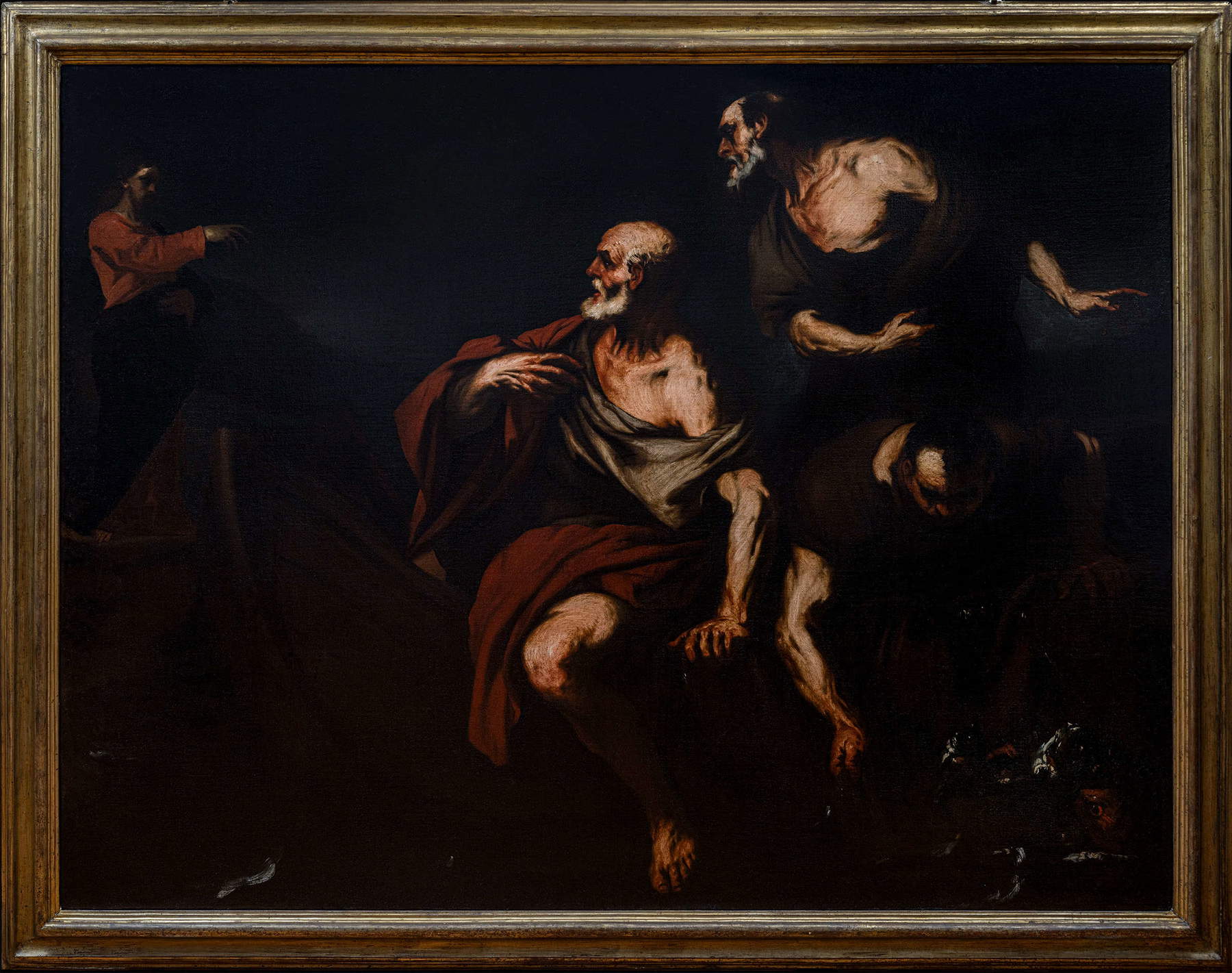
The subject is drawn from one of the best-known passages in the Gospel of Matthew, in which Christ meets the fishermen and announces that he will make them “fishers of men.” Their daily work, therefore, becomes the starting point for a radical transformation: Peter and Andrew are called to abandon their former lives and take on the task of leading people to God. Giordano captures this transformation in the very moment the call takes place. Peter and Andrew are in the boat, along with a third fisherman who continues to tend to the catch without apparently realizing what is happening. This is a significant detail in the composition of the scene: while the world is changing for the two brothers, the man beside them remains immersed in the routine of his daily work.
Christ, on the other hand, stands slightly farther back. The gesture with which he addresses the boat is broad, almost grand, and introduces a solemn dimension to the scene that contrasts with the fishermen’s down-to-earth reality. The distance between the main figures and the varying degrees of awareness among the characters thus construct a narrative that depends not only on the action but also on the characters’ gazes, postures, and the distribution of light.
“The Calling” was, after all, a theme that Giordano would address several times throughout his career, and the various versions differ in their compositional approach and the arrangement of the figures, confirming how frequently the painter returned to the subject in search of different solutions. The work on display at MarteS belongs to a particularly significant phase of his career, when his experience in Venice offered him the opportunity to engage directly with a pictorial tradition different from the Neapolitan one in which he had been trained. His stay in 1664–1665 thus plays a central role in understanding the nature of the painting: during these years, Giordano synthesized Ribera’s energetic and dramatic naturalism with Venetian figurative art, characterized by color, painterly texture, and expansive compositional structures. *The Calling* demonstrates this synthesis through a style of painting in which chiaroscuro does not obscure the color but rather makes it stand out with greater intensity.
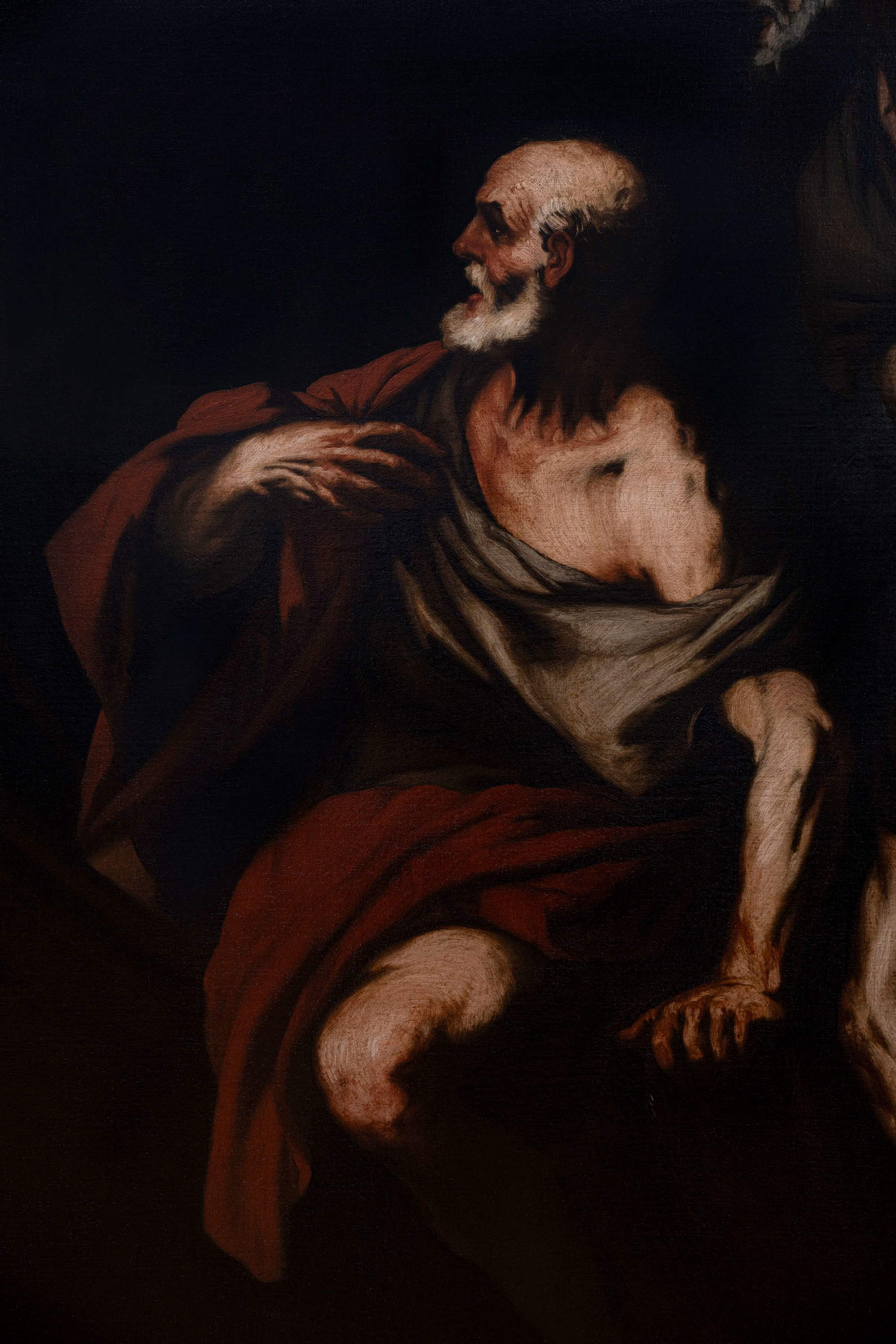
It is in this context that the work finds its counterpart within the MarteS. The canvas is, in fact, juxtaposed with several paintings from the permanent collection attributable to the leading Venetian and Venetian-style practitioners of tenebrist painting, including Andrea Celesti, Antonio Zanchi, and Girolamo Forabosco. Dark backgrounds, luminous contrasts, and a particular intensity in the figures thus establish a direct dialogue between Giordano’s painting and works that belong to the same broader figurative tradition. This comparison allows us to trace not only the spread of the tenebrist style but also the depth of Caravaggio’s legacy in 17th-century Italian painting. The light that bathes Pietro and Andrea, isolating them from the surrounding darkness, is in fact one of the tools through which the religious scene becomes immediately intelligible. The chiaroscuro structures the narrative and identifies the protagonists, while the painterly texture and the monumentality of the figures lend the episode a physical and almost theatrical dimension.
The MarteS exhibition thus arises from the encounter between a work that had not previously been presented to the public and a selection from the permanent collection that allows it to be viewed in a new light. The temporary presence of Giordano’s canvas alters the museum’s exhibition layout for a few weeks and creates a connection between works created in different contexts but united by their focus on light, contrast, and the dramatic power of representation.
For the museum in Calvagese della Riviera, this is also an opportunity to bring to the public’s attention a large-scale painting that has until now remained in a private collection. Its presentation offers a direct glimpse into an early phase of Giordano’s career, before his Baroque style was fully established, and allows visitors to appreciate, through the painting itself, the various elements that shaped his artistic development.
“The temporary inclusion of this masterpiece by Luca Giordano in our museum’s exhibition creates a fruitful dialogue with the works in the permanent collection, stimulating reflections, comparisons, and new interpretations,” says Stefano Sorlini, president of the Luciano Sorlini Foundation. “The theme of the Calling, so splendidly orchestrated by the Neapolitan painter through a vibrant and immediate narrative, offers everyone—from the most rigorous scholars to visitors encountering art for the first time— the opportunity to personally experience the thrill of discovery, demonstrating that beauty can and must speak to everyone.”
“Luca, Hurry Up!”—A previously unseen “Conversion” by Luca Giordano —will be on view at the MarteS Sorlini Art Museum from October 24 to November 29, 2026. The exhibition will be accompanied by a monograph published by Silvana Editoriale.
 |
| An unpublished early masterpiece by Luca Giordano will be on display at MarteS on Lake Garda |

Warning: the translation into English of the original Italian article was created using automatic tools. We undertake to review all articles, but we do not guarantee the total absence of inaccuracies in the translation due to the program. You can find the original by clicking on the ITA button. If you find any mistake,please contact us.




























 IT
IT FR
FR DE
DE ES
ES CN
CN


