





On July 19, the July 22 National Memorial will open to the public in Oslo’s new Government Quarter. It was built to commemorate the victims of the terrorist attacks on July 22, 2011, which claimed the lives of 77 people and marked one of the most tragic events in Norway’s contemporary history. The work, commissioned by Public Art Norway (KORO), will be unveiled a few days before the commemorations marking the fifteenth anniversary of the attacks.
The attacks of July 22, 2011, were carried out by a Norwegian far-right terrorist. A bomb exploded in front of the H-Block government building in the center of the capital, killing six ministry employees and two passersby. The attacker then traveled to the island of Utøya, the site of the summer camp for the AUF, the youth wing of the Labor Party, where he killed 69 people, most of whom were teenagers. Numerous others were seriously injured, and the impact of the attacks was felt throughout Norwegian society. According to the Oslo District Court, the attack was politically motivated and directed against the AUF, the Labor Party, the Norwegian government, and the country’s democratic institutions, and was fueled by a deep contempt for religious and ethnic minorities.
In 2012, the Norwegian government decided to erect two official memorials: one on Utøya and one in Oslo’s Government Quarter. For the site in the capital, the “Upholding” design by Norwegian artist Matias Faldbakken was selected; he was the winner of the international competition, the results of which were announced on April 8, 2025, during a public event at Kunstnernes Hus (House of Artists) in Oslo.
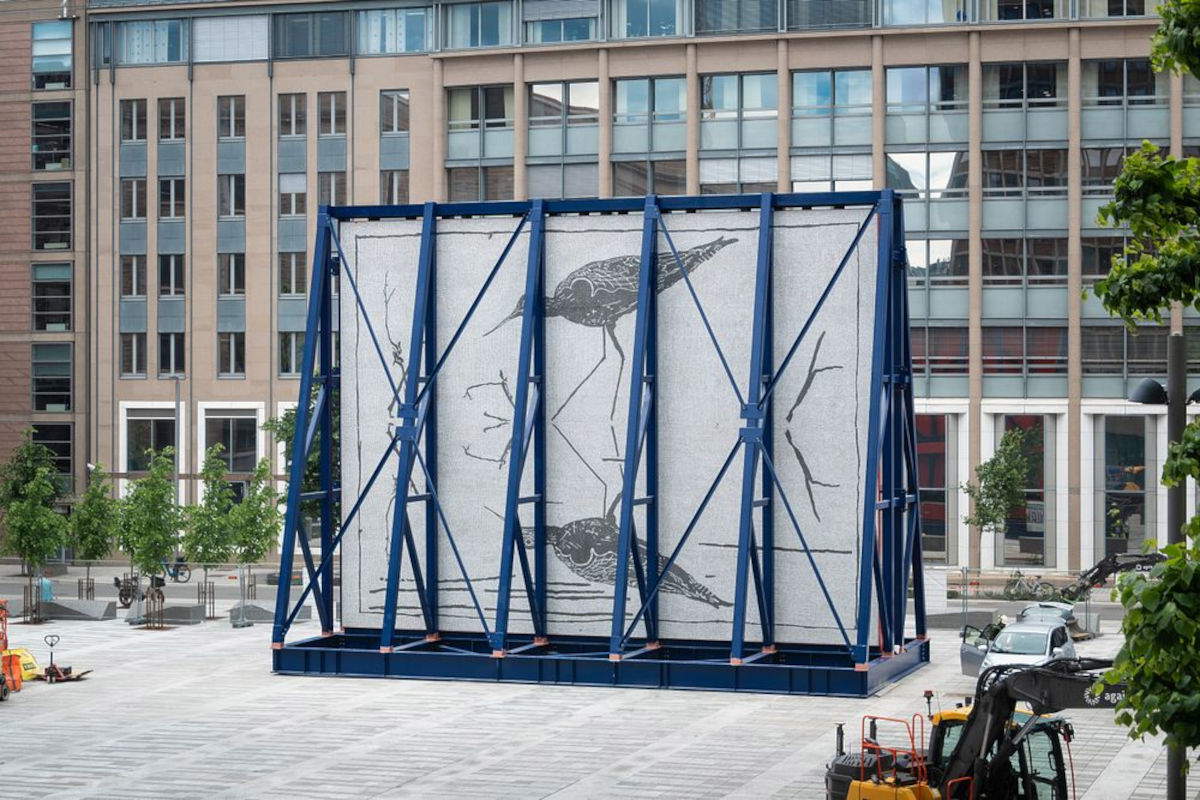
The work is located in the plaza in front of the H-Block, a building designed in 1958 and a symbol of the Government Quarter, situated between the western wing of the historic building and the new July 22 Center. The memorial takes the form of a large steel structure that echoes the frame used to support and relocate *The Fishermen*, the mural by Pablo Picasso salvaged from the Y-Block building, which was demolished as part of the area’s reconstruction following the attack.
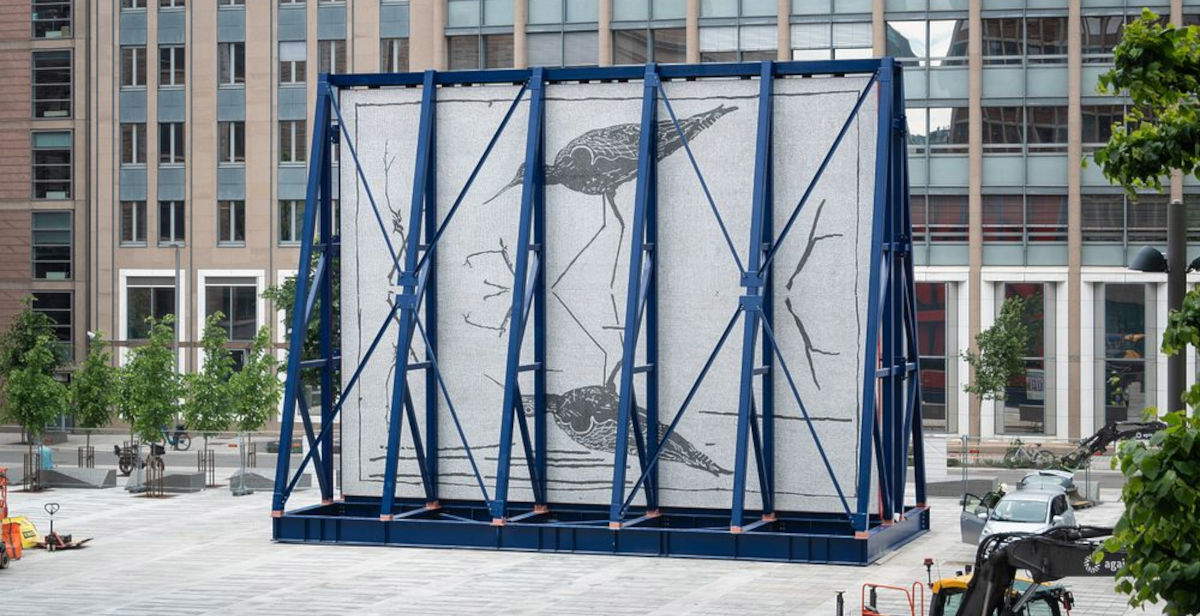
Inside the structure, Faldbakken has incorporated a monumental mosaic composed of approximately 300,000 stone tiles. The image depicts a small wading bird found on Utøya, along with reeds and branches reflected in the waters of Lake Tyrifjorden. On the opposite side, however, the geometric pattern of the structure’s bracing is visible, painted in shades of deep blue, dark green, and bright red. Together, these elements symbolically connect the two sites of the attacks: the Government Quarter and Utøya.
The creation of the mosaic also included a participatory phase. In collaboration with the July 22 Center and KORO, Faldbakken invited survivors, family members of the victims, teenagers, and citizens to help lay the final tiles. Over the course of three weeks, approximately 2,000 people participated in the work at a temporary workshop set up on the memorial site, completing the final 7,000 stones of the mosaic. The final tile was laid by Merete Stamneshagen, president of the National Support Group for the Aftermath of July 22, who lost her daughter in the Utøya massacre.
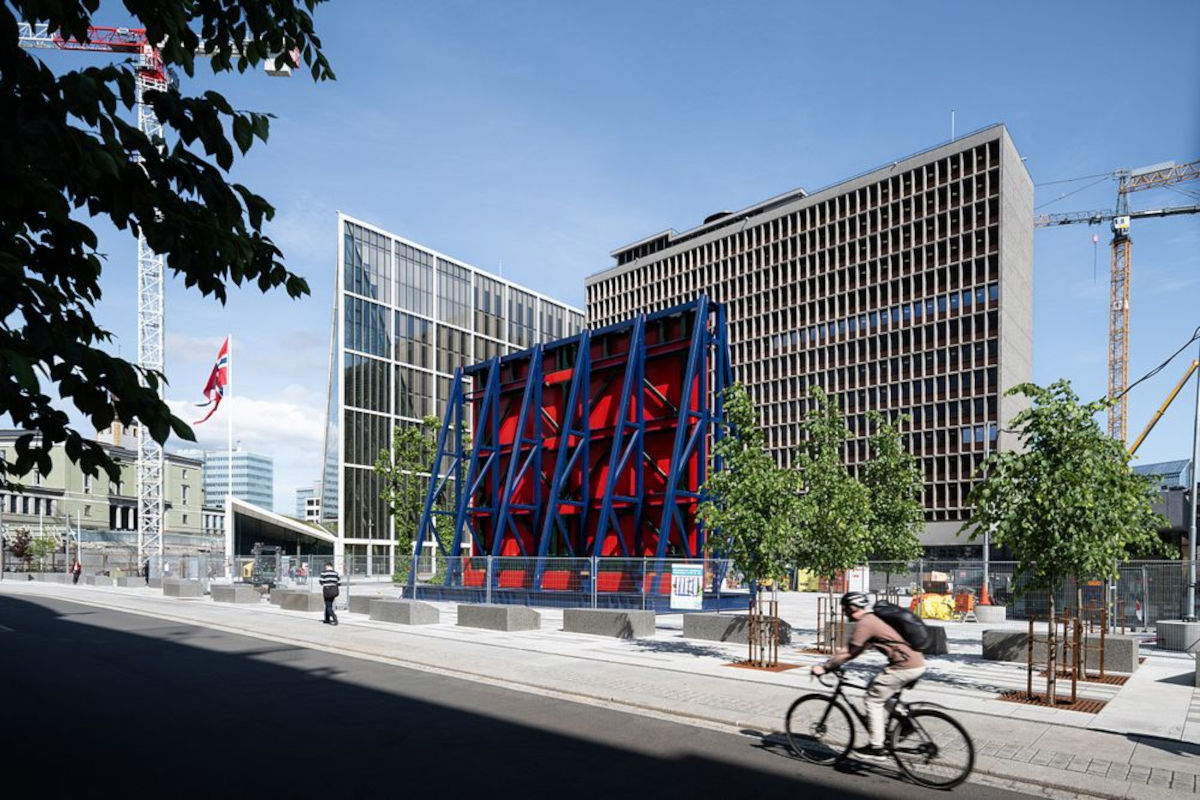
According to the project’s concept, “Upholding” differs from the traditional monumental designs developed since the 1980s. The memorial does more than simply commemorate the victims; it invites reflection on maintaining the conditions necessary for democratic life and on the collective responsibility to counter the far-right ideology that inspired the attacks. The industrial-looking metal structure evokes the work required to build and sustain a democratic society, while the figure of the bird alludes to the vitality and vulnerability of life, serving as a silent witness to the political processes unfolding around it.
The opening of the memorial concludes a four-year process that included an international call for proposals, a two-phase competition, and a series of public seminars. Throughout the entire process, KORO fostered dialogue with those directly affected by the attacks, including the victims’ families, survivors, the national support group formed after July 22, the AUF, government ministries, public servants, and local residents. The memorial is also located next to the new public art project created by KORO as part of the first phase of the Government Quarter’s reconstruction.
The July 22 National Memorial and the nearby July 22 Center, dedicated to raising awareness about the attacks and their consequences, together with Utøya, constitute one of the main tools through which Norway intends to keep the memory of the victims alive, strengthen democratic values, and promote initiatives to prevent violent extremism. Today, the AUF has resumed its activities on the island of Utøya, and government employees have returned to work in their offices; however, for the survivors, the victims’ families, and all those directly affected by the attacks, the consequences of that July 22 remain permanent.
“The memorial will be a place dedicated to the memory of those killed in the terrorist attack, as well as to the suffering inflicted on the victims’ families, the survivors, and everyone involved,” said Karianne Tung, Minister of Digitalization and Public Administration, during the event. “It will become an important symbol of the fact that our democracy has been able to withstand even the most serious threat.”
“My motivation was to create a work of art dedicated to the people who lost their lives that day,” says Faldbakken. “At the same time, the work aims to embody much of the complex national history that unfolded after the terrorist attack. The sculpture is designed to be perceived as imposing and striking—even brutal—and its enormous weight is meant to reflect the weight this tragedy has had on Norway. The mosaic, for its part, represents a major investment in craftsmanship, characterized by tactile qualities and an image that evokes fragile, exposed, and irreplaceable lives.”
“Today, in Johan Nygaardsvold Square, a new aesthetic form of the memorial is being unveiled,” says curator and KORO jury member Trude Schjelderup Iversen. “Faldbakken’s work suggests that a society’s ability to build the infrastructure necessary to uphold the democratic values targeted on July 22 is inseparable from the memory of those who lost their lives.”
 |
| Norway: Memorial for the July 22, 2011, Attacks Unveiled in Oslo |

Warning: the translation into English of the original Italian article was created using automatic tools. We undertake to review all articles, but we do not guarantee the total absence of inaccuracies in the translation due to the program. You can find the original by clicking on the ITA button. If you find any mistake,please contact us.













 IT
IT FR
FR DE
DE ES
ES CN
CN


