




On the afternoon of Thursday, June 26, in Siena, the Drappellone for the Palio of July 2, 2026, was unveiled. The work, created by one of Italy’s most acclaimed young painters, Ismaele Nones, is destined to be displayed in the museum of the Contrada that wins the next Carriera. The presentation took place in the presence of Siena’s mayor, Nicoletta Fabio, and curator and art critic Davide Ferri. The Drappellone, traditionally known as the “Cencio,” is dedicated to the Madonna of Provenzano and fits into the Siena Palio calendar with a title that also commemorates the 800th anniversary of the death of St. Francis of Assisi, a central figure in medieval spirituality and Italian religious culture. The work presents itself as a single, compact, and coherent image, yet it is built upon a complex narrative structure that, to facilitate its interpretation, can be ideally divided into three levels: an upper band, a central band, and a lower band, each with its own symbolic and compositional function.
The upper section of the Drappellone features the Madonna of Provenzano, the iconographic centerpiece of the July 2 procession. The Marian figure is depicted with her traditional attributes: the crown and the 19th-century silver plate serving as a mantle—an element that also evokes the riza of Orthodox icons. This undecorated surface becomes, as the project unfolds, a narrative space transformed by the artist into a sort of visual field intended to accommodate further meanings. Within this space is the figure of St. Francis, depicted alongside the friar Benedetto da Piratro in the act of dictating the so-called “Little Testament of Siena” of 1226. Beyond its historical value, the document represents a symbolic moment of deep connection between the saint and the city of Siena, underscoring an identity-defining bond that spans the centuries. Numerous birds also flit around the scene—an iconographic element now recurrent in depictions of St. Francis and a symbol of his preaching directed toward creation and nature.
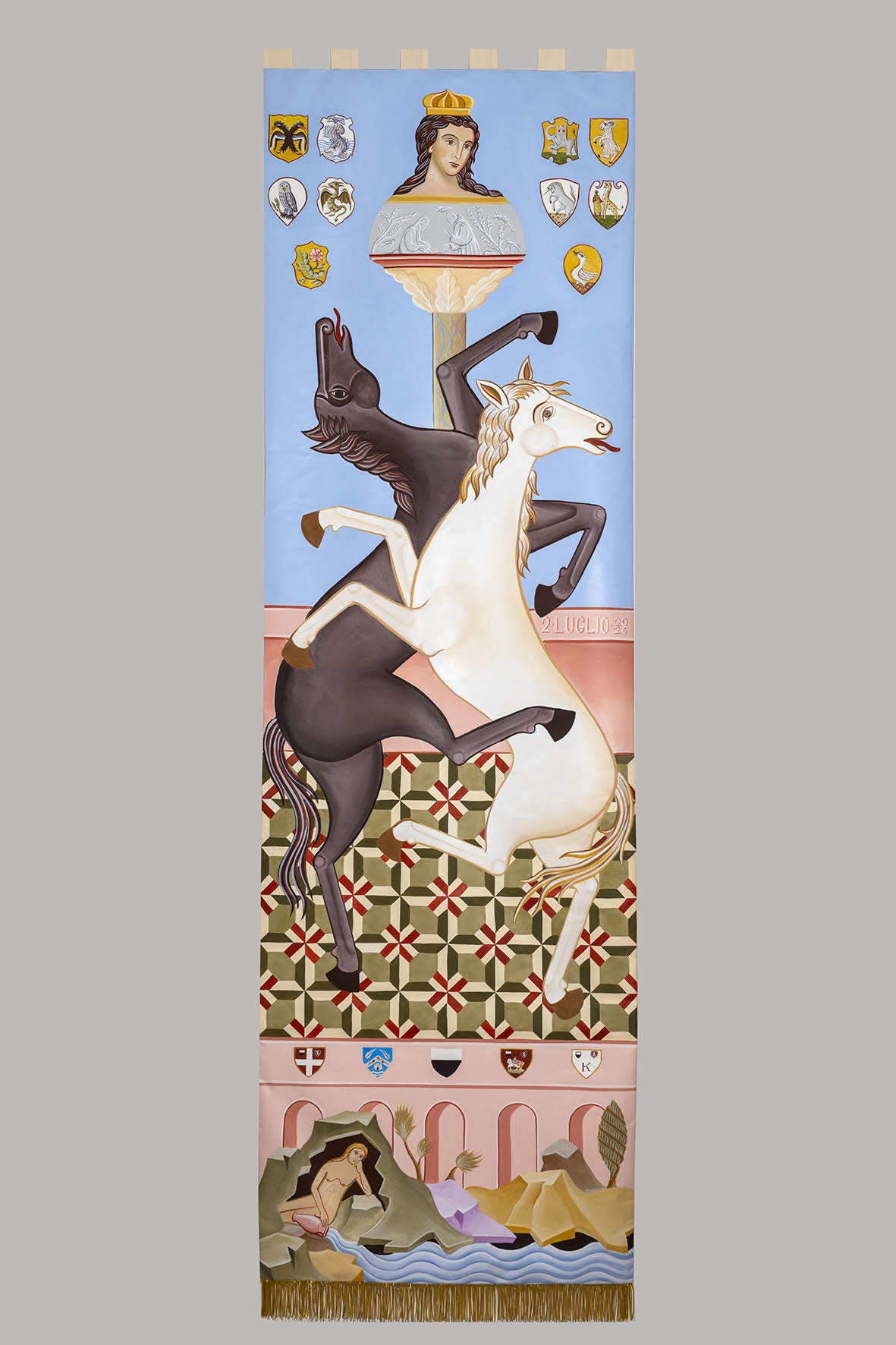
The Madonna of Provenzano is placed on a column, a choice that serves a dual purpose—both compositional and symbolic. The column, in fact, traditionally represents the link between earth and heaven, thus becoming an element of mediation between the human and divine realms. On either side of the Marian figure, the ten Contrade participating in the Carriera are arranged in an orderly fashion, divided into two groups of five, according to a strict symmetry that helps reinforce the overall balance of the composition.
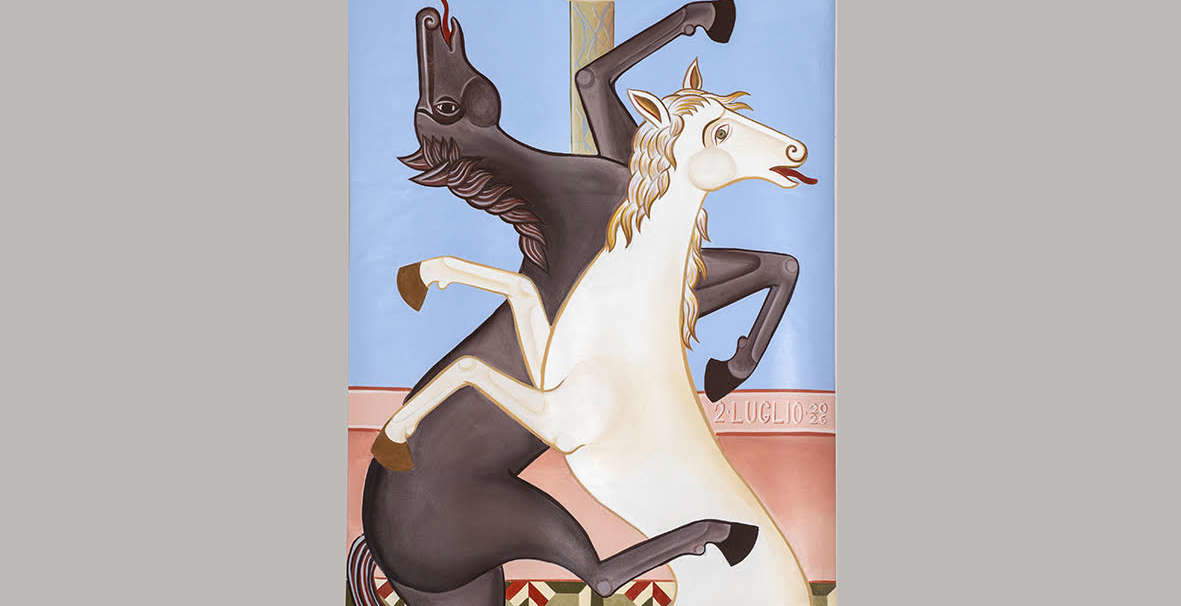
The scene then unfolds in the lower portion, where two horses appear, dancing and facing off against a clear sky. One is white and the other black, evoking the legend of the Balzana, Siena’s coat of arms, which, according to tradition, derives precisely from the colors of the horses ridden by the legendary founders Senio and Ascanio as they fled from their uncle Romulus. The two animals are not depicted in violent opposition, but rather in a dynamic of play and festive interaction, almost as if to suggest that competition is also a form of relationship and mutual recognition.
Their dance unfolds on a decorated floor that evokes the city’s main square, inspired by the motif found in the Sala del Pellegrinaio of the Santa Maria della Scala complex. This element helps anchor the scene in an urban and historical imagery deeply rooted in the city, transforming the pictorial space into a symbolic transposition of the Sienese piazza.
Behind the horses, a city wall frames the scene and introduces an additional narrative layer. Inscribed on it is the date of the Palio, July 2, 2026, which once again ties the image to its celebratory function and its precise temporal context. Below the square, a city wall unfolds, depicting the city’s Terzi, the mayor’s coat of arms, and, at the center, Siena’s Balzana—the city’s quintessential symbol of identity.
Beneath this urban band lies a hilly landscape that directly evokes the Sienese countryside, underscoring the indissoluble bond between the city and its natural environment. The composition thus unfolds as a layered system in which Siena appears not only as a physical place but as a cultural and symbolic construct that extends from the urban center to the surrounding landscape.
Finally, at the lowest part of the work, the allegorical figure of Diana emerges, linked to the legend of the underground river that, according to tradition, flows beneath the city. Depicted with an expression that is at once bored and resigned, Diana becomes an ironic and melancholic presence, suspended between myth and collective memory. Her anticipation of the river’s discovery becomes a metaphor for the relationship between the city and its hidden secrets, between what is visible and what remains underground.
“The unveiling of the Drappellone,” explained Siena’s mayor, Nicoletta Fabio, “marks the beginning of the journey that will lead us to the Palio: it is the moment when the anticipation finally takes shape, and July 2 is no longer just a date on the calendar but becomes a shared emotion. Ismaele Nones has interpreted this spirit with great sensitivity, creating a work that views tradition not as a repertoire to be repeated, but as a living source of meaning, capable of engaging with the present. His Drappellone deeply respects Siena’s identity. From references to the Pellegrinaio of Santa Maria della Scala to Diana, from the black-and-white horses evoking the city’s origins and the Balzana to the Madonna di Provenzano, every element is woven into a personal and coherent vision. Particularly significant is the choice to depict the two horses not in competition, but in a playful, almost affectionate pose. It is an image that invites reflection on the truest meaning of rivalry in the Palio: the opponent is not merely the one against whom one competes, but an indispensable presence, for without challenge, there would be no extraordinary sense of identity that fuels the life of the Contrade. This Drappellone presents us with an image of a Siena in which competition does not erase the bond but strengthens it; in which rivalry coexists with respect, and differences help to fortify a shared history. It is harmony, in the highest sense of the word, that this work conveys as a wish for our Festival.”
“I am proud—and also moved—to present the work of Ismaele Nones,” stated Davide Ferri, curator, art critic, and artistic director of Arte Fiera Bologna. “Nones is one of the leading figures in contemporary Italian painting, a movement that has been experiencing, for at least the past ten years, a period of great vitality and visibility within the context of the latest trends in contemporary art. There is nothing more powerful, then, than the opportunities that an event as prestigious as the Palio offers an artist of our time to reaffirm and revitalize the defining features of his artistic vision, through such a fruitful engagement with tradition. Looking at Nones’s Drappellone, it seems that the elements characterizing the history of the Palio and its visual landscape—the Madonna di Provenzano, the symbols of the city and the Contrade—are in perfect balance with the artist’s forms and methods: the construction of the image on a distinctly two-dimensional plane that evokes ancient and pre-Renaissance painting; a visionary quality that thus always seems to engage with the history of painting; a penchant for storytelling, for constructing a complex narrative within a very close-up foreground and through overlapping layers of representation. And at the center of the painting is the image of the two horses—one white and one black—depicted in profile and in an upward surge, appearing as if watched over by the figure of the Madonna of Provenzano: not only an emphasis on the competitive dimension, but a genuine evocation of a joyful, ritual dance around which the entire image ideally revolves.”
“This Drappellone stems primarily from the people I’ve met along this extraordinary journey,” explained Ismaele Nones. “For this reason, I would like to extend specific thanks. I thank Mayor Nicoletta Fabio and Director Michela Eremita for the trust they have placed in me and my work by entrusting me with this assignment. I thank Michela Bacconi and Sara Corti for the invaluable help they’ve given me over the past few months in managing all the logistics and paperwork. I thank the seamstresses for their exceptional dedication and for completing the work in the best possible way. I would like to thank everyone at the City of Siena who has supported and helped me during this time. Thank you to Davide Ferri for the presentation and the fruitful discussion. My deepest gratitude goes to Emanuela Perra, who has always accompanied my work with constant, productive, and stimulating dialogue. Thank you to Galleria Lunetta 11 for its support. But my greatest thanks go to all the citizens of Siena for the warm welcome, kindness, and affection you have shown me over these past few months. Thank you from the bottom of my heart. Long live the Palio. Long live art.”
 |
| Siena: The Drappellone for the July 2 Palio, painted by Ismaele Nones, was unveiled |

Warning: the translation into English of the original Italian article was created using automatic tools. We undertake to review all articles, but we do not guarantee the total absence of inaccuracies in the translation due to the program. You can find the original by clicking on the ITA button. If you find any mistake,please contact us.





















 IT
IT FR
FR DE
DE ES
ES CN
CN


