




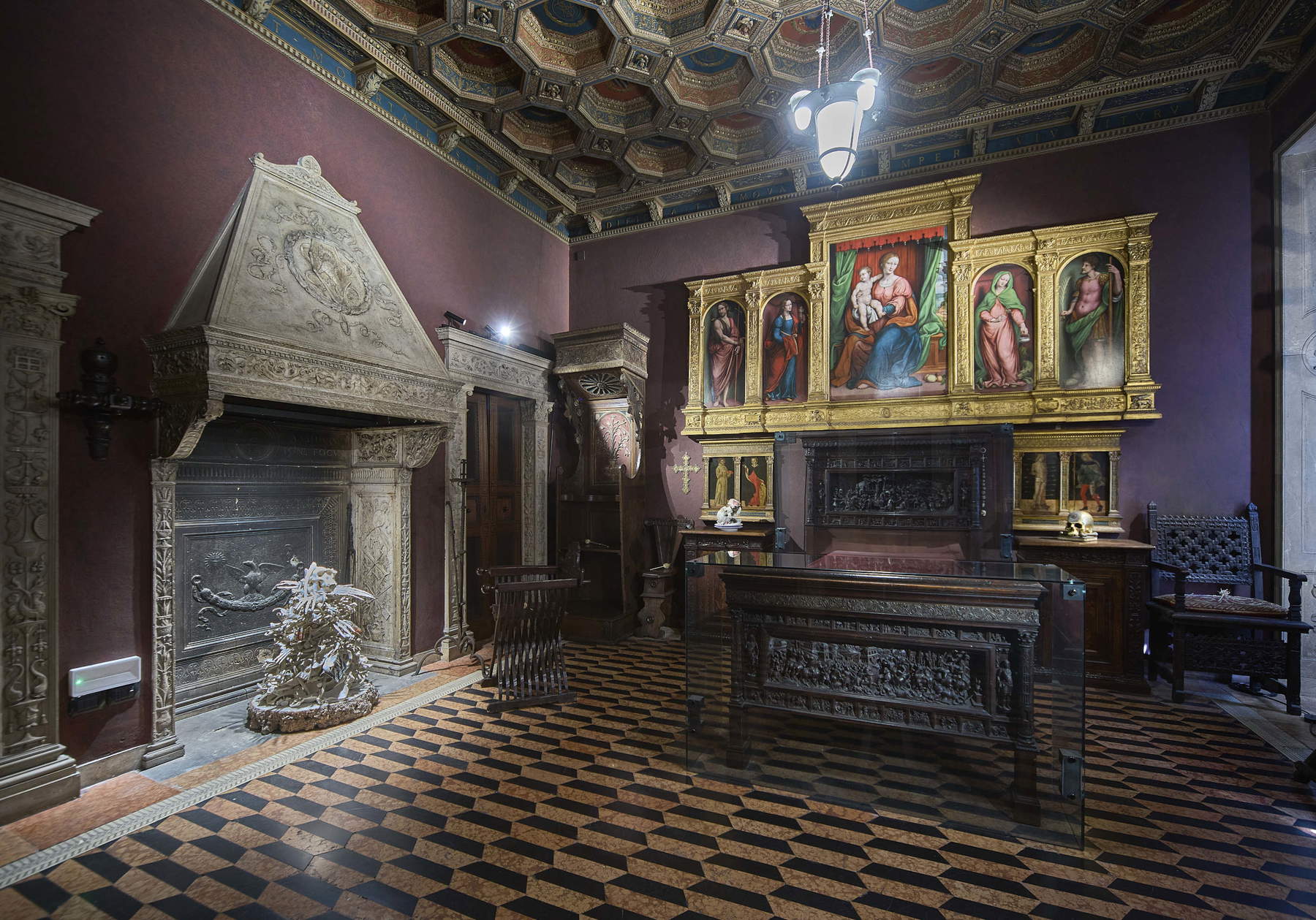
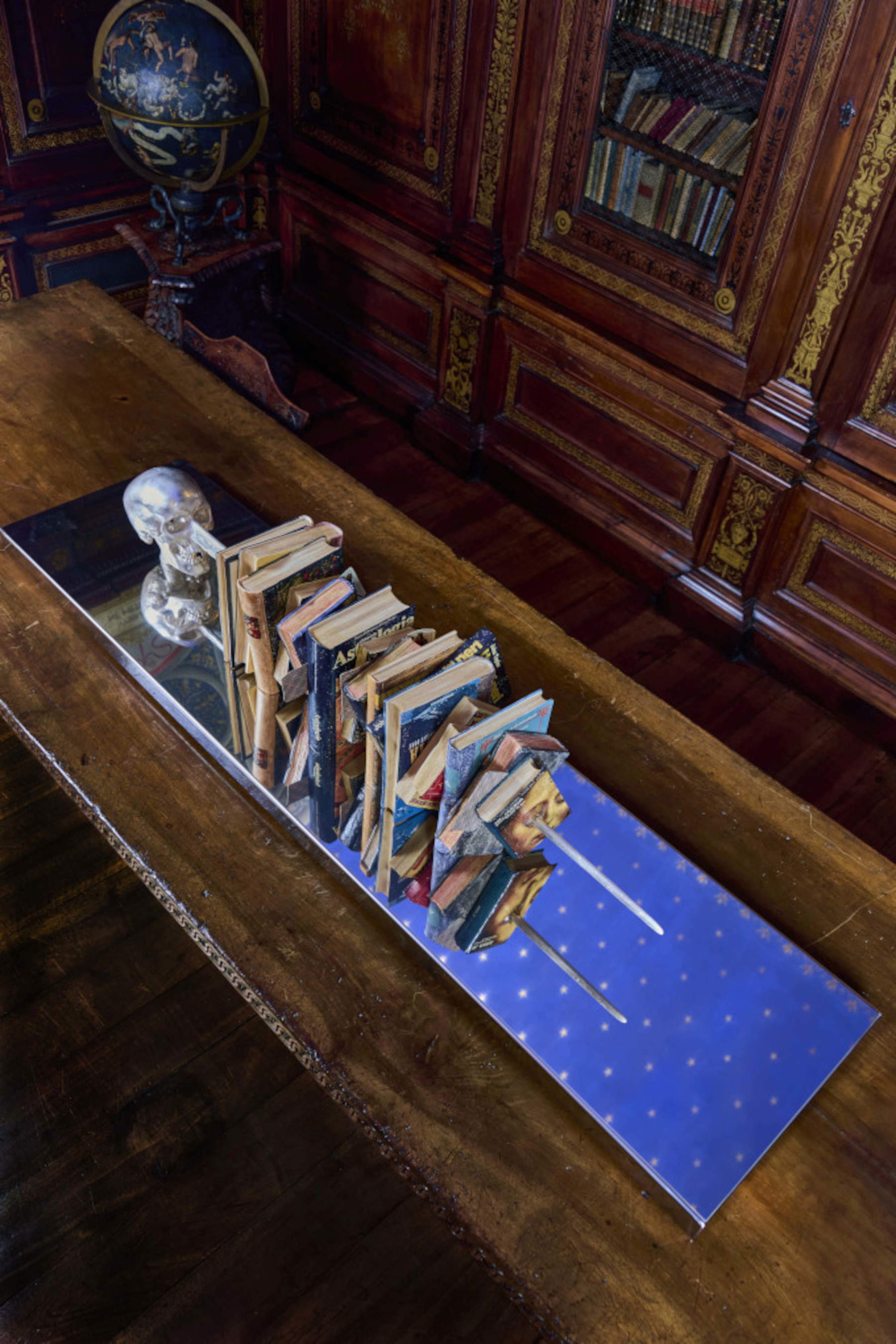
The ceiling of the Bagatti Valsecchi library is right before our eyes: if you try to lift your chin, you’ll see the frescoes and grotesques in their proper places, motionless, exactly where they’re supposed to be. Then, as you lower your gaze, the vaults will appear inverted, mirrored, reflected on the surfaceof the Enigma that Bertozzi & Casoni have chosen to set up for this occasion, for this unquestionably thanatocentric exhibition that, for just over a month, will take on the task of renewing the discourse that Fausto and Giuseppe Bagatti Valsecchi left suspended—only in appearance. Now, when one sees these ceiling frescoes, one might think that the two brothers were not in the habit of extending particular courtesies to their guests: it’s just that it’s not entirely clear what they are; we don’t know if we’ve stumbled into some Renaissance relic, if we’re looking at the work of some disciple of Pinturicchio from the Piccolomini Library who somehow ended up in Milan, or if it’s all a hoax, and so today we need to read a sign to realize that yes, we were right to be suspicious—these grotesques, too precise and perfect to be real, are the brainchild of a nineteenth-century painter, Luigi Cavenaghi, who, moreover, was a master restorer and a friend of Icilio Federico Joni—a man who made a living painting fake 14th- and 15th-century paintings to sell to collectors who were, more often than not, unaware of the deception. Today, all you have to do is read a sign, and it’s easy, but back when the two brothers lived here, you had to trust what they said (not least because the rooms are full of genuine objects: there are altarpieces, suits of armor, fragments of frescoes torn from their churches, Renaissance reliefs, oil lamps, stools, chests, clocks—all items the brothers collected from merchants, antique dealers, and secondhand dealers). The hostess, Camilla Bagatti Valsecchi, says that we are inside a residential illusion, inside a sort of perceptual puzzle, inside something that seems designed specifically to disorient us, and since the works of Bertozzi & Casoni are also tools for challenging matter, then, adds director Antonio D’Amico, the resulting semantic layering is entirely in keeping with the legacy left by the two brothers.
One might say that, in this sense, the exhibition is a complete success, and comparisons with the “tranche de vie” that the duo staged three years ago in Imola, at Palazzo Tozzoni, are inevitable. However, they are two different things, even though both exhibitions sought to convince us that a house can be a work of art, even when it pretends not to be, and that a work of art can be a house, even when it least expects it. The Tozzoni family resided in that palace for five centuries—a period long enough for living there to become a sort of profession, especially for a family that existed for five centuries (and not just a profession: it was also a matter of prestige—no small detail when a family holds public roles in the life of its city, and thus has rooms to open for solemn occasions). Bertozzi & Casoni arrived at the Tozzoni house as “revitalizers,” one might say, like two guests bold enough to think they could converse with the ghosts while nurturing the idea of bringing a house back to life: the result was an almost institutional, discreet presence, a presence that sought to remind that house that it had once been a home, and those rooms that they had once been spaces where its inhabitants ate, read, slept, drank, ran, watered plants, studied, made a mess, played music, died, forgot, and played. Obviously, the building was chock-full of deceptions and pitfalls (“a great laboratory of doubt,” as its curator, Diego Galizzi), and of course one couldn’t banish those hints of death that surface everywhere in the art of Bertozzi & Casoni (even Pinocchio, at the time, had become a bedraggled old man with withered skin, even though he was still made of wood), and there was even a little monkey at the entrance, climbing up the damask wallpaper and warning the public. At the Bagatti Valsecchi Museum, it’s a different story. A different culture of living, for starters: at Palazzo Tozzoni, no one ever pretended to be anything other than themselves (or, if they did, it wasn’t on purpose). In the Bagatti Valsecchi home, all solidity evaporates into the performance of a Renaissance dream. Then, another kind of contradiction, of paradox: at Palazzo Tozzoni, the task was to make a residence that is no longer alive seem alive. At the Bagatti Valsecchi Museum, the task was to add a staging to the staging. And finally, one might say, a certain teleological discrepancy, at least in appearance, for while Palazzo Tozzoni celebrated a sort of continuity—the survival of objects—at the Bagatti Valsecchi Museum, one inevitably ends up speaking of passing away, if only as the fate of the representation itself.
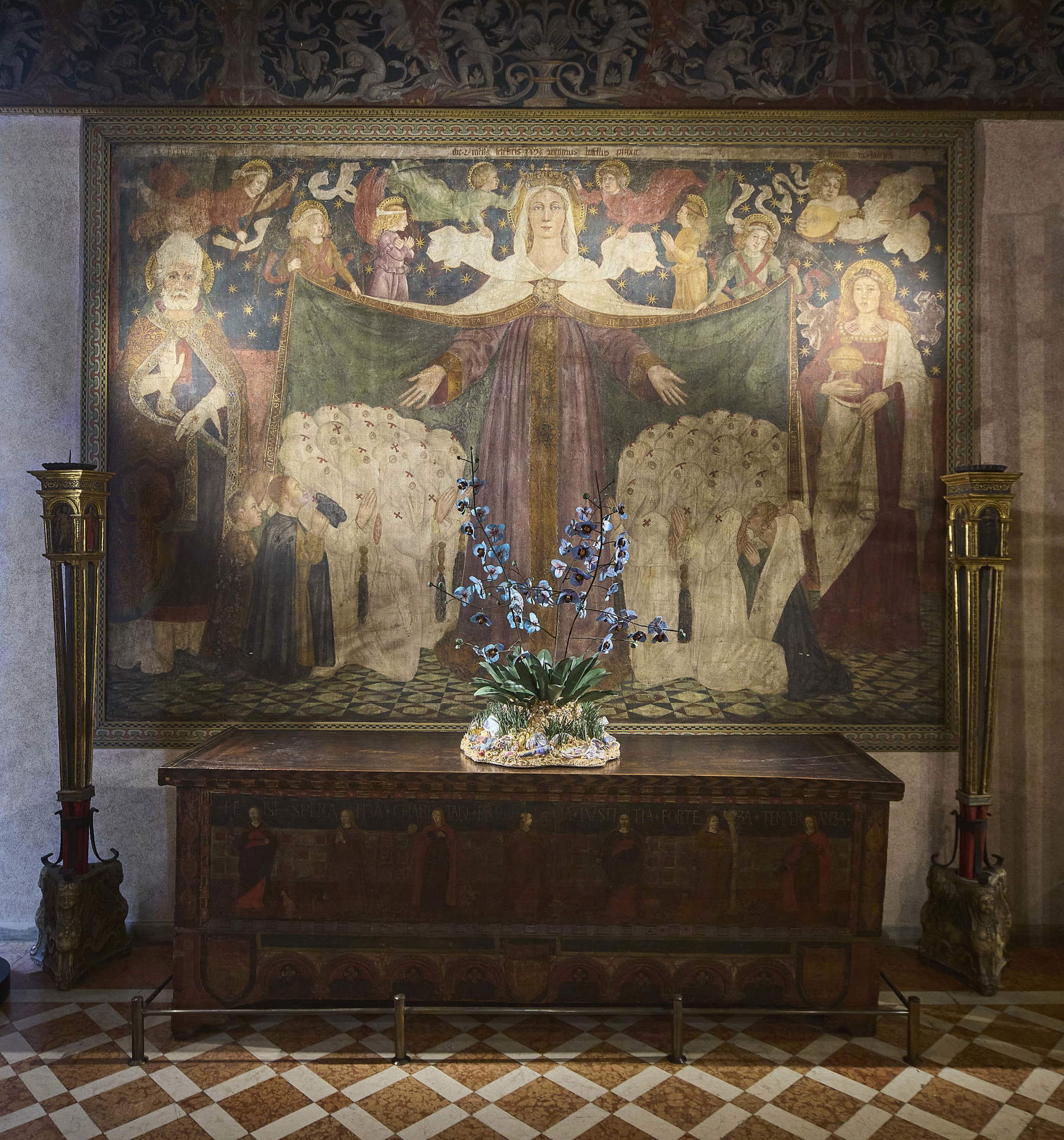
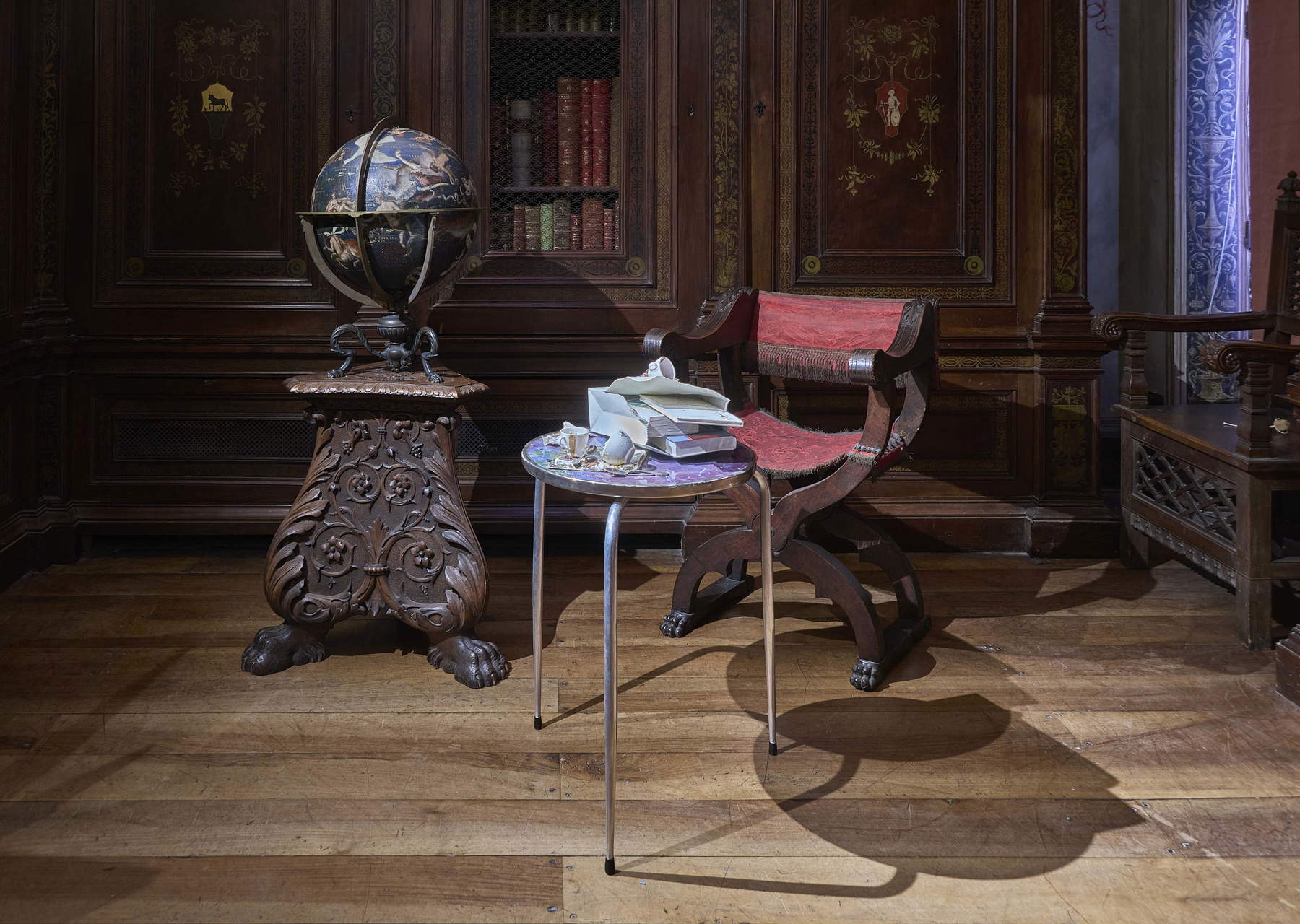
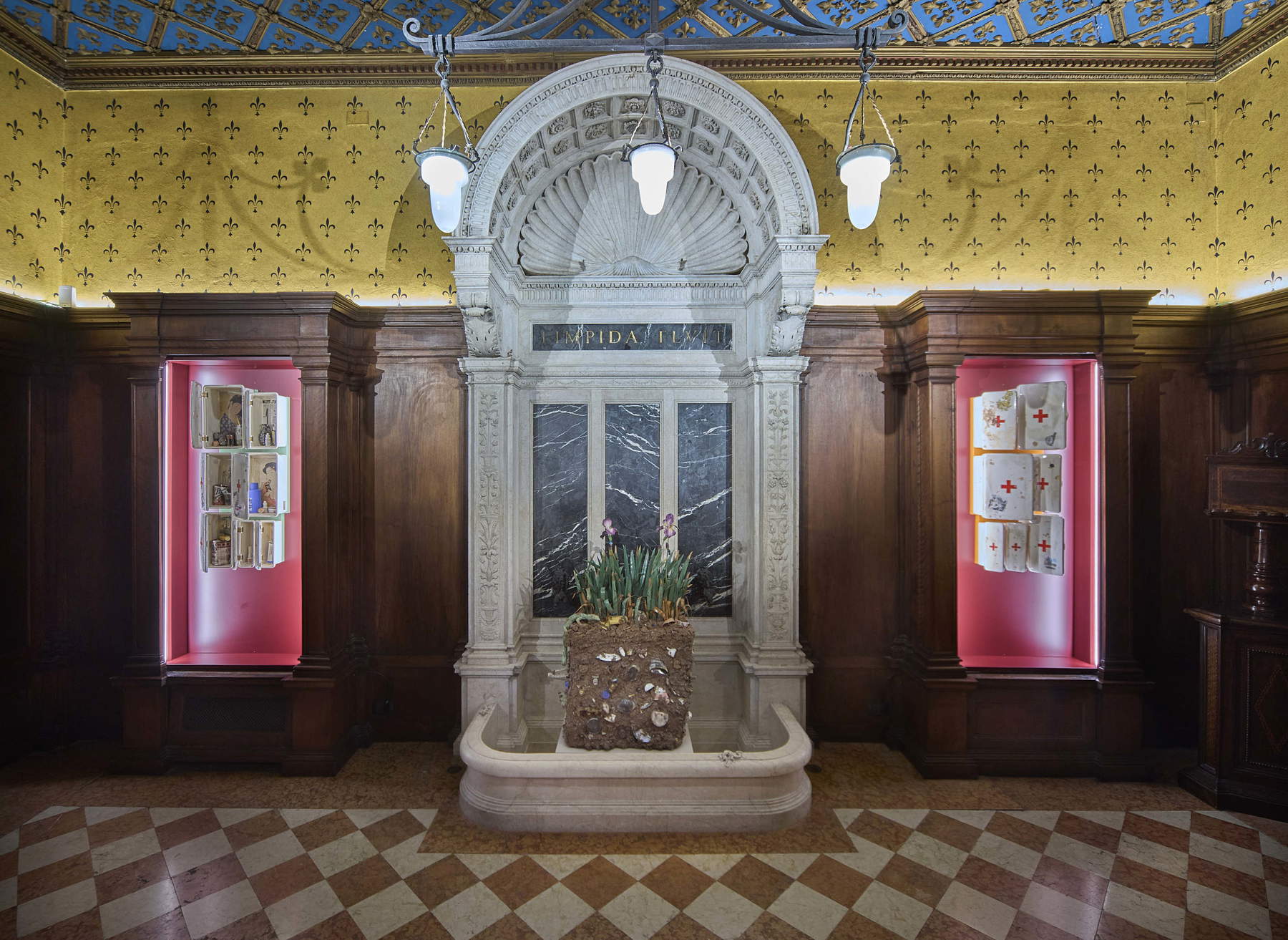
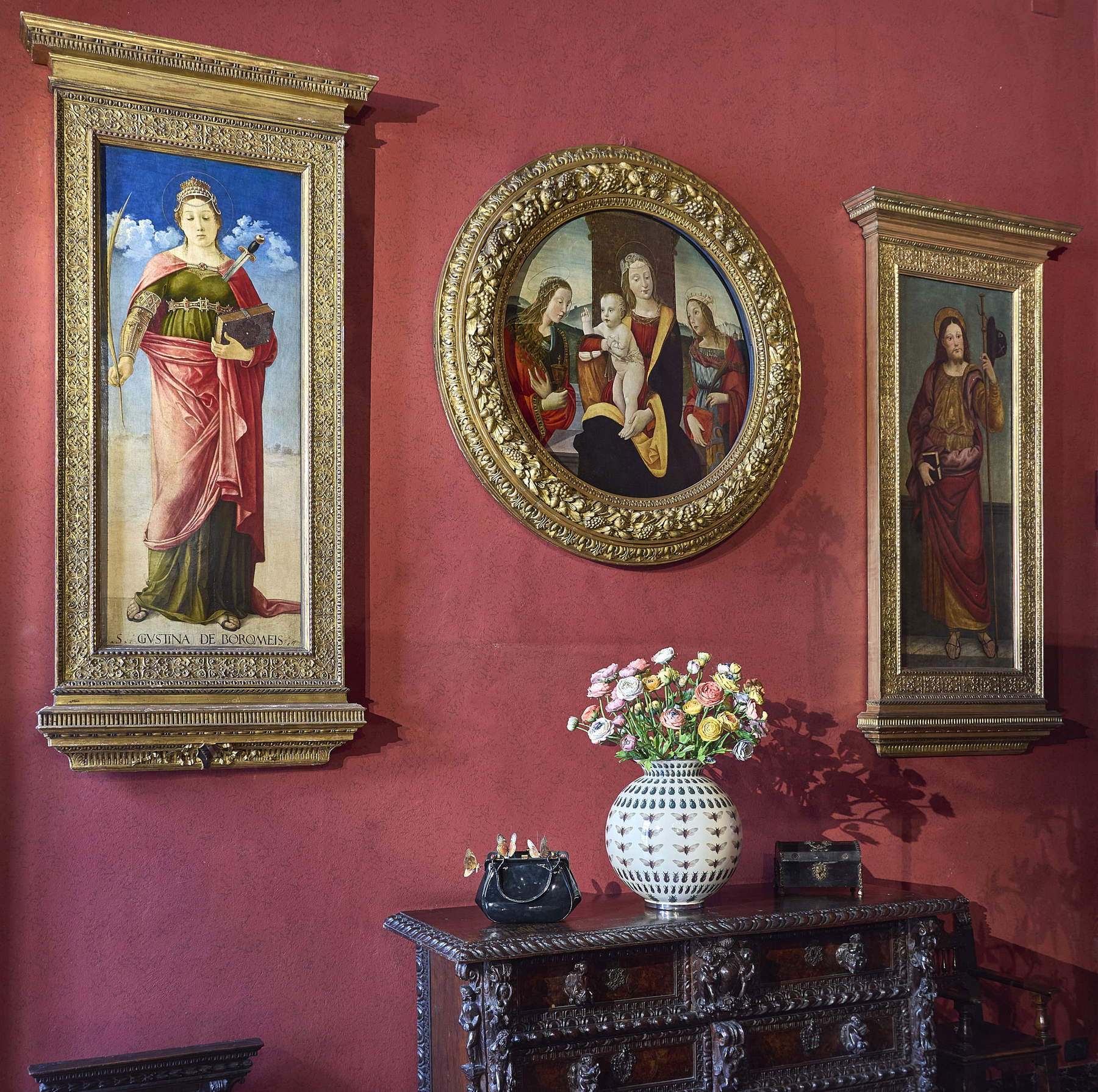
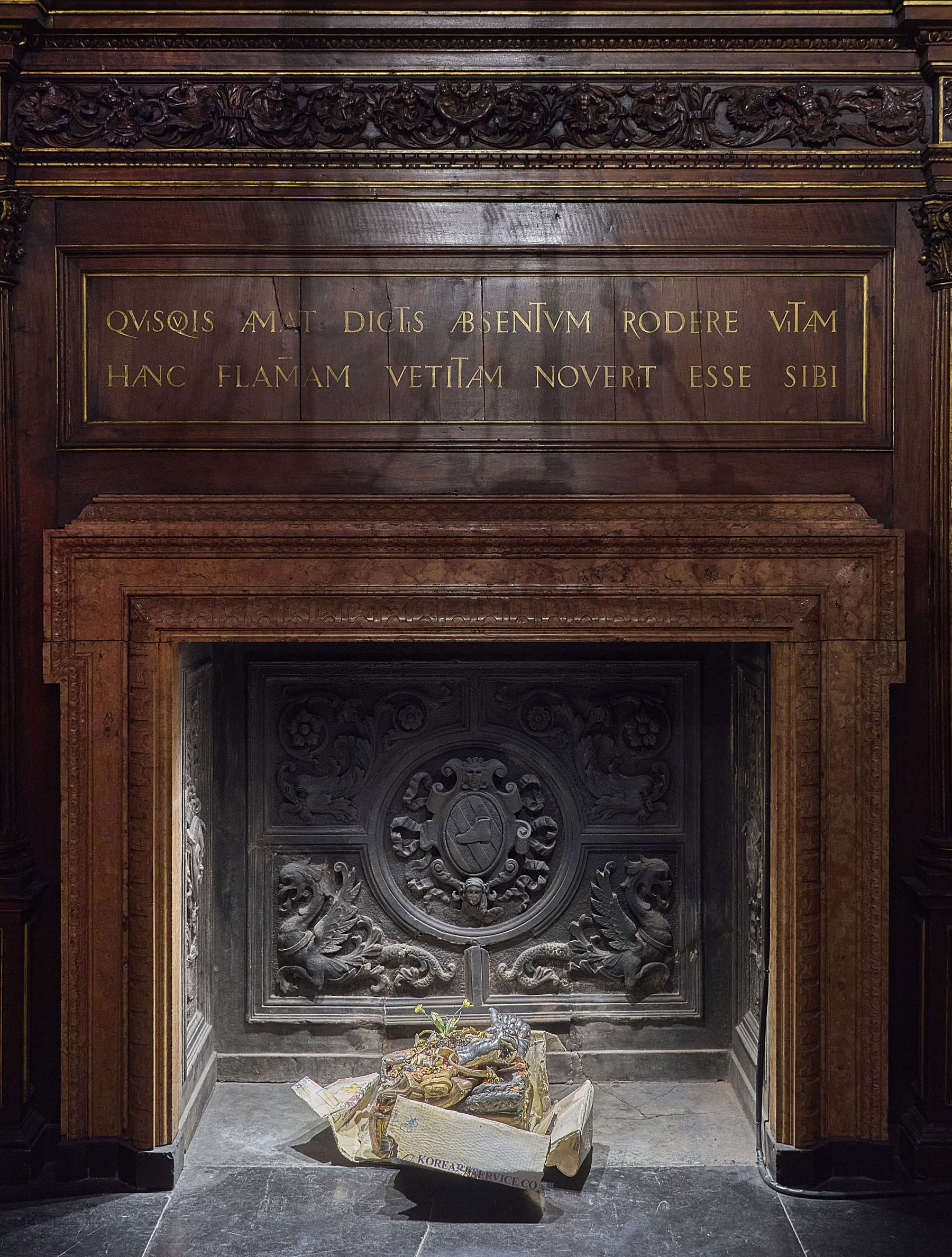
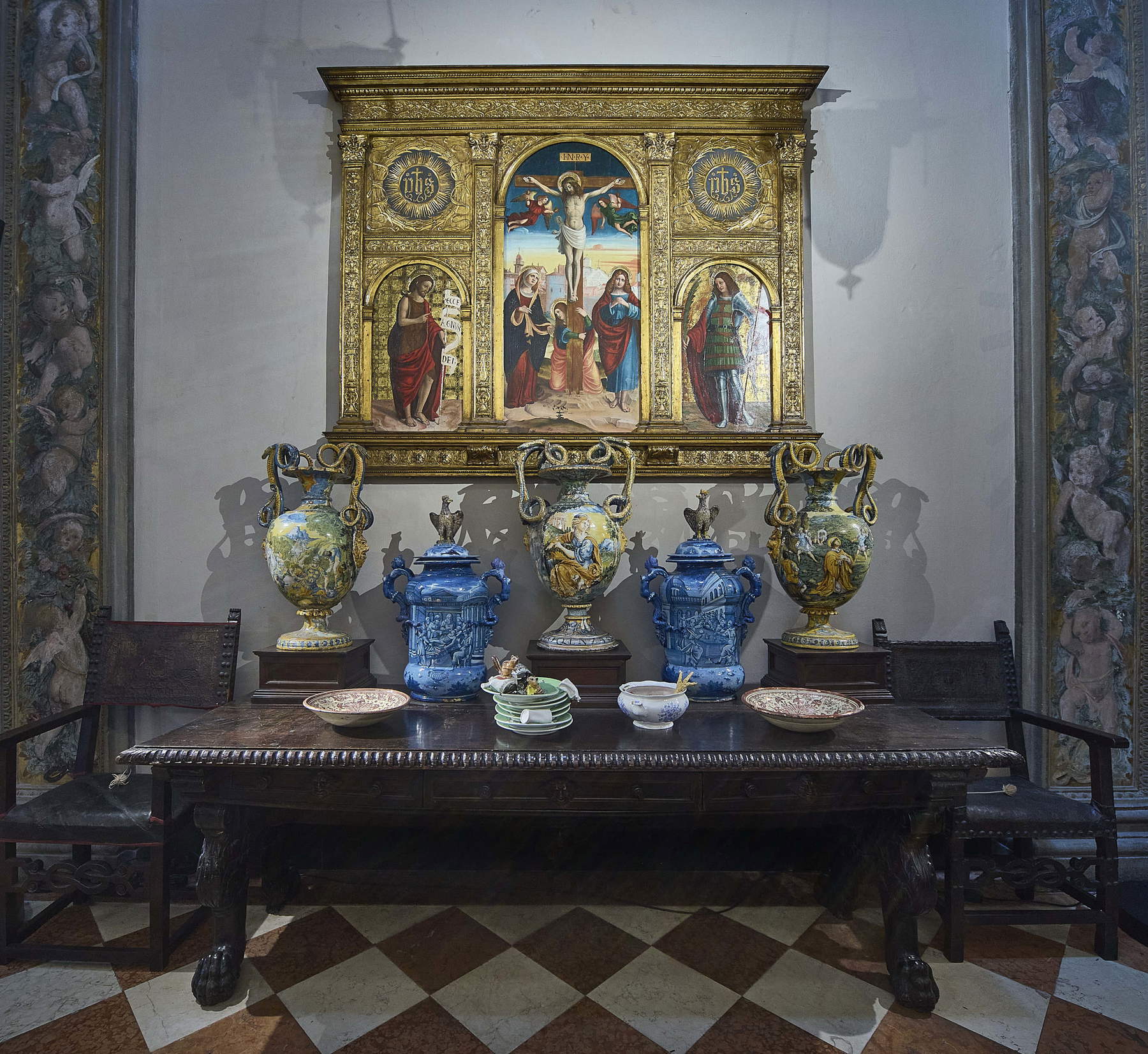
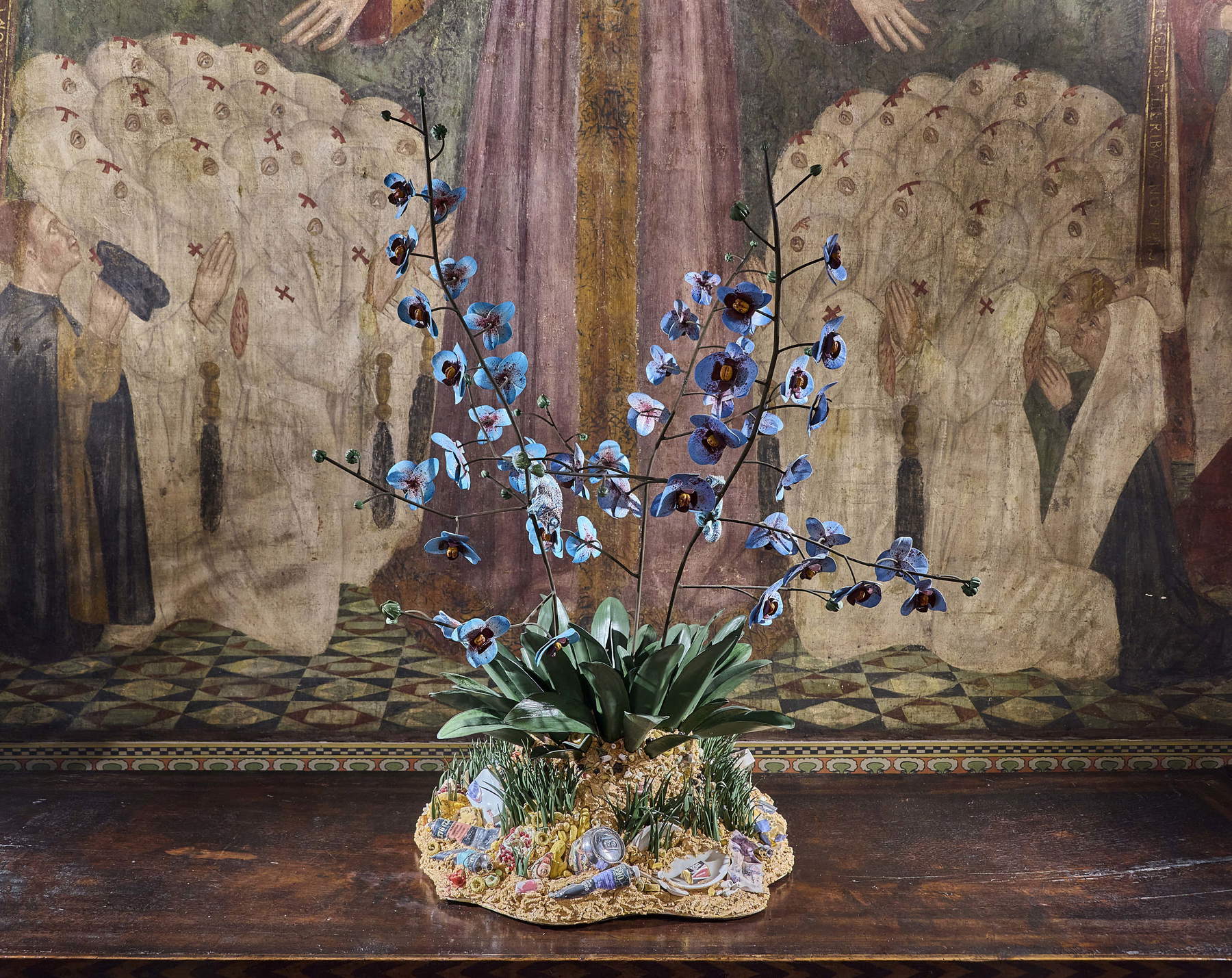
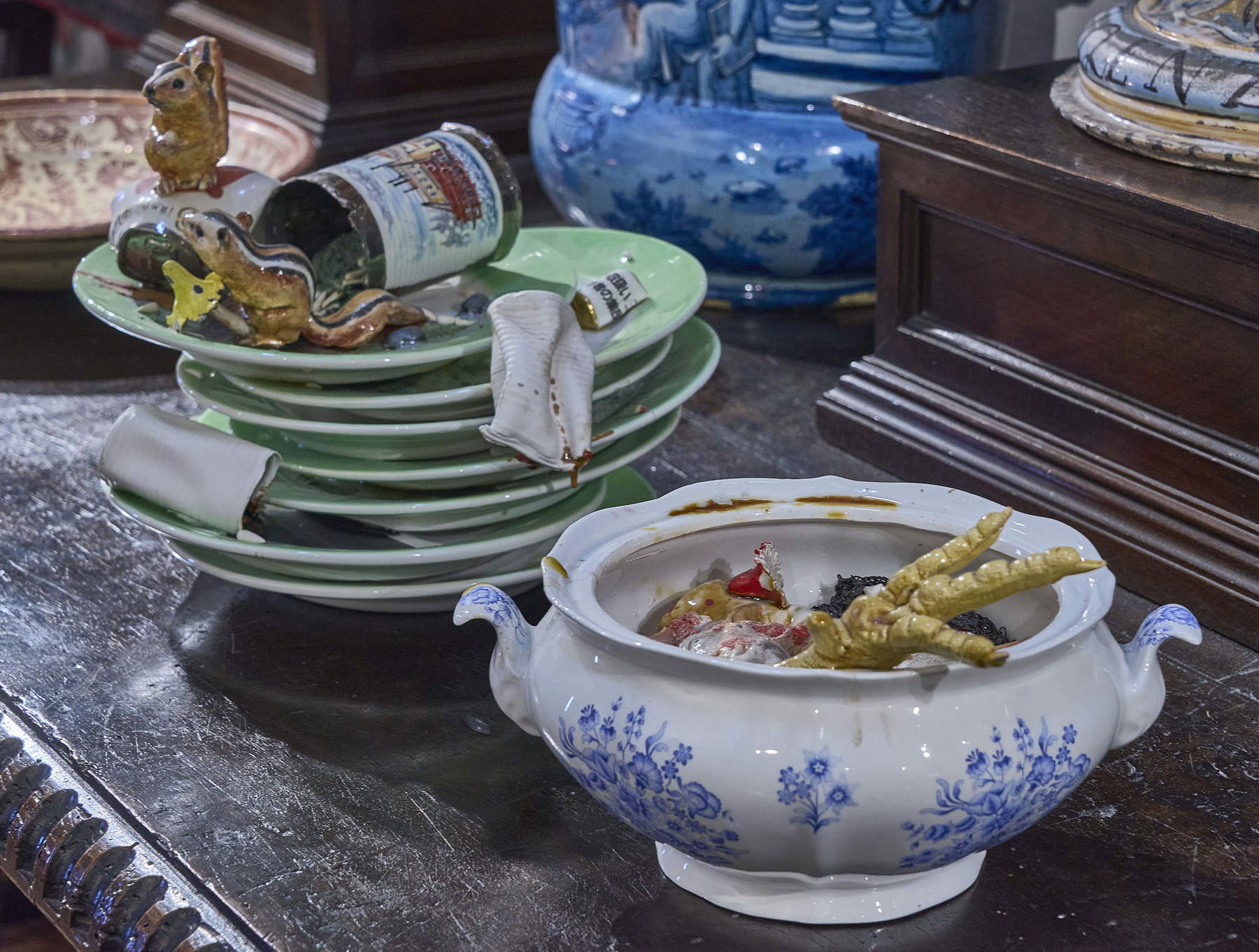
One might wonder, even before beginning, whether one should use Bertozzi & Casoni to interpret Bagatti Valsecchi, or whether one should use Bagatti Valsecchi to interpret Bertozzi & Casoni: one risks, however, leaving without having found an answer to the question, because in certain passages one almost gets the impression of witnessing a contest to see who can lie the most. These are the most playful parts of the exhibition: take, for example, the fresco room, with its faux Renaissance portal leading into the space featuring the genuine Renaissance fresco, now overrun by Bertozzi & Casoni’s orchids—flowers that, if you look closely, harbor two chameleons camouflaged among the petals. Or all those vases, which you might overlook because you could mistake them for part of the decor, when they are actually insolent ceramic intruders. There are flowers pretending to wilt in front of a fifteenth-century polyptych, bouquets of roses beneath the tondos depicting Madonnas and saints—figures almost obscured by pieces of ceramic— handbags casually resting on the canterani (then you see butterflies emerging from the clutch and start to take notice of what you’re seeing), violin cases hanging inside the Sala della Stufa Valtellinese (then you see that there are Fontana cut-outs inside, and that’s when you start paying attention to what you’re seeing). There’s a turtle looking at another turtle; one is by Bertozzi & Casoni (and, incidentally, just like the handbags, just likethe *Enigma* placed inside the Library, just like the large *Prelievo* placed inside the bathroom, just likefour other smaller works scattered throughout the rooms, it is a new piece, created for the occasion), while the other is a curious object by the two brothers, who evidently had fun imagining an armored reptile busy carrying around a balance scale, and decided to put it inside their home. Every ambiguity is left unresolved.
Then, of course, one can (and perhaps should) leave the Bagatti Valsecchi Museum amused by this whole display of oddities, by this overwhelming abundance of mimicry, by this profusion of implausible realism. Or at the very least, they’ll leave in awe of the technical skill: at Bertozzi & Casoni’s exhibitions, there are plenty of people asking whether that peanut shell is really made of ceramic, whether that three of clubs is really made of ceramic, if that well-sharpened pencil is really made of ceramic, if that plastic teaspoon is really made of ceramic, if that ceramic coffee cup is really made of ceramic. In this latest production, the exhibition at the Bagatti Valsecchi Museum does not claim to be exceptional. However, the matter begins to take on a more serious tone when the rooms are invaded by an explicit and raw notion of death—a sense of unease that fills Fausto Bagatti Valsecchi’s bedroom with skulls and bones. It is curious to realize that on Fausto Bagatti Valsecchi’s nightstand sits a skull-shaped clock, of French or Italian manufacture—a macabre, imposing object made of copper and gilded brass, consisting of a skull stripped of its jawbone, resting atop two crossed femurs, and adorned with a dial attached to the skull—a contraption meant to serve as a reminder that every hour that passes brings you closer to your death. Bertozzi & Casoni have compounded the gloom with *Avanzo*, perhaps the oldest work in the exhibition—a *memento mori* in which the deathly image of the skull is compounded by the decay of the trash assaulting it, and then with a pile of monkey bones (Chimpanzèè) arranged in the fireplace—dust to dust.
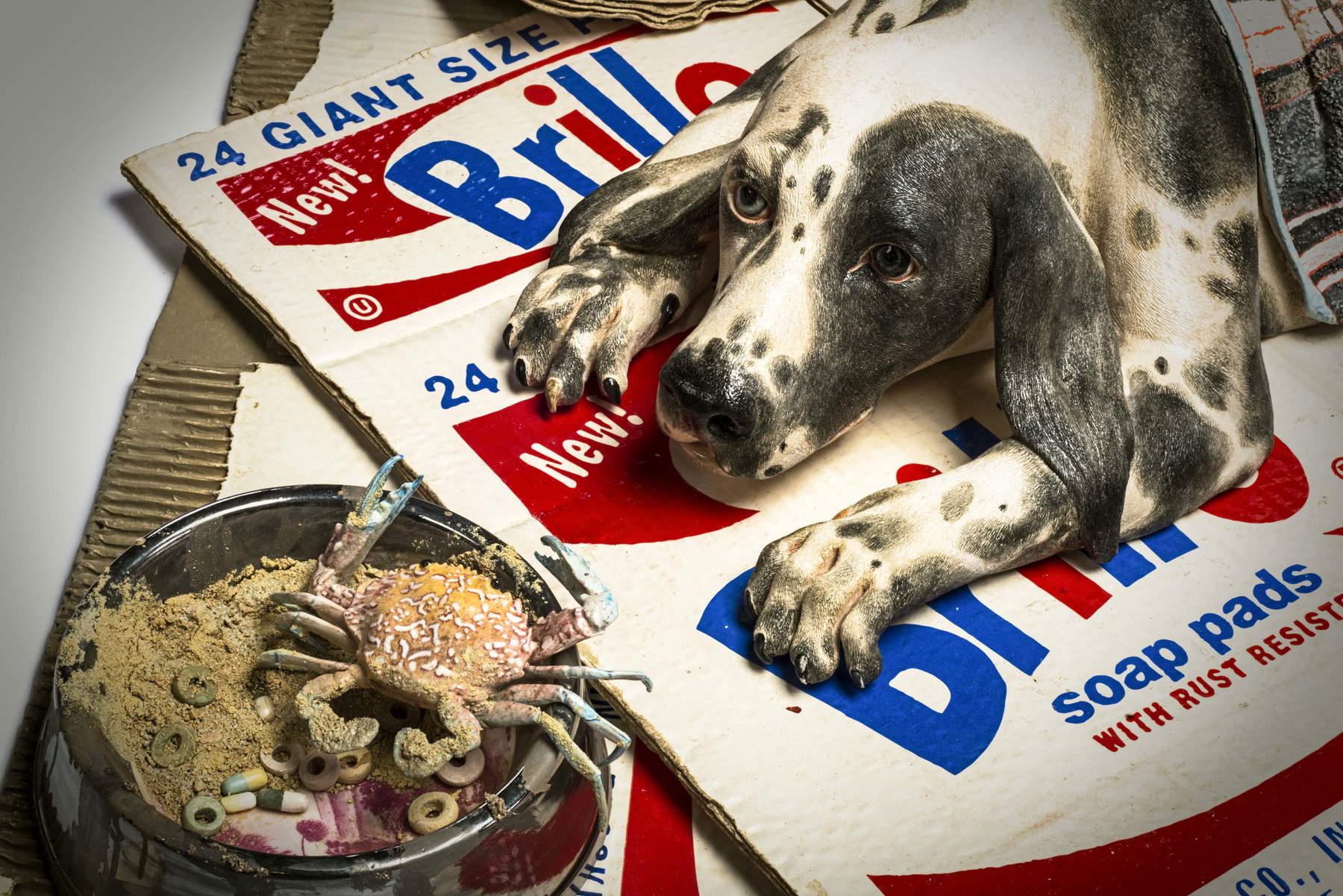
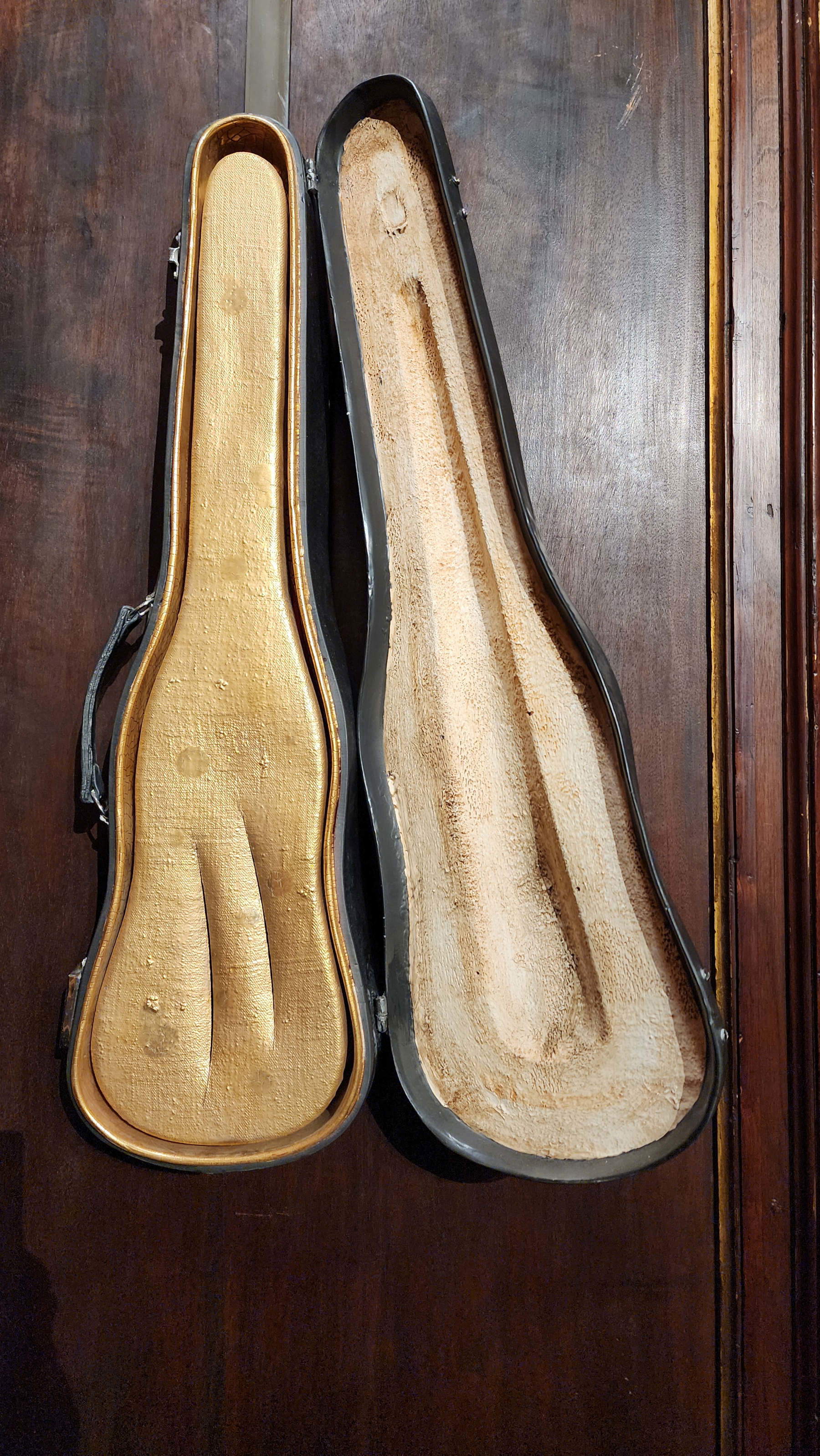
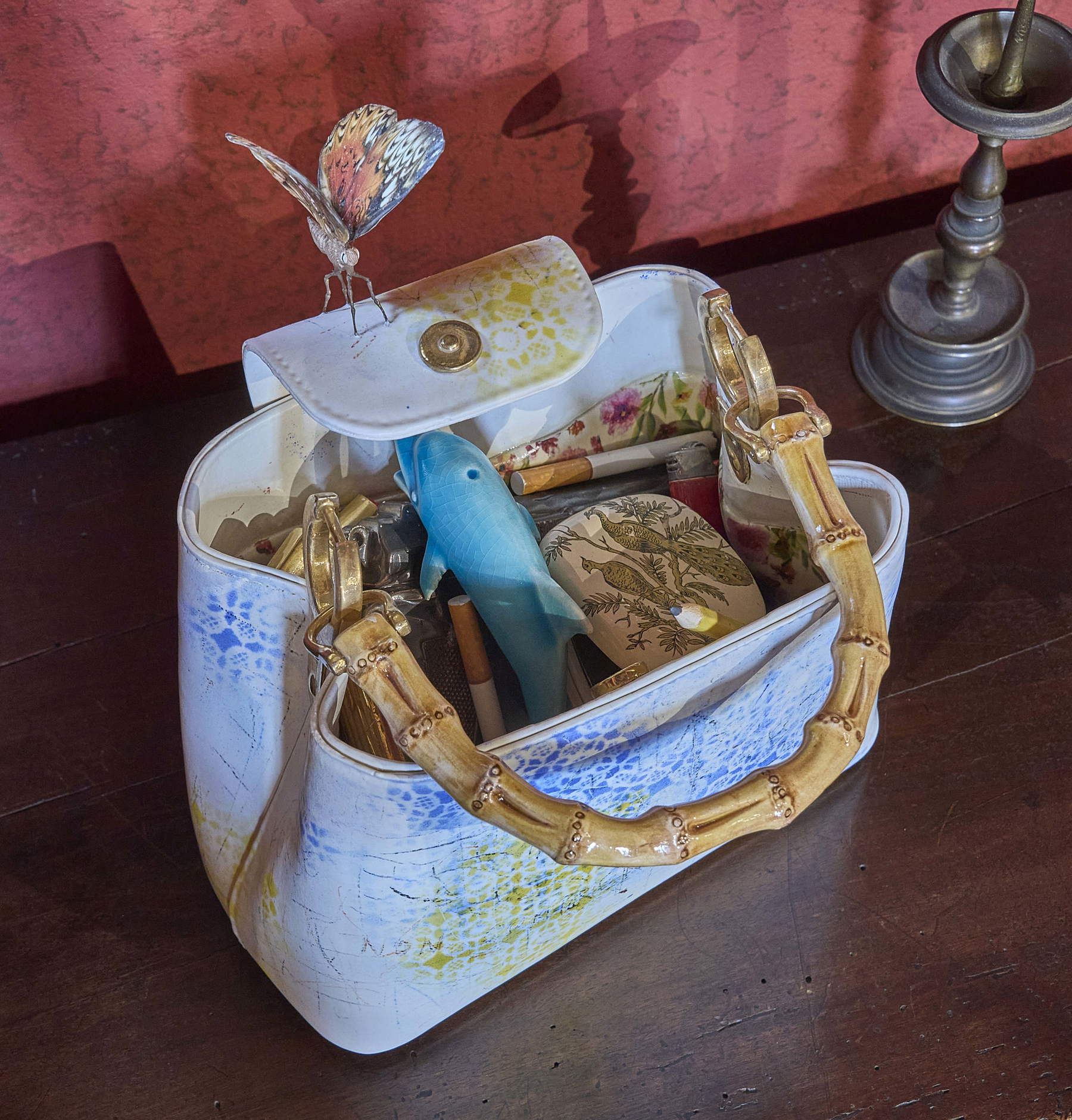
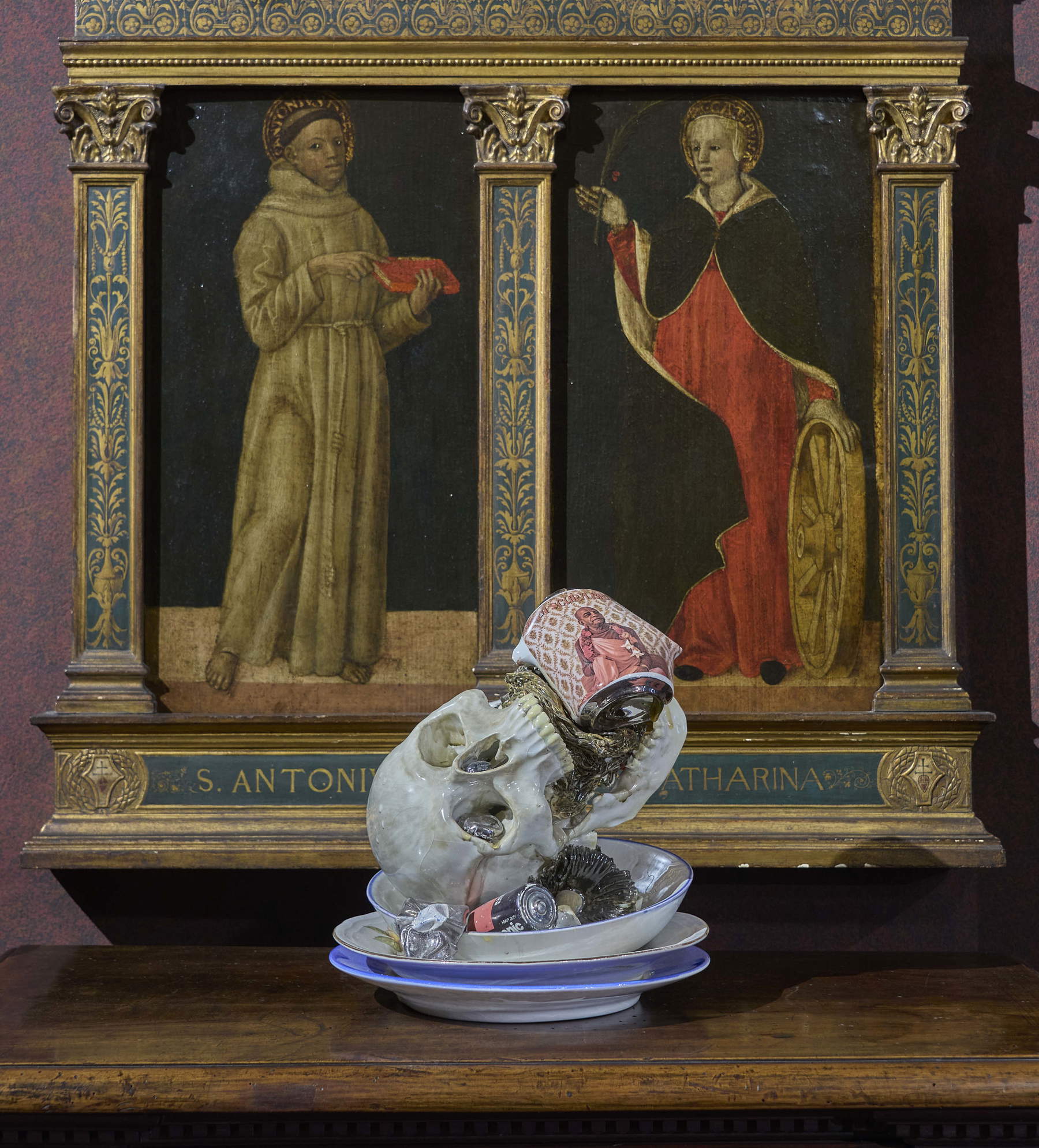
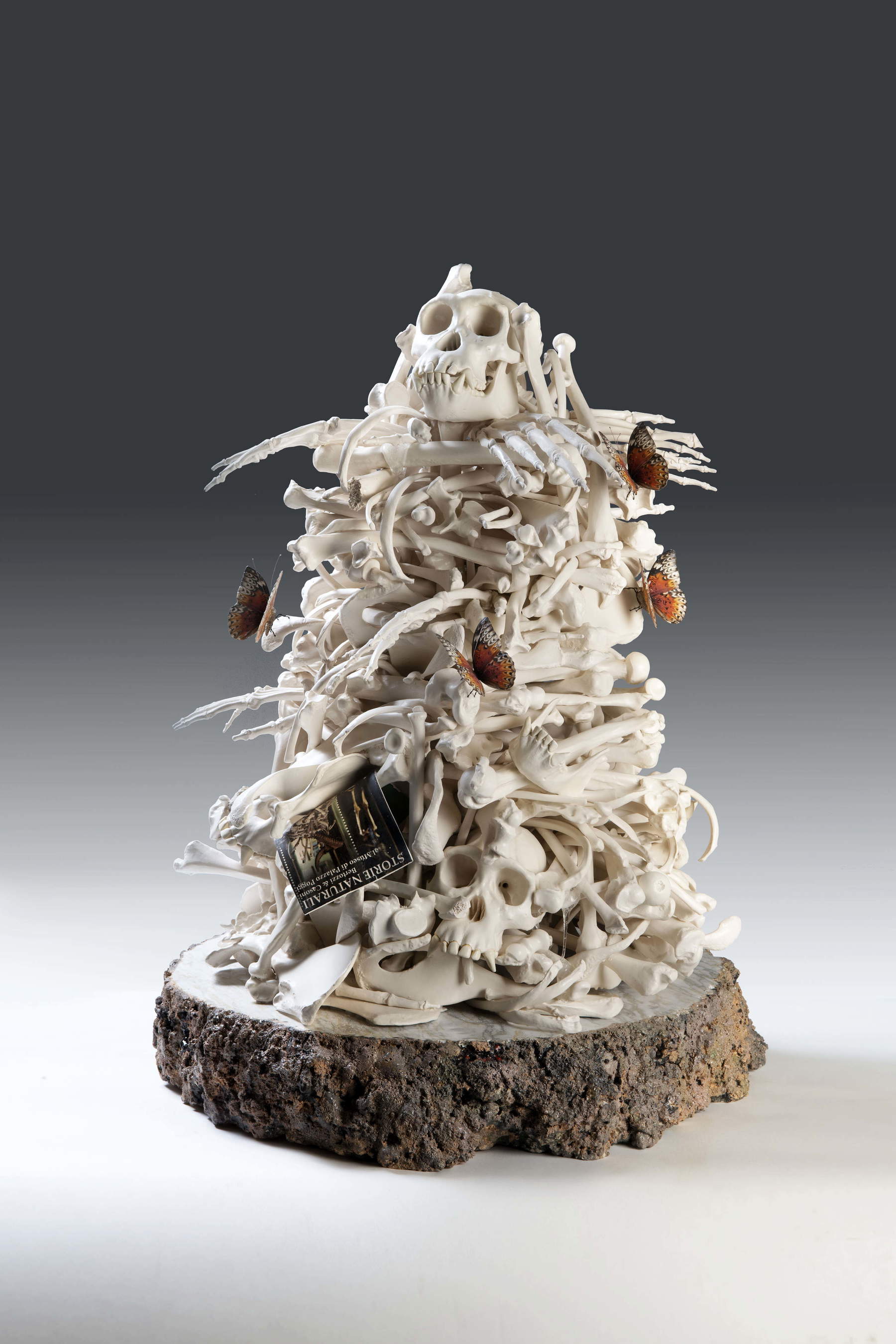
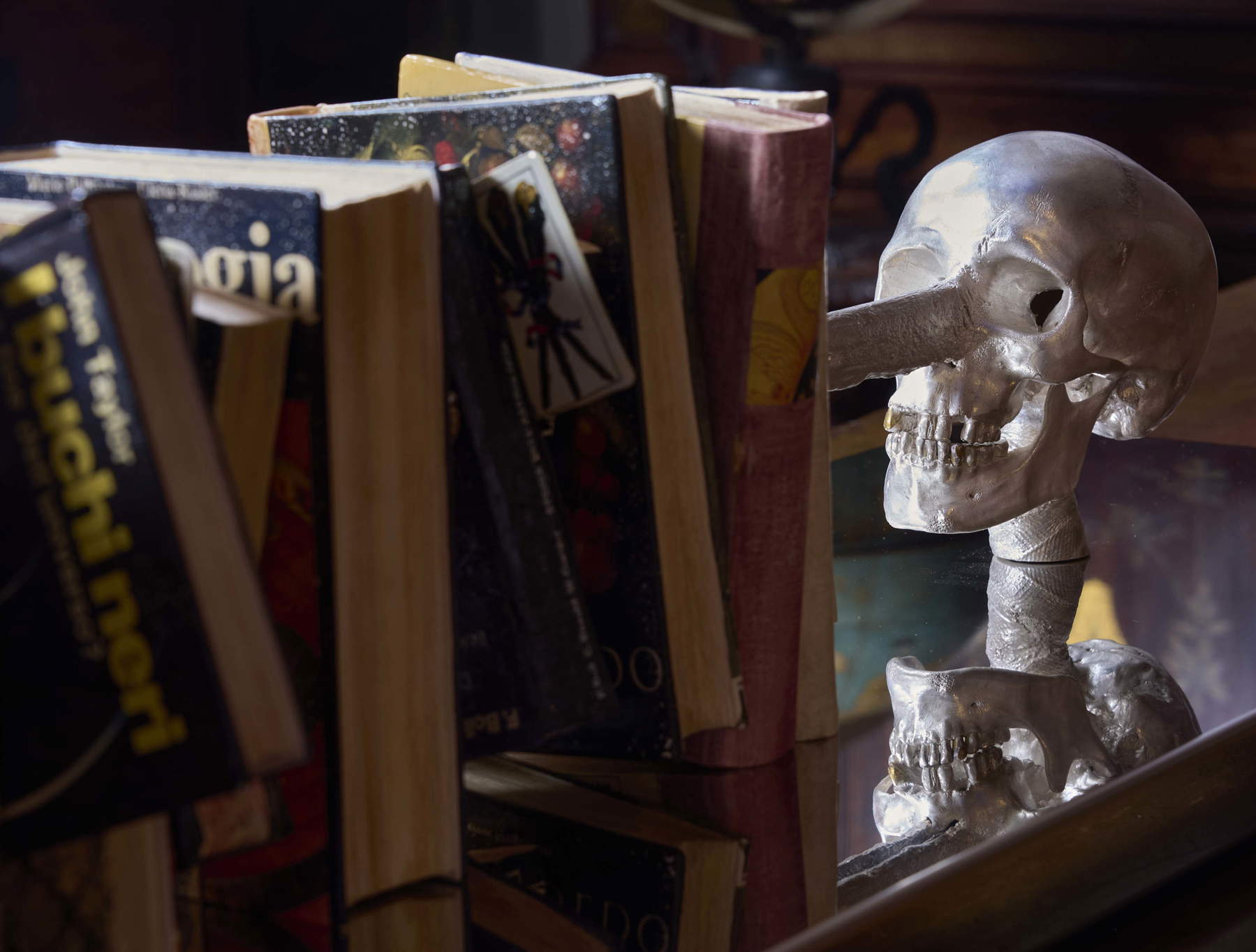
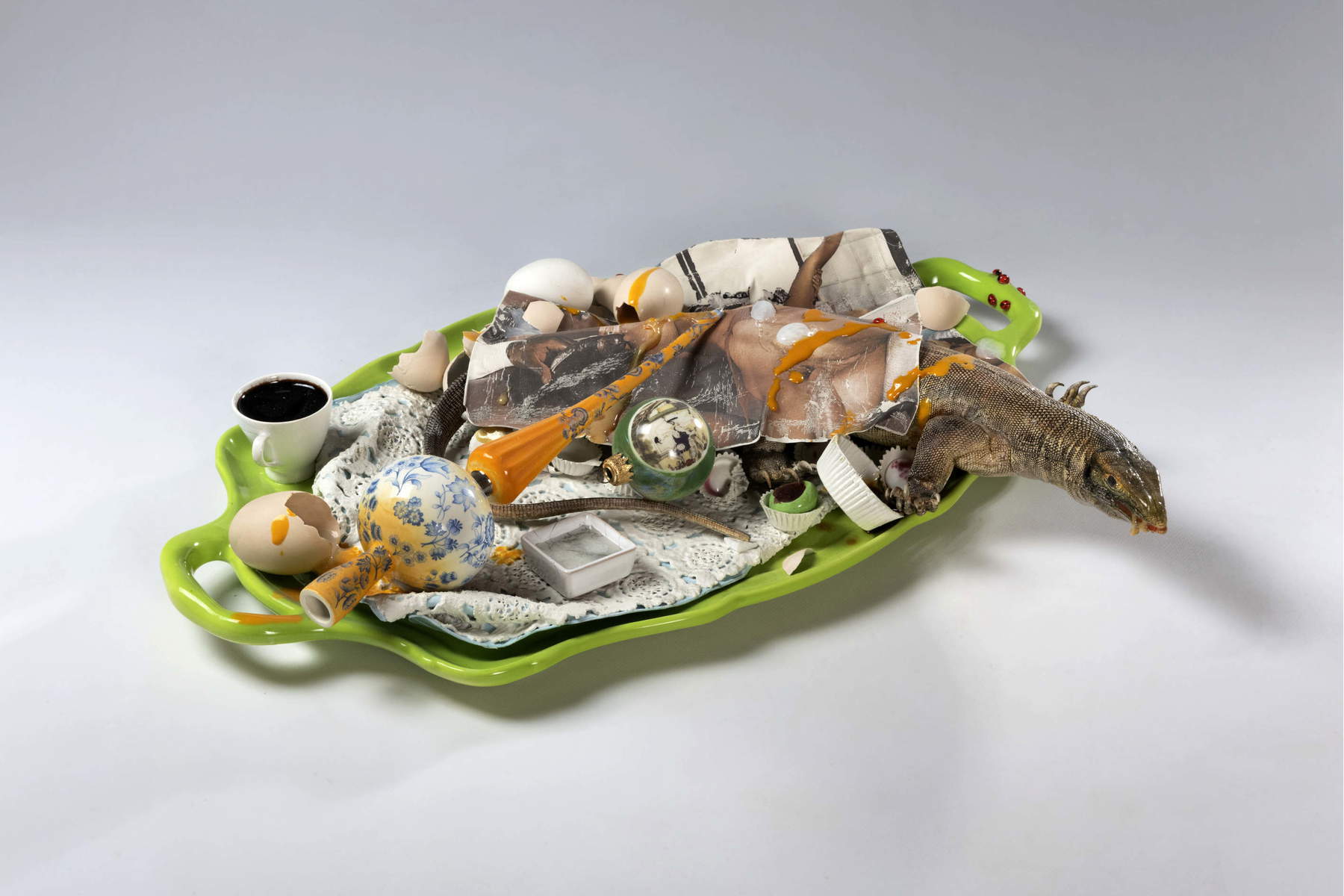
There is no reason not to think that the art of Bertozzi & Casoni is also the art of ruin, putrefaction, deterioration, corruption, and decay. And there’s no need to pretend here: in decomposition, Bertozzi & Casoni’s art finds a dimension that is truer than reality itself. It’s just that one, caught up in this hyperreal, millimeter-precise, bewildering and confusing, shimmering and stunning, phallic and intrusive world—caught up in virtuosity, kitsch, trash, art history, and trompe-l’oeil— well, caught up in all of this, one tends not to think about it—and perhaps it’s even better not to think about it—because that would mean one has tried to unravel the lie, and it would be depressing to transform a resplendent lie into a transliteration of reality. It is also interesting to note, however, that Bertozzi & Casoni do not depict death or decay. Of course, it would be natural to think so, since at first glance everything seems dead, motionless. What is a pile of bones if not a pile of bones—traces of something that was once alive? What is a cleared table if not a breakfast or dinner in an advanced state of decomposition? And then there are flowers with their heads bowed, piles of trash, the remnants of sumptuous feasts—meals that no one would ever dream of eating anymore—buried under ash, threatened by the animals that will feast amid those remains. Yet this is not a mere description: rather, one senses the intention to capture a moment—a rather precise moment, even: the lizards and squirrels darting among the remains, and it’s not rational to think they’ll stay there forever; at most, they’ll stay for a few seconds, just long enough to suck out what’s left of an egg or a cup before retreating back into their hiding places. There are pieces of chocolate that haven’t melted yet, whole pieces of fruit that haven’t rotted yet, chicken heads that haven’t yet been bothered by scavenging insects, and butterflies fluttering over the bones. On the 2005 Tray there are even the freshest traces of a sumptuous cumshot that can’t have been there for more than a few minutes—a sign that even amidst the leftovers, someone is having fun, a sign of life amid that decay that has always fascinated Bertozzi & Casoni—by their own admission—a sign that even ruin can be something undeniably carnal. And then one also tries to imagine: sooner or later, someone will realize that a chimney isn’t exactly the most suitable place for monkey bones to be, and so they’ll throw them somewhere else; they’ll end up somewhere underground or in the middle of a landfill, acids and moisture will dissolve the calcium, the bone will fracture, crumble, and turn to dust.
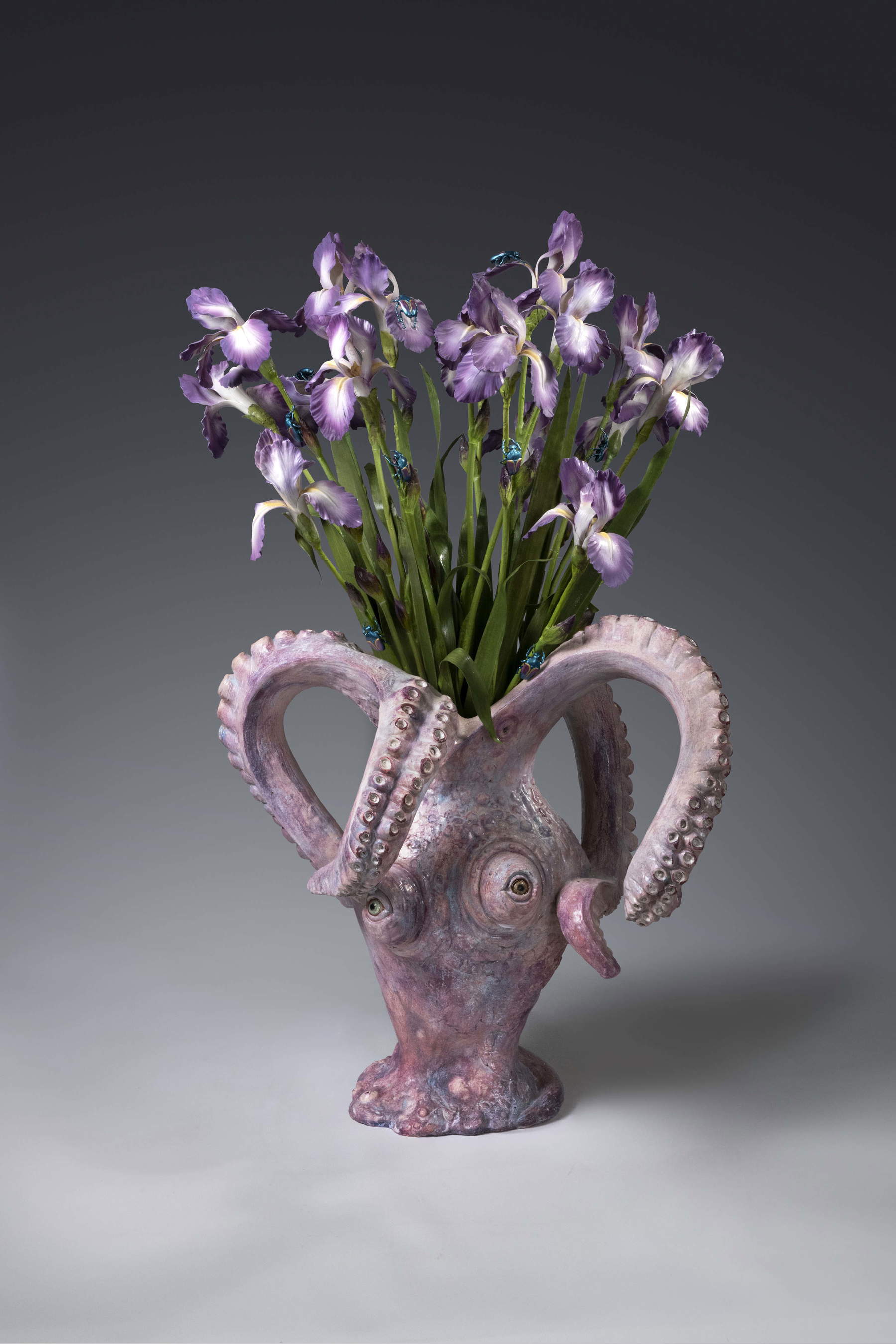
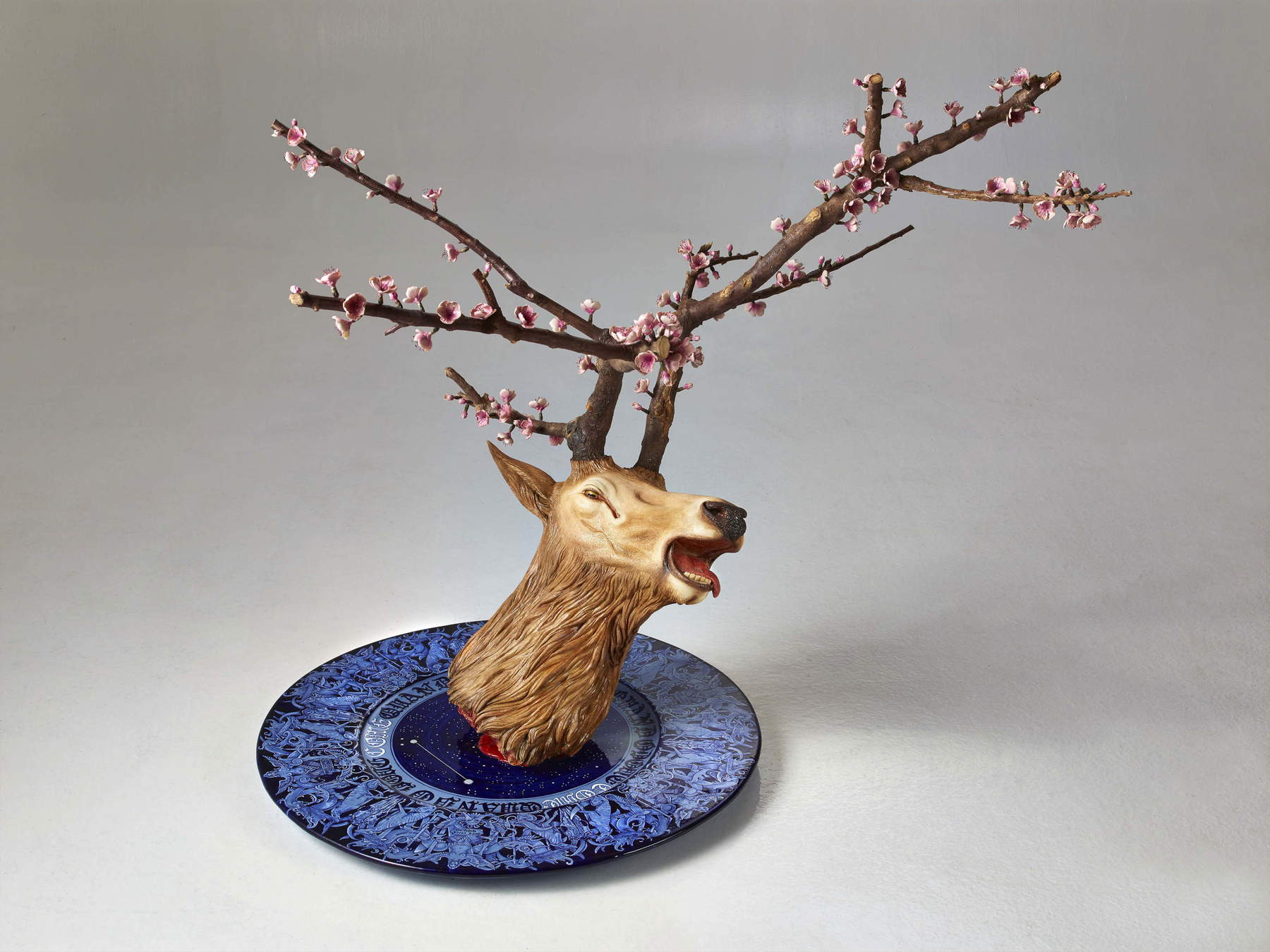
Rather, what we see is the idea of decomposition as a transition—a transition to be captured, and thus to be grasped in all its radiance: an approach that, after all, is not inconsistent with the venue hosting the exhibition—namely, the home of two brothers who had a dream and which became a museum after the dream died. The dream, too, was a transition.*L’Enigma*, created for the occasion—a skull with a long nose à la De Dominicis piercing a stack of books as if on a skewer—is a Warburgian survival of symbols, notes the exhibition’s curator, Alberto Mattia Martini; it is knowledge that tends to repeat itself and transform. *Dove Come Quando*, the severed head of a deer whose antlers have been transformed into budding branches, is metamorphosis in its purest form: moreover, it was created for an exhibition at Palazzo Te and was conceived to encapsulate a sense of disorientation—that of Palazzo Te itself—“which is disorientation,” writes Marco Tonelli, who curated that exhibition, “which Bertozzi & Casoni re-propose in our era, without turning it into drama, tragedy, sociological, or political issues—even if some have read it that way and even if one might do so with good reason: a characteristic of our times in which anxiety and crisis—now endemic to our era—are resolved through fantasies and wordplay.” A work in which, therefore, death was part ofthat visual otium that is the very same force that generated the visions of Palazzo Te. *Il Prelievo*, another work created specifically for the Bagatti Valsecchi, is a further portrait of this ambivalence: humus and scraps, reptiles and cigarette butts, growing irises and dead leaves.
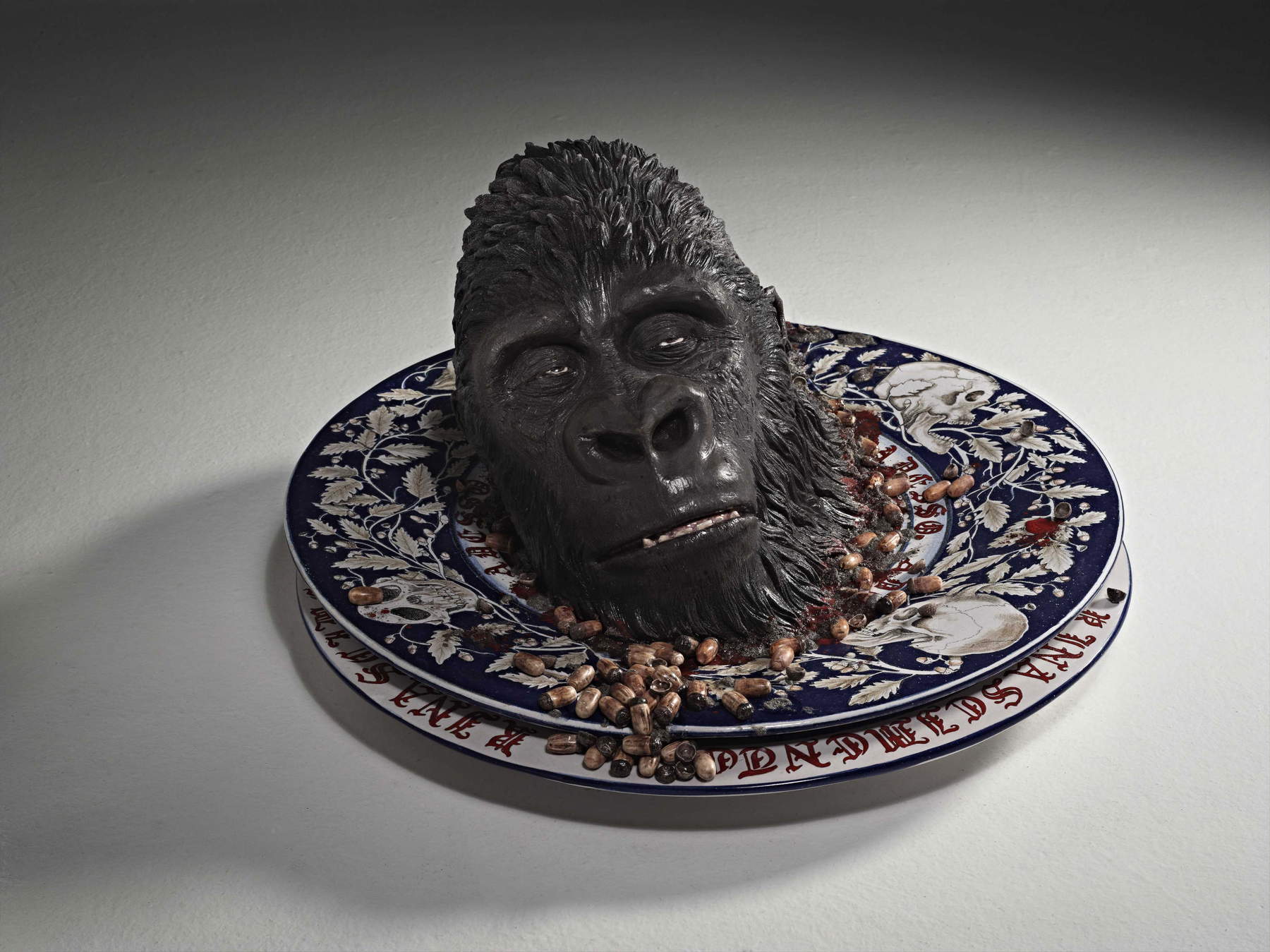
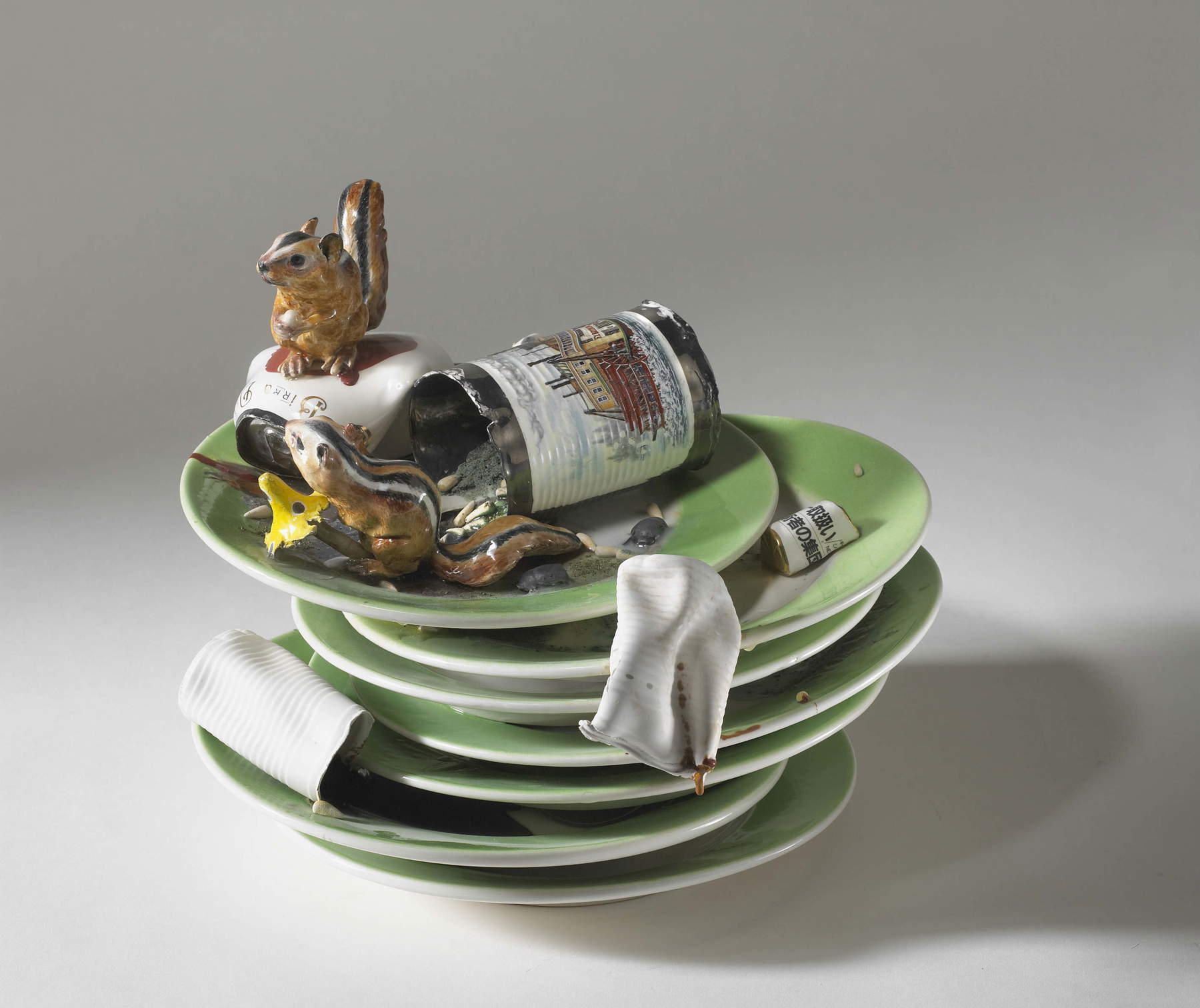
Each work by Bertozzi & Casoni thus resembles a tension, a form of dialectic between darkness and light, in which, however, neither dimension manages to prevail over the other. If decay is an abyss, there is nonetheless a glimmer near that abyss which—however fragmentary, however crooked, however occasional, however fleeting, however perhaps even illusory, forces us to acknowledge that in the midst of ruin nothing happens—perhaps because something can still happen. Even decay, as the two artists recalled during an exhibition of their work more than twenty years ago, is a worldview. Indeed: it is a worldview endowed with a particular intensity. “In decay you find the true essence of life, because everything else is tamed, designed to numb us. In decay you see true life; you see the essence of humanity.”
Everything that is part of a dream is already part of its end, but everything that is part of the end is also part of something else—only it does so under different conditions. And that, on closer inspection, is what the two Bagatti Valsecchi brothers did with their antiques scavenged from secondhand dealers, with their Renaissance polyptychs, with their fragments of frescoes—and it is exactly what happened to the two brothers; it is what happened to their home. Perhaps they never asked themselves what is true at the moment one becomes aware that everything is merely a transition. But you can bet that even they knew full well—and if they didn’t know it, they certainly sensed it—that death always bears the nature of eternity and a calling toward matter.

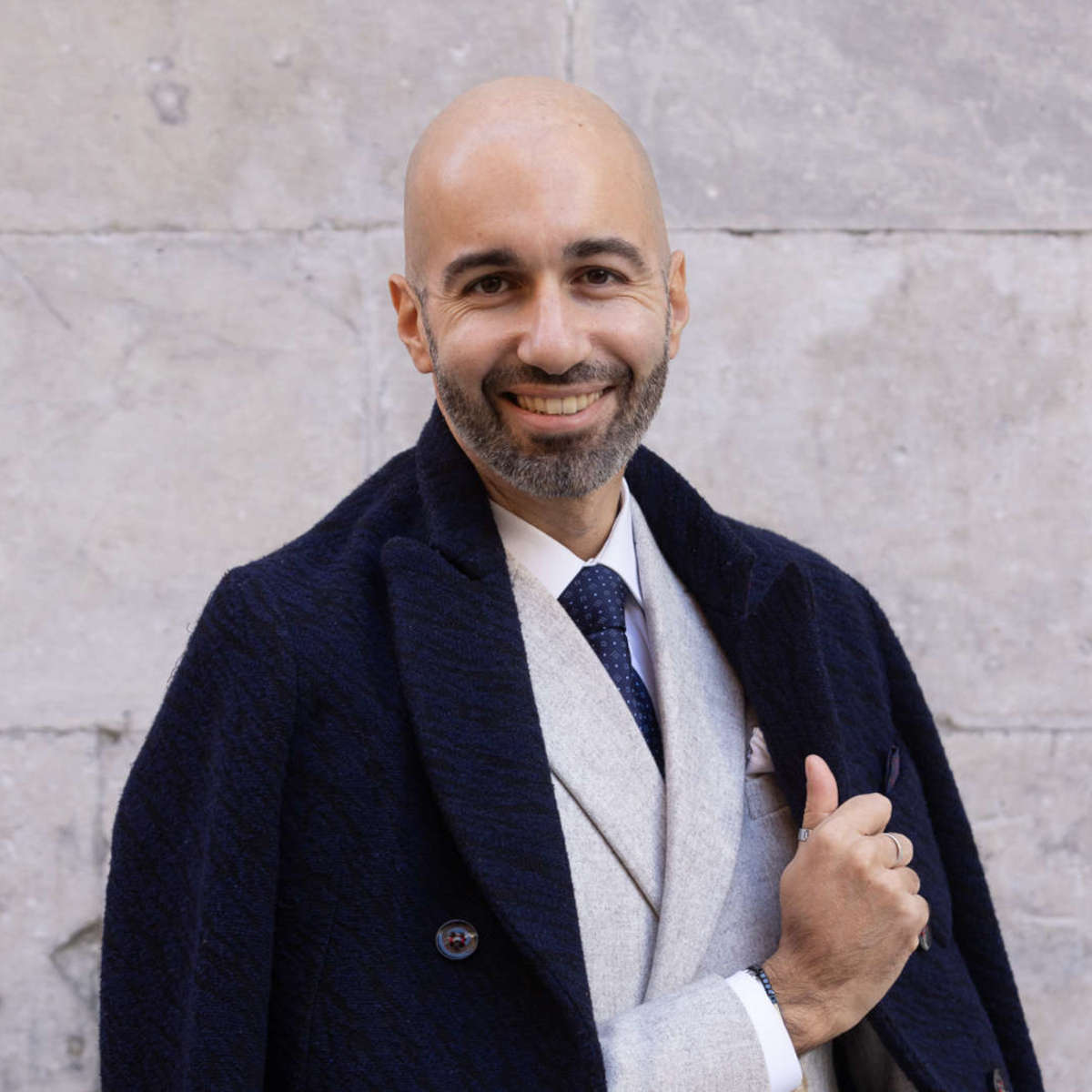
The author of this article: Federico Giannini
Nato a Massa nel 1986, si è laureato nel 2010 in Informatica Umanistica all’Università di Pisa. Nel 2009 ha iniziato a lavorare nel settore della comunicazione su web, con particolare riferimento alla comunicazione per i beni culturali. Nel 2017 ha fondato con Ilaria Baratta la rivista Finestre sull’Arte. Dalla fondazione è direttore responsabile della rivista. Nel 2025 ha scritto il libro Vero, Falso, Fake. Credenze, errori e falsità nel mondo dell'arte (Giunti editore). Collabora e ha collaborato con diverse riviste, tra cui Art e Dossier e Left, e per la televisione è stato autore del documentario Le mani dell’arte (Rai 5) ed è stato tra i presentatori del programma Dorian – L’arte non invecchia (Rai 5). Al suo attivo anche docenze in materia di giornalismo culturale all'Università di Genova e all'Ordine dei Giornalisti, inoltre partecipa regolarmente come relatore e moderatore su temi di arte e cultura a numerosi convegni (tra gli altri: Lu.Bec. Lucca Beni Culturali, Ro.Me Exhibition, Con-Vivere Festival, TTG Travel Experience).
Warning: the translation into English of the original Italian article was created using automatic tools. We undertake to review all articles, but we do not guarantee the total absence of inaccuracies in the translation due to the program. You can find the original by clicking on the ITA button. If you find any mistake,please contact us.























 IT
IT FR
FR DE
DE ES
ES CN
CN


