



by Redazione 05/07/2026



Categories: Exhibitions / Disclaimer
More than 100 works from the Carlo Palli Collection trace more than 60 years of the verbovisual artist’s creative journey. The exhibition on Lamberto Pignotti, organized at Palazzo Guadagni Strozzi Sacrati in collaboration with the Pecci Center, will be open to the public through August 24.
Florence is celebrating the 100th birthday of Lamberto Pignotti (Florence, 1926) with a major exhibition that traces over sixty years of artistic and theoretical work by one of the most innovative figures of the Italian Neo-Avant-Garde. From June 29 to August 24, 2026, Palazzo Guadagni Strozzi Sacrati, the headquarters of the Region of Tuscany, will host *Visibile Invisibile*, a comprehensive exhibition curated by Laura Monaldi and organized in collaboration with the Luigi Pecci Center for Contemporary Art. The opening is scheduled for Monday, July 6, at 1:00 p.m. The exhibition brings together over one hundred works from the Carlo Palli Collection in Prato, one of the most important private collections dedicated to Italian verbal-visual art. The works on display come partly from the Carlo Palli Archive and partly from donations the collector made to the Luigi Pecci Center for Contemporary Art, offering the public a unique opportunity to explore Pignotti’s entire creative journey, from his early beginnings to the most recent developments in his work.
The exhibition project highlights the coherence of a body of work that has spanned decades of cultural transformation without compromising its radical nature. From the early pencil drawings of his youth to his mature works, the exhibition aims to highlight the continuity of a body of work that has always centered on the relationship between language, image, and contemporary society, making linguistic experimentation andinterdisciplinarity the defining elements of Pignotti’s work.


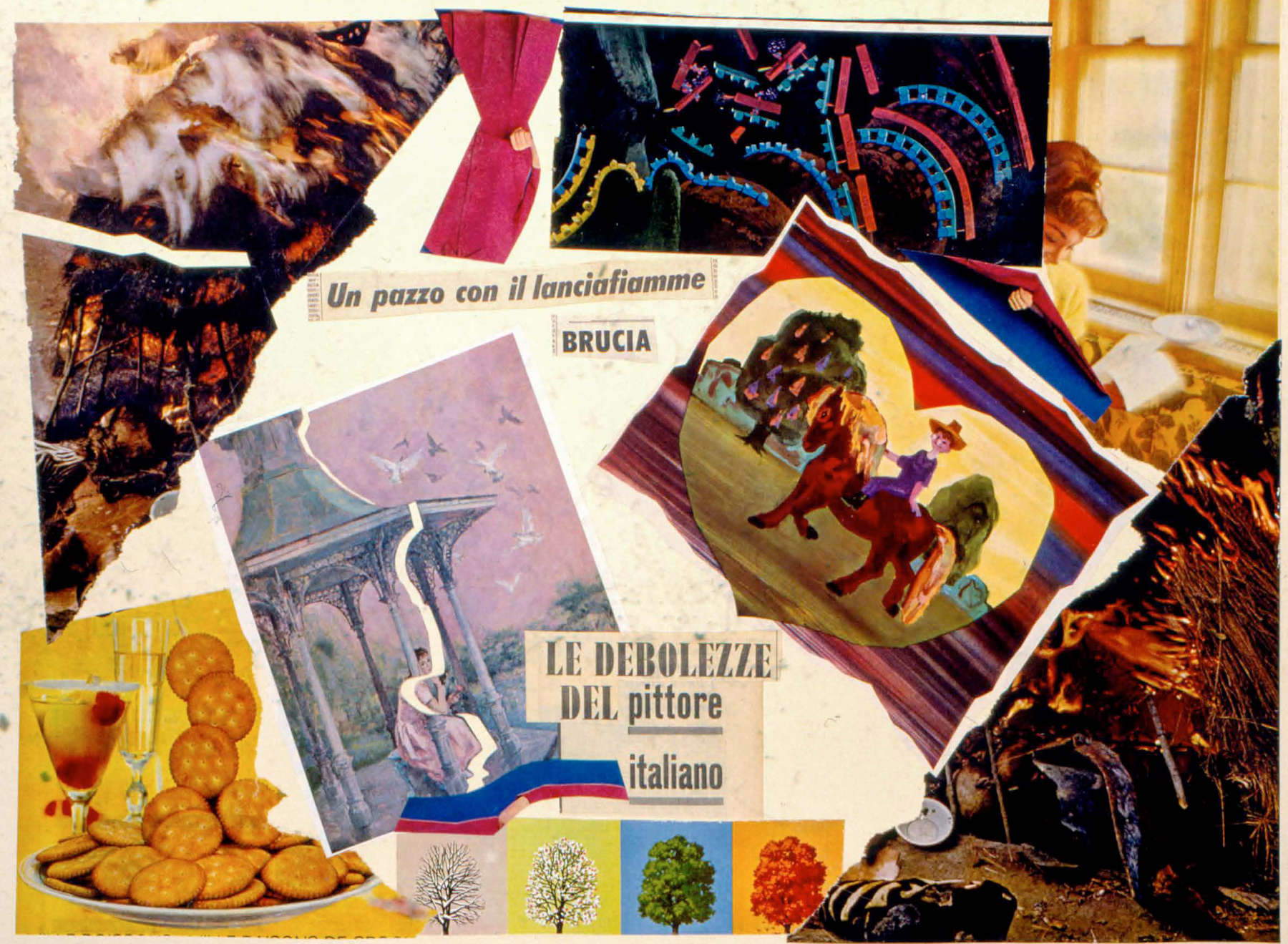
The exhibition documents all the fundamental aspects of his verbal-visual practice. On display are the famous collages created on printed paper in the 1960s, a period during which the artist began using materials from mass media, transforming them into poetic and critical tools. Alongside these are the “Zero,” “Souvenir , ” and “Versus” series, created between 1969 and 1970, which are considered among the most significant milestones in his artistic career. Visitors will also be able to view the artist’s stamps, the 1968 works on cardstock , and those fragments of a female voice “stolen” from everyday language, which represent one of the most original features of Pignotti’s poetics. The exhibition continues with the cyclical “Decomposizioni,” created between 1976 and 1979, and the “Visibile Invisibile” cycle, leading up to works from the 1980s and 1990s, including the *Drink Poems*, and concluding with collages from the 1990s and 2000s, in which writing, image, and irony merge into an expressive system that continues to generate new layers of meaning.


The very title of the exhibition, Visible Invisible, encapsulates one of the central aspects of the artist’s reflection. The exhibition invites visitors to engage with the mechanisms of contemporary communication, highlighting the visual and verbal saturation that characterizes today’s society and demonstrating how language—whether verbal or iconic—can never be considered neutral, transparent, or devoid of implications. The exhibition thus aims to construct a comprehensive reading of Pignotti’s work, highlighting the continuity of a body of work that, over more than six decades of activity, has consistently maintained a strong critical stance toward the languages of mass communication. From the biting irony of his 1960s collages to the sophisticated semiotic layers of his most recent works, a poetic vision emerges that questions the present through the blending of languages.
“On the centennial of Lamberto Pignotti’s birth,” says curator Laura Monaldi, “the exhibition traces over sixty years of one of the most radical artistic explorations of the Italian Neo-Avant-Garde. A poet, theorist, and visual artist, Pignotti founded the Gruppo ’70 in Florence in 1963, together with Eugenio Miccini, ushering in an era that challenged the boundaries between word and image, between literature and mass communication. The exhibition traces the various phases of his artistic practice: from the collages of the 1960s and his most famous artistic series to his most recent cycles. Through verbal-visual collage, Pignotti transforms the language of advertising, the press, and the mass media into poetic material, restoring to writing a critical function vis-à-vis consumer society. Today, decades later, those experiments appear remarkably prescient. The dissolution of boundaries between the arts, the hybridization of word and image, the centrality of the technical device, and the active participation of the viewer—elements that now appear structural to the contemporary cultural ecosystem—were already at the heart of the experiments of the 1960s. Digital culture, with its networked and multimedia nature, finds a surprisingly lucid precedent in the intermedial practices of that period. Re-examining Lamberto Pignotti’s poetics means exploring the origins of a sensibility that has become our own. A century after his birth, the lesson from this intellectual lies in the need for poetry to constantly renegotiate its relationship with contemporary language, without isolating itself or conforming to the mainstream. Through the fusion of languages, he redefined the role of poetry, transforming it into a critical tool for interpreting the present and offering tools that remain valid for understanding today’s aesthetic and media complexity.”
The exhibition is on view at Palazzo Guadagni Strozzi Sacrati, located at Piazza Duomo 10 in Florence. It will be open Monday through Friday from 10 a.m. to 12:30 p.m. and from 2 p.m. to 4:30 p.m., while on Saturdays it will be open from 10 a.m. to 12:30 p.m. Visits are by reservation only; please call 055 4385616 Monday through Friday from 9 a.m. to 1 p.m.
Notes on the Artist
Born in Florence in 1926, Lamberto Pignotti earned his degree in the Tuscan city, where he lived until 1968, the year he moved to Rome. As early as 1944, having absorbed the lessons of the historical avant-garde movements, he began his first experiments in the field of verbal-visual art, anticipating much of the artistic exploration that would characterize his later work. Starting in the mid-1950s, he became a prolific essayist focused on militant criticism and current cultural issues. She was a regular contributor to national newspapers and magazines, including *Paese Sera*, *La Nazione*, *l’Unità*, and *Rinascita*, and also appeared on RAI programs, helping to foster artistic and cultural debate in Italy.
In the 1960s, he developed and theorized the earliest forms of technological poetry and visual poetry, publishing the first anthology of these works in 1965. In 1963, he was among the founders of Gruppo ’70, an initiative destined to profoundly influence the landscape of Italian artistic experimentation, while a few months later he also participated in the formation of Gruppo 63, another pivotal moment in the literary neo-avant-garde.
Alongside his artistic work, he also pursued an academic career. From 1971 to 1996, he taught first at the Faculty of Architecture in Florence and later at DAMS in Bologna, dedicating his courses to the relationships between artistic avant-gardes, mass media, and new communication technologies, thereby contributing to the education of generations of students.
Pignotti’s entire body of work is based on the interaction between different codes. Verbal languages, images, sounds, smells, taste, touch, behaviors, and the theatrical dimension are continually brought into relation with one another, giving rise to a multimedia and synaesthetic body of work that includes happenings, performances, “Poesie e no,” cine-poems, logo-musical cassettes, plastic object-books, poems to touch, drink, and eat, “chewing poems,” and, of course, his famous visual poems created through collages and interventions on news, fashion, and advertising photographs.
Throughout his career, Pignotti has published works of poetry, fiction, essays, and visual poetry with some of Italy’s leading publishers, including Mondadori, Einaudi, Marsilio, Laterza, and Skira. His work has been included in numerous Italian and international anthologies and has been the subject of extensive critical scholarship. In 2025, Mimesis Editions published *Opere letterarie* (Literary Works), edited by Teresa Nocita, a volume that brings together the author’s entire body of poetry and prose.
In terms of exhibitions, the artist’s career has been marked by a constant presence at major events dedicated to contemporary art. He participated in six editions of the Venice Biennale—in 1966, 1972, 1978, 1980, 1986, and 1993; he was present at Documenta 5 in Kassel in 1972 and at the 11th Rome Quadriennale in 1986. His works are now held in numerous Italian and international institutions.
Further recognition came in 2023, when his archival and library collection was declared to be of historical interest by the Archival and Bibliographic Superintendence of Lazio. The collection was subsequently acquired by the National Central Library of Florence, which dedicated the exhibition “Originali” to him, thereby contributing to the promotion of his documentary legacy.
The centennial of his birth also gave rise to a packed program of initiatives in Italy and abroad, including exhibitions, conferences, and publications that confirm the central role played by Lamberto Pignotti in the history of 20th-century Italian art, poetry, and culture.
|
| Lamberto Pignotti: An Exhibition in Florence to Mark His 100th Birthday |
Warning: the translation into English of the original Italian article was created using automatic tools. We undertake to review all articles, but we do not guarantee the total absence of inaccuracies in the translation due to the program. You can find the original by clicking on the ITA button. If you find any mistake,please contact us.