




The Italian tour of *The Woman in Blue*, one of the most famous paintings by Johannes Vermeer (Delft, 1632–1675)—part of the Rijksmuseum’s collection in Amsterdam and considered one of the finest examples of 17th-century Dutch painting—continues. After taking center stage in the exhibition held in the Sala Atelier of Palazzo Madama in Turin from March 5 to June 29, 2026, the work arrives in Rome, where it will be on display in the halls of Palazzo Barberini from July 8 to October 11, 2026. Its arrival in the capital offers a new opportunity to engage with one of the most enigmatic and fascinating works by the Master of Delft, an artist who, despite having left behind a relatively limited body of work, continues to exert an extraordinary influence on the history of Western art. *Woman in Blue Reading a Letter*—the title by which the painting is generally known—is, in fact, an exemplary synthesis of Vermeer’s artistic vision: a painting built on silence, light, and allusion, capable of transforming an everyday gesture into a scene suspended in time.
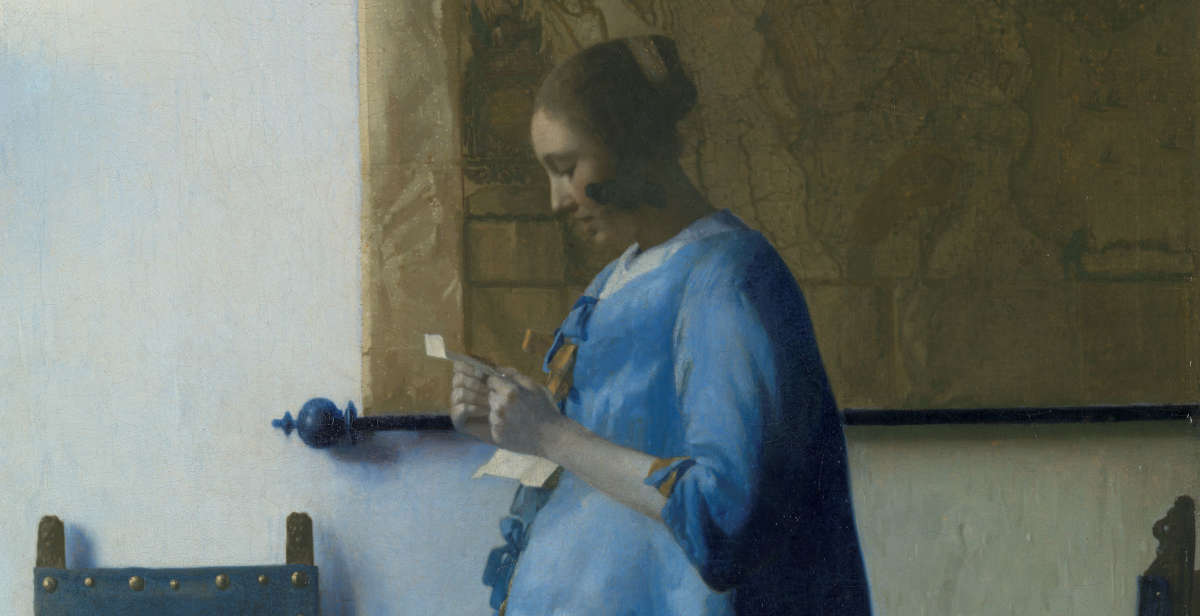
The composition unfolds within a domestic setting illuminated by daylight. Nothing extraordinary appears to be happening: a young woman is portrayed in profile as she reads a letter. Her hair is tied back, and her attire is simple and suited to domestic life. Yet it is precisely in the choice of an ordinary moment that the artist’s greatness is revealed—he is capable of transforming everyday life into a visual and psychological experience of extraordinary intensity. The woman holds the sheet of paper with both hands and appears completely absorbed in her reading. Her body is still, almost motionless, while her face suggests a concentration that never gives way to an openly expressed emotion. The viewer is confronted with a private scene to which they are not truly admitted. They can observe, but not participate. They can imagine, but not know.
One of the elements that has most caught the attention of scholars concerns the young woman’s possible pregnancy. Her soft, rounded belly, emphasized by the line of her dress, suggests this interpretation, although the matter remains a subject of debate. The beddejak—the traditional Dutch house jacket, fastened with small bows and characterized by a deep blue hue that dominates the entire composition—helps emphasize the centrality of the figure. A few essential objects are arranged around the protagonist. The dark wooden chairs decorated with brass studs, the table covered with a cloth, and a few seemingly secondary elements create a tidy yet richly symbolic setting. On the table, one can make out a pearl necklace, a sheet of paper that might be another letter, and an open box, as if someone had just been searching for something inside it. These are details that amplify the narrative sense of the scene without providing definitive explanations.
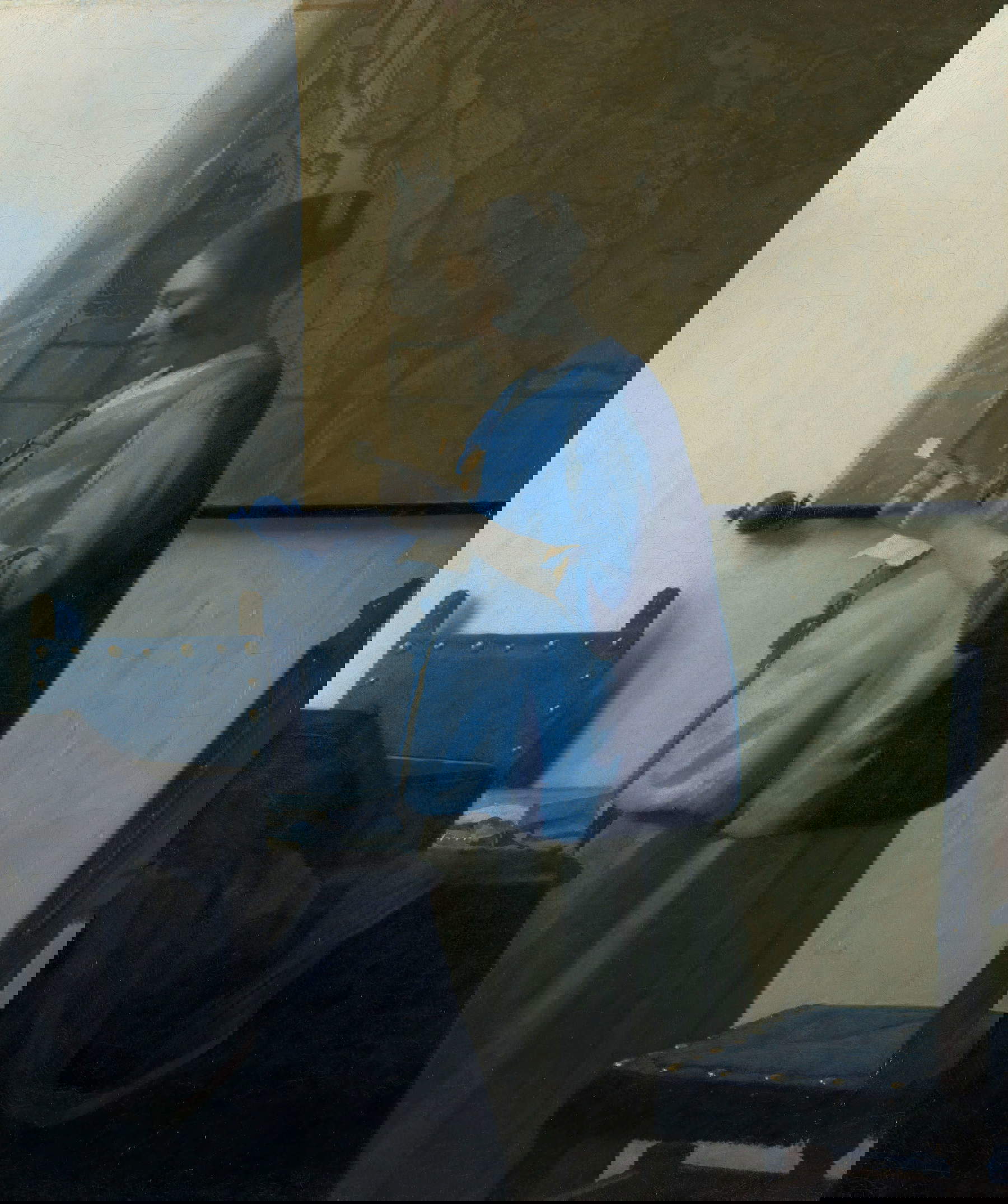
As is often the case in Vermeer’s paintings, the narrative remains open-ended. The letter the woman is reading represents the symbolic center of the work, but its contents remain unknown. We do not know who wrote it, where it came from, or what news it contains. Nor do we know what relationship exists between the sender and the recipient. The artist offers no answers but instead constructs a system of clues that invites the viewer to imagine a story without ever being able to reconstruct it completely. This ability to suggest rather than explain is one of the most modern aspects of Vermeer’s painting. The narrative tension arises precisely from the absence of certain information. The viewer is drawn into an interpretive process that inevitably remains unfinished, transforming the painting into an open-ended and ever-relevant work.
Color dominates the scene above all else. The true visual focal point of the painting is, in fact, the intense blue patch on the dress—a chromatic presence that organizes the entire composition and determines its balance. The blue does not serve a merely decorative function. Rather, it becomes the energetic center of the image, the point around which the relationships between light, space, and figure are constructed. To achieve this result, Vermeer turned to one of the most precious materials available in seventeenth-century Europe: lapis lazuli. This stone yielded the pigment used to produce natural ultramarine, a particularly expensive color that reached Europe via the major trade routes connecting the continent with Asia.
The decision to use such a precious material attests not only to the painter’s artistic ambitions but also to his deep understanding of the perceptual effects of color. The blue created with lapis lazuli possesses unique characteristics: it absorbs light and reflects it diffusely, creating a vibration that gives the figure an almost tangible presence. The dress seems to expand into space, transforming into a visual field that envelops the entire scene.
The power of the painting, however, does not stem solely from the female figure. The elements in the background also contribute to the work’s meaning. Behind the woman, in fact, a large map hangs on the wall. It is a depiction of Holland and West Friesland, based on the famous map printed in 1621 by Willem Janszoon Blaeu after a design by Balthasar Floriszoon van Beckernrode. The presence of the map introduces an additional dimension to the domestic scene. While the woman is immersed in a moment of absolute intimacy, the map symbolically opens up the space to the outside world. The object evokes the Dutch Golden Age, a period during which the Republic of the United Provinces experienced extraordinary economic, commercial, and cultural expansion. Maritime explorations, international trade, and the establishment of commercial networks extending far beyond European borders constitute the historical context evoked by that map. The map thus becomes a sort of symbolic window connecting the protagonist’s private sphere to the global reality of her time.
The tension between the interior and the exterior is one of the work’s most subtle aspects. While the woman focuses all her attention on the contents of the letter, behind her unfolds an image of the world that evokes travel, discovery, and long-distance relationships. The letter itself could also be interpreted as the meeting point between these two dimensions: an object that traverses space and connects distant people, bringing news from elsewhere into the home.
To fully understand the meaning of this painting, it must be placed within the context of Delft in the second half of the 17th century. The city where Vermeer lived and worked was not only an important economic center but also a place characterized by extraordinary cultural vitality. Here, commercial activity, scientific experimentation, technical innovation, and artistic production coexisted. Artisans’ workshops interacted with cartographers’ studios, while merchants’ homes housed scientific instruments, maps, and objects from the most diverse corners of the world. An interest in observing reality and in empirical knowledge was an essential component of Dutch culture at the time.
It was in this environment that Vermeer’s sensibility developed. The artist was not an isolated figure or one detached from the transformations of his time. On the contrary, his work appears deeply embedded in the cultural climate that characterized the Dutch Republic during its heyday. Antonie van Leeuwenhoek, the great pioneer of microbiology born in Delft, stands as one of the most significant figures in this context. His scientific work helped transform the way reality was observed, drawing attention to details and phenomena that had previously been invisible. Although they belong to different fields, Leeuwenhoek’s scientific research and Vermeer’s painting share a common focus on observation and the precision of the gaze. Alongside this scientific dimension stands the thought of Baruch Spinoza, one of the most important philosophers of seventeenth-century Europe. The symbolic proximity between these figures paints a picture of a complex and open intellectual environment, in which art, philosophy, and science contributed to redefining the relationship between humanity and the world.
 |
| Vermeer's "Woman in Blue" Arrives in Rome Following the Exhibition in Turin |

Warning: the translation into English of the original Italian article was created using automatic tools. We undertake to review all articles, but we do not guarantee the total absence of inaccuracies in the translation due to the program. You can find the original by clicking on the ITA button. If you find any mistake,please contact us.























 IT
IT FR
FR DE
DE ES
ES CN
CN


