





Today in Pietrasanta, the Sant’Agostino Complex—one of the symbols of the area’s historical and artistic heritage—is being returned to the city: The official inauguration of the restored complex is scheduled for Saturday, June 27, at 7:00 p.m., following a lengthy restoration project promoted and fully funded by the Paolo and Giuliana Clerici Foundation, which has invested over 900,000 euros in the project over the past six years. The restoration process, which began in 2020, yielded its first result in May 2023 with the reopening of the historic Sala dell’Annunziata, which is once again available as an exhibition and cultural space for the community. The project is now complete with the restoration of the marble façade of the Church of Sant’Agostino. The restoration project was accompanied by a parallel cultural initiative: the photography exhibition *La Santità della Pietra* by Luca Forno, held in June in the Sala delle Grasce. The exhibition documented the restoration site and the complex’s historic surfaces, offering a visual account of the monument’s transformation process.
Institutional recognition of the bond between the Foundation and the city came in 2024, when the Municipality of Pietrasanta conferred honorary citizenship upon Paolo and Giuliana Clerici, in recognition of their role in supporting the preservation of the local cultural heritage.
Among the most significant interventions was the restoration of the bronze lunette created by Igor Mitoraj, an element of great symbolic value that once again engages with the city’s artistic identity at the very moment when Pietrasanta is inaugurating the new Mitoraj Museum, designed to house part of the master’s legacy. The project, however, was not limited to architectural conservation alone but evolved into a sort of multidisciplinary research laboratory under the guidance of architect Maura Tardini. The project involved historians, archaeometrists, geologists, architects, conservators, and engineers, bringing to light new information about the complex’s history and its structural stratifications.
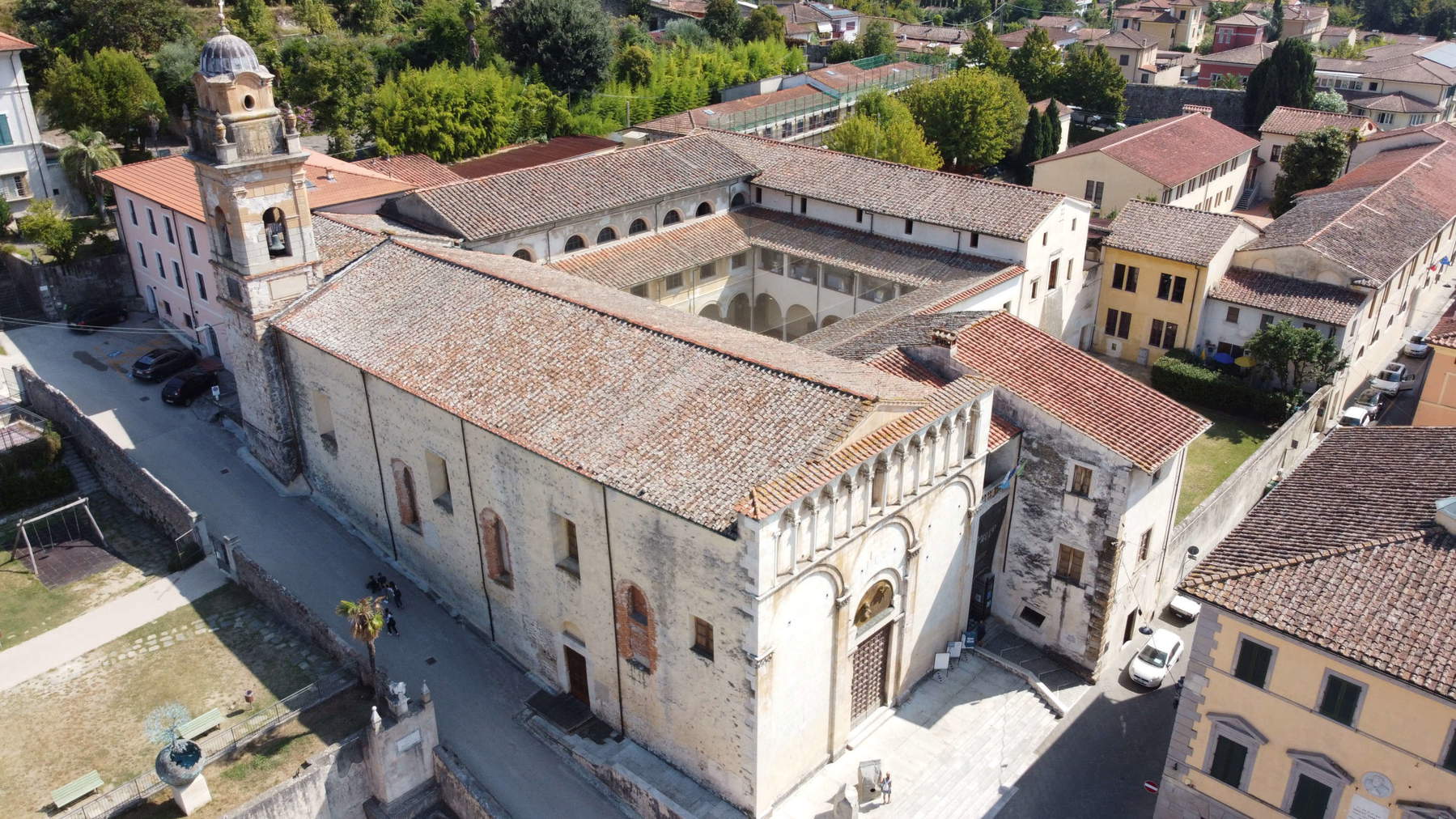
Among the most significant discoveries is the exceptional variety of stone materials used for the façade. Analyses have in fact revealed the presence of numerous types of marble from the Apuan Alps, some of which are rare, presenting the façade as a veritable “atlas of Apuan marbles,” in which the material itself serves as historical and geographical evidence.
The investigations also made it possible to identify fragments of ancient medieval tombstones that were reused in the construction of the façade, helping to redefine the monument’s chronology and strengthening the hypothesis that the lower part of the façade was attributed to the workshop of the Pisan master Giovanni di Gante.
The restoration project involved numerous professionals and specialized firms. The restoration of the marble elements was entrusted to Restauroitalia, while the bronze lunette was restored by Atelier Mitoraj. EMI and Localnet Livorno handled the mechanical and electrical systems, while RED Studio managed the design and construction supervision. Safety coordination was entrusted to engineer Italo Viti. Additional expertise was provided by historian and geologist Antonio Bartelletti, together with Pietro Vecchio.
“Over the years, my wife Giuliana and I,” says Paolo Clerici, president of the Paolo and Giuliana Clerici Foundation, “have developed a deep connection with Pietrasanta, an extraordinary city where art, history, craftsmanship, and culture coexist in a unique way. Contributing to the restoration of Sant’Agostino means giving back a symbolic place to the community and, at the same time, helping to preserve a heritage that belongs to the entire country.”
“Seeing the façade of Sant’Agostino restored to its original beauty,” says Alberto Stefano Giovannetti, mayor of Pietrasanta, “is an emotion that touches the heart of every resident of Pietrasanta. I thank Paolo and Giuliana Clerici for this commitment, which is a true testament to their selfless love for culture and for the preservation of our shared heritage. Thanks also to the craftsmen and technicians who worked on the project: Saturday, June 27, will be a celebration for our entire city.”
The Sant’Agostino Complex, originally known as the Church of the Santissima Annunziata, stands as one of the most important testaments to the Augustinian presence in Tuscany. Founded in the early 14th century as a city convent, the complex gradually became a key religious, social, and economic hub for the local community, during a period when the city benefited from trade linked to the nearby port of Motrone. Over the centuries, Lucca’s leading merchant families—including the Altelminelli, Sbarra, Forteguerri, Perfettucci, Tadolini, and Gigli—chose the church as a burial site and a symbol of their social status, helping to cement its role as a symbolic space for the city. The tombstones still preserved within the complex serve today as a reminder of that economic and cultural system linked to the Lucca silk trade and the medieval European merchant network.
The monumental white marble façade, built in the early decades of the 15th century using materials from the Apuan Alps, is one of the most significant examples of late Gothic Tuscan architecture and bears witness to the deep connection between Pietrasanta and marble—an element that still defines the region’s industrial and cultural identity today.
The complex is also linked to the figure of Eugenio Barsanti, born in Pietrasanta in 1821 and considered one of the pioneers of the internal combustion engine alongside Felice Matteucci. It was in this very church that Barsanti attended his first religious services before embarking on the scientific path that would lead to his inventions.
However, the completion of the restoration project does not mark a definitive end point. The research activities initiated during the restoration will continue in the coming months and will culminate in a scientific conference scheduled for the fall, organized in collaboration with the Municipality of Pietrasanta and the Superintendence of Archaeology, Fine Arts, and Landscape for the provinces of Lucca, Massa-Carrara, and Pistoia. On that occasion, the results of the studies and the new findings that emerged during the restoration will be presented.
 |
| Pietrasanta: The Clerici Foundation Returns the Sant’Agostino Complex to the City |

Warning: the translation into English of the original Italian article was created using automatic tools. We undertake to review all articles, but we do not guarantee the total absence of inaccuracies in the translation due to the program. You can find the original by clicking on the ITA button. If you find any mistake,please contact us.






























 IT
IT FR
FR DE
DE ES
ES CN
CN


