





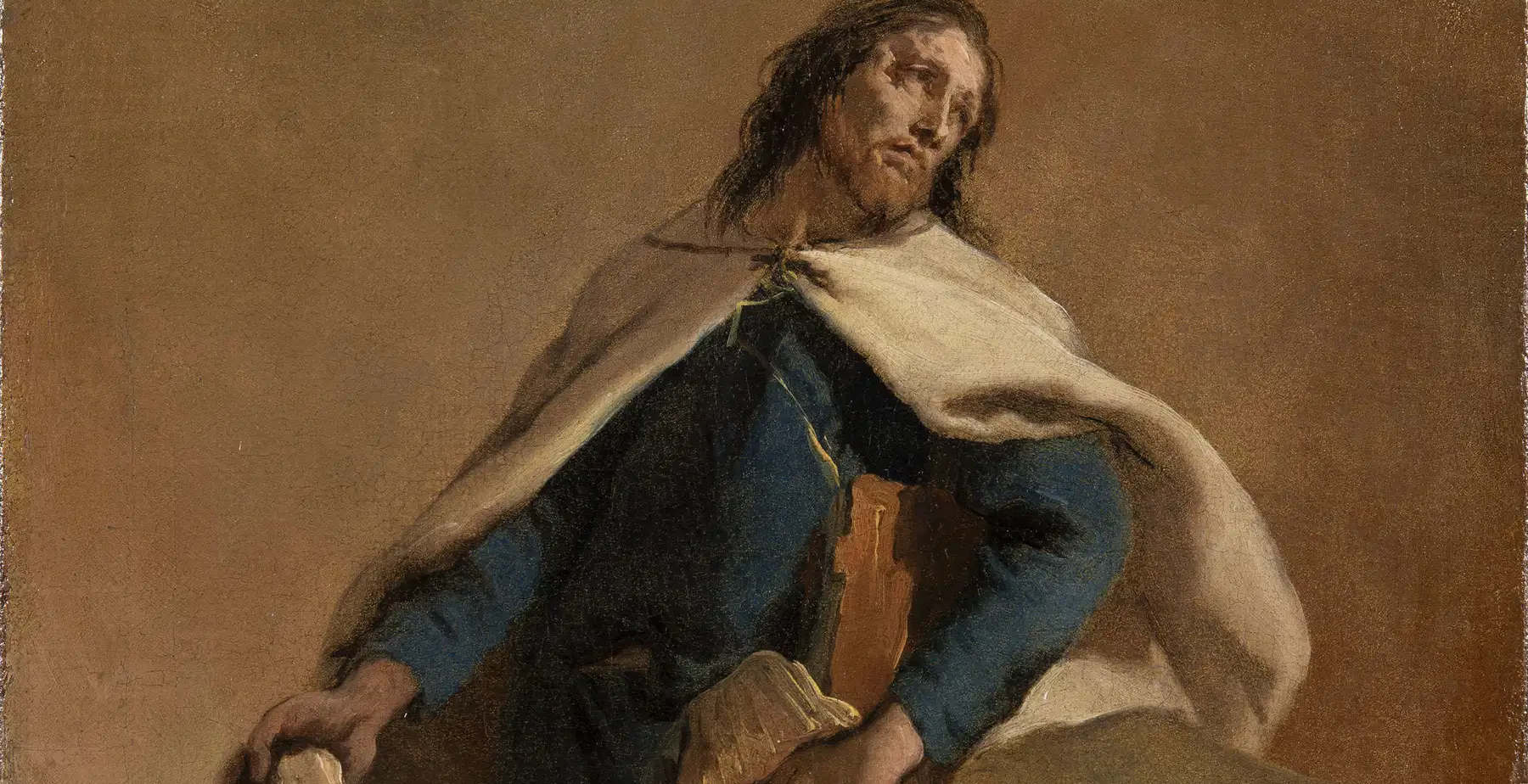
A beam of intensely warm light, golden-yellow like the sun filtering through the fog of the Venetian lagoon, envelops the solitary figure of a pilgrim who has stopped atop a rocky outcrop: he has long, flowing hair that falls over his shoulders, his gaze fixed upward in contemplative ecstasy steeped in mystical reverence, while with a measured gesture he pulls back the hem of his robe to reveal the plague wound etched on his thigh. Beside him, crouched among the rocks, a dog with an alert muzzle watches over his solitude, a symbol of that providential loyalty that nourished and sustained the saint during the darkest days of his illness and exile. It is an image of intense spiritual power and extraordinary painterly mastery, contained within the small dimensions of a small panel measuring just 44.5 by 32.5 centimeters. This is a previously unpublished painting depicting Saint Roch with his dog, attributed to Giambattista Tiepolo (Venice, 1696 – Madrid, 1770). The work, an oil on primed canvas, was presented by the Santa Tecla srl gallery at the 34th edition of the Florence International Antiques Biennale, where it is for sale (asking price: 195,000 euros) and on view through October 4, and represents a significant acquisition for studies on the Venetian master, reopening the fascinating chapter linked to his renowned “variations on a theme” dedicated to the miracle-working saint.
The rediscovery of this painting brings critical attention back to a highly distinctive phenomenon of collecting and devotion in early 18th-century Venice: it was art historian Antonio Morassi, in 1950, who first identified the existence of a group of small canvases of similar format painted by Giambattista Tiepolo over the course of about a decade. Initially, the renowned scholar cataloged thirteen examples held in various private collections, describing them as “variations on a theme, rich in imagination and surprise,” capable of demonstrating “how a great artist can create and recreate the same subject without ever repeating himself.”
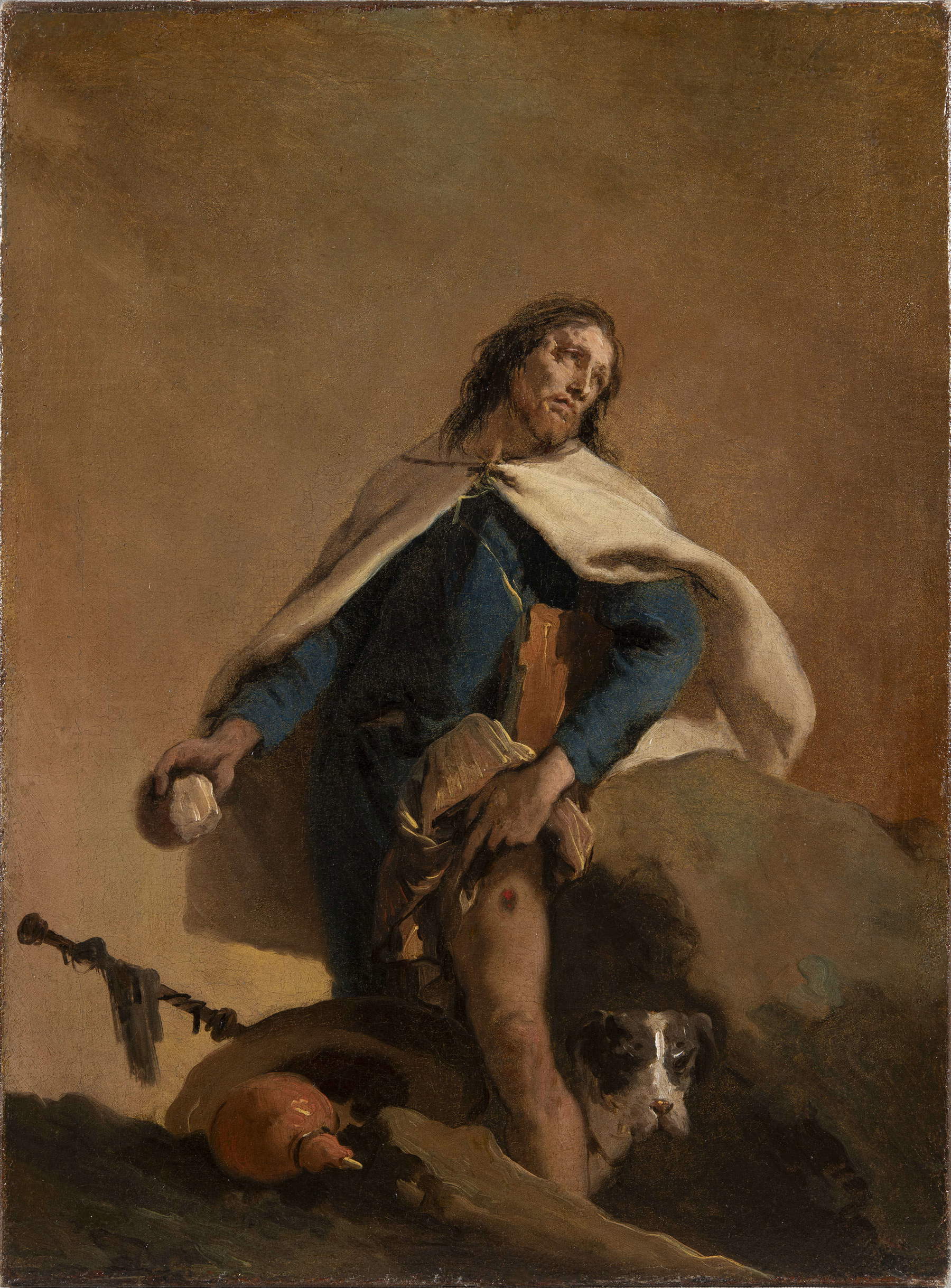
Subsequent research confirmed and expanded upon Morassi’s insight. In 1962, continuing his investigations, the scholar increased the number of identified autograph canvases to eighteen, to which Aldo Rizzi added another example that same year. Further additions came in 1993 with the monograph on the painter edited by Massimo Gemin and Filippo Pedrocco, who published two more previously unpublished works. The recent discovery of this new version further broadens our understanding of Tiepolo’s exploration of this theme, highlighting the artist’s ability to produce multiple interpretations of a single subject while maintaining a constant freshness of invention.
But what motivated the painter to create such a large number of small works related to the healing saint? As reconstructed by Morassi’s studies, the explanation lies in the intense popular devotion and the influence of the powerful Venetian confraternity dedicated to Saint Roch, of which Tiepolo himself may have been a member. The demand for these interior paintings likely stemmed from the great acclaim received by the exhibition of one of the artist’s early works, *The Drowning of the Pharaoh*, presented in 1716 on the occasion of the patron saint’s feast day and met with unanimous praise by the art connoisseurs of the time. Following that successful outcome, the wealthy members of the Scuola Grande di San Rocco asked Giambattista to create devotional images dedicated to their patron saint.
In early 18th-century Venice, the production of these “artist-designed devotional prints,” so to speak, was not motivated solely by religious reasons but also served as a reflection of social status. Confirming this phenomenon, works with similar subjects appear just as frequently in the catalogs of other famous Venetian painters contemporary with Tiepolo, foremost among them Giambattista Pittoni and Sebastiano Ricci. They, too, were commissioned to create paintings intended for private devotion—works that thus highlight the central role of painting in the spiritual and social life of the Serenissima.
The version by Santa Tecla srl depicts a pilgrim saint with long, flowing hair—a saint who embodies a figure that is at once serene and resolutely proud. He wears a robe of a deep, vivid blue—a symbol of humility but also a chromatic frame designed to highlight the sanctity attested by the visible stigmata on his thigh. A white cloak rests on his shoulders—an emblem of divine purity—while the figure stands atop a rocky outcrop that evokes spiritual isolation and the harshness of the trials the saint endured during his ceaseless pilgrimage.
The pose, marked by a slight dynamic tension, suggests an upward movement toward God that transfigures the suffering of the journey. The absorbed and contemplative face reveals a profound mysticism, accentuated by the mystical divine light with a golden-yellow hue that envelops the scene like fog over the Venetian lagoon. An essential element of the composition is the dog, a symbol of the care, loyalty, and divine assistance received by the saint during his period of exile and illness. Its placement at the pilgrim’s side not only balances the figurative composition but also lends depth and richness to the visual narrative. In the background, the landscape is minimalist and barely sketched, yet retains a theatrically dramatic tone.
An immediate stylistic connection is established with the *Saint Roch* housed at the Musée des Beaux-Arts et d’Archéologie in Besançon, France, of which this small canvas appears almost as a mirror image. Both paintings share the same facial features of the protagonist, the same color palette, and a measured use of chiaroscuro, where the dramatic contrasts between light and shadow intensify the emotional impact of the depiction. The attention to detail in the clothing and the rock conveys a strong sense of realism, while the dominant warm, earthy tones are beautifully set off by the vivid blue of the robe.
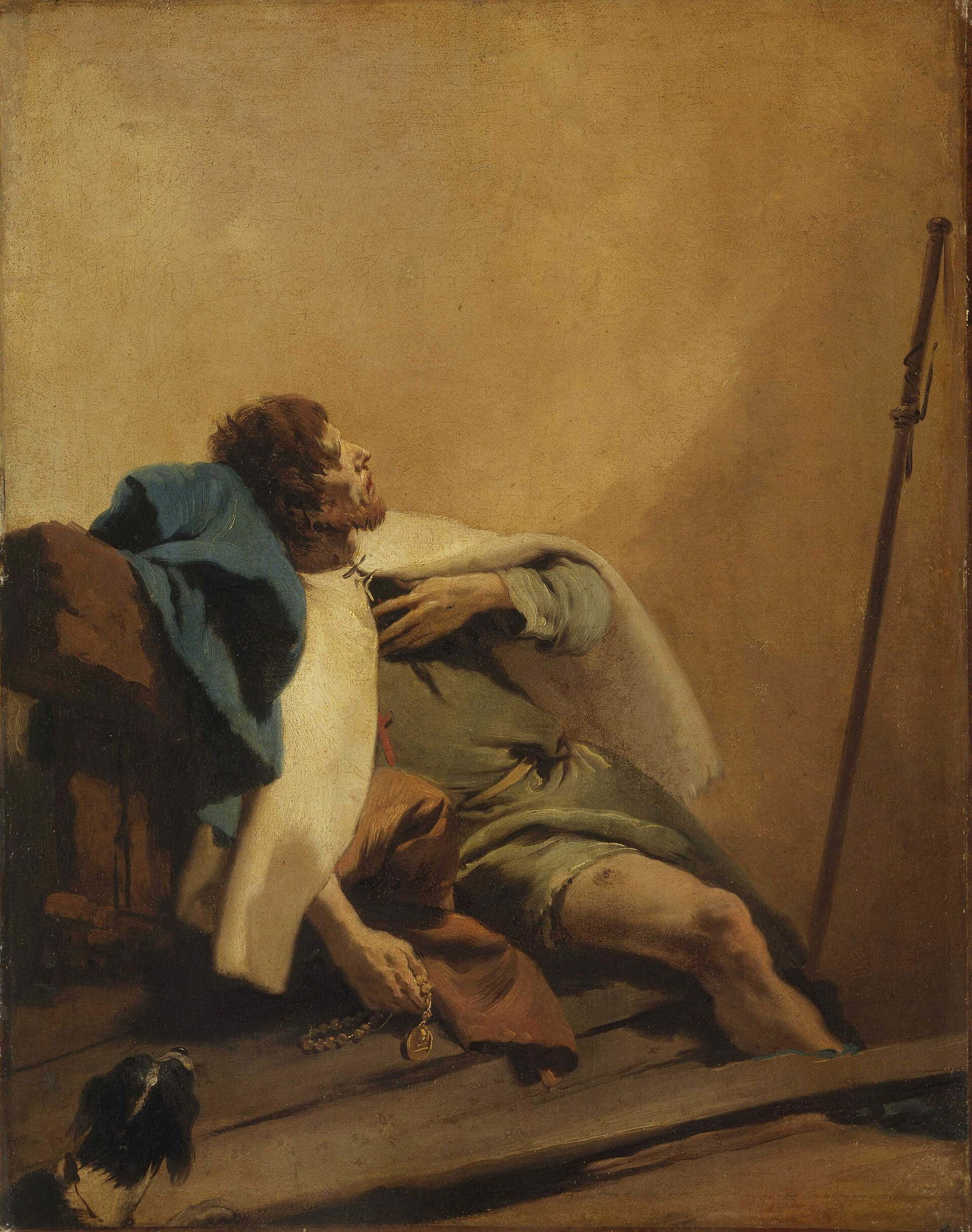
Critical scholarship has put forward various proposals regarding the dating of this series. Antonio Morassi had placed the creation of the various works within the time frame of 1730 to 1735. Rodolfo Pallucchini, on the other hand, proposed a more narrow chronology, limiting the creation of the series to the two-year period of 1732–1733. Recently, scholar Keith Christiansen confirmed this approach, dating the small canvas in question to the very early 1730s.
The work’s provenance attests to its historical and artistic value: before reaching its current owner in London, the canvas was part of the prestigious Brauer Collection and subsequently passed through the Clarke auction house in New York. This is a remarkable collecting history for a rediscovered, precious painting that provides a fundamental piece of the puzzle regarding Giambattista Tiepolo’s inexhaustible creative mastery.
 |
| A Rediscovered Giambattista Tiepolo: A Previously Unseen "Saint Roch" Unveiled at the BIAF |

Warning: the translation into English of the original Italian article was created using automatic tools. We undertake to review all articles, but we do not guarantee the total absence of inaccuracies in the translation due to the program. You can find the original by clicking on the ITA button. If you find any mistake,please contact us.




























 IT
IT FR
FR DE
DE ES
ES CN
CN


