





In Fano, the first phase of archaeological investigationsin the area of Piazza Andrea Costa has come to a close, but the research, conservation, and enhancement project dedicated to the Basilica of Vitruvius is set to continue thanks to the collaboration between the Municipality of Fano, the Superintendence of Archaeology, Fine Arts, and Landscape of the Marche, and the Marche Region. During a press conference held directly at the construction site, the main findings from the excavations conducted over the past few months were presented, along with the new initiatives that will enable the work to continue.
The municipal administration confirmed its intention to increase its financial commitment to the project. Mayor Luca Serfilippi also announced plans to renovate the building that currently houses the fish market.
“Today is a great day for Fano,” said Mayor Serfilippi, “because we are finally beginning to see important findings. They are not yet conclusive, but they represent fundamental elements for defining with greater precision what we believe to be Vitruvius’s Basilica and for understanding the transformations this building has undergone over time, confirming its long history of continuous use. Archaeological investigations have made it possible to reconstruct shapes, dimensions, and structures, including those parts that Vitruvius does not explicitly describe in his text but which he clearly implies were present.” “The collaboration with the Superintendency,” he added, “is proving particularly effective, which is why the Municipality and the Marche Region have decided to invest an additional 400,000 euros in total—200,000 euros each—to continue the process of showcasing this discovery. The regional contribution, guaranteed by President Francesco Acquaroli, will be financed through the tourism fund.”
Further updates have also come from the Ministry of Culture. Superintendent Andrea Pessina has in fact announced the arrival of new funding intended to support the continuation of the investigations and preservation efforts. “The Ministry of Culture has already allocated 350,000 euros for initial restoration work on the artifacts and for the continuation of further archaeological investigations,” explained Pessina. “At the same time, we have already submitted a new funding request for 800,000 euros to ensure the continuity of excavation activities. The discovery of Vitruvius’s Basilica represents a heritage of extraordinary scientific and cultural value that deserves to be further studied and highlighted.”
The results of the investigations will also be presented at the next edition of the Mediterranean Archaeological Tourism Exchange in Paestum, scheduled for late October through early November, thus offering an important opportunity for dialogue with the international scientific community.
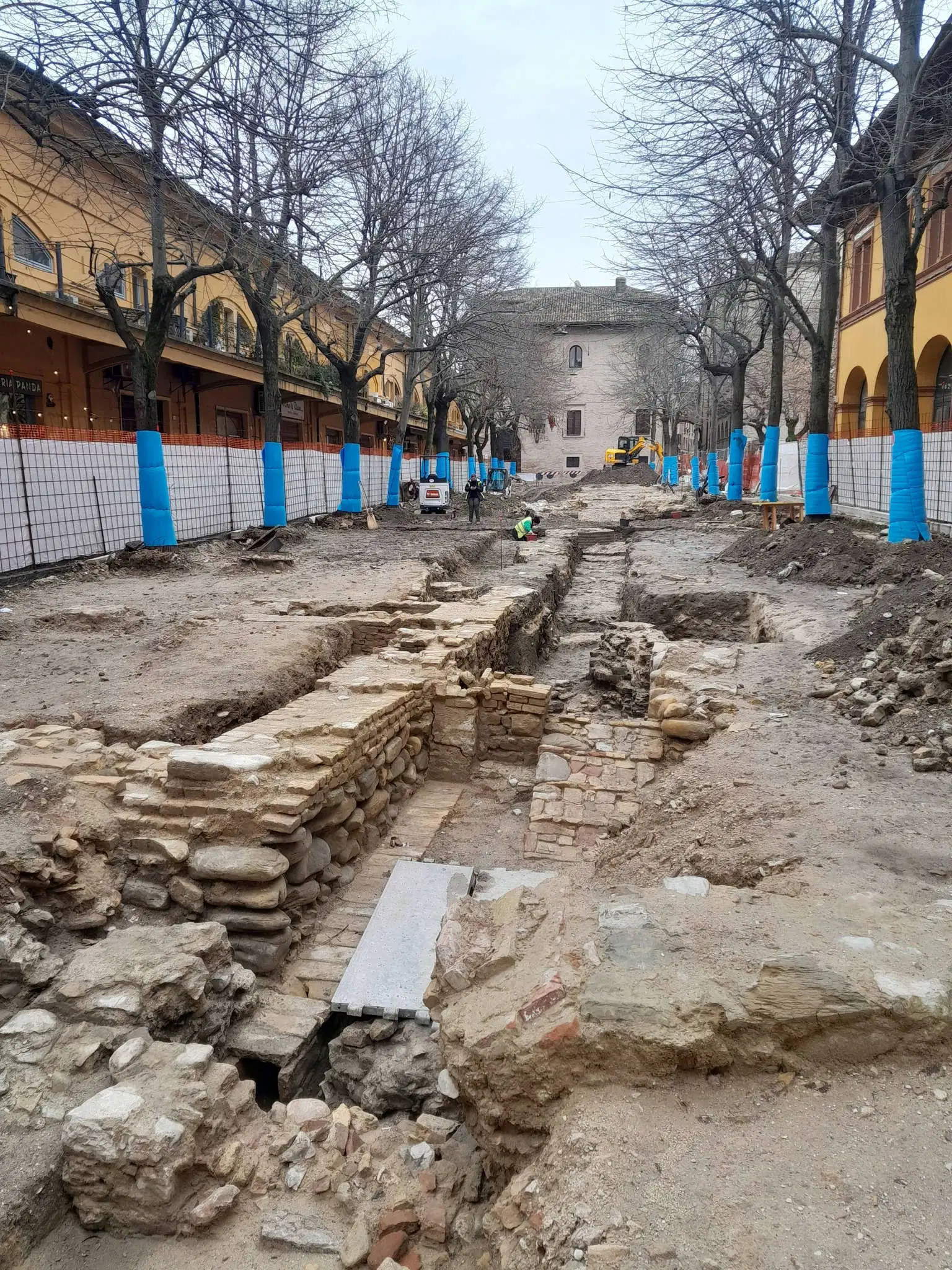
Cristiano Casci Ceccacci, an archaeologist with the Superintendency, outlined the most significant aspects of the research and presented the data emerging from the stratigraphic investigations. “In recent weeks, we have gathered important confirmations, but entirely new elements have also come to light,” explained Casci Ceccacci. “The investigations covered various sectors of the excavation area, allowing us to better define the masonry structures and floor levels from the Roman era. On the side facing Via Arco d’Augusto, along the perimeter of the basilica, evidence of looting from the post-Roman period was documented, with the discovery of ceramic materials dating from the 11th to the 12th centuries A.D., which attest to the reuse of the area during the Middle Ages.”
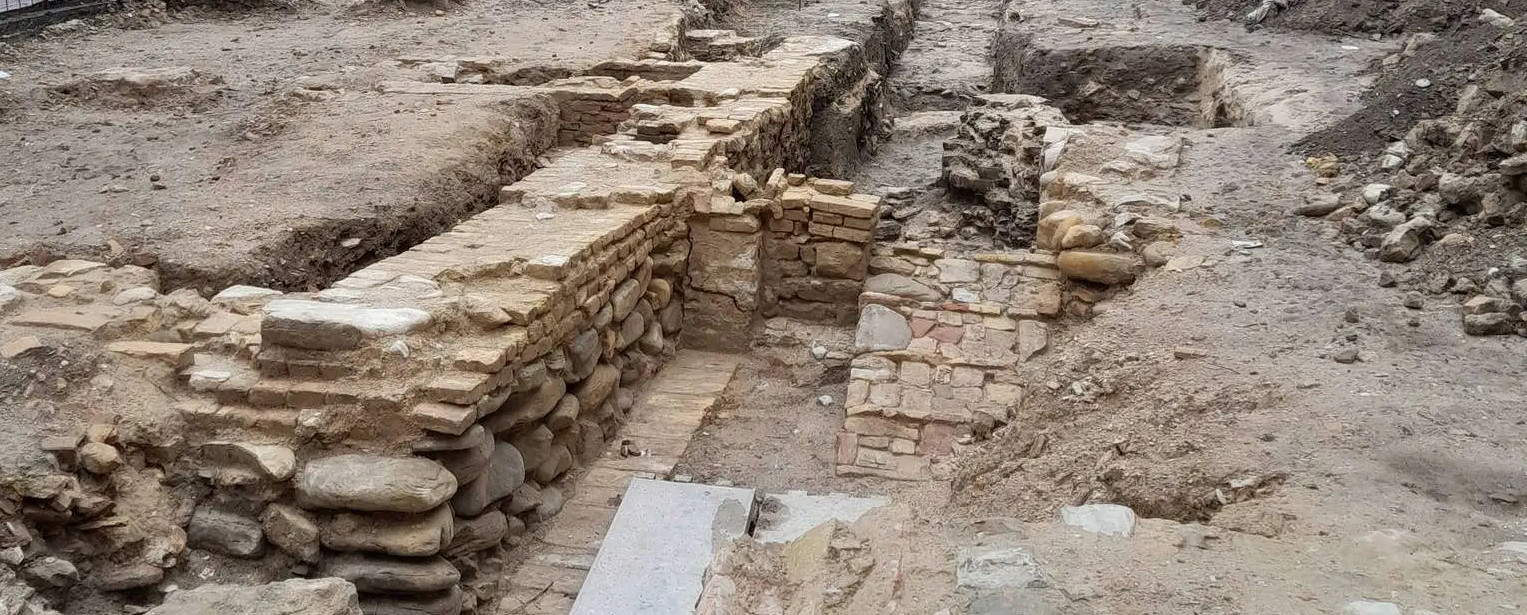
Among the most significant discoveries is the uncovering of the base of the sixth column on the Darderi side, although it is partially damaged by later interventions. “Work also continued on exposing the Roman floor and a new section of wall along the Via Montevecchio side, elements that allow for an increasingly precise understanding of the floor plan of the Vitruvian monument,” added the archaeologist. “In the central area of the basilica, excavation work has been completed, bringing to light the remains of an apse-shaped wall. This is a particularly significant finding that opens up new interpretive perspectives on the possible locationof the aedes Augusti, the temple dedicated to imperial worship.”
The excavations have also provided deeper insight into the building’s various phases of existence and the transformations that have progressively altered its appearance throughout history. "The basilica underwent major renovations as early as the 2nd century A.D., aimed at enhancing its original layout, as evidenced by the discovery of marble from the Peloponnese. The excavations have also confirmed that the building was constructed on top of pre-existing structures, the nature of which is still under study. What has come to light now allows us to reconstruct with greater certainty not only the monument but also the overall urban context of the Roman city,” he concluded.
Archaeological work will continue in the coming weeks with further stratigraphic analysis and the study of the recovered materials.
 |
| New Details Emerge About the Basilica of Vitruvius: Initial Investigations in Fano Have Been Completed |

Warning: the translation into English of the original Italian article was created using automatic tools. We undertake to review all articles, but we do not guarantee the total absence of inaccuracies in the translation due to the program. You can find the original by clicking on the ITA button. If you find any mistake,please contact us.

























 IT
IT FR
FR DE
DE ES
ES CN
CN


