





An important 6th-century B.C. burial complex has been discovered in Sirolo, in the Conero area, during preventive archaeological surveys coordinated by the Superintendence of Archaeology, Fine Arts, and Landscape for the Provinces of Ancona and Pesaro and Urbino and carried out by the company ArcheoLab in collaboration with the municipality. The discovery significantly expands our knowledge of the great Picene necropolis and the elites who ruled the region in pre-Roman times. The research, funded by the Ministry of Culture through a special grant allocated for the protection of archaeological heritage, has led to the identification of a complex noble burial ground organized around a monumental princely tomb. The discovery also makes it possible to reconstruct the original context of the famous warrior’s tomb found in 2020 on Via del Leccio, placing it within a larger funerary complex intended for the aristocratic families of the Conero region.
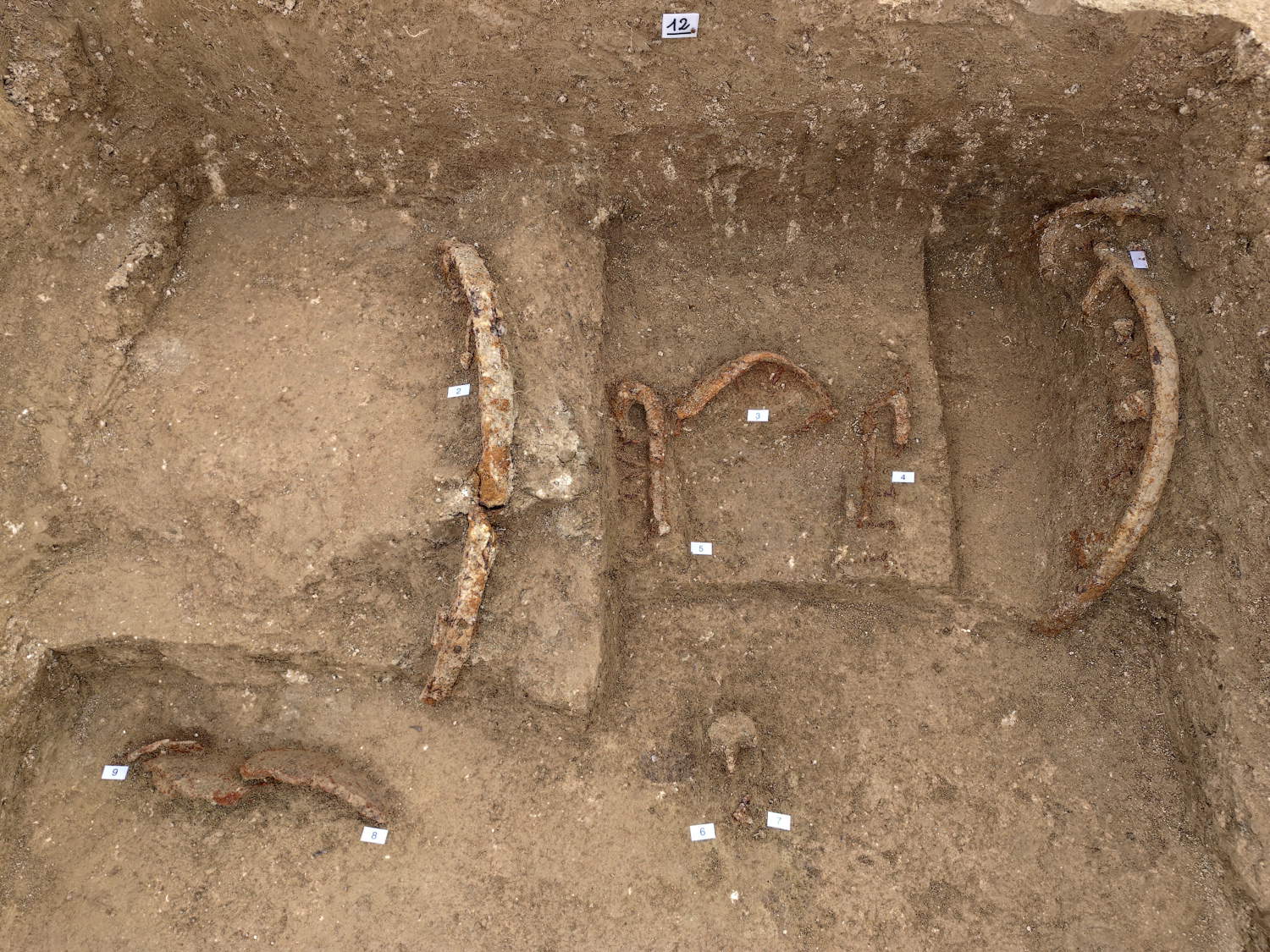
At the center of the monumental circle, a large male burial was uncovered that contained the remains of a currus—a two-wheeled chariot likely placed intact in the burial pit—a symbol of the deceased’s high rank and characteristic of the most important aristocratic burials in pre-Roman Italy. The grave goods include a rich array of weaponry—comprising a helmet, an axe, and other offensive weapons—along with artifacts still undergoing restoration that may offer new insights into how the Picene aristocracy represented its power, a topic that has been poorly documented to date.
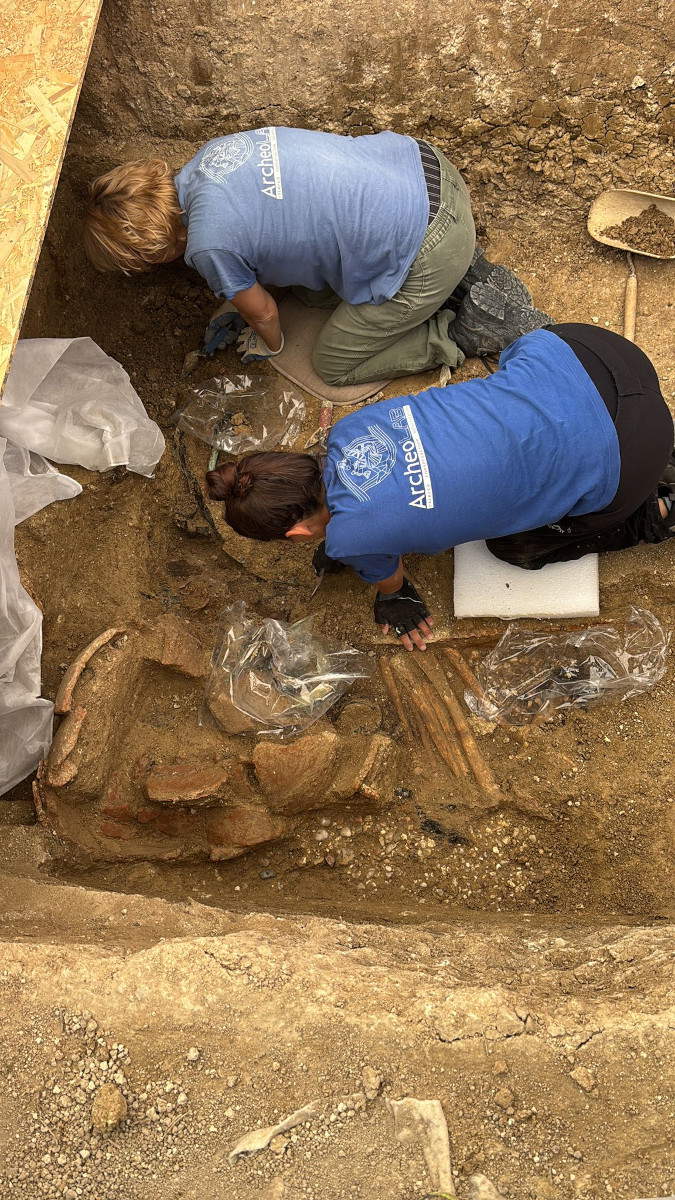
Among the most surprising elements is the structure of the monument itself. Unlike other large funerary circles in the Piceno region, which are generally bounded by an annular ditch, the Sirolo complex was enclosed by a circular palisade, identified thanks to a regular sequence of post holes containing small ritual deposits with selected ceramic fragments. This is a solution previously unrecorded in this region.
Also of particular interest are several large bronze vessels discovered in the chariot tomb. Still sealed with ceramic lids, they contained organic material, animal remains, and ceramic fragments that may represent evidence of the funeral banquet held during the burial or food offerings intended for the deceased.
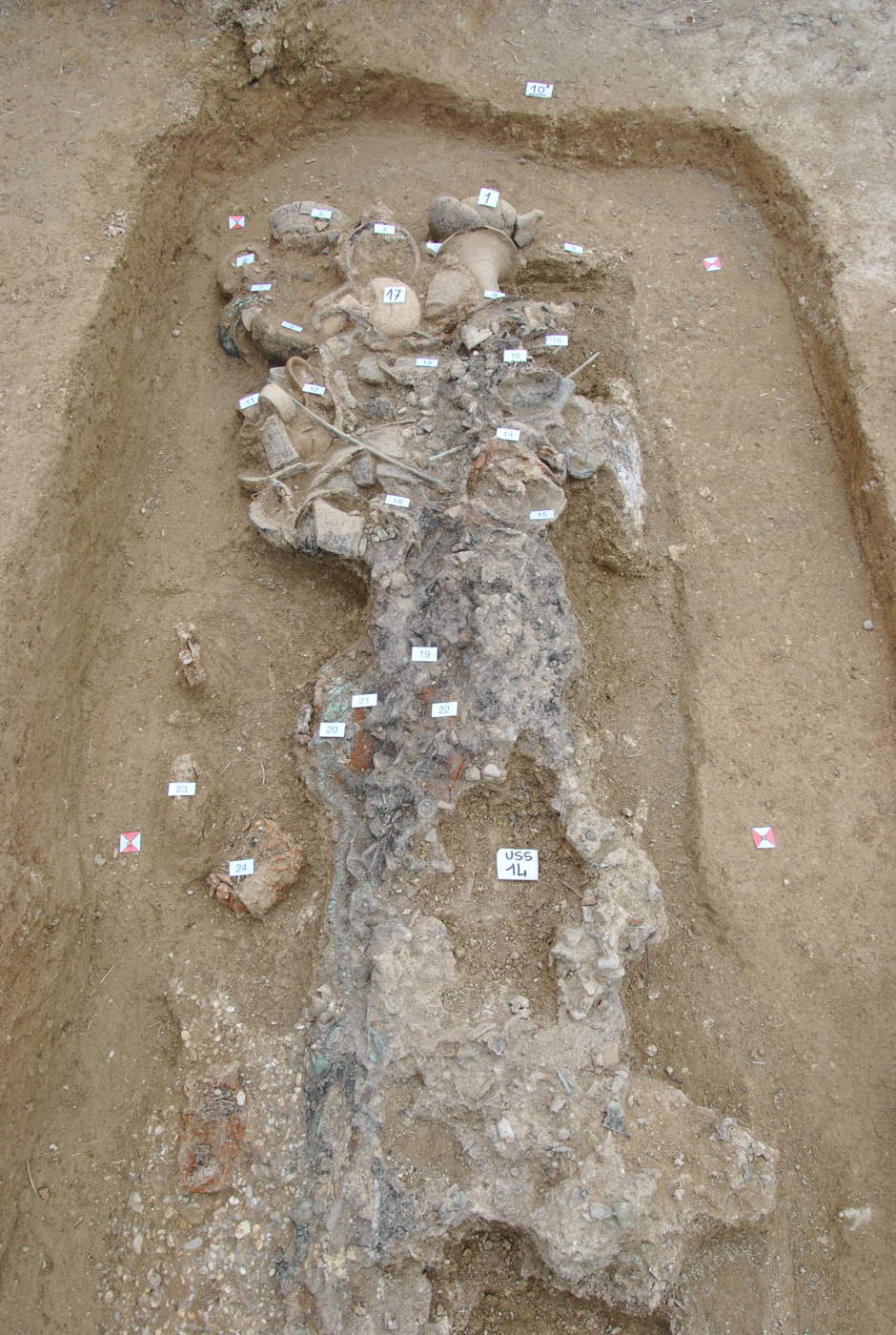
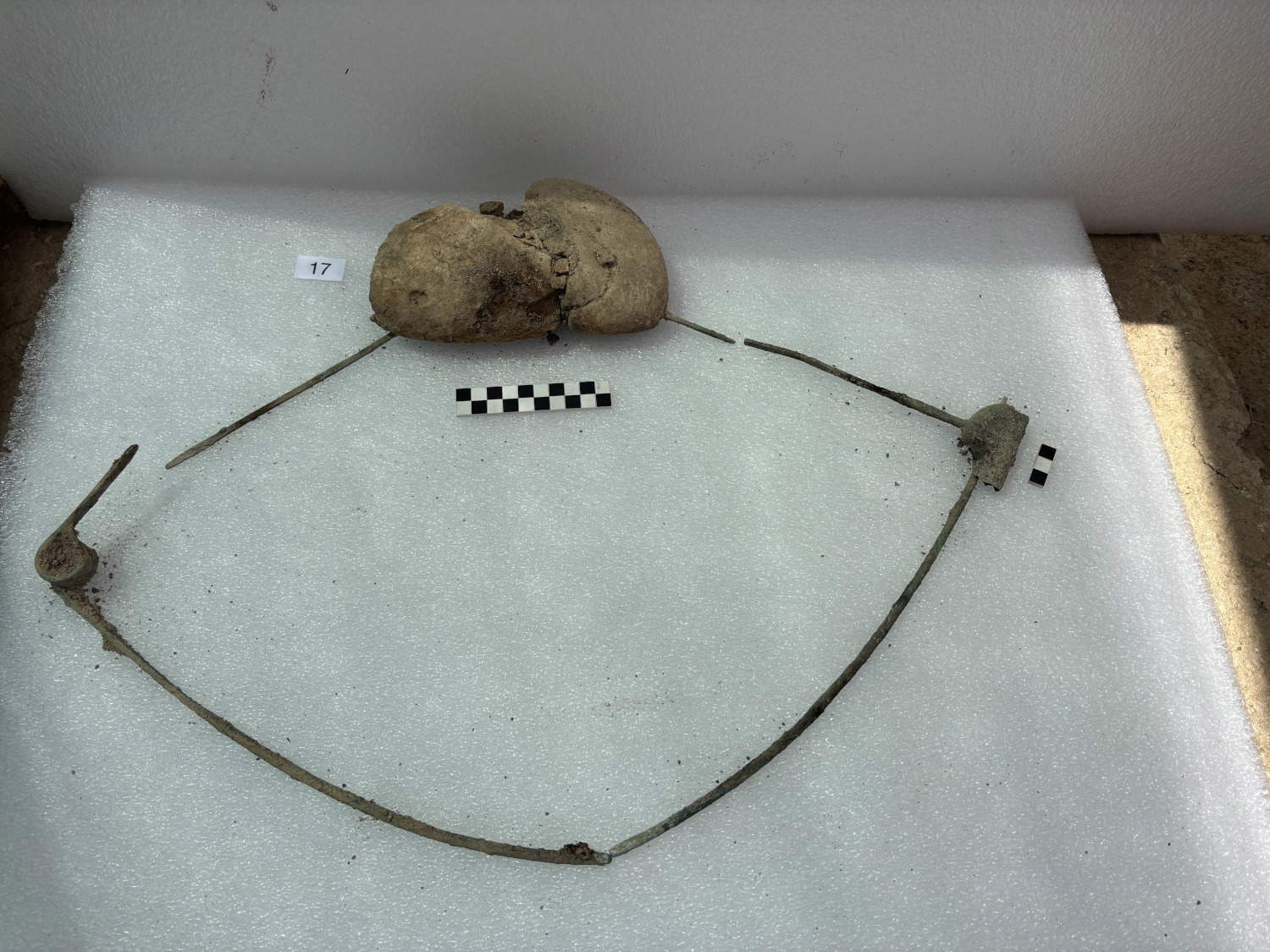
Next to the princely tomb, archaeologists also identified a female burial, exceptionally well-preserved. The excavation revealed traces of textiles, decorations, and footwear with metal elements still in their original positions. Numerous fibulae were placed on the body to secure the garments and the shroud, while a large fibula with an amber core, placed beyond the deceased’s head, may have belonged to a headdress or an elaborate hairstyle. This evidence will allow for a deeper understanding of funerary practices and the role of women within the Picene aristocracy, offering new insights into the representation of female prestige in the 6th century BCE.
The new complex is located near the famous Tomb of the Queen and the Necropolis of the Pines. Geophysical surveys and non-invasive prospecting indicate that the burial area was much larger than previously known, suggesting the existence of a vast monumental landscape intended for the Conero elite.
The burial complex also occupies a slight natural elevation that overlooks the surrounding territory—a location most likely chosen to make the monument clearly visible and to affirm, even within the landscape, the prestige and authority of the aristocratic families buried there.
“This discovery,” emphasized archaeologist Stefano Finocchi, the excavation’s scientific director, “finally allows us to reconstruct the original context of the warrior’s tomb discovered in 2020 and to place it within a larger funerary complex organized around a princely burial with a chariot. For the first time, we can observe not a single tomb, but an entire aristocratic group, with hierarchical and symbolic relationships that open up new perspectives on the structure of the elites who led the great Picene center that developed in the area of present-day Conero. The monumentality of the complex, the quality of the grave goods, and certain artifacts still under study outline the profile of ruling groups embedded in a dense network of relationships that connected the central Adriatic to the major centers of central Italy.”
|
| Sirolo: A burial complex featuring a princely tomb and the remains of a chariot has been discovered in the Picene necropolis |

Warning: the translation into English of the original Italian article was created using automatic tools. We undertake to review all articles, but we do not guarantee the total absence of inaccuracies in the translation due to the program. You can find the original by clicking on the ITA button. If you find any mistake,please contact us.



























 IT
IT FR
FR DE
DE ES
ES CN
CN


