




by Redazione 09/06/2026



Categories: Design / Disclaimer
On June 10, 2026, the new Galerie nationale du design opens at the Cité du design in Saint-Étienne: an institution without a permanent collection that brings together works from France's leading museums through annual exhibitions and unprecedented curatorial projects. It is the first French museum dedicated to design.

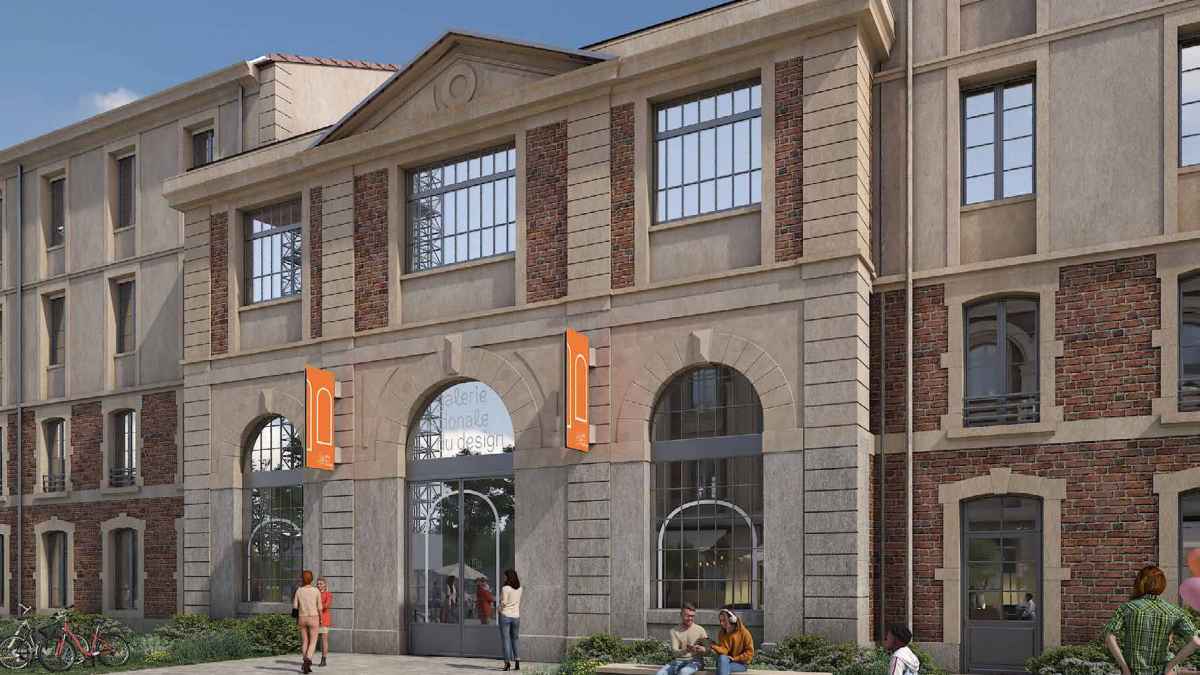
On June 10, 2026, France will officially open the Galerie nationale du design in Saint-Étienne, France’s first museum dedicated to design, thus a completely new institution in the country’s cultural landscape that opens its spaces in the heart of the Cité du design in Saint-Étienne. The project marks a significant step in the valorization of design as a national cultural heritage, proposing for the first time a museum model that forgoes a permanent collection and instead relies on the circulation of works and the construction of annual exhibition narratives entrusted to invited curators.

The new facility was created as a shared initiative between the EPCC Cité du design - École supérieure d’art et design de Saint-Étienne and the Musée d’art moderne et contemporain de Saint-Étienne Métropole, known as MAMC+. This collaboration is complemented by a network of leading cultural institutions that includes the Centre national des arts plastiques, the Centre Pompidou - Musée national d’art moderne, the Musée des Arts décoratifs et du Design in Bordeaux, the Frac Grand Large - Hauts-de-France, the Musée des Arts décoratifs in Paris, the Manufactures nationales - Sèvres & Mobilier national, and numerous others that will be added over time depending on the exhibition projects.


The principle behind the Galerie nationale du design is tomake visible and legible a diffuse heritage, now preserved in several French public institutions, through a temporary linking of collections. In this way, design is presented not as a static set of objects, but as a dynamic field spanning the country’s cultural, social, and technological history. The stated aim is to enhance the plurality of design forms, from its industrial origins to the most contemporary experiments, returning to the public a comprehensive and articulated vision.


The exhibition space is spread over more than 1,000 square meters within the Cité du design and integrates not only exhibition rooms, but also environments dedicated to cultural mediation, experimentation and event programming. The project is in the wake of the 2019 Assises du design, a moment considered foundational for the definition of a national cultural policy dedicated to design, which emphasized the need for new ways of exhibiting and accessing heritage, including through digital tools and innovative forms of mediation.
The choice of Saint-Étienne as the headquarters of the new institution is part of an established historical trajectory. Indeed, the city represents one of the main French hubs related to industrial design culture and has been hosting the Biennale Internationale Design Saint-Étienne for more than two decades, as well as a system of already active exhibition spaces such as La Platine and La Cabane. In this context, the birth of the Galerie nationale du design appears as a natural evolution of a cultural ecosystem already strongly oriented toward research and experimentation.
One of the distinctive elements of the project is the absence of a permanent collection. Each year, an invited curator will be called upon to construct a new exhibition narrative from works from partner institutions. This model makes it possible to multiply points of view and to approach design as an open language, capable of telling not only the history of objects, but also the social, economic and cultural transformations that run through them.
Among the institutions involved, the Centre Pompidou plays a central role in the link between design, art and architecture, while Cnap represents a reference for contemporary experimentation. The MAMC+ in Saint-Étienne, on the other hand, holds one of the most important public collections of industrial design in France, bearing witness to the historical relationship between industrial production and design. The Musée des Arts décoratifs in Paris and that of Bordeaux offer a historical and stylistic reading of design and decorative arts, while the Frac Grand Large - Hauts-de-France focuses on more experimental and hybrid practices. Finally, the Manufactures nationales and the Mobilier national add the dimension of traditional craftsmanship and public commissioning.
The sum of these collections constitutes a patrimony of some twenty-five thousand pieces, making it possible to reconstruct a broad and diverse history of French and international design. The initiative aims to make this heritage more accessible and comprehensible to the public, while encouraging dialogue between institutions and the construction of new critical interpretations.
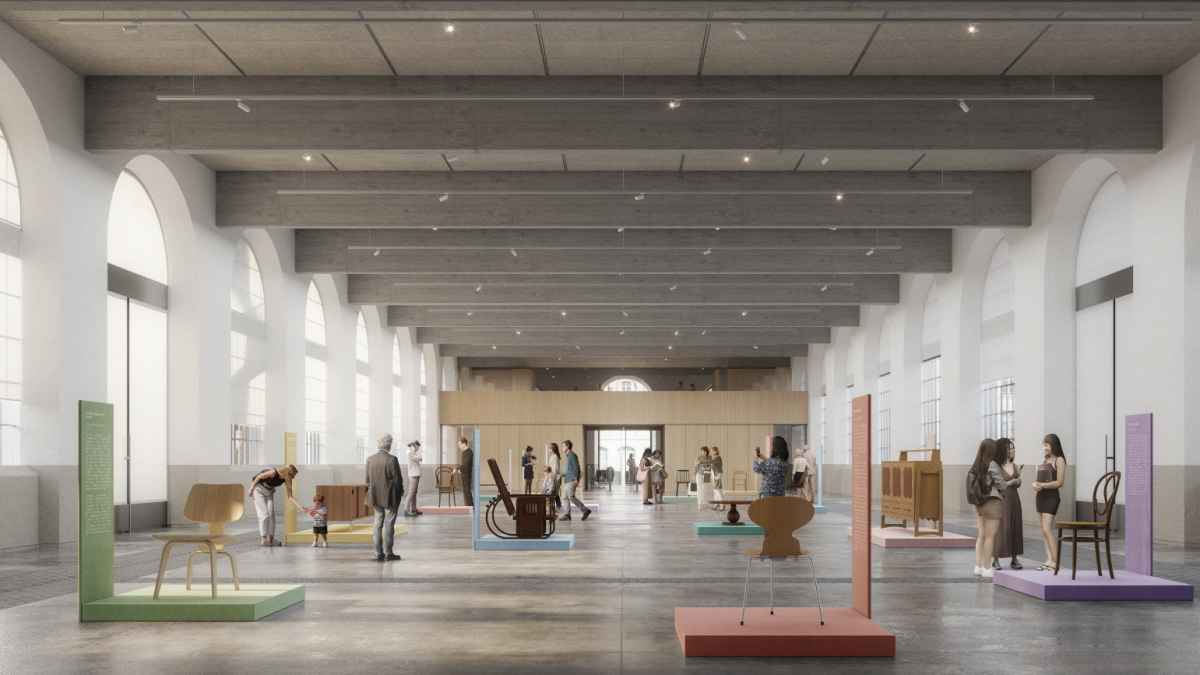
Alongside the exhibition dimension, the Galerie nationale du design also develops a strong pedagogical and participatory framework. The spaces are divided into three main environments: the Seuil, the exhibition hall, and the Mezzanine. The Seuil is conceived as a reception area that is also open without a ticket, designed as a place to stop and make first contact with design through direct contact with objects and furnishings. The exhibition hall forms the heart of the itinerary and is configured as a neutral and modular space, designed to accommodate different narratives and encourage a free enjoyment of the works. Finally, the Mezzanine is dedicated to educational activities, workshops and public meetings, with a flexible layout designed to adapt to different uses and formats.
The architectural and curatorial design insists on the experiential dimension of the visit, inviting the public to consider design not only as an aesthetic or technical discipline, but as an everyday element that runs through contemporary life. In this perspective, design is interpreted as a tool for reading society, capable of narrating its transformations and anticipating its evolutions.
The inaugural programming includes three exhibitions entrusted to different curatorial figures, conceived as a true design manifesto. Each exhibition will offer an autonomous reading of design, relating works from different contexts and emphasizing the plural nature of the discipline. The common thread is the idea that design represents a universal language, capable of reflecting the societies that produce it and at the same time transforming them.
The project is also based on extensive cooperation between institutions and an accessibility strategy that also includes a shared digital platform, which is already active and brings together and makes accessible the design collections of several French institutions. This digital infrastructure is an additional tool to expand the use of heritage and strengthen the public dimension of the project.
With the opening of the Galerie nationale du design, France is thus introducing an unprecedented model of a cultural institution, in which the value lies not in the stability of the collection, but in the ability to relate different heritages and to constantly renew the keys to interpreting design. A cultural device that presents itself as a permanent laboratory, in which design is narrated as a historical, social and creative phenomenon in continuous transformation.
|
| Galerie nationale du design, the first museum on design in France, is born in Saint-Étienne |
Warning: the translation into English of the original Italian article was created using automatic tools. We undertake to review all articles, but we do not guarantee the total absence of inaccuracies in the translation due to the program. You can find the original by clicking on the ITA button. If you find any mistake,please contact us.