




If there is one place where, at the dawn of the 20th century, popular social life revealed all its ambiguity, it is the tavern. Trattoria, tavern, wine bar, and inn: different names for spaces that we today tend to associate solely with conviviality, but which back then served multiple functions. They were places for wine and meals, but also for social gatherings, news, bargaining, political discourse, and small acts of solidarity; they could become settings for revenge and even rebellion, but also places for gossip, mutual surveillance, slander, and mistrust. This was especially true in Tuscany, where municipal traditions, neighborhood life, the constant interplay between city and countryside, and a language naturally inclined toward judgment made the tavern not merely a public establishment, but a small theater of human life. Many of these characteristics had been part of Tuscan taverns since time immemorial; and as early as the nineteenth century, these places—with their tables, counters, low-ceilinged rooms, wine, smoke, hunger, and loud conversation—had firmly entered the region’s literary, political, and artistic memory. Consider Renato Fucini, who turned this humble social life into almost a literary genre of popular Tuscany. In the poet’s memories and stories, the public space for eating and drinking is the place where a community gathers, observes one another, and either accepts or rejects one another. It could be a noisy student café, like the Ussero in Pisa recalled in *Foglie al vento*, or a village trattoria.
These were certainly not innocent or neutral spaces. They could serve as alternatives to power, mirrors of social unrest, environments where the seeds of revolution, of a united Italy, of the republic, or more simply of protest took root before they did elsewhere. In the cafés of Pisa, the wine bars of Livorno, and the semi-public gathering places of Tuscan cities, political discourse mingled with everyday life and casual conversation. And these discussions were rarely constructive or peaceful, because taverns are also shadowy places of brawls and shady dealings, where one risks a black eye and sometimes even worse. A notable example is the fate of the Livorno patriot and writer Carlo Bini, who, on a December evening in 1827, was apparently stabbed by mistake during a brawl that broke out in a tavern, leading to his untimely death.
Alongside these places of politics and discourse, there were also those of art. The most famous is, of course, the Caffè Michelangiolo on Via Larga in Florence, where the Macchiaioli generation gathered and where, amid discussions, smoke, jokes, controversies, and disdain for the official school of painting, one of the most important revolutions in nineteenth-century Italian art took shape. Yet even these gathering places, though imbued with obvious artistic and civic value, remained working-class venues marked by hunger, poverty, and fierce pranks. Anna Franchi recalls this as she compiles the memoirs of Giovanni Fattori, Telemaco Signorini, and their companions, when she recalls Gigi Porco on Via de’ Pucci, where the artists, crammed into a tiny cubbyhole, were fed a portion of boiled donkey meat: tough and indigestible, yet it had the merit of keeping their stomachs full for longer. With the 20th century—a century of mass movements, political unrest, and new bourgeois fears—taverns ceased to be merely picturesque backdrops and became microcosms of a harsh and diverse humanity.
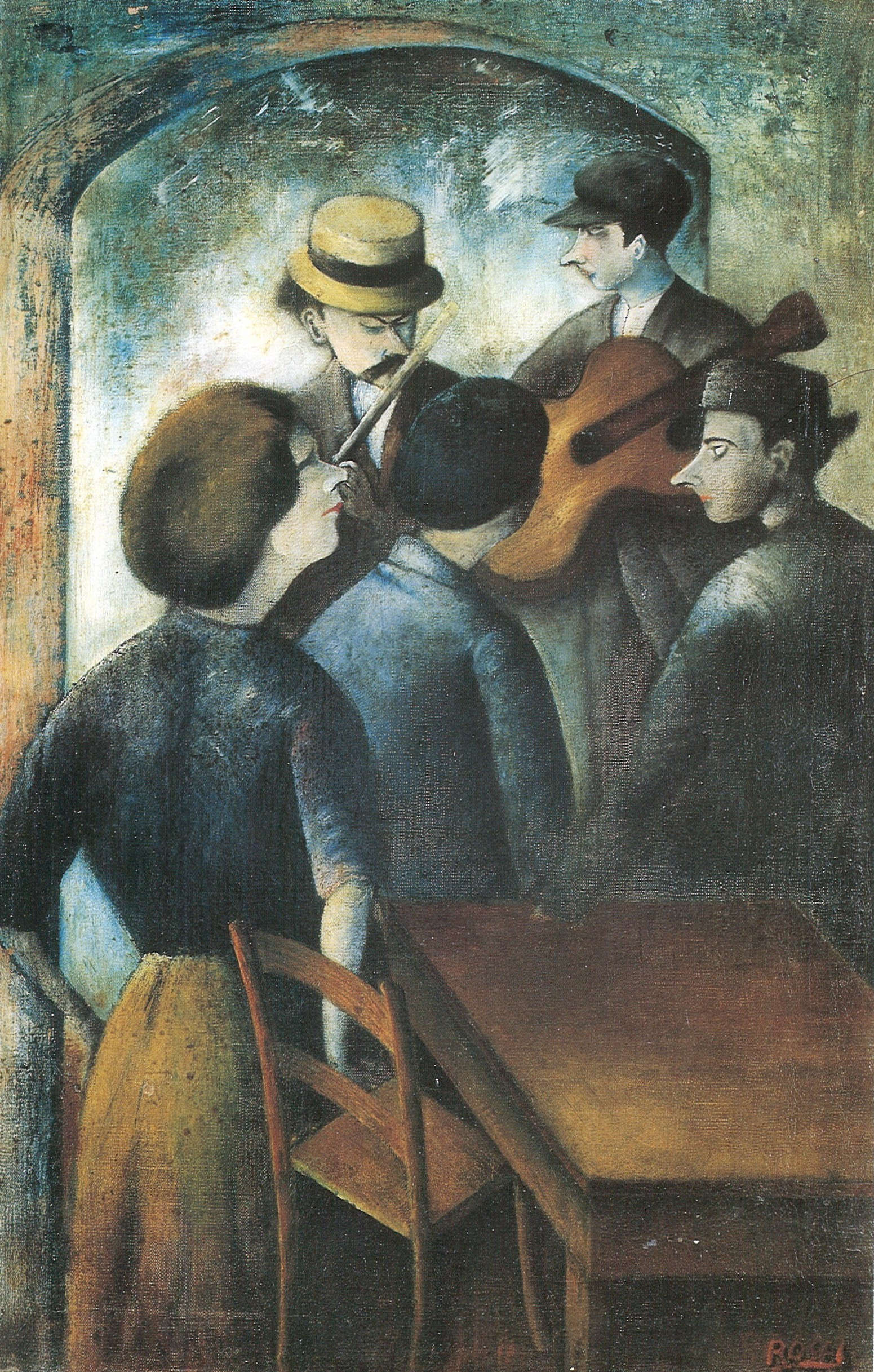
It is no surprise, then, that early 20th-century Tuscan literature frequently featured these places. In the work of Federigo Tozzi, son of a tavern owner in the center of Siena, the tavern loses any remaining sense of comfort, becoming a seedy, ambiguous, suffocating space where the power dynamics of provincial society come to the fore. It is primarily a male gathering place, where men drink, swear, pick fights, and put to the test a masculinity that is both violent and fragile. In the short story *Un’osteria*, a young female teacher from out of town is subjected to the judgment and cruelty of the patrons; the tavern neither comforts nor protects, but rather unmasks; those who do not know its unwritten rules, those who do not belong, risk being immediately crushed by it. While Tozzi’s depiction of the tavern captures its murkiest and cruelest side, Vasco Pratolini presents a less brutal—though by no means peaceful—dimension. In his pages, taverns, trattorias, and bars are part of the very fabric of working-class Florence; they punctuate the life of the neighborhoods, gathering voices, small acts of solidarity, and gossip, becoming places where the community observes and tells its own story. It is a Florence far removed from any monumental image, inhabited by people who are often defeated but by no means defeated. And it is from this very Florence that an essential part of the painting of Ottone Rosai ( Florence, 1895 – Ivrea, 1957)—one of the most recognizable artists of 20th-century Tuscany—also takes shape. The connection with Pratolini is not merely a suggestion; in fact, the writer knew Rosai well, lived near his studio, and that friendship played a decisive role in his cultural development. This is also confirmed by *Men at the Table*, a work by Rosai that once belonged to Pratolini, which bears the following dedication on the reverse: “To Vasco, with thirty years of friendship, your Ottone, Florence, September 30, 1952.”
While Tuscan literature had recognized taverns, trattorias, and wine bars as some of the most revealing settings of everyday life, in painting it was above all Rosai who became the interpreter of this world. He did so not as an outside observer, nor with the complacency of a sketch, but immersed in a harsh familiarity—one made up of neighborhoods, streets, tables, men, humble interiors, and silences. From this participatory and rigorous observation emerged one of the most recognizable themes in his work: that of men in taverns, drinkers, and figures seated around a table.
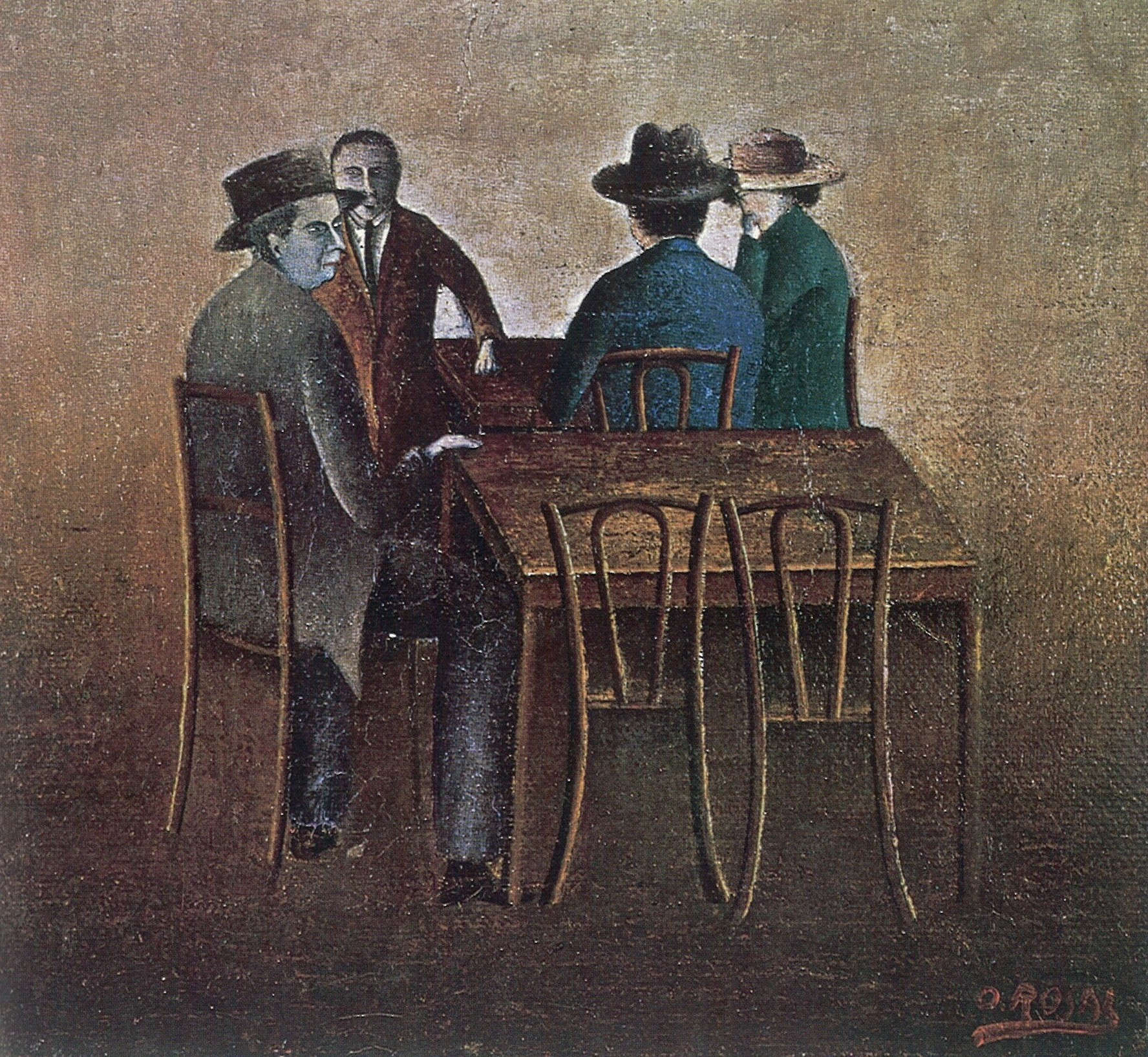
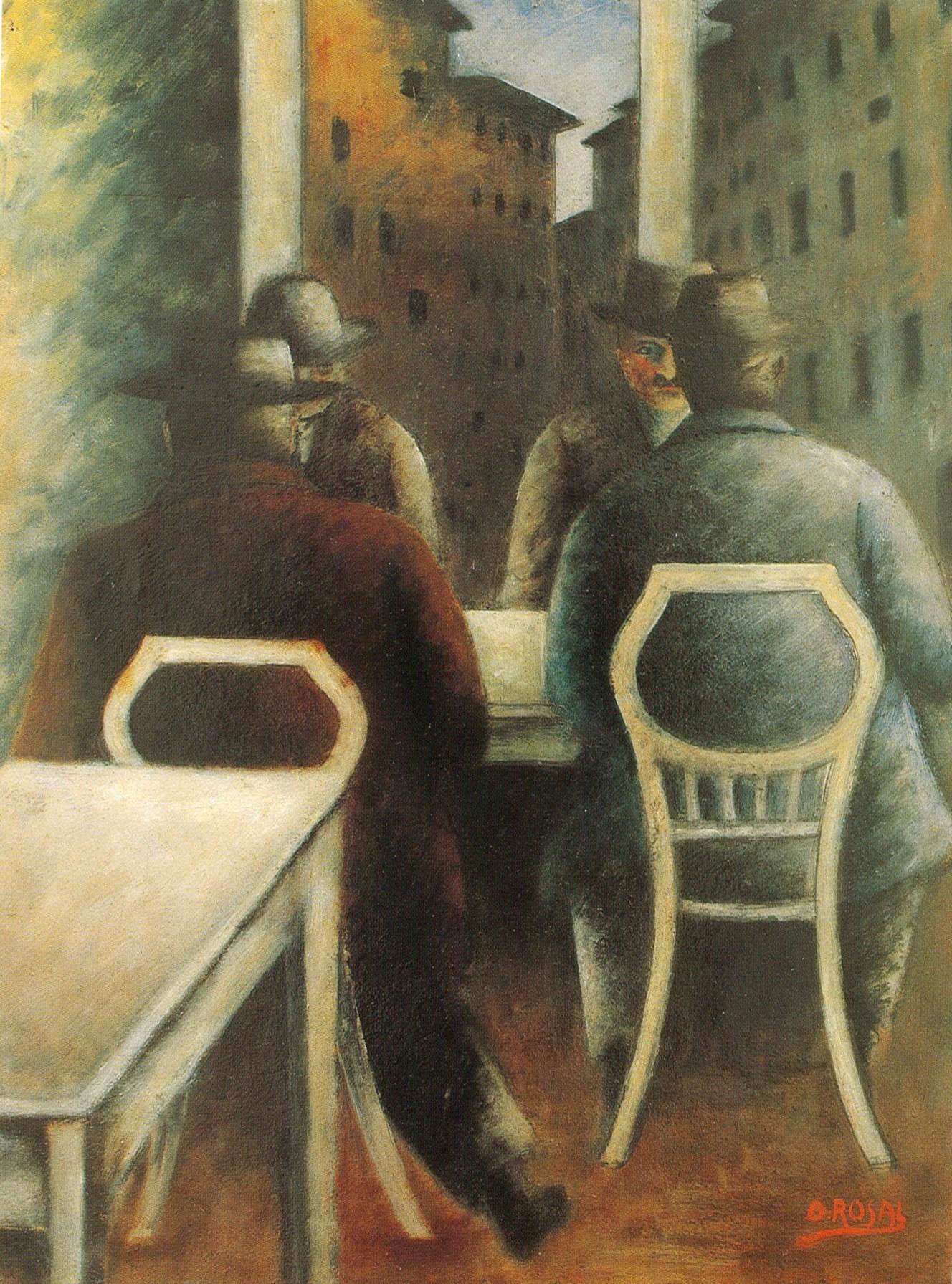
Despite the significant role he played in Tuscan and Italian painting of the early 20th century, his art has, however, often remained confined within overly rigid critical frameworks. First and foremost is the accusation of provincialism, leveled at a sedentary artist who was reluctant to leave Florence and remained faithful to a very limited human and urban horizon. This is, however, a judgment to be handled with caution, since Rosai was no stranger to the anxieties of his time, as evidenced by his involvement with Lacerba’s circle and his brief foray into Futurism; rather, he remained resistant to permanently adhering to fads, programs, and school affiliations. After all, loyalty to a place, to a few streets, and to a few types of people is not necessarily a limitation; much of Italian culture stems precisely from rooted perspectives, from localisms capable of becoming a language in their own right.
On the contrary, however, Rosai should not be turned into an untouchable myth. His work also features repetitions, insistent formulas, and subjects revisited to the point of becoming almost a signature. At times, this recognizability can seem tired, even self-satisfied. Yet, in his finest moments, it is precisely within this obstinacy that his true artistic essence is revealed. Rosai does not seek a wide variety of themes, nor an open narrative, nor a declared message. He works by subtraction, through successive returns, as if a few subjects were enough to measure his entire relationship with the world. It is here that the tavern takes on decisive significance—not merely as a scene of everyday life, but as a framework through which to explore the world.
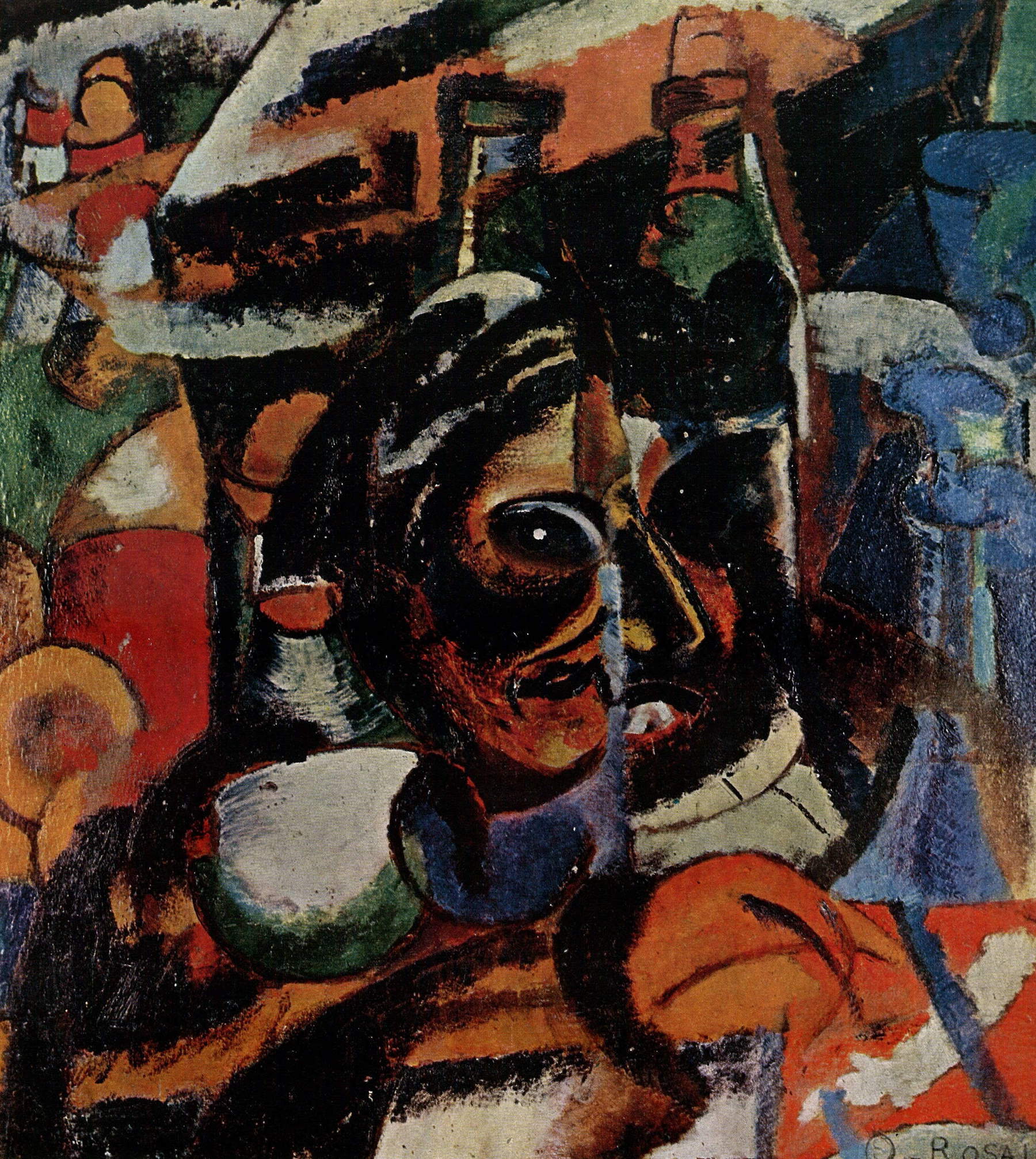
It is one of the places where Rosai’s painting most clearly finds its subject matter—namely, people gathered in the same space, bodies close yet closed off, tables that are meant to bring people together but often seem to mark a distance. The theme of the tavern, interiors, and groups seated at tables would recur throughout the Florentine painter’s entire body of work, albeit with significant iconographic and stylistic differences. The theme was likely developed starting in the 1920s, but an early precedent can be found in the 1914 painting *Dinamismo Bar San Marco*. This early work features the bar motif within Rosai’s brief Futurist phase. After a restless period of training, divided between the Academy and independent study, the young painter saw Lacerba’s Futurist exhibition in Florence, coming into contact with a movement from which he did not derive a complete doctrine, but rather an iconoclastic and anti-academic driving force capable of liberating the image from its customary constraints. This work demonstrates that, where dynamism—contrary to Futurist dictates—does not appear as pure movement but as a dense decomposition of planes, figures, and objects: the bar is agitated and fragmented, yet already held in check by a need for structure that would remain deeply characteristic of Rosai.
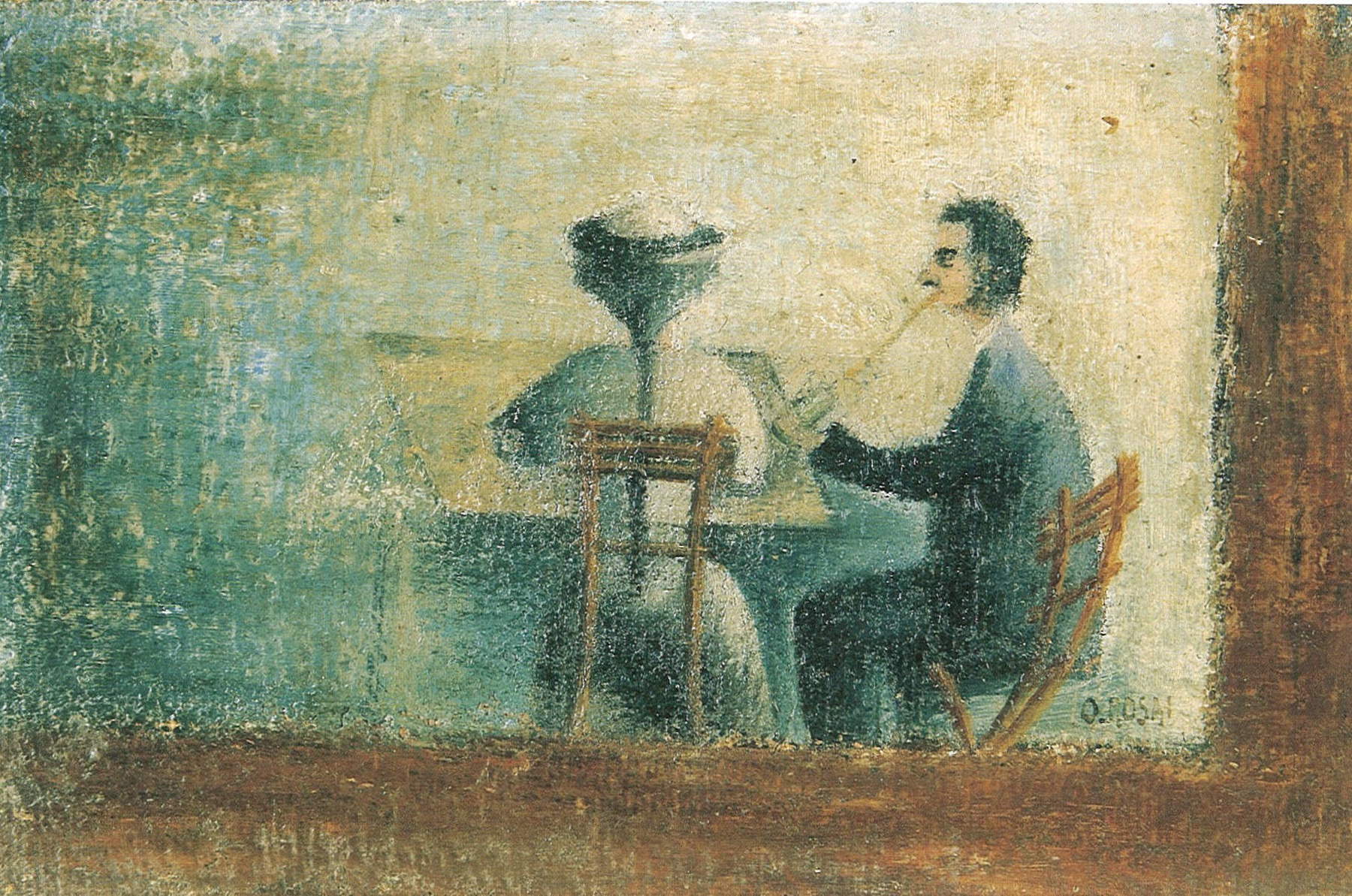
In the 1920s, this theme would become recurrent, though it did not yet take on a single, unambiguous form. In an early phase, works such as *Trattoria Lacerba* and *I fidanzati (Coppia al caffè) * still display a lyrical, fluid style of painting, permeated by vibrations of light and a frayed texture. The setting of the café, the trattoria, or the lived-in interior is not yet fixed in a closed composition, but the figures seem rather immersed in a suspended atmosphere—at times almost evanescent—where the table, the instruments, the chairs, and the people do not impose themselves as solid blocks, but as presences gathered within a space that is still unstable and sensitive, traversed by bursts of color and soft transitions.
It was, however, during this same decade that this motif began to change in nature. In works such as *Serenata*, *L’attesa*, *Caffè Bottegone*, and *Interno di caffè*, Rosai seems to gradually shift his focus from atmosphere to composition. The table is no longer merely an element of the scene but becomes the pivot around which figures, chairs, walls, windows, outlines, and planes are arranged. Regarding *Caffè Bottegone*, critics spoke of a “tight compositional order,” of a movement that rises from the “tabletop” toward houses, windows, and rooftops, within a true “architecture of forms.” The café is no longer simply a working-class setting but a pictorial structure, a place where Rosai measures relationships of weight, interlocking elements, volumes, and pauses. This transformation is also evident in *Interior of a Café*, where the small figures and furnishings are arranged within a delicate web of luminous interplay and chromatic textures. Thus, within the same decade, the theme shifts from a still lyrical and vibrant style of painting to a more sculptural and constructive one. The café and the tavern become mental spaces, enclosed rooms where social interaction gathers, comes to a standstill, and begins to give way to silence.
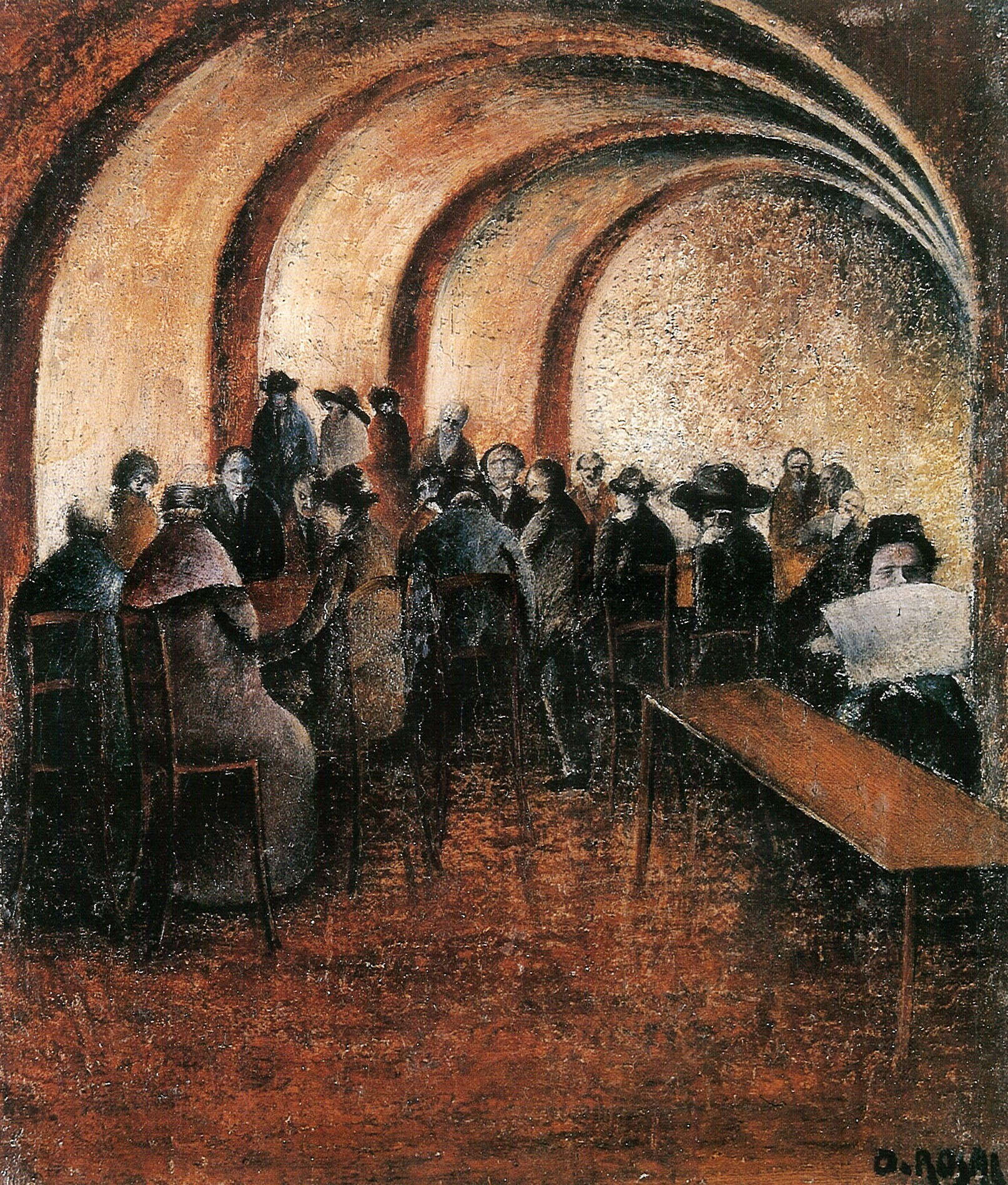
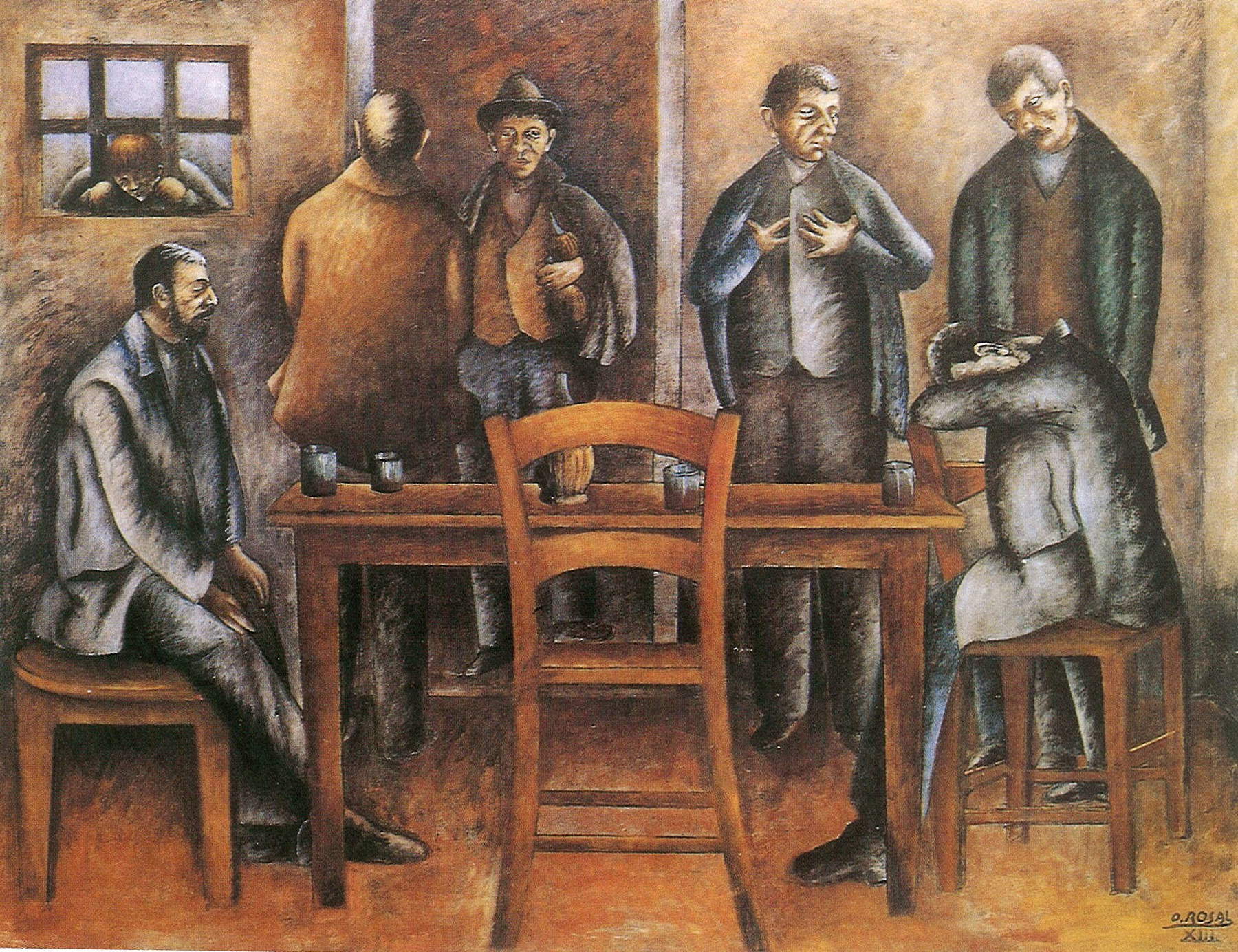
With *Interior with Figures (Tavern)* (1935), the motif reaches a phase that is now fully architectural. After the more lyrical and loose experiments of the previous decade, the scene solidifies into a more rigid order, in which tables, chairs, walls, and figures are arranged as elements of a simple, almost masonry-like architecture. One can sense an echo of a return to order, but without any classicist reconciliation. The regularity of the composition does not produce harmony, but rather closure, weight, and a rough, vernacular stillness. Rather than the serenity of the classical, this painting seems imbued with a more austere modernity, akin in atmosphere to certain European movements of New Objectivity, with a dry, disenchanted, almost polemical gaze directed at the people and places of everyday life.
It is within this progressive solidification of space and form that Rosai’s famous “little men” also take shape: short, closed-off, stocky figures, often seated or gathered in small groups, who at first glance might seem like simple Florentine commoners. But in his best paintings, they are neither caricatures nor extras in a neighborhood comedy. Savinio recognized in them something more ancient and profound, speaking of an “Etruscan soul” that “re-emerges and endures in the paintings of Ottone Rosai” and defining those “little men” as “the stocky man,” “the Etruscan man,” and at the same time “the monumental man.” The common man—poor, almost unassuming—is reduced to a compact, archaic, heavy presence, capable of occupying space with an unexpected gravity. Rosai’s painting moves ever further away from narrative and anecdote. What matters, therefore, is not what the men are saying to one another, but the fact that they are there—still, heavy, consigned to a sociality that no longer coincides with communion.
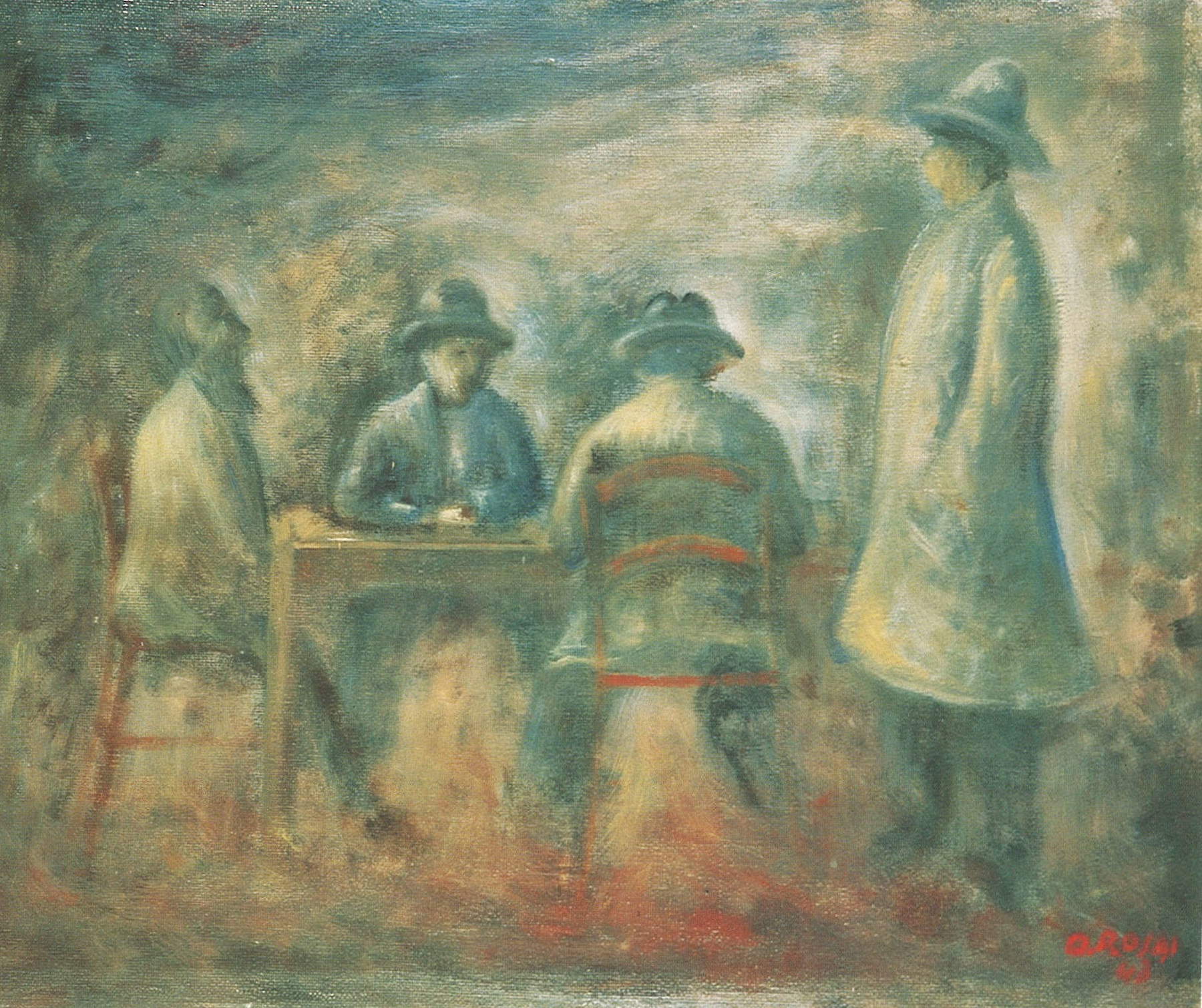
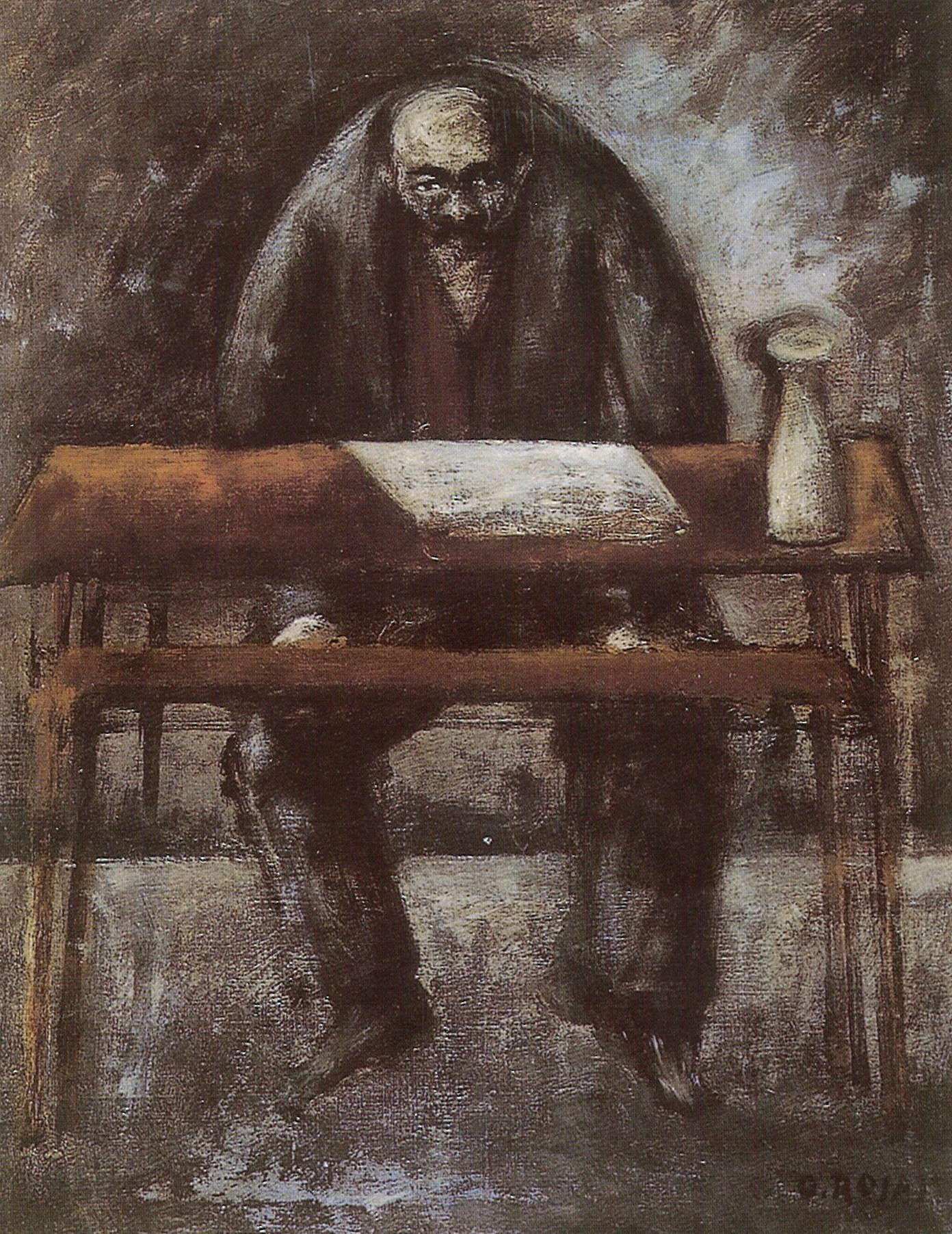
In the 1940s, then, the motif seems to take on an even more overt sense of unease. The war, Florence scarred by bombing, and Italy—first ravaged by conflict and then by a pacification that was anything but painless—cannot be taken as mechanical explanations; yet they help us understand the shift in tone. In works such as *La partita*(1943) and *Uomo al tavolo*(1948), Rosai’s painting appears more tormented, rougher, almost worn out. The paint begins to break down again, but not with the lyrical vibrancy of his early works; rather, it is a frayed, defeated style, permeated by a sense of weariness and isolation.
Even the table takes on a new significance: it is no longer merely the compositional center around which figures and space are arranged, nor the still-possible setting for conversation or waiting. It becomes a silent surface, almost a barrier. The men sitting at it or gathered around it seem all the more alone precisely because they are close together. If in the 1920s the café and the tavern were still places to be constructed pictorially, and in the 1930s they became simple, brick-and-mortar structures, in the 1940s they transformed into spaces of minimal resistance, where only the weight of man remains in the presence of others and of himself.
It is perhaps here that the theme finds its most coherent conclusion. Rosai’s tavern is never simply a genre scene, nor a picturesque memory of working-class Florence. It is a real, recognizable place, rooted in the city, but it is also a pictorial space in which the clatter of social interaction is gradually silenced. From the Futurist bar of his early days to the gloomier interiors of the postwar period, Rosai explores conviviality to reveal its flip side—not the celebration, but the waiting; not the anecdote, but the presence; not the pacified community, but men sitting side by side, close yet irremediably separated. In conclusion, to borrow the words of art historian Luigi Cavallo, taverns are like familiar cages of misery, through which the artist pointed to the grim and sordid fate of his generation, shattered in its desires and civic consciousness.

The author of this article: Jacopo Suggi
Nato a Livorno nel 1989, dopo gli studi in storia dell'arte prima a Pisa e poi a Bologna ho avuto svariate esperienze in musei e mostre, dall'arte contemporanea alle grandi tele di Fattori, passando per le stampe giapponesi e toccando fossili e minerali, cercando sempre la maniera migliore di comunicare il nostro straordinario patrimonio. Cresciuto giornalisticamente dentro Finestre sull'Arte, nel 2025 ha vinto il Premio Margutta54 come miglior giornalista d'arte under 40 in Italia.Warning: the translation into English of the original Italian article was created using automatic tools. We undertake to review all articles, but we do not guarantee the total absence of inaccuracies in the translation due to the program. You can find the original by clicking on the ITA button. If you find any mistake,please contact us.
























 IT
IT FR
FR DE
DE ES
ES CN
CN


