




by Redazione 26/06/2026



Categories: Exhibitions / Disclaimer
The Bastion of St. Mark is now part of the Castel Sant’Angelo tour, hosting an exhibition that chronicles the turbulent history of Rome from the 6th to the 19th century through archival documents and historical weapons.


The Bastion of St. Mark has officially become part of the Castel Sant’Angelo tour, opening a new exhibition space to the public with the exhibition *Signs and Stories: Scenes of a Turbulent Rome from the 17th to the 19th Centuries*. The exhibition will be open from June 25 through September 13, 2026. Promoted and produced by the Pantheon and Castel Sant’Angelo – the National Museums of the City of Rome, in collaboration withthe State Archives of Rome and organized by Civita Mostre e Musei, the exhibition offers a journey through the history of the capital via documents from the State Archives of Rome, historical artifacts, and testimonies that reveal the lesser-known side of the city between the 17th and 19th centuries.
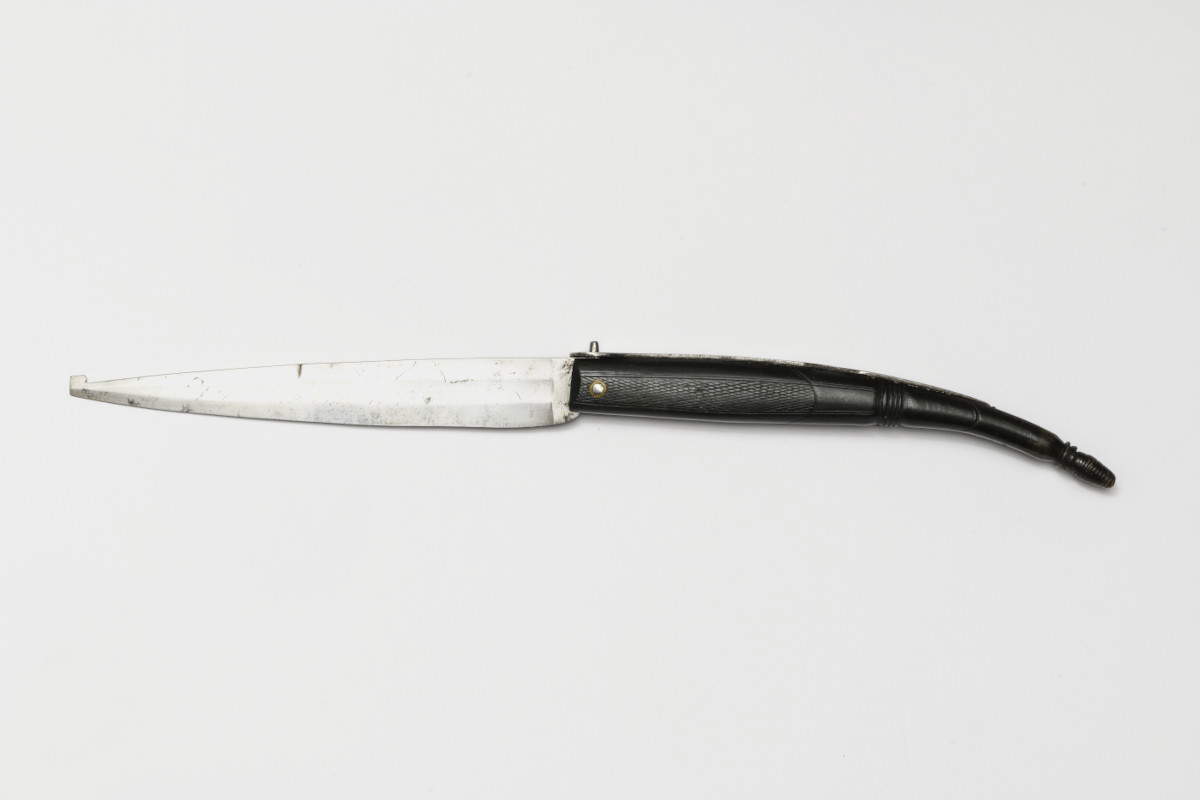
The exhibition itinerary stems from the combination of a valuable collection of archival sources—identified during Franco Russo’s research—and a selection of historic knives from his private collection. Court records, minutes, proclamations, and judicial documents, dating from 1611 to 1865, interact with the weapons on display, reconstructing news stories, episodes of violence, conflicts, and moments of daily life in papal Rome.


Among the exhibition’s most significant features are the sketches of knives drawn in the margins of numerous court documents. These sketches, created at the time to precisely describe the weapons used in the events recounted, now find a concrete counterpart in the specimens on display, thus linking the written sources to the original objects. The exhibition also offers the opportunity to trace the evolution of the traditional Roman knife, the so-called “serratore,” observing its transformations over the centuries without losing the fundamental characteristics already documented in 17th-century sources.
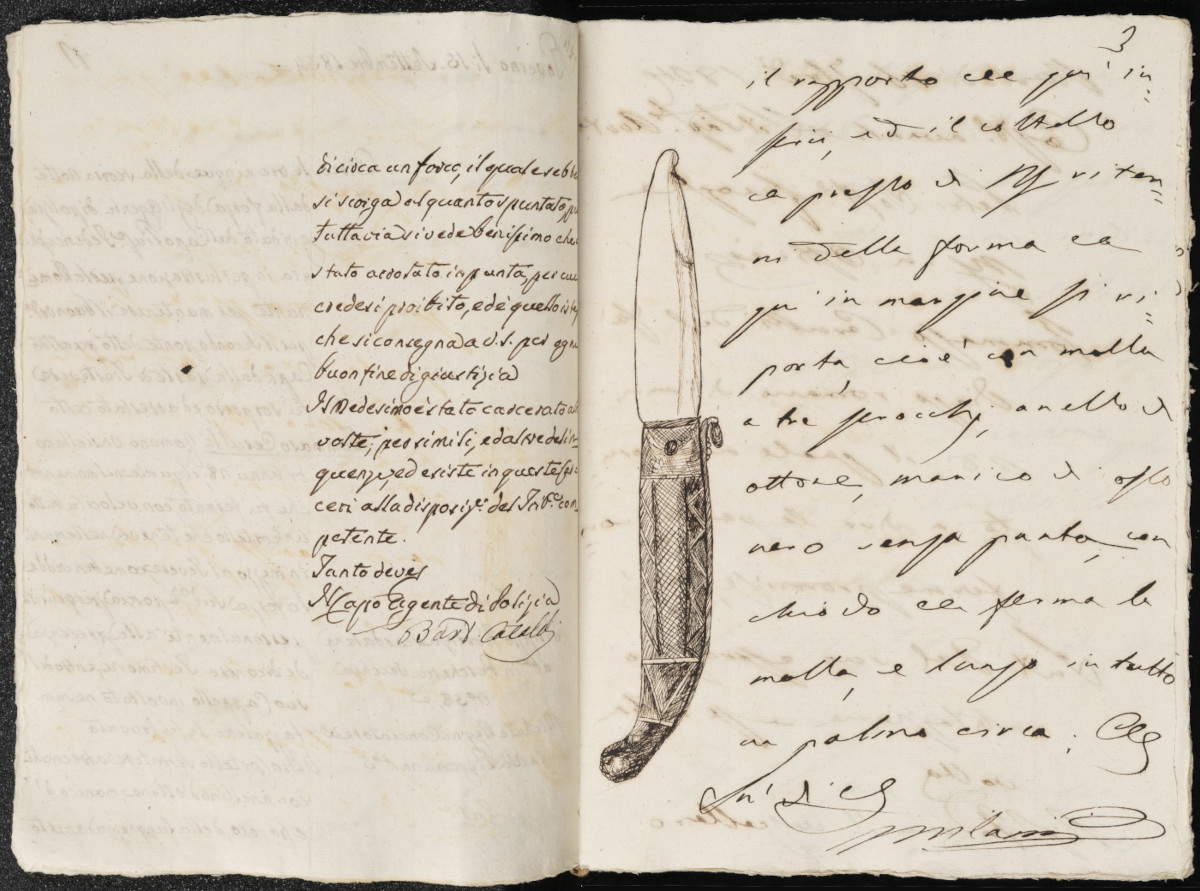
The documents preserved in the State Archives paint a vivid picture of life in papal Rome. Court records chronicle the daily lives of the lower classes, marked by disputes, matters of honor, violence, and petty crimes, while proclamations issued by the authorities reflect the institutions’ perspective and their strategies for controlling the territory. The comparison between these two perspectives is one of the exhibition’s central themes, offering a reflection on the relationship between justice, public order, and society. The result is a collective narrative composed of ordinary stories, anonymous protagonists, and events often excluded from the grand narratives of official history. Through these documentary fragments, the lives of men and women resurface—people who, through their daily experiences, helped shape the face of Rome between the modern and contemporary eras.
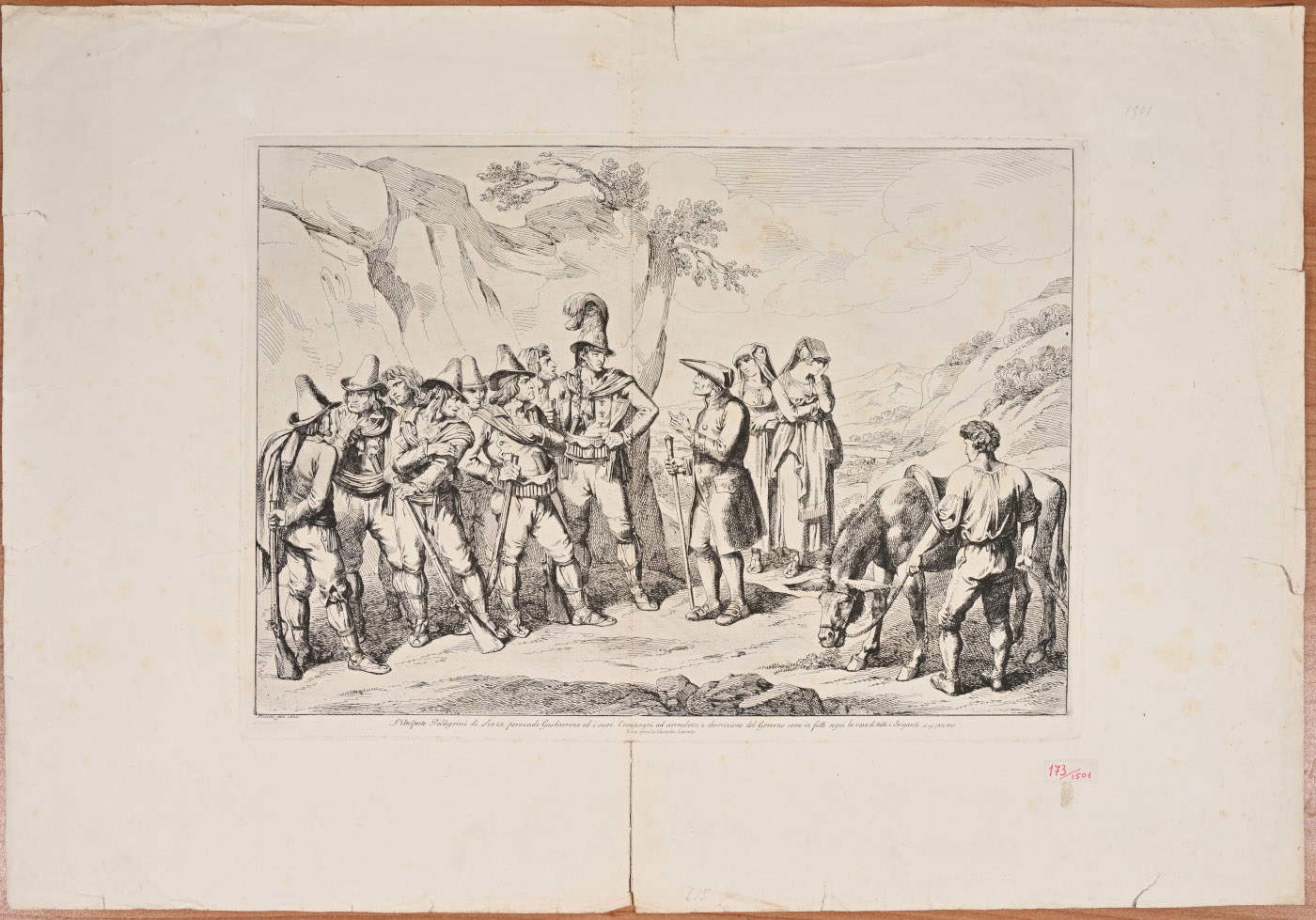
Castel Sant’Angelo also plays a central role in the project. In addition to hosting the exhibition, the monument is an integral part of the narrative, having served for centuries as a place of detention for many figures similar to those commemorated in the documents on display. Among the figures featured in the exhibition, the bandit Antonio Gasbarrone stands out as a symbol of an era marked by social tensions and contradictions. His story is evoked through the original door of one of the castle’s cells, restored specifically for the occasion, along with engravings by Bartolomeo Pinelli, which depict life in nineteenth-century Rome. A dagger from the Castel Sant’Angelo collections also contributes to the dialogue between the documents and the collections; it has been included in the exhibition itinerary as an ideal link to the “Panopliae” exhibition, on view in the Upper Armory. While the latter is dedicated to weapons used in military and court contexts, *Signs and Stories* focuses instead on the instruments of everyday violence, offering a complementary perspective on the society of the time.
At the heart of the exhibition, however, is the documentary heritage of the State Archives of Rome, which, thanks to this collaboration, is being brought out of storage. The exhibition thus invites the public to interpret history through its most authentic traces, rediscovering the complexity of Rome’s past and the stories of a population that rarely finds a place in official narratives.
Hours: Tuesday through Sunday, 9 a.m. to 7:30 p.m. Closed Mondays.
|
| Castel Sant’Angelo opens the Bastione di San Marco with an exhibition on Rome’s turbulent history from the 17th to the 19th centuries |
Warning: the translation into English of the original Italian article was created using automatic tools. We undertake to review all articles, but we do not guarantee the total absence of inaccuracies in the translation due to the program. You can find the original by clicking on the ITA button. If you find any mistake,please contact us.