





From June 26 to September 27, 2026, the MAC Museo d’Arte Contemporanea “Ludovico Corrao” in Gibellina hosts Domestic Displacement, an exhibition curated by Giulia Ingarao and Antonio Leone included in the program of Gibellina Capitale Italiana dell’Arte Contemporanea 2026. The project brings together fifteen international artists to construct an articulated reading of the transformations of contemporary living, with particular attention to the phenomena of uprooting, vulnerability and identity instability that traverse the global present.
The exhibition starts from a premise that identifies displacement, understood as physical, cultural and symbolic displacement, as a structural condition of contemporaneity. Forced migrations, linguistic exiles, cultural diasporas, the erosion of belonging and the continuous redefinition of the body politic constitute the context within which the works in the exhibition are situated. The body of research presented constructs a nonlinear map of dwelling, in which identity and memory are configured as unstable elements, subject to continuous negotiation.
The conceptual core of the exhibition is developed around the idea that vulnerability, impermanence and mutation represent ordinary conditions of contemporary existence. In this perspective, displacement extends to a dimension that invests the perception of self and social relations. Inhabiting uncertainty thus becomes an interpretive key that aims at their coexistence through forms of mutual listening and redefinition.
The works of Anya Gallaccio, Regina José Galindo, Mona Hatoum, Paolo Icaro, William Kentridge, Anna Maria Maiolino, Shirin Neshat, Olu Oguibe, María Magdalena Campos-Pons, Amalia Pica, Mustafa Sabbagh, Santiago Sierra, Holly Stevenson, Zehra Doğan and Akram Zaatari confront themes such as trauma of uprooting, precariousness of memory, political conflict and transformation of visual languages. What emerges is a set of artistic practices that traverse intimate experiences and global historical tensions without tracing them back to a single narrative.
![Akram Zaatari [L YM BSM] Ancient World New Age (2026; signed, dated, titled recto ink and acrylic on mulberry paper, 63.5 x 91.5 cm) © Akram Zaatari. Courtesy of the artist, Sfeir-Semler Gallery and Thomas Dane Gallery.](https://cdn.finestresullarte.info/rivista/immagini/2026/fn/akram-zaatari-ancient-world-new-age.jpg)
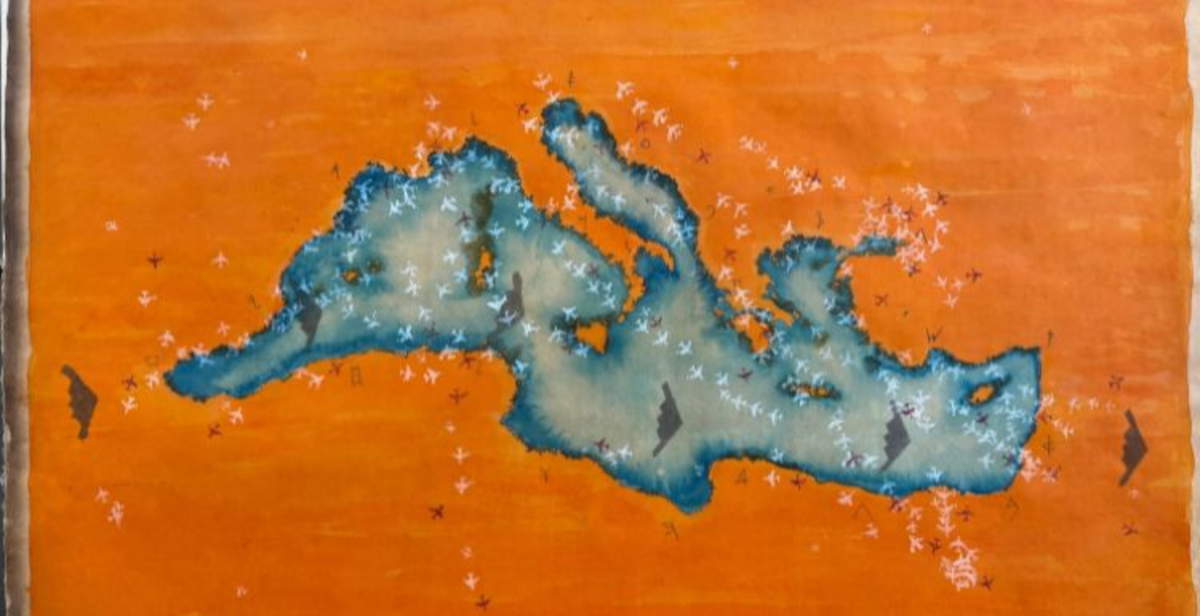
The exhibition is divided into three sections: Unstable Geographies, Inhabiting Dislocation and Fragile Forms of Coexistence. Each addresses a specific declination of the relationship between space, identity and memory, building a progression that is not based on a narrative linearity, but on a logic of overlap and cross-references. In the section Unstable Geographies, the theme of cartography becomes a tool for critical reflection. Mona Hatoum intervenes on the planisphere, reworking the representation of territory and questioning the stability of geopolitical boundaries, which are continuously redefined by conflicts and economic dynamics. Akram Zaatari, with works from the YM series, offers further reworked cartographies in which temporal and cultural stratifications overlap.
In the work L YM BŠM (2026), the spread of the Phoenician alphabet in the Mediterranean basin is intertwined with contemporary air routes, including military ones, returning a layered reading of space. William Kentridge’s work, in Porter Series: Espagne Ancienne (Porter with Dividers) (2001-2008), returns an unstable geography, traversed by erasures and rewritings, reflecting the contemporary condition of dislocation. Shirin Neshat addresses the identity fracture generated by distance from the homeland, relating internal tensions in countries of origin and countries of adoption. Zehra Doğan uses an archetypal visual language to refer to the plight of the Kurdish people and the defense of their cultural identity, while Santiago Sierra employs a radical aesthetic grammar to highlight power dynamics, exclusion and systemic violence in contemporary societies.
The section Inhabiting Dislocation addresses uprooting as a structural condition of the present. In this context, dwelling is defined by mobility and contamination between languages, memories and symbolic practices. Mustafa Sabbagh, with Made in Italy© - Handle with Care (2015), explores cultural plurality and the tension between belonging and transformation. Regina José Galindo, with Raíces (2015), addresses the relationship between roots and coexistence, questioning the possibility of maintaining a connection to one’s origin within contexts of dislocation. María Magdalena Campos-Pons constructs a visual language in which genealogy, diaspora and Afro-Caribbean spirituality are intertwined, bringing out the persistence of colonial legacies in the present. Olu Oguibe develops a reflection on the postcolonial and migratory condition through an interweaving of language, history and Afro-Descendant aesthetics.
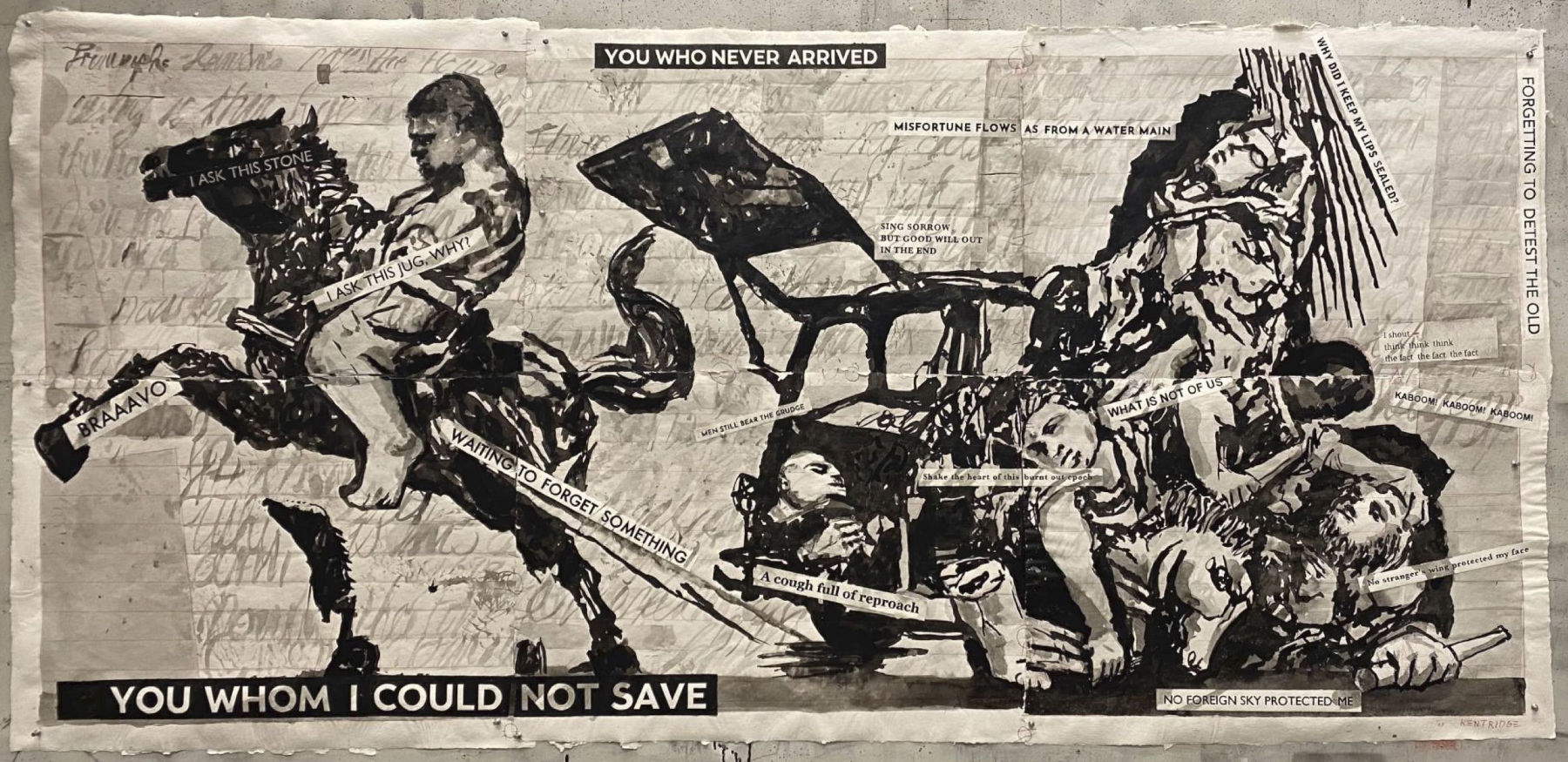
The third section, Fragile Forms of Coexistence, focuses on the dimension of vulnerability as a shared element. Holly Stevenson and Amalia Pica address the precariousness of languages and forms of relationship. Stevenson, with her ceramics inspired by Leonora Carrington’s The Debutante (2025), explores the boundaries of the body and its symbolic transformations, while Pica, in her series Souvenir (2018) and Catchphrase (2022), constructs hybrid assemblages in which ordinary, anatomical, and vegetal elements coexist in a continuous tension between recognizability and ambiguity. In Please open hurry(2018), the artist investigates the limits of communication and the fragility of language.
Anya Gallaccio, in the pictorial series Untitled (2016-2018), works on the transformation and dissolution of the image through fragments of lived landscapes. Anna Maria Maiolino addresses the everyday gesture as a political practice, developing a reflection on identity marked by the experience of migration and resistance to repressive contexts during the 1970s and 1980s. Paolo Icaro, with Personae (1991), goes beyond the traditional sculptural dimension to open a process of reflection on the images of violence and depersonalization, starting also from the representations related to the Vietnam War. Domestic Displacement is thus configured as a constellation of critical positions and visual devices that question the possibility of inhabiting the present in conditions of permanent instability.
“Gibellina inhabits this exhibition as her own meta-narrative. It has experienced uprooting and interpreted rebirth through art and artists,” says the Artistic Director of Gibellina Capitale Italiana dell’Arte Contemporanea 2026, Andrea Cusumano.
 |
| "Domestic Displacement" in Gibellina: the unstable map of contemporary living |

Warning: the translation into English of the original Italian article was created using automatic tools. We undertake to review all articles, but we do not guarantee the total absence of inaccuracies in the translation due to the program. You can find the original by clicking on the ITA button. If you find any mistake,please contact us.




















 IT
IT FR
FR DE
DE ES
ES CN
CN


