



by Redazione 21/05/2026



Categories: Exhibitions / Disclaimer
From June 13 to Oct. 18, 2026, the JMUSEO in Jesolo hosts "Elliott Erwitt. Icons," an exhibition curated by Biba Giacchetti featuring 80 photographs by the Magnum Photos master. The exhibition spans portraits, historical scenes and iconic black-and-white shots of the 20th century.

Jesolo’s JMUSEO, a four-level exhibition and cultural center designed as a space dedicated not only to exhibitions but also to public events and activities, is hosting from June 13 to Oct. 18, 2026 the exhibition Elliott Erwitt. Icons, dedicated to one of the protagonists of 20th century photography. The exhibition is promoted by the City of Jesolo and JMUSEO, in collaboration with Orion57 and Bridgeconsultingpro, and curated by Biba Giacchetti, with project management and technical assistance by Gabriele Accornero and Valentina Bruno.
The exhibition project features a selection of 80 images considered among the most representative of the career of Elliott Erwitt (1928-2023), an American photographer known for an approach that combines documentary observation, irony and attention to the everyday dimension. The photographs, all in black and white, return a broad and articulate narrative of the 20th century, traversing historical moments, scenes of ordinary life and portraits of public figures.
The itinerary is set in the context of the bicentennial of the first photograph in history, traditionally identified with the View from the Window at Le Gras, taken in 1826 by Joseph Nicéphore Niépce, an episode that marks the beginning of the possibility of permanently fixing a real image on a physical support. Within this historical frame of reference, the exhibition relates the evolution of photographic language to the work of Erwitt, former president of Magnum Photos, an agency founded in 1947 by Robert Capa and Henri Cartier-Bresson.


The selected images document some of the best-known nuclei of the author’s production. An important part of the work is devoted to animals, particularly dogs, recurring subjects in his photographs. In these shots, often constructed from the animal’s point of view, human figures are reduced to partial elements such as shoes or legs, according to a compositional choice that aims to overturn traditional perspective and produce situations of an ironic nature. To obtain natural reactions, Erwitt also resorted to direct expedients such as sudden sounds or vocal calls.
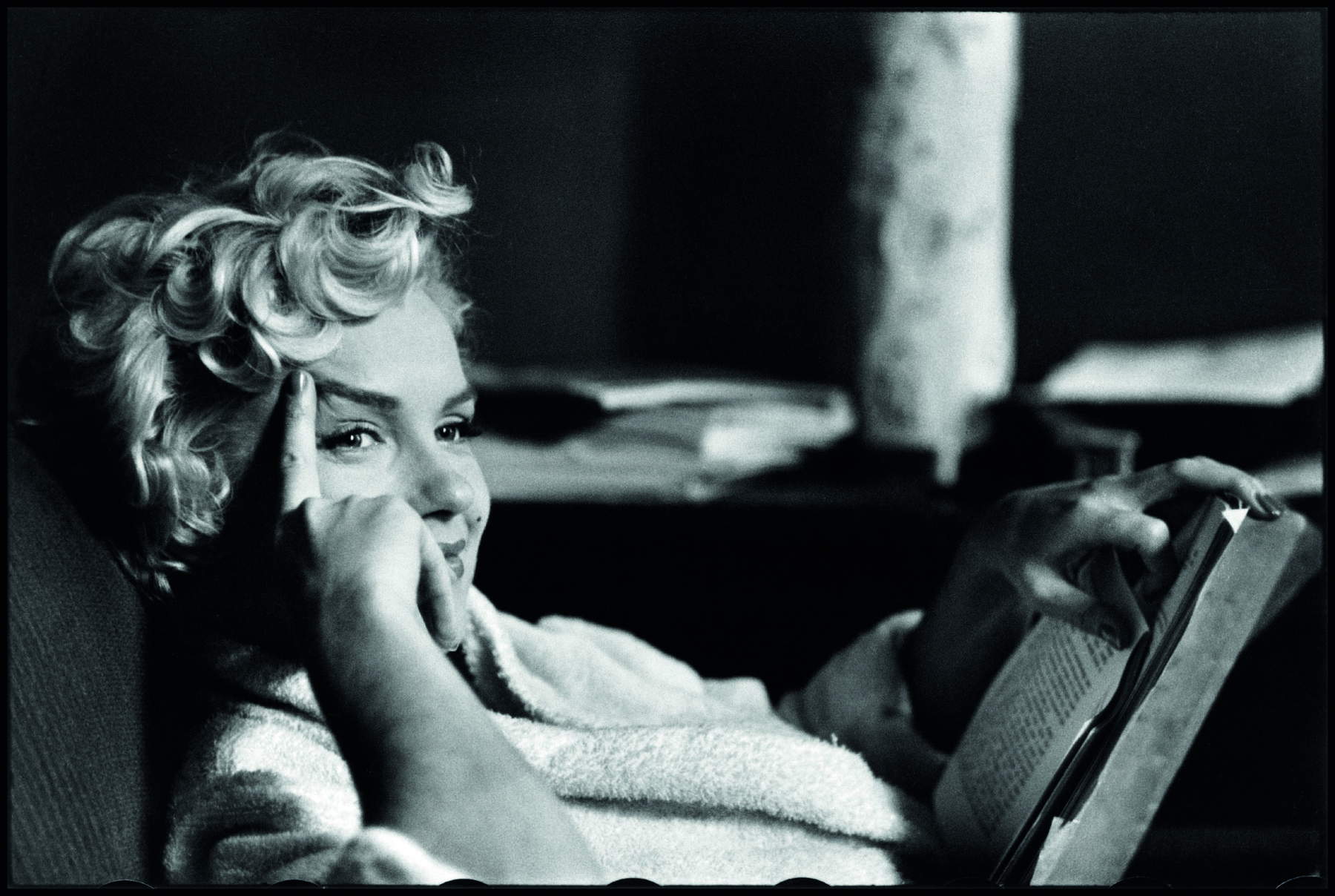
The itinerary also includes numerous portraits of personalities from the worlds of culture, entertainment and politics. These include Ernesto Che Guevara, Jack Kerouac, Marlene Dietrich, Fidel Castro, Sophia Loren, and Arnold Schwarzenegger. Also featured is one of the author’s best-known shots of Marilyn Monroe during the filming of Billy Wilder’s When the Wife is on Vacation, in a moment that has become iconic in the history of the photographic image.
The selection also includes photographs related to historical events of the twentieth century, such as the funeral of John Fitzgerald Kennedy and the meeting between Nixon and Khrushchev, immortalized in an episode of political tension in which the U.S. president points to his Soviet counterpart. Alongside these public images, the exhibition also features works of a more private and autobiographical nature.
Shots on display include California Kiss, made through the reflection of a rearview mirror, and other images set in Paris, a city central to the author’s production. This includes Umbrella Jump, a photograph depicting a man jumping over a puddle at the Trocadéro with the Eiffel Tower in the background and two lovers in the background of the scene. Also part of the selection is an image commissioned by a French tourist board depicting a grandfather and grandson on a bicycle.
The exhibition also includes photographs dedicated to the author’s family, including a shot of his infant daughter observed by her mother and a cat, and a section of self-portraits in which Erwitt uses his own image as an object of self-mockery. The exhibition is accompanied by a catalog published by Orion57 / Elliott Erwitt Studio, which documents the exhibition and the selection of images presented to the public.
Statements
“With the exhibition dedicated to Elliott Erwitt,” comments Christofer De Zotti, mayor of Jesolo, “the JMuseo confirms its vocation to host the protagonists of international photography. His images, famous throughout the world, tell a century of history with irony and extraordinary sensitivity, restoring moments of everyday life, events and faces that have entered the collective imagination. Welcoming this exhibition to Jesolo means offering citizens and visitors a valuable cultural experience and continuing to strengthen the role of the JMuseo as a space open to contemporary culture, capable of enriching the offer of our city throughout the year.”
“Elliott Erwitt,” comments Biba Giacchetti, co-curator of the exhibition and one of Erwitt’s leading international connoisseurs, “was not just a photographer, but an unparalleled visual storyteller, capable of transforming the instant into history, the everyday into art, irony into poetry. His images evoke in the viewer emotions that move on different registers, from emotion to a smile to the most spontaneous amusement. Passing away in November 2023 at the age of 95, he left us an immense legacy: an archive of photographs that cross eras, cultures and feelings with a universal language, inviting us to look at the world with more indulgence and wonder, always putting himself at our side in that profound lightness that he called ’The Art of Observation.’”
“Elliott Erwitt,” adds one of the exhibition’s two project managers Gabriele Accornero, “is, like his photographs: ironic, enigmatic, aerial. Behind all this one perceives a great personality and a sharp intelligence, almost disorienting. The artistic value of Erwitt’s work seems to reach itself almost incidentally, is never pursued, and perhaps that is why it is so often centered. Sterile reading schemes borrowed from art history do not suit Erwitt, he is only concerned with making good photographs; Erwitt’s photographs are generally light-hearted, carefree, luminous, but this does not detract from the fact that some images rise to manifestos of thought, even of social claim.”
 |
| Elliott Erwitt in Jesolo: 80 icons of 20th century photography at JMUSEO |
Warning: the translation into English of the original Italian article was created using automatic tools. We undertake to review all articles, but we do not guarantee the total absence of inaccuracies in the translation due to the program. You can find the original by clicking on the ITA button. If you find any mistake,please contact us.