





From July 10 to September 27, 2026, Palazzo Altemps, home of the National Roman Museum in Rome, will host “Mircea Cantor – Constellations of Antiquity,” a solo exhibition by Romanian artist Mircea Cantor, curated by Pier Paolo Pancotto and Federica Rinaldi. The exhibition is staged in the spaces of the museum directed by Federica Rinaldi and is the result of a collaboration with the Romanian Academy and the Romanian Cultural Institute, under the patronage of the Romanian Embassy in Italy and in collaboration with the National Museum of Romanian History in Bucharest.
The exhibition is conceived as a site-specific installation that connects the language of contemporary art with the collection of ancient sculptures housed at Palazzo Altemps. The exhibition features fifteen works—some original and others drawn from the artist’s body of work—with the aim of exploring some of the recurring themes in his practice, particularly the relationship between memory and the present, approached as an element of constant engagement with history, material culture, and everyday experience.
Mircea Cantor, born in Romania and a resident of France for over twenty years, has built his artistic career on the intersection between the culture of his country of origin and the international context in which he works. This dialogue permeates his body of work and manifests in the use of symbols, structures, movements, and cultural references that connect different eras and traditions. In his works, the theme of memory takes center stage and is explored through images that reflect on how the past continues to shape our perception of the present.
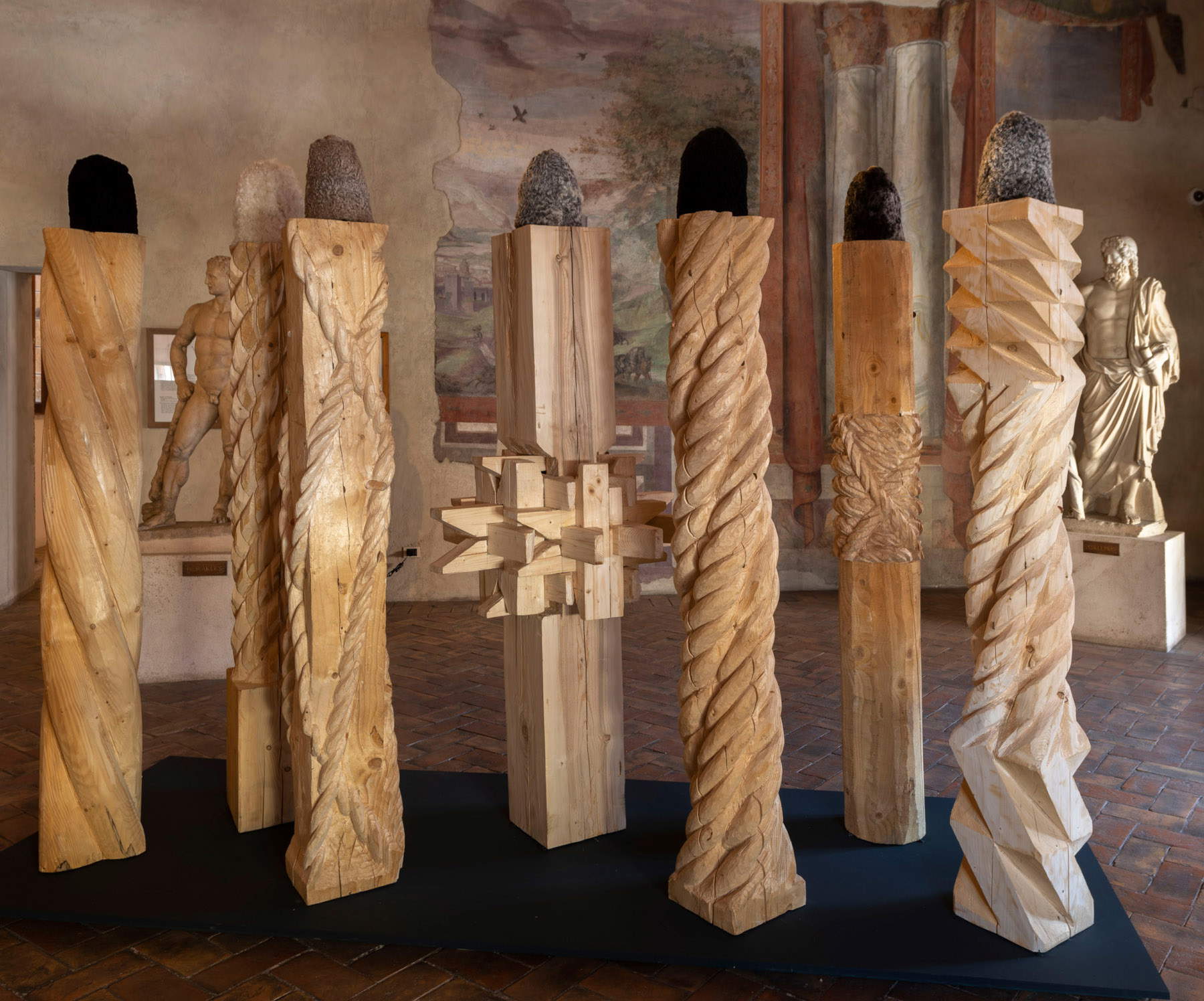
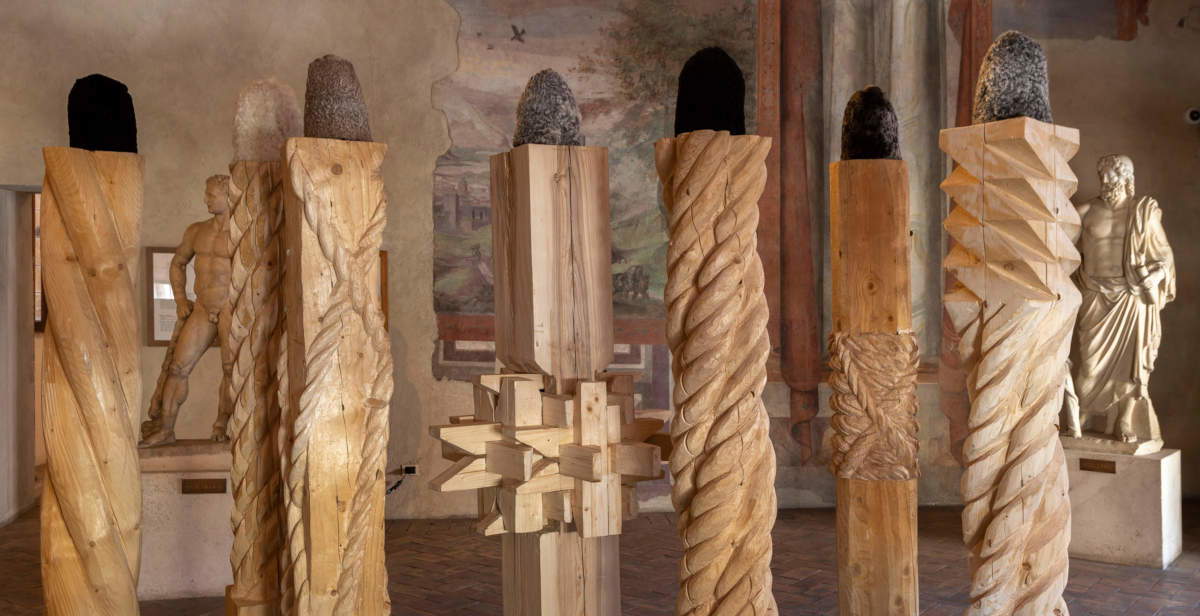
The exhibition is arranged throughout the palace’s rooms, following a path that establishes a direct dialogue with the museum’s archaeological works. Among the pieces on display is *The Seven Guardians*, a sculptural installation that evokes ancient columns and engages with the so-called *Hall of Perspectives*. The work consists of pine columns, carved by artisans from northern Romania under the artist’s guidance and topped with the traditional fur hat. The ensemble evokes the figure of the pileatus, a member of the aristocracy of ancient Dacia, recognizable precisely by his characteristic conical headdress.
Another central part of the exhibition is *Murus dacicus*, an installation created specifically for the spaces of Palazzo Altemps. The work draws inspiration from the walls built by the Dacians to defend their cities and is presented on traditional handmade rugs. The juxtaposition of elements evoking ancient stone inscriptions with contemporary materials such as ordinary bricks prompts reflection on the relationship between permanence and fragility. The juxtaposition of objects from different historical and social contexts also evokes themes related to cultural heritage, social conditions, and economic factors, offering a reinterpretation of the meaning of ancient ruins in a contemporary context.
The exhibition is rounded out by *Sleeping Hyperion*, an installation situated in the grand hall of the Galata Suicida, in dialogue with the sleeping head of the Erinyes housed in the museum. The work consists of a plaster mask that reproduces, at actual size, the face of the Romanian poet Mihai Eminescu. The cast rests on a pile of traditional wool blankets and creates a comparison between different eras, figures, and cultural references, set within an environment with an almost domestic feel.
Throughout his career, Mircea Cantor has received some of the most prestigious awards in contemporary art, including the Marcel Duchamp Prize in 2011 and the Fondation d’Entreprise Ricard Prize in 2004. His work has long focused on the themes of freedom and the human condition, explored through installations, sculptures, and other artistic languages in which rhythm, repetition, and symmetry serve as tools for connecting the individual dimension with collective memory.
“[…] From the very beginning of my career,” says Mircea Cantor, “I have been interested in the relationship between art and the past. […] One field in particular that is very close to my heart is archaeology. […] For me, as an artist, direct contact with artifacts from the past (through museums and archaeological sites) is an invaluable source of questions, information, and constant inspiration; a way to seek answers by lifting veils and associating them with masterpieces of art history (paintings, sculptures, writings) […] ”.
 |
| Mircea Cantor at Palazzo Altemps: Fifteen Works Engage in Dialogue with Ancient Sculptures |

Warning: the translation into English of the original Italian article was created using automatic tools. We undertake to review all articles, but we do not guarantee the total absence of inaccuracies in the translation due to the program. You can find the original by clicking on the ITA button. If you find any mistake,please contact us.























 IT
IT FR
FR DE
DE ES
ES CN
CN


