





From September 5, 2026, to January 9, 2027, the Museo dell’Ottocento – Fondazione Di Persio-Pallotta in Pescara will host *The Barbizon School: The Roots of Impressionism*, an exhibition that brings together the Foundation’s entire French collection for the first time. The exhibition aims to highlight a collection that now comprises 120 works, recently enriched by 39 new acquisitions.
The exhibition chronicles one of the most significant and innovative movements in 19th-century European painting. Between 1830 and 1870, a group of French artists chose to break away from traditional academic models and settle in the vicinity of the village of Barbizon, on the edge of the Forest of Fontainebleau. Here, a new approach to landscape painting emerged, based primarily on the direct observation of nature. Théodore Rousseau, Charles-François Daubigny, Jules Dupré, and Narcisse Diaz de la Peña were among the leading figures of this movement, dedicating themselves to depicting woods, clearings, and natural scenes. The landscape thus became the true protagonist of the composition, observed in its transformations and in its most authentic form.
The focus on light, atmospheric conditions, and seasonal changes led the Barbizon artists toward a completely new painterly sensibility. Observing the landscape from life and the desire to capture nature’s variations on canvas helped lay the groundwork for the Impressionists’ subsequent explorations. The Barbizon School represents, in fact, one of the fundamental steps toward that revolution in painting which, in the second half of the nineteenth century, would profoundly change the way reality was depicted.
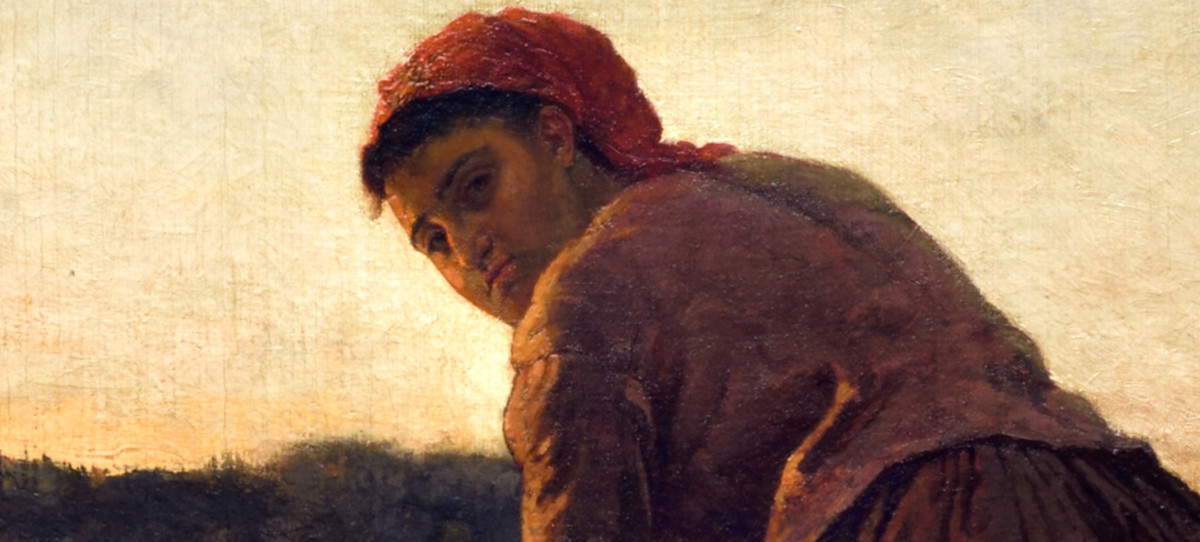
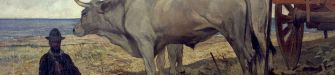
Raymond Eugène Goethals’ *Peasant Woman at Work at Dusk* was chosen as the exhibition’s featured image; it is one of the most significant acquisitions recently added to the collection. The work encapsulates some of the fundamental themes of realist aesthetics and conveys with particular intensity the truth of observation, the relationship between human beings and the natural environment, and the value of daily labor. The figure of the peasant woman set against the landscape becomes an image that unites a focus on reality, social sensitivity, and the observation of nature.
Another central element of the exhibition is the relationship between the Barbizon School and 19th-century Italian painting. The new French focus on nature also influenced numerous Italian artists, who were able to reinterpret this sensibility within their own artistic explorations. Among the key figures in this dialogue is Giuseppe Palizzi, an Italian artist with ties to France and a leading figure in 19th-century naturalist painting. His work attests to the vibrancy of cultural exchanges between the two countries and the role that landscape painting played in the circulation of new artistic ideas in 19th-century Europe.
The Barbizon School not only represented a shift in the way landscapes were painted but also helped transform the very way nature was viewed and interpreted. Forests, countryside, and rural landscapes took on a new centrality and became places of observation, experience, and reflection. Nature came to be increasingly perceived as a heritage to be understood and respected, foreshadowing a sensibility that remains highly relevant today.
Nearly two centuries later, the exhibition at the Museo dell’Ottocento in Pescara aims to highlight the importance of the Barbizon School as the root of Impressionism, shedding light on its contribution to the emergence of a new sensibility toward the landscape.
 |
| The Barbizon School: The Roots of Impressionism on Display at the Museo dell’Ottocento in Pescara |

Warning: the translation into English of the original Italian article was created using automatic tools. We undertake to review all articles, but we do not guarantee the total absence of inaccuracies in the translation due to the program. You can find the original by clicking on the ITA button. If you find any mistake,please contact us.























 IT
IT FR
FR DE
DE ES
ES CN
CN


