





In the work of Nina Carini (Palermo, 1984), matter is never an inert presence: it is an organism permeated by tensions, energies, and processes of transformation that continually challenge the boundary between the visible and the invisible, presence and absence, form and dissolution. Nina Carini’s works often arise from the observation of fragile and imperceptible phenomena: the movement of flowers over time, the unstable equilibria of lagoon ecosystems, and the traces left by what is disappearing. At the heart of her practice lies a constant question: how can we make perceptible that which eludes the gaze? From this emerges a language that operates through subtraction, fragmentation, and metamorphosis, in which sculpture seems to free itself from its own weight to transform into a field of forces, tension, and breath. In this conversation with Gabriele Landi, Nina Carini traces her journey toward sculpture, reflecting on the meaning of intensity, her dialogue with nature, and the role of the body as a site of transformation.
Trained at the Academies of Fine Arts in Verona and Milan and at the École nationale supérieure des beaux-arts de Lyon, the artist took her first steps in the field of painting, quickly moving beyond the specific constraints of individual artistic languages to reinvent the meaning and purpose of the medium she uses in each instance. Each of her works is preceded by a long period of study dedicated to understanding the phenomena she explores: her forms are not fixed in time or closed in on themselves but, on the contrary, transcend their own limits. This approach proves decisive for creating art using alternative means to traditional ones and for continuing to experiment, particularly with sound, installations, and video. Among the recent exhibitions in which he has shown his works are: Komorebi (The St. Regis, Venice, 2026); Atto Primo(Carlo Zauli Museum, Faenza, 2025); Straperetana(Palazzo Maccafani, Pereto, 2024); *Materia sonora*(Italian Cultural Institute of Madrid, Madrid, 2024); the Cairo Prize(La Permanenente Museum, Milan, 2023); *Aperçues* (Basilica of San Celso, Milan, 2023) Meteorite in giardino 13 (Merz Foundation, Turin, 2021), For 24h CALL ME POET! Let’s meet on the horizon (Casa Testori and Casa degli Artisti, Milan, 2020), 8th VAF Foundation Award, “Passione: 12 Projects for Italian Art” (MART Museum of Modern and Contemporary Art of Trento and Rovereto, 2019), “Are my eyes distracting my hearing? ” (NM Contemporary, Munich, 2019). She was a finalist in the 8th VAF Foundation Prize with the work *Confine* (2017), now part of the collection at MART, the Museum of Modern and Contemporary Art of Trento and Rovereto.
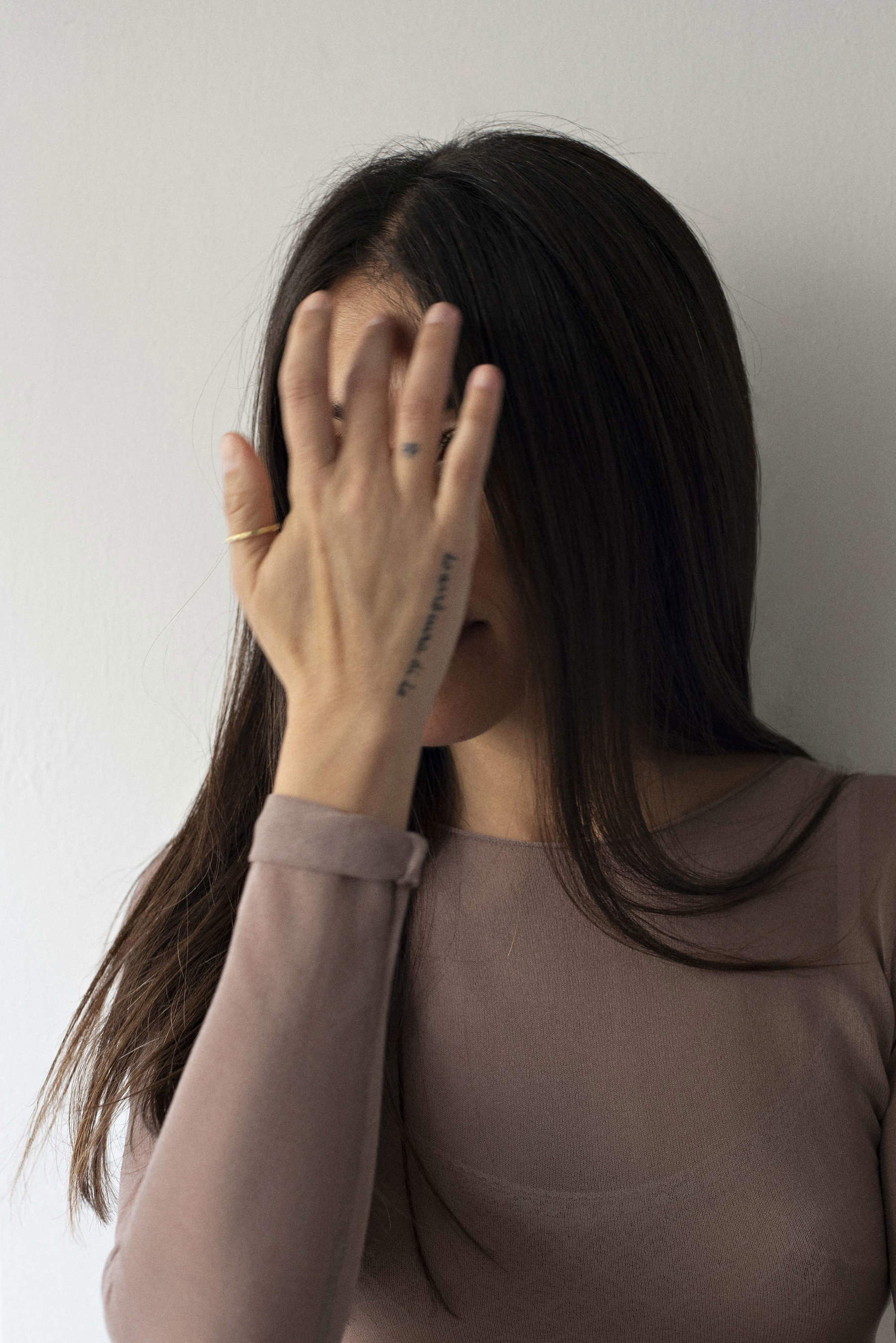
GL. Nina, how important is the idea of intensity in your work?
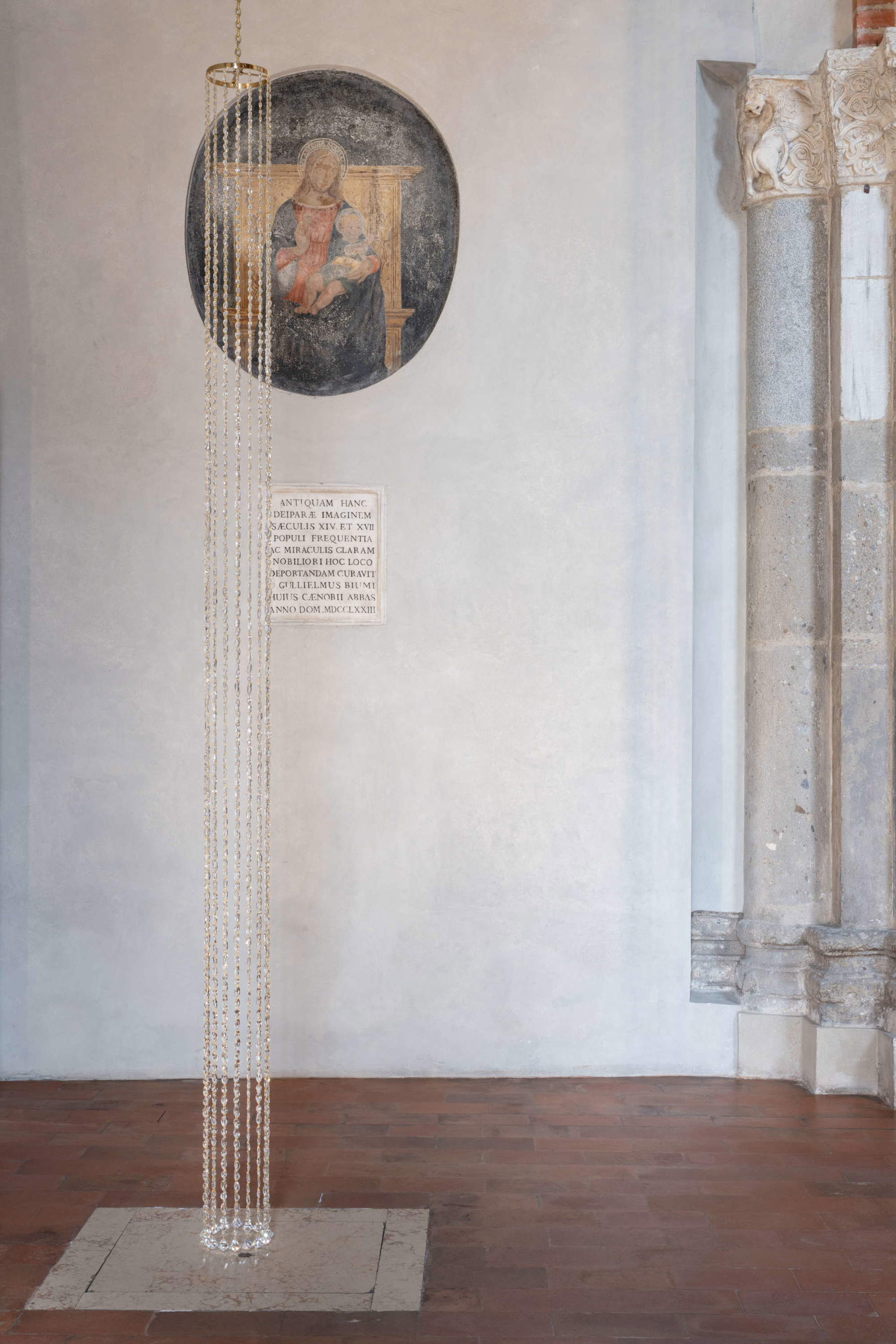
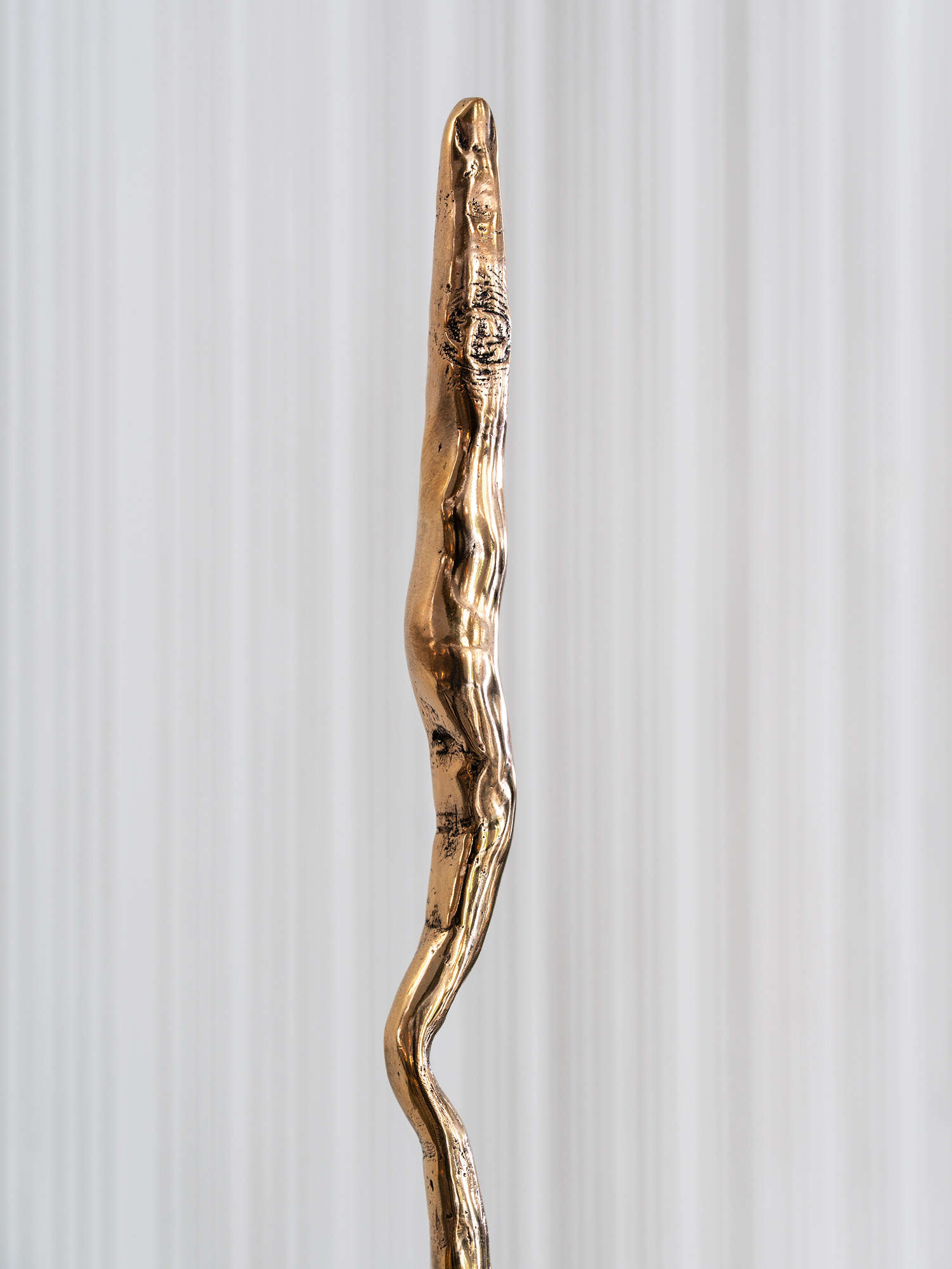
NC. “Intensity” is a word whose root embodies the idea of “striving toward.” I believe that the sculptural work in my latest body of work carries this tension within it, even if it’s not something I seek out intentionally. My relationship with sculpture is recent and began thanks to a commission for a private collection. The challenge I set for myself was to overcome that sense of gravity I feel when observing sculptural works. Looking back at my latest body of work with greater distance today, I recognize a recurring desire: to create a magnetic field of forces and tensions. This reflection gave rise to my latest bronze work, *Misuratore*, currently on view in the exhibition *Komorebi*, curated by Marta Cereda, which opened on May 8 at The St. Regis in Venice on the occasion of the 61st Venice Biennale. *Misuratore* stems from a concept linked to perceptible energies and the fields that pass through us while remaining invisible. I made a cast of my hands while holding them in a state of tension; then I poured the wax, sectioned the fingers, and began to layer them one on top of the other, as if they were segments of an emotional state. The result is a composition that, viewed from a distance, might resemble a trickle of water defying gravity.
What do you mean by “sense of gravity” in the sculpture?
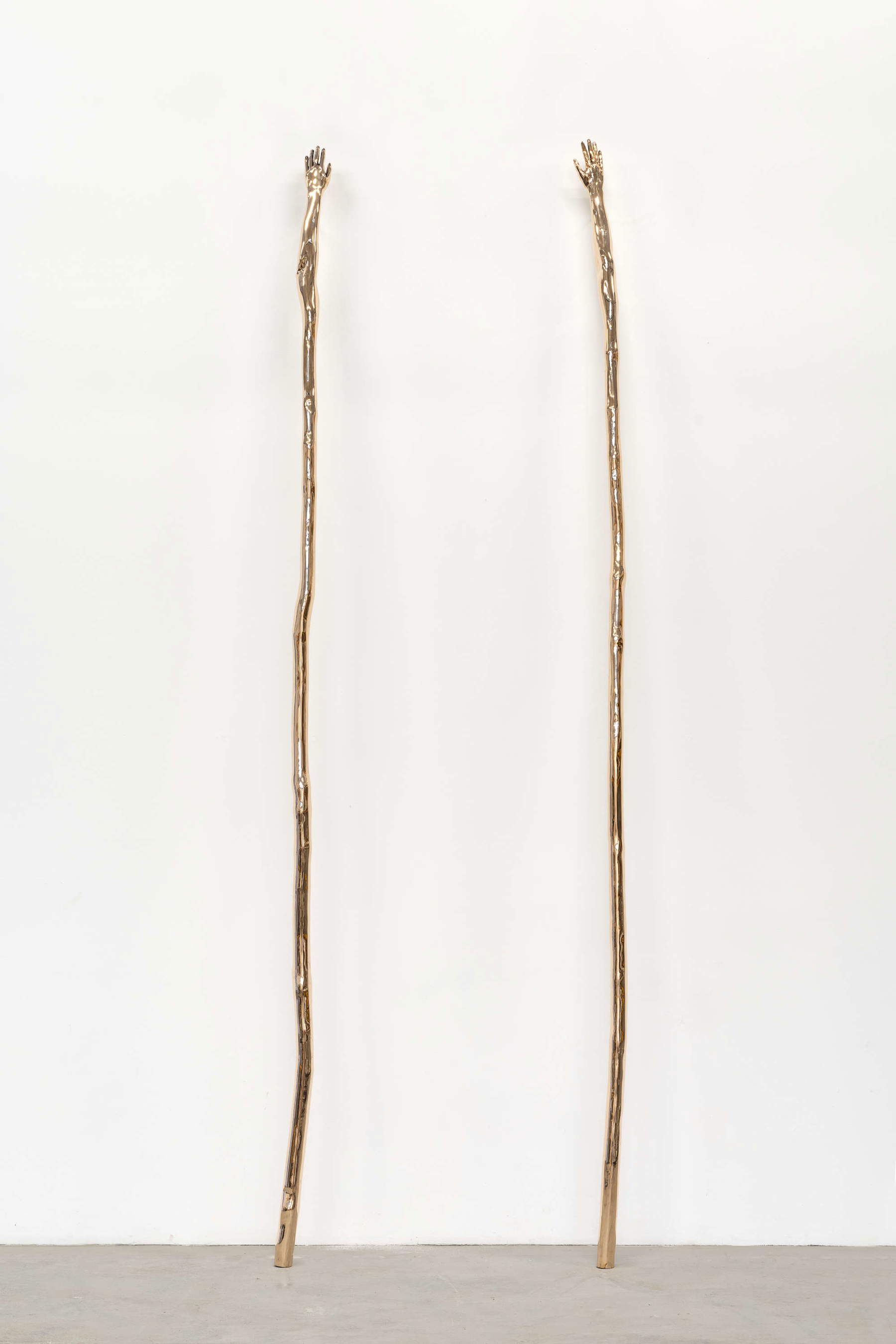
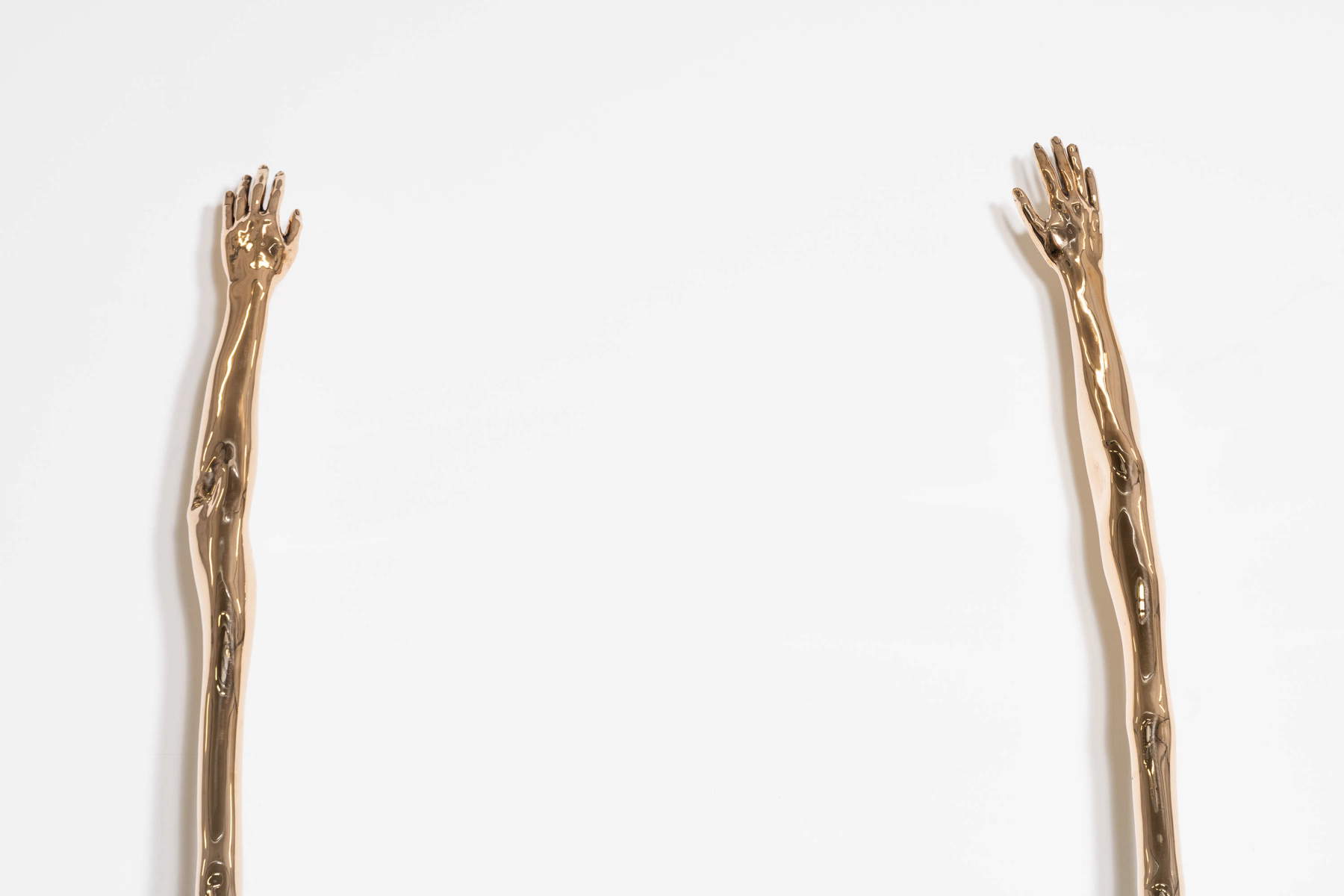
I need to take a step back. I earned my degree in sculpture from the Brera Academy of Fine Arts, but for my thesis I presented a public sound installation. During my classical academic training, I perceived sculpture as a solemn language. I was guided by the reflection in *Scultura lingua morta*(*Sculpture: A Dead Language*), where Arturo Martini writes that sculpture is a “dead language that has no vernacular”; and his twisted, headless figure often came to mind, like a body still searching for a voice. Then came Louise Bourgeois, Eva Hesse, and Ettore Spalletti. Yet I hadn’t truly considered the dialogue with the material until 2021, when the Nembrini Collection commissioned me to create a site-specific sculptural work. At that time, I was working on the environmental installation *The Indeterminacy of an Encounter* for the Merz Foundation, and—without being fully aware of it—I had already embarked on an exploration of the work’s architectural dimension. My relationship with the image is closely tied to the need for its fragmentation, for its dispersion in space and time. I believe that everything stems from a genuine distrust of the image itself: in my work, a question that constantly shifts form keeps recurring—how to make an image invisible without losing its presence. I constantly seek to escape closed, defined forms. This is also the source of my exploration of levitation: an internal transformation, a tension reaching upward. A material that still bears its weight but attempts to transcend it. It is almost a sculptural definition of breath. This idea of gravity is completely challenged when I undertook my residency at the Fonderia Artistica Battaglia and created *Mani come rami che toccano cielo*(*Hands Like Branches Touching the Sky*), a bronze work over four meters tall that maintains a continuous tension within it. Looking at it, I lose the sense of weight and instead perceive a resistance to falling. I believe that a concrete relationship with materials compels us to step outside the mental categories we had about the discipline. That’s where the desire to look beyond began: I started thinking of matter as a presence capable of vibrating, suspending itself, and transforming.
How important are the concepts of the body and the sacred in your work?
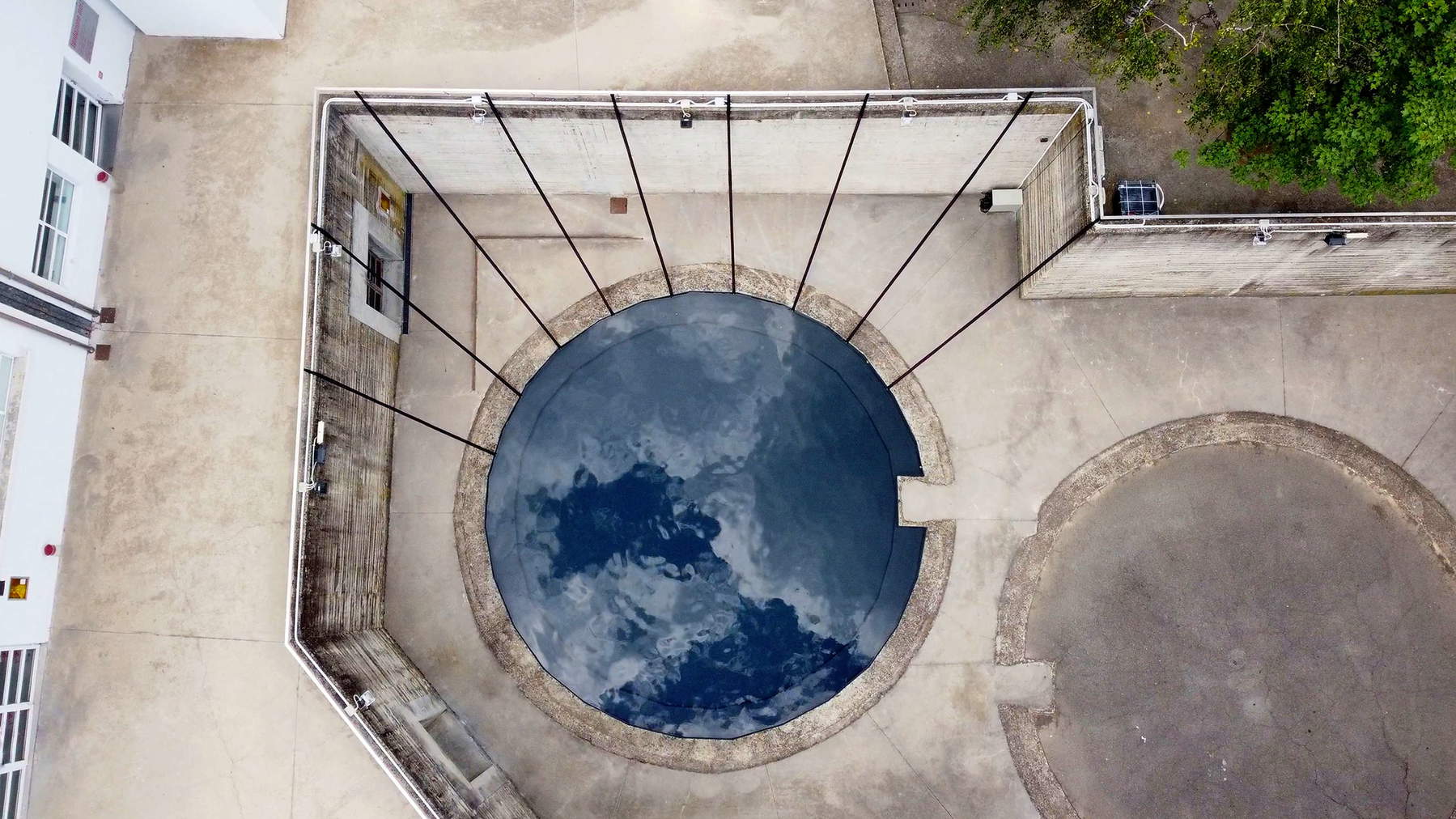
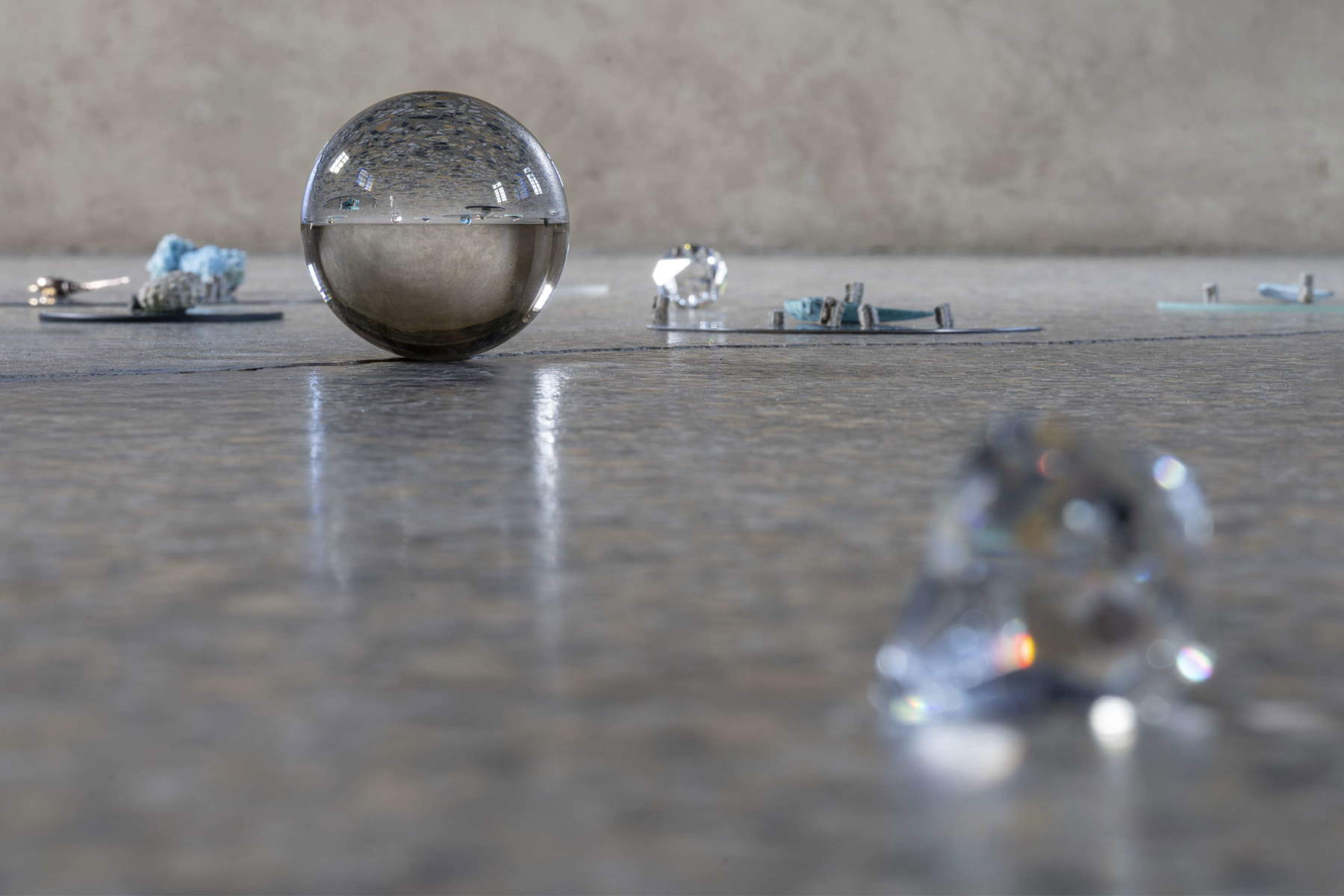
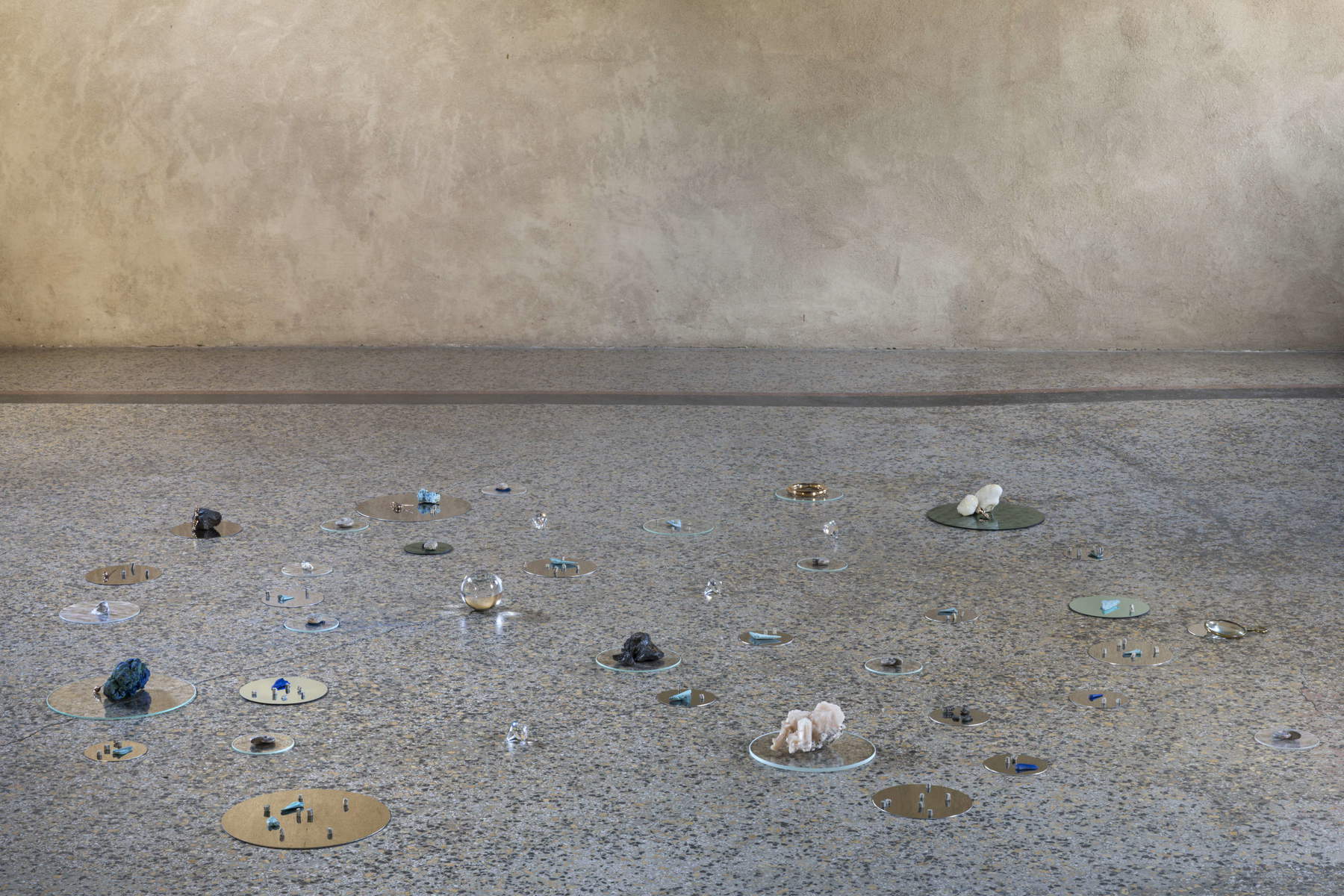
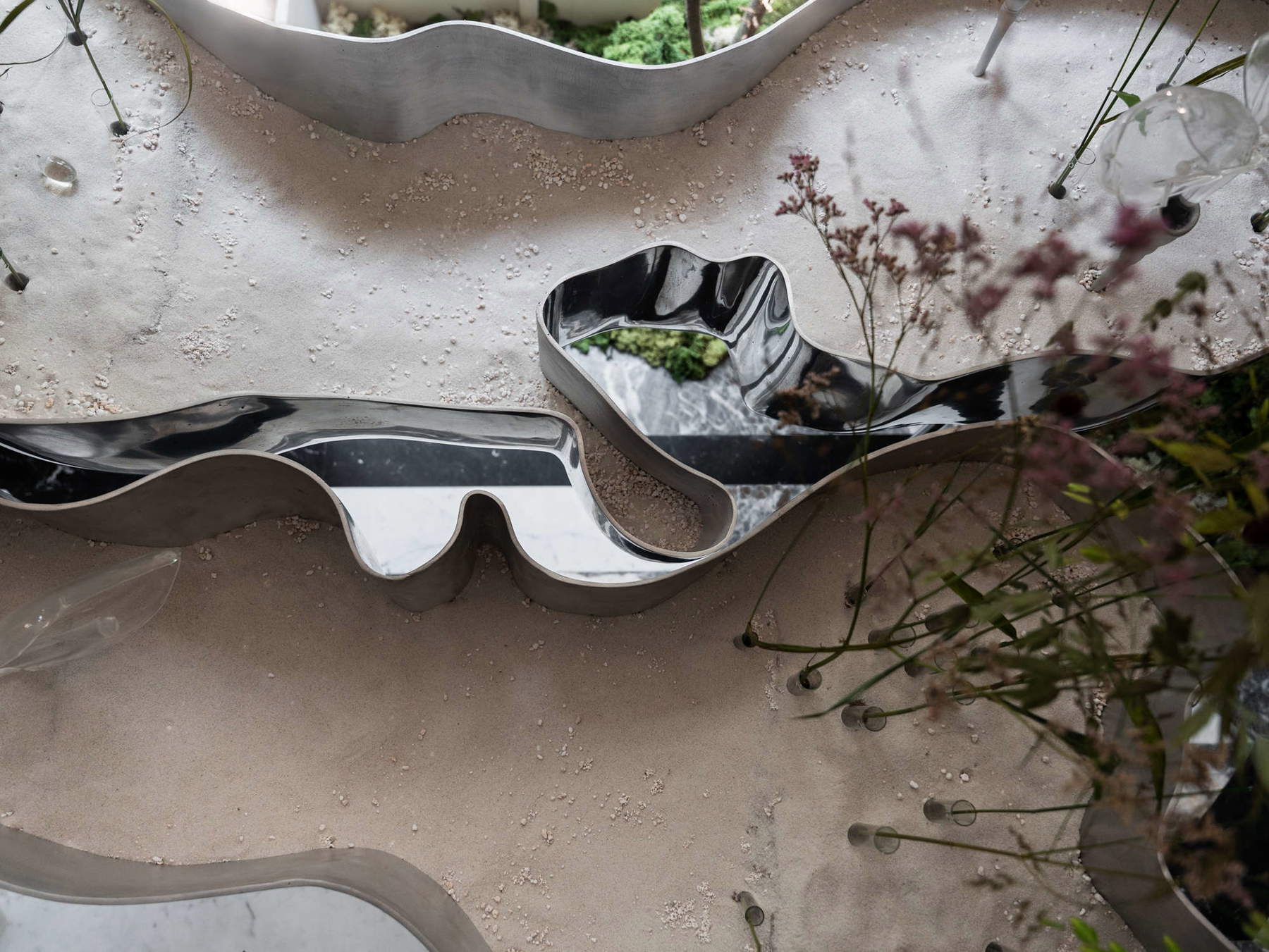
It’s interesting that you’ve decided to combine these two themes into a single question. The idea of the body is first and foremost linked to the relationship with form. If by “body” we mean the human body, then using parts of my own body to create molds serves as a starting point when I engage with the classical idea of form. It’s a necessity that arises from a desire for metamorphosis: a body that transforms, and in which the act of transformation must be inscribed within the very process of sculpture. Perhaps this is also why I often choose the lost-wax casting technique. At the same time, I am interested in a form that tends to dematerialize: one that crumbles, disperses, or blends with the light until it becomes almost invisible. In the installation *The Water Rises 2026* , the only real body present is that of the cut flower. The sculptures in the *Plume* series are crafted from Murano glass at Berengo Studio: their transparency leaves them suspended between appearance and disappearance. The lines emerge from drawings inspired by microscopic observations of microorganisms inhabiting the salt marshes of the Venetian Lagoon—ecosystems that are now under threat. The exploration focuses on microscopic identities, situated between what can be observed and what eludes the human gaze. Although the forms originate from real organic elements, they gradually move away from the natural to embrace hybrid configurations. In this sense, the project engages with certain contemporary philosophical reflections that interest me, such as the capacity of nature and cultures to generate new orders after collapse—a theme addressed by Federico Campagna in *Altri Mondi*. The crystal sculptures are embedded within the aluminum castings of the *Matrice ospite* series. These works stem from research on the lagoon landscape and its unstable equilibria. The process begins with a photographic image of the landscape, which is etched, fragmented, and subsequently translated into a three-dimensional form through the lost-wax casting technique. The forms that emerge take shape as open, constantly transforming presences. During my residency at the Zauli Museum, I began to recognize a relationship that is gradually entering my practice: that between the body and the landscape as places where time manifests itself. I am interested in its unstable and transitory nature, and in the way this awareness compels us to re-educate our gaze. Both the body and the landscape thus appear not as finished forms, but as processes in constant flux. The theme of the sacred, on the other hand, I believe is a more intimate matter, linked to our relationship with the void. Here, too, it is not something I seek out deliberately. Perhaps it emerges from a yearning for absence, from a presence that never fully manifests itself. After all, a significant part of the Western religious tradition is founded precisely on this experience: making perceptible that which cannot be seen. It is a threshold that continues to fascinate me, both on a formal and an existential level.
What is your view of nature?
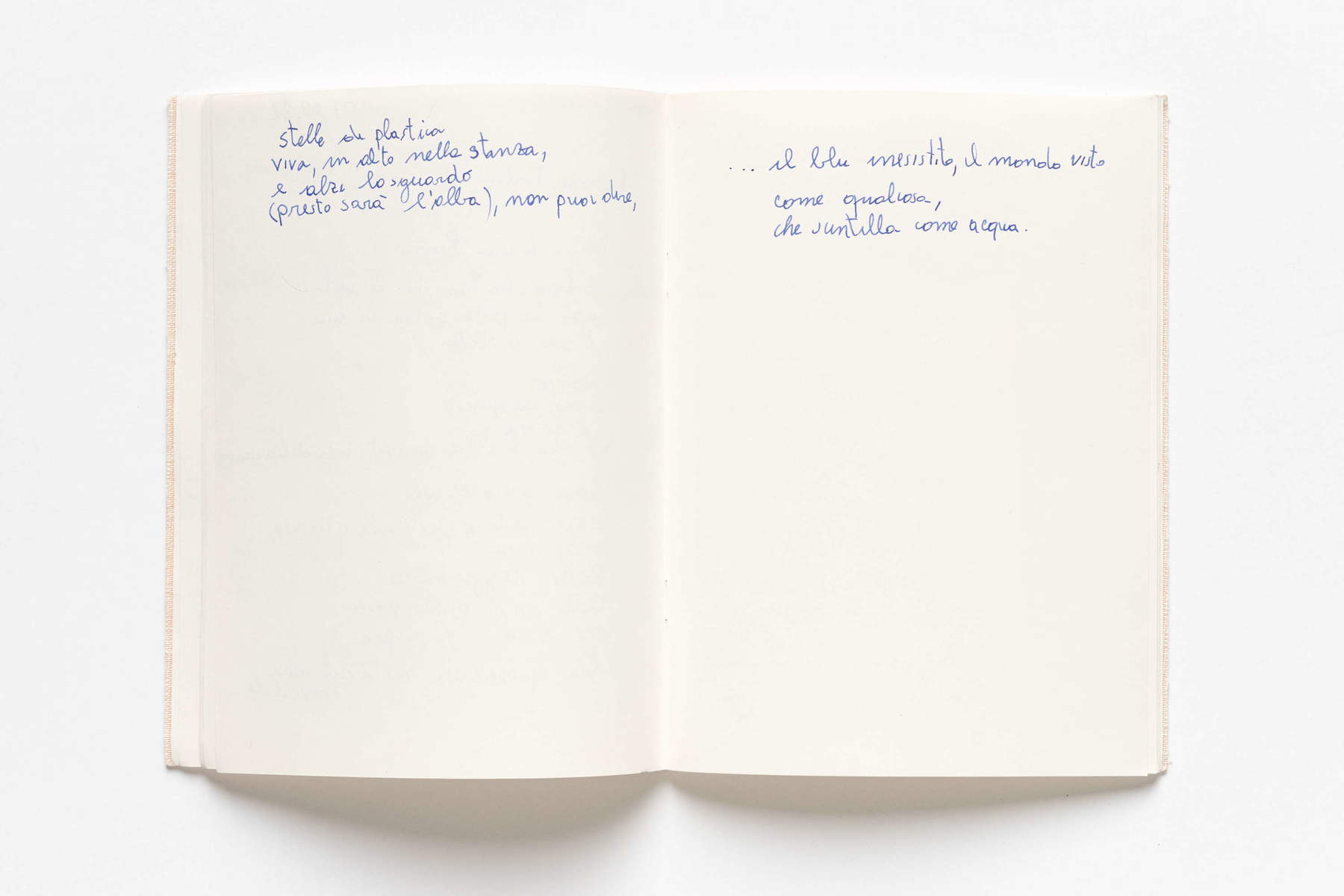
I don’t have a defined, fixed idea. I’m in an open dialogue with it. I’m interested in observing how it moves over time—the invisible phenomena that shift things, the forms of resistance. I think about those who protect it and those who don’t. And about everything that’s disappearing because we no longer have a sense of care. Perhaps nature has become an exercise in attention. I recall my studies of German and English Romanticism. That yearning for the infinite continues to speak to me. But what interests me most today is nature’s performative character: its ability to appear, change, collapse, and regenerate. I’m obsessed with flowers. Because, like us, they’re destined to perish, yet they pass through time with disarming grace. I keep a journal. I observe how the petals fall, how they rest on the ground. Sometimes it feels like I’m reading a musical score. Other times, a form of writing I don’t yet know.
I’d like to ask you to tell me a little more about this journal: is this something you’ve been doing for a while, how is it structured, and how do you keep it…?
It’s a Moleskine notebook—unlined and unquilled—with a soft, strictly black cover. The first page is always important, that first empty rectangle: I experience it as a beginning. It’s an intimate space where I carry so many things; I jot down dreams and nightmares, transcribe verses from poems that speak to me in a special way, or my own verses. I have a strange relationship with drawing, but there I feel free to sketch out a new form. Often, there are existential questions weighing heavily on my chest. I draw with iridescent pencils and insert my best Polaroids. I hide the flowers I discover, almost as if to protect them; when it’s over, I feel a deep sense of melancholy. I often include word maps. I can’t always open it up; it’s a bit like when I go to the studio—I can’t always go because I know I’ll start looking inside myself, and it’s an exercise that requires a lot of effort. While I was in residence at the Carlo Zauli Museum, I created a sound piece dedicated to a section of my diary—an imaginative dialogue with Etel Adnan: *Paysage intime. A fable to Etel Adnan* (2025). While reading *Voyage au Mont Tamalpaïs*, I jotted down a series of questions for the author in my diary, as if on a contemplative journey. Here are a few of them: What shape does depth take? When you repeat a gesture, do you push thoughts aside? Drawing the movement of flowers over time. Is the natural world self-sustaining? Does poetry exist in a time that does not exist?
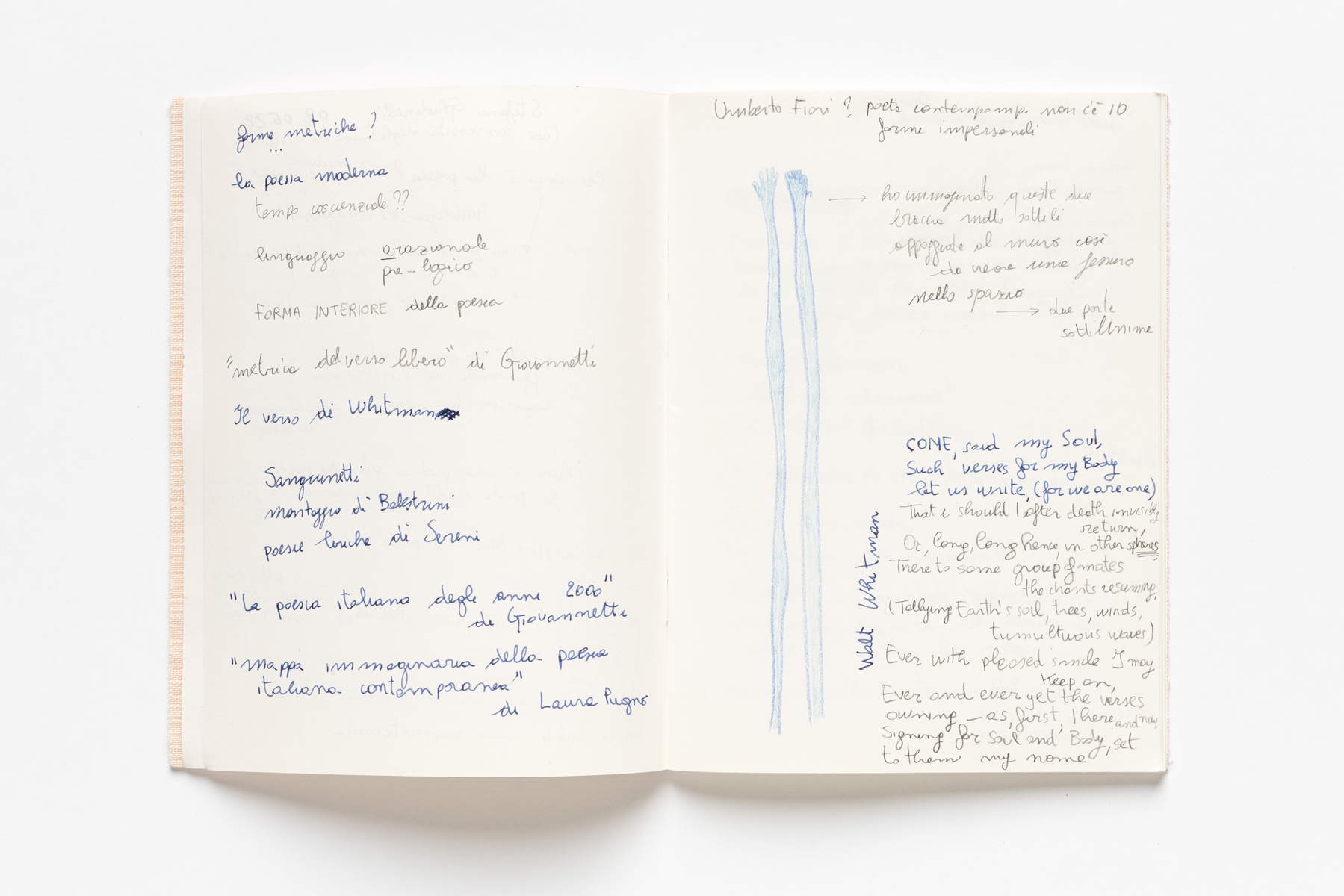
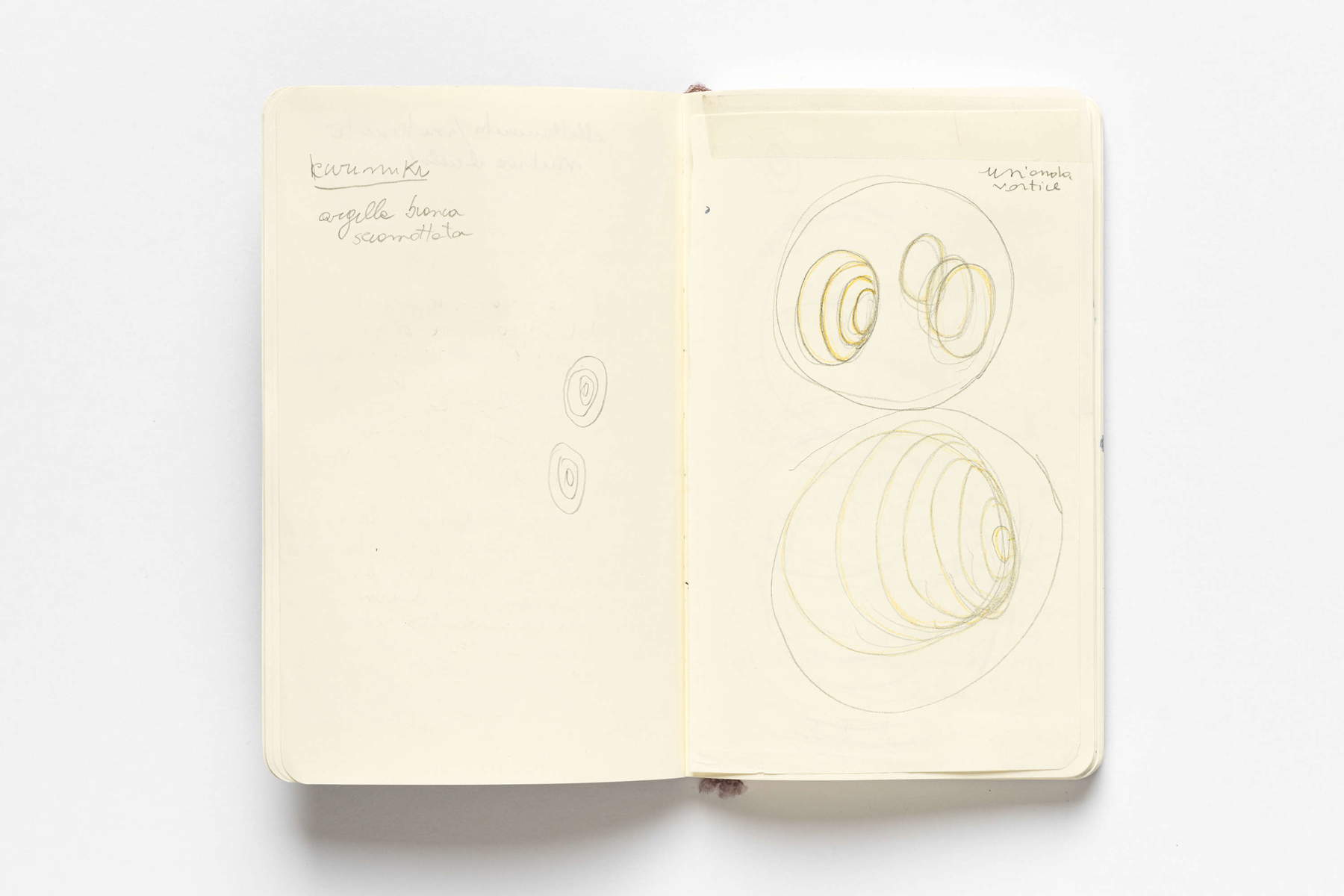
What if you tried answering these questions? What shape does depth take?
I don’t think depth can be confined within a form—understood as the outward appearance that defines every physical or imaginary object, or its representation. To me, depth seems rather close to the idea of infinity. One can represent a part of it, but something of its essence inevitably remains hidden. It has no end. I imagine it as a centripetal force moving inward, an action that unfolds within. I think of the energy that moves the Earth’s crust, the mechanisms that trigger a volcano, or the inner life of an organ, of a feeling, the physical force that traverses the ocean’s depths. Perhaps one could try to depict it as a wave converging toward a dark center or a tiny point of light from which a ray emanates—a void where no boundary can be perceived. I don’t believe it’s a physical place, but rather a spiritual dimension. It’s also the ability to go beyond sensory appearance. My perspective on this theme is likely influenced by the fact that I’m deeply interested in what happens inside: the invisible forces, the internal tensions, everything that animates things without fully revealing itself.
When you repeat a gesture, do you set your thoughts aside?
Yes, absolutely. I believe that repeating a gesture can activate another form of attention—think of meditative practice, prayer, or someone reciting the rosary. In my case, it all began with drawing. At first, I drew with a needle and thread on paper, creating micro-marks that slowly formed an abstract order. In that repetition, a sort of loss occurred: the gesture became continuous, almost autonomous, and I entered a state of suspension. Now I practice something similar with colored pencils, though it’s more difficult. There’s still a strong tension at play. Two years ago, I participated in a seminar led by Claudia Castellucci at the Triennale di Milano. The workshop was titled *Sahara*; we entered a void populated by myriad mental images, and everything was observed as it emerged. No personal involvement had developed among us participants: we were given very rigorous exercises related to the void, time, and perception. It was an experience that taught me a great deal about how the body can become a space for inquiry. Lately, I’ve been revisiting those reflections. Right after graduating from the Academy, I created a performance piece in which my body was tied to a chair. Today, however, I feel the need to relate the body to the tensions of nature: its invisible forces, internal movements, and the dynamics of resistance and transformation. I’m beginning to think about a new performance piece that stems precisely from these reflections.
Is the natural world self-sustaining?
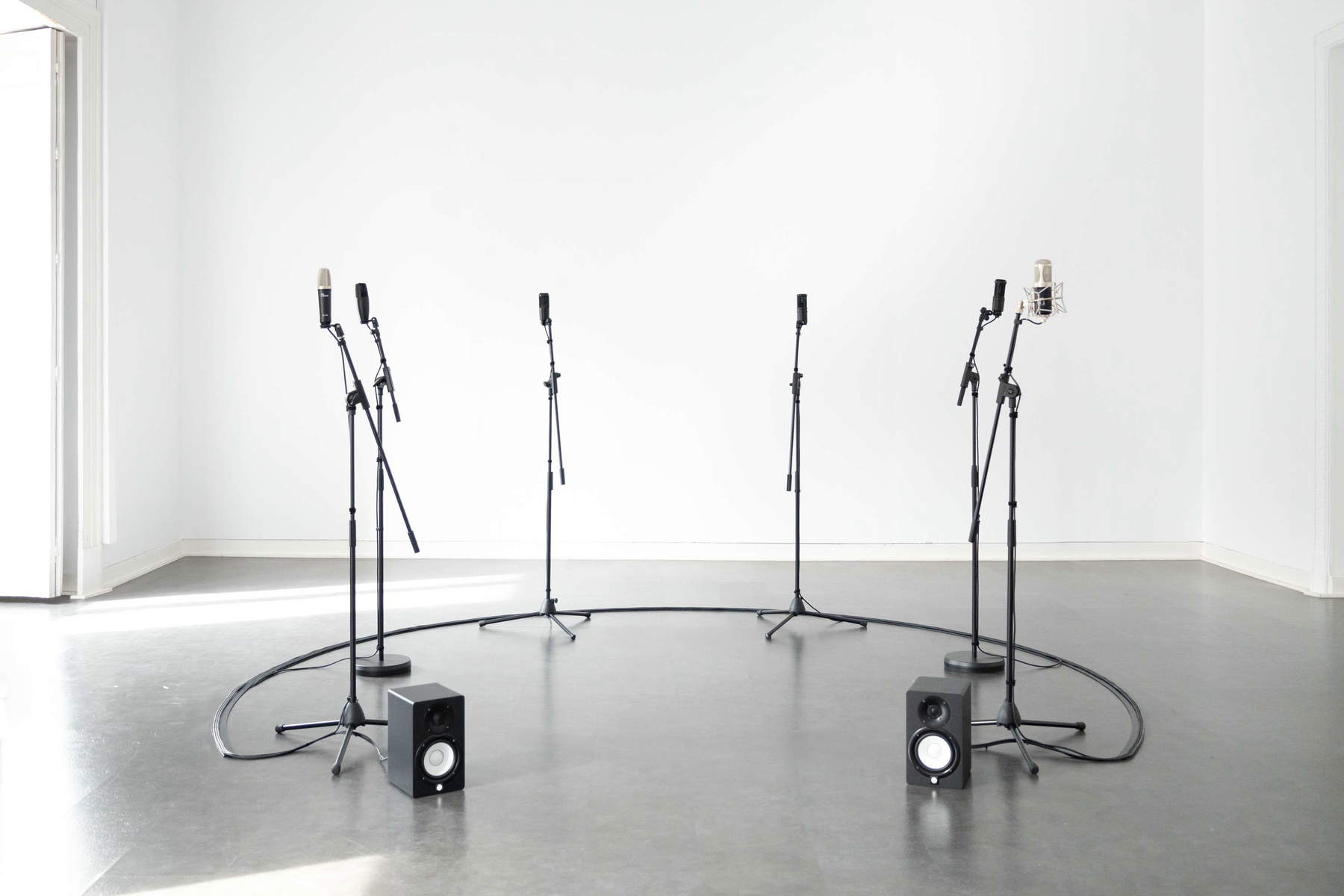
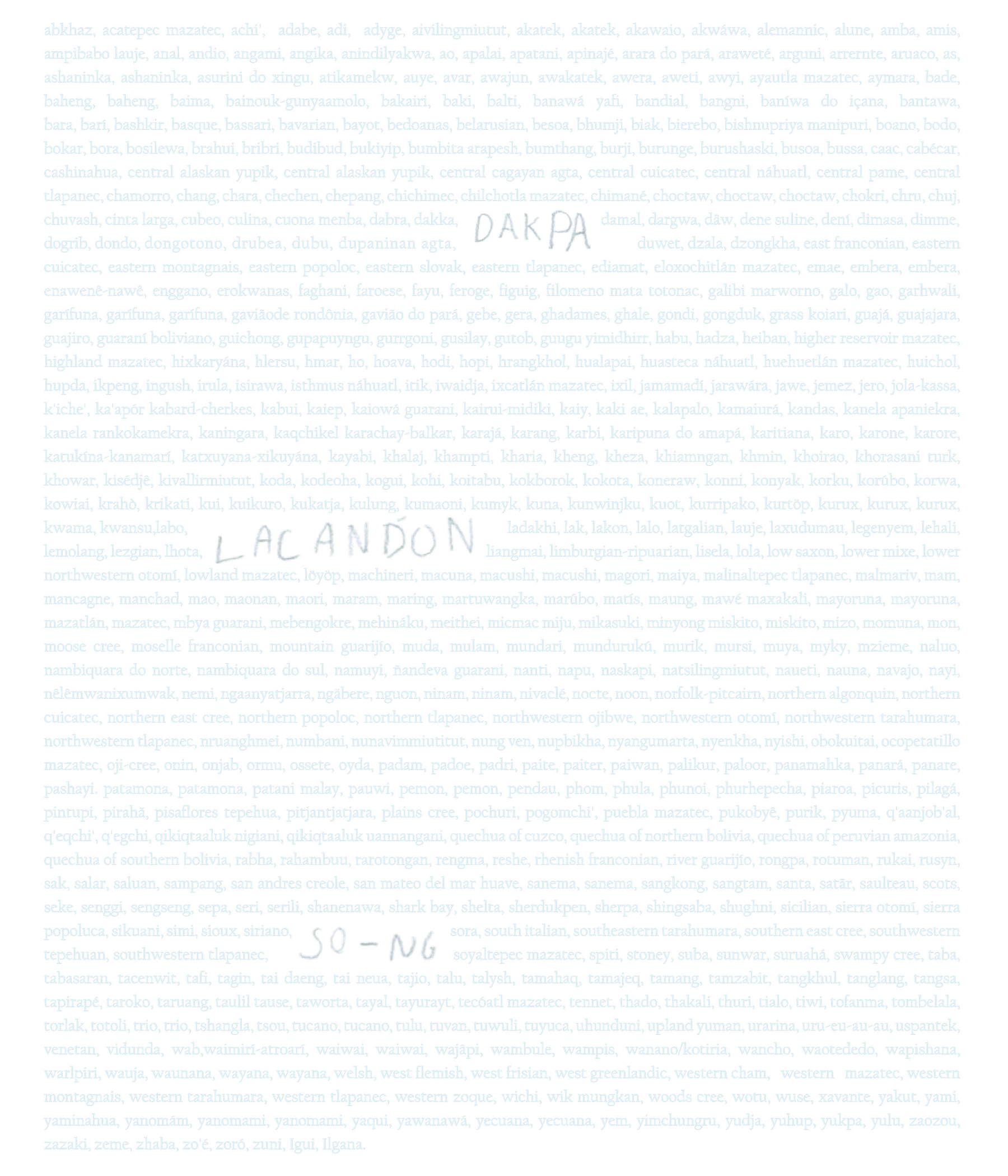
Perhaps the natural world sustains itself precisely because it does not align with the idea of balance that we have constructed. Nature is not a stable universe: it continually undergoes processes of transformation, collapse, and regeneration. In this sense, it possesses a profound capacity for adaptation and metamorphosis. But I also believe there is a difference between being self-sustaining and merely surviving. Nature will likely continue to exist even without us, but this does not mean that what we know today—landscapes, ecosystems, species, forms of coexistence—cannot disappear. Lately, I’ve been interested in observing precisely that fragile threshold where something persists even as it is already changing form. In 2022, I discovered a small book by the contemporary poet Simona Menicocci, *Glossopetrae*. At a certain point in the text, she stops writing poetry and begins to compose lists of incomprehensible words: identities at risk of disappearing. This inspired *Le cose in pericolo (A, B, C, D, E...)* (2023), a four-channel sound installation exhibited outside the Basilica of San Celso for the solo exhibition *Aperçues*. The work is dedicated to what is on the verge of extinction in our world. Five groups of elementary school children read lists in incomprehensible languages—yet each term is in a different language. These are words that signify what is disappearing: languages, tribes, and geographical regions of the world. The idea that after every collapse new configurations of life may emerge—new ways of inhabiting reality and building relationships—also permeated the reflections developed in the new sculptures *Matrice Ospite*, 2026: islands that host endangered plants and forms that evoke natural processes of regeneration. I have tried to imagine the capacity of matter and nature to continually reinvent their own forms of existence. I wonder if we will still be able to relate to the natural world without destroying its invisible balances.
Does poetry exist in a time that doesn’t exist?
Here I’ll answer you with a beautiful poem by Antonella Anedda: *Quanti*. “Physicists say that death / has always been present in a precise space / placed beside birth like a lamp or an apple / or any object on a table. / That time, therefore, does not exist, and we must say ‘now’ and ‘then’ / just to keep from going mad, one year after another / folding the days into calendars / thinking of their numbers as flat / when in fact they buzz, full of larvae and honey.”

The author of this article: Gabriele Landi
Gabriele Landi (Schaerbeek, Belgio, 1971), è un artista che lavora da tempo su una raffinata ricerca che indaga le forme dell'astrazione geometrica, sempre però con richiami alla realtà che lo circonda. Si occupa inoltre di didattica dell'arte moderna e contemporanea. Ha creato un format, Parola d'Artista, attraverso il quale approfondisce, con interviste e focus, il lavoro di suoi colleghi artisti e di critici. Diplomato all'Accademia di Belle Arti di Milano, vive e lavora in provincia di La Spezia.Warning: the translation into English of the original Italian article was created using automatic tools. We undertake to review all articles, but we do not guarantee the total absence of inaccuracies in the translation due to the program. You can find the original by clicking on the ITA button. If you find any mistake,please contact us.



















 IT
IT FR
FR DE
DE ES
ES CN
CN


