





On July 7, as part of the “Old Master Prints” auction organized by Christie’s, Antonio del Pollaiolo’s *The Battle of the Nudes* —considered one of the most important and influential prints of the Italian 15th century and created around 1470–1475—will be sold.
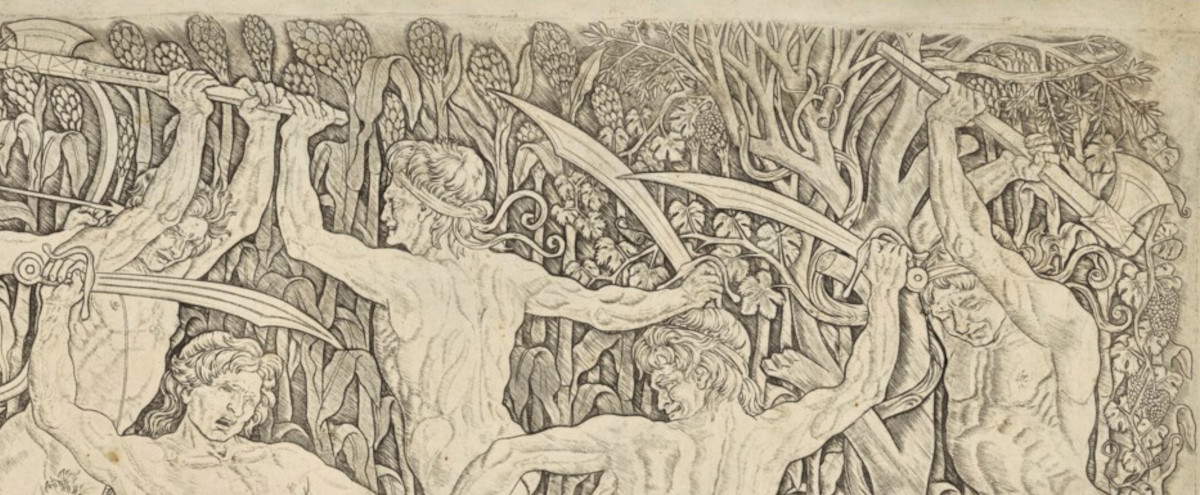
The work, from a private collection and estimated at between 250,000 and 350,000 pounds, depicts ten completely nude men engaged in a violent battle, set against a landscape thick with reeds, trees, and vines. They confront one another with swords, daggers, axes, bows, and arrows, while their bodies are depicted in an extraordinary variety of poses: facing forward, in profile, from behind, standing, crouching, or lying on the ground. The careful anatomical rendering, achieved through a skillful use of shading, highlights the muscular tension and the dramatic intensity of their expressions. On the left is a plaque hanging from a tree bearing the inscription OPVS ANTONII POLLAIOLI FLORENTINI, a signature that makes this work the first signed engraving in the history of Italian art.
Antonio Pollaiolo, a student of Lorenzo Ghiberti and a leading figure of the Florentine Renaissance, was a painter, sculptor, goldsmith, draftsman, and engraver. Despite the vastness of his output, only a limited number of his works have survived to the present day. Although several other prints have been attributed to him over time, *The Battle of the Nudes* remains the only engraving that can be attributed with certainty to the artist.
Dating to the 1470s, the engraving represents a decisive milestone in the rediscovery of the human body inspired by classical antiquity. Its innovative style anticipated many of the developments of the High Renaissance, profoundly influencing Italian and European artists. Its influence is recognizable, for example, in Michelangelo’s *Ignudi* in the Sistine Chapel and in Albrecht Dürer’s famous engraving *Adam and Eve*, which directly borrowed some figures conceived by Pollaiuolo, including the archer positioned at the top left of the composition. Over the centuries, the figures from the *Battle of the Nudes* havebeen copied, reinterpreted, and reworked by numerous artists, both as individual anatomical studies and as models for battle scenes.
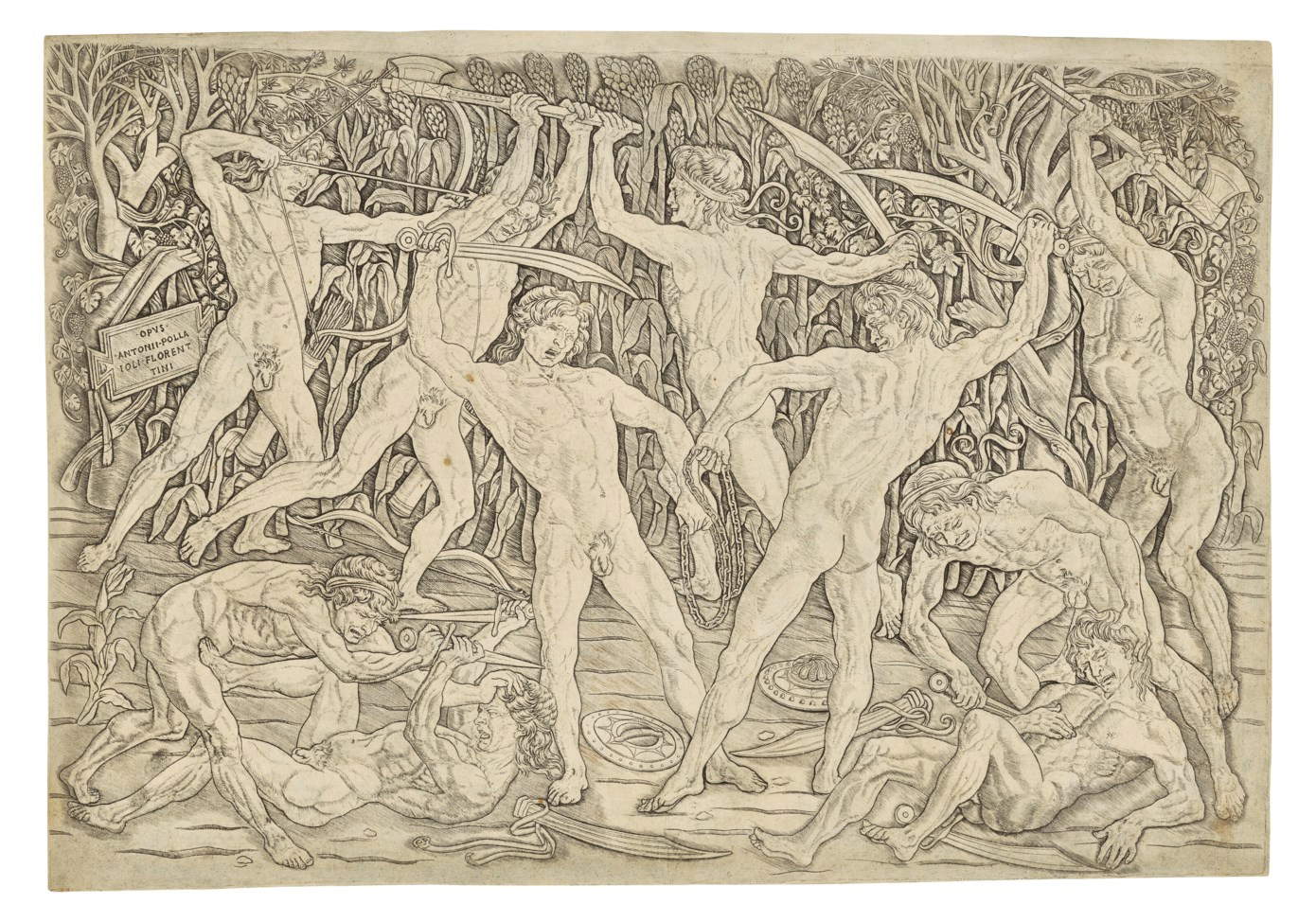
The meaning of the work continues to fuel debate among scholars to this day. Devoid of explicit references to mythology or ancient history, the composition has been interpreted as a study of the human figure and movement, as well as a reflection on the relationship between painting, engraving, and sculpture. The deliberately compressed space and the vegetation framing the background are reminiscent of the reliefs on Roman sarcophagi, with which Pollaiolo was thoroughly familiar.
Particularly striking is the artist’s choice to use the same model for all ten combatants. The same face and the same physical build recur in every figure, varying only in their poses and expressions. This approach suggests that the engraving was also conceived as an extraordinary exercise in the study of anatomy and movement, as well as a didactic tool intended for artists and artisans.
Beyond its practical function, *The Battle of the Nudes* represents an extraordinary statement of artistic ambition. The size of the plate, the complexity of the composition, the exceptional technical quality, and the decision to openly sign his work all attest to Pollaiuolo’s desire to elevate engraving to the rank of the major arts.
Two different states of the engraving are known. The first survives as a single copy preserved at the Cleveland Museum of Art, although copies made as early as the late fifteenth century demonstrate that several copies were printed. Subsequently, the plate was reworked—probably by Pollaiuolo himself or his workshop—with the addition of new shading and the enhancement of certain details to allow for a larger print run. There are currently 49 known copies of the second state, three of which were destroyed or lost during World War II. Only four remain in private collections: among these are the one from the Duke of Devonshire’s collection at Chatsworth, the example from the Sam Josefowitz collection sold by Christie’s in 2023 for 693,000 pounds, and the one now being offered at auction, which formerly belonged to the Art Institute of Chicago between 1955 and 1967, when it was sold because it was considered a duplicate.
 |
| Pollaiolo’s *Battle of the Nudes* up for auction at Christie’s: it is the first signed engraving in the history of Italian art |

Warning: the translation into English of the original Italian article was created using automatic tools. We undertake to review all articles, but we do not guarantee the total absence of inaccuracies in the translation due to the program. You can find the original by clicking on the ITA button. If you find any mistake,please contact us.




















 IT
IT FR
FR DE
DE ES
ES CN
CN


