




by Redazione 30/05/2026



Categories: Modern Art / Disclaimer
After a year of conservation work, the Louvre returns "The Crusaders' Entrance to Constantinople" to the public. The removal of old varnish has brought to light the chromatic and narrative complexity of the painting, considered one of Eugène Delacroix's greatest masterpieces.

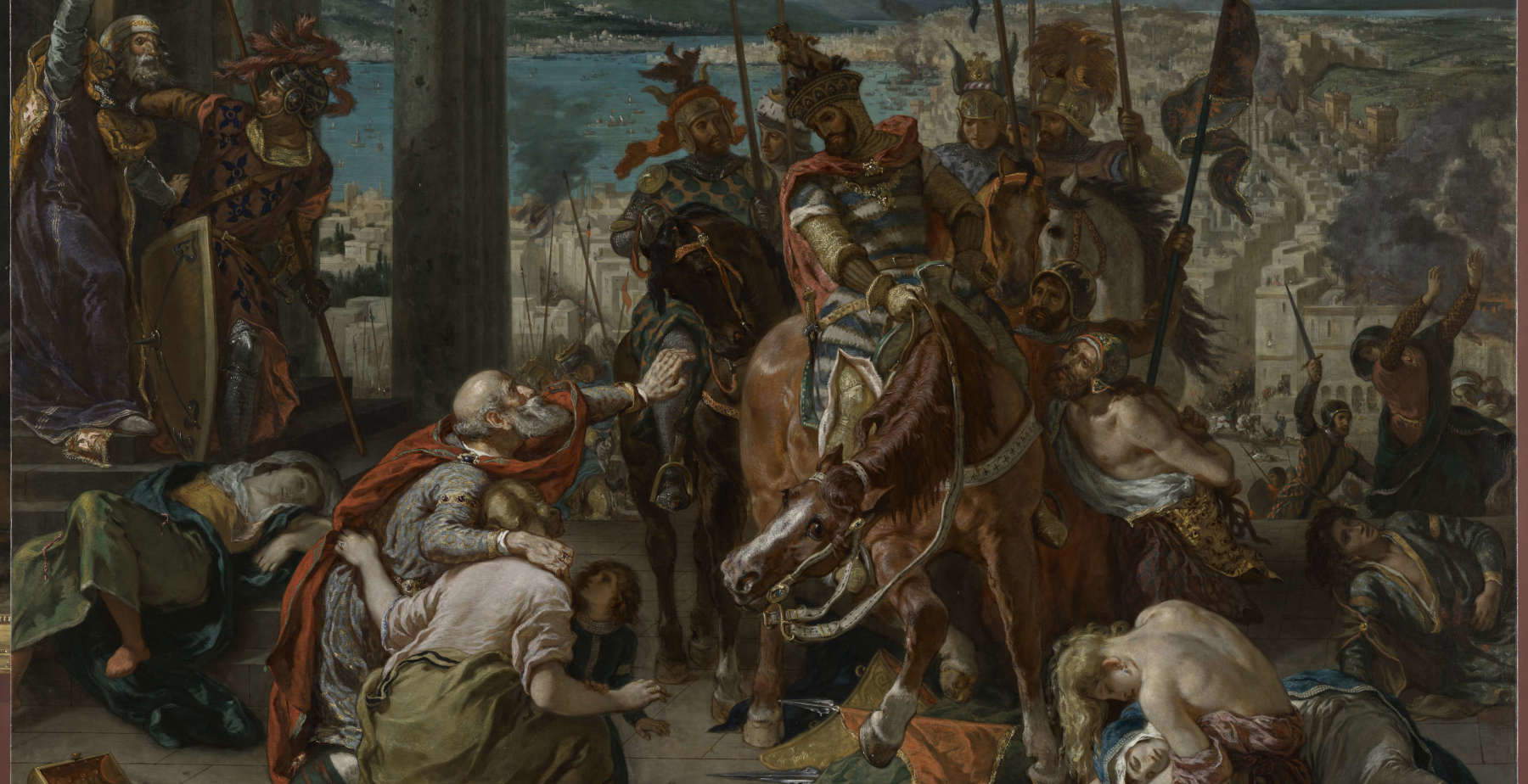
In Paris, one of the absolute masterpieces of Eugène Delacroix (Saint-Maurice, 1798 - Paris, 1863) is back in its original guise. After painstaking conservation work lasting nearly a year, The Crusaders’ Entry into Constantinople (April 12, 1204) is back in the Louvre’s Red Rooms, where it stands alongside other celebrated works by the master of French Romanticism. The restoration, completed in April 2026, restored brilliance and chromatic depth to a painting that time and yellowing varnishes had gradually obscured, allowing us to rediscover not only its extraordinary pictorial quality but also the complexity of its historical and human message.


Commissioned in 1838 by King Louis Philippe I, the work was part of the ambitious decorative program intended for the historic galleries of the Palace of Versailles. Delacroix completed the painting in 1840 and presented it at the Paris Salon the following year. It later found its place in the Crusade Rooms of the Château de Versailles, within a neo-Gothic setting designed to celebrate the great pages of French history. Since its creation, the painting was considered one of the artist’s most important works. Over the years it returned to Paris several times to be exhibited at major retrospectives devoted to Delacroix, including those in 1855 and 1864. Final recognition came in 1881, when it was decided to transfer the painting to the Louvre because of its exceptional artistic value. A life-size copy was left at Versailles to replace the original.


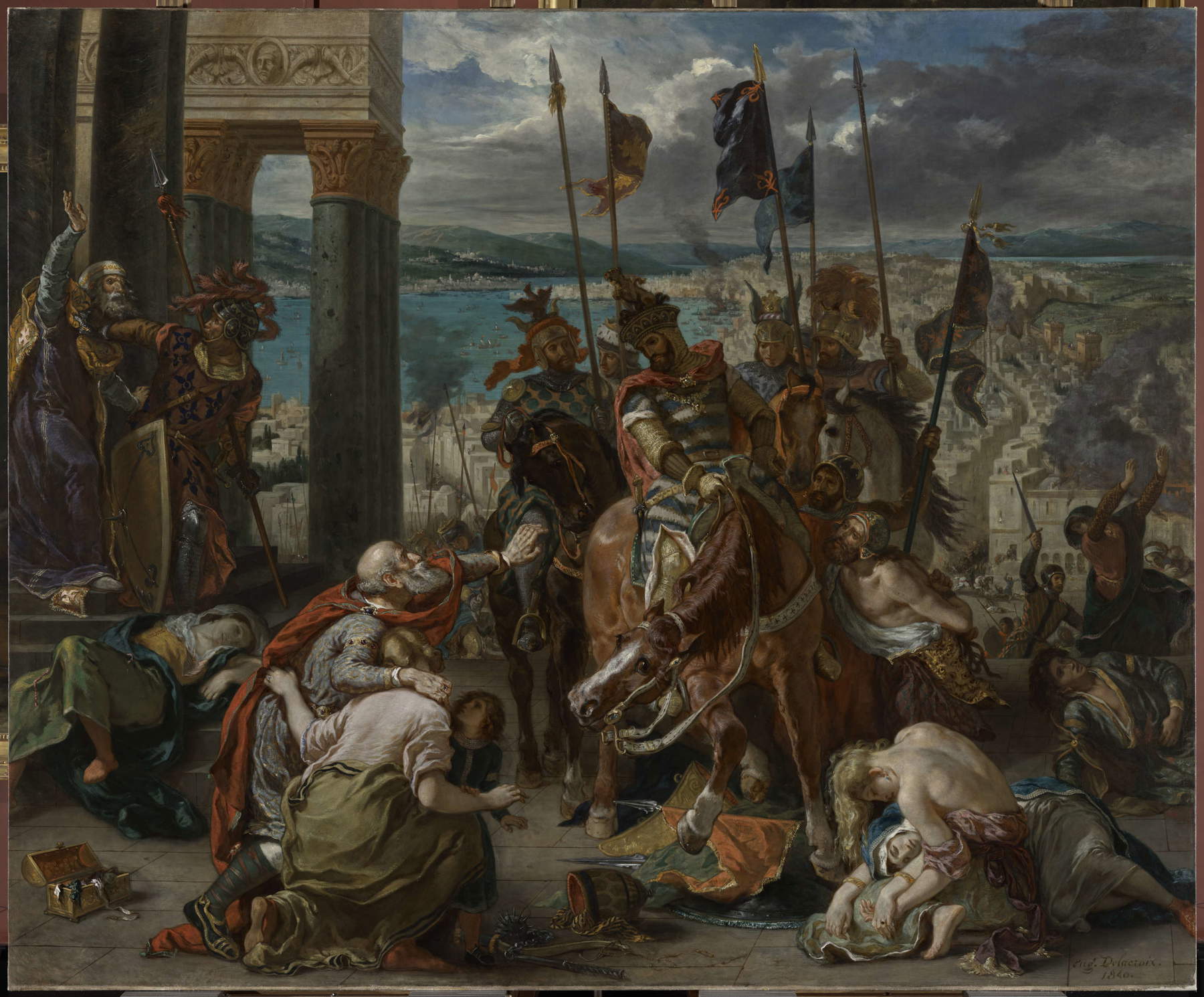
The work deals with one of the most controversial episodes of the Crusades: the sack of Constantinople in 1204 by Western knights. Instead of proceeding to reconquer Jerusalem, the Crusaders took advantage of the political and financial crisis facing the Byzantine Empire to storm its capital. Delacroix translated this historical event into a monumental and complex composition capable of recounting the violence of the conquest without turning it into a heroic celebration. The theme imposed by the commission, in fact, was particularly difficult. Indeed, the painter found himself depicting an episode in which Western Christians attacked other Christians, staging a conflict steeped in moral ambiguity. The solution devised by Delacroix transformed the painting into a masterpiece of history painting, in which the suffering of the victims takes center stage and the glory of the victors appears deeply problematic.
Over the decades, however, the image had gradually altered. The paints applied over time had taken on a yellowish hue that obscured the original colors, flattening the color effects and reducing the legibility of the composition. The surfaces appeared darker and more uniform, making it difficult to perceive the technical sophistication that characterizes Delacroix’s work.
To restore the work to its original qualities, the Louvre undertook extensive conservation work between May 2025 and April 2026. The work involved both the support and the paint surface. The canvas was remounted on its restored frame, consolidating the work’s structure. In parallel, the restorers removed weathered varnishes and residual materials left behind from previous conservation work. Once the cleaning was completed, a new clear varnish was applied and the small gaps in the pictorial layer were reintegrated. The result brought to light a chromatic range much closer to that imagined by the artist, restoring depth, luminosity and legibility to the entire scene.
The intervention was accompanied by in-depth scientific investigations that provided a better understanding of Delacroix’s creative process. Indeed, diagnostic images revealed details hidden beneath the painting’s surface, showing how the painter had initially conceived an even more explicit representation of the violence of the historical event.
Among the most significant discoveries that emerged during the study was the presence, in the preliminary version of the work, of the body of a soldier run over by the hooves of a horse in the foreground. Delacroix later decided to conceal this figure behind a series of banners. The change explains some compositional elements that had long raised questions, particularly the abrupt movement of the horse’s head and its terrified gaze aimed directly at the viewer.
According to scholars, the animal takes on a fundamental emotional function within the composition. Through its expression of fear and suffering, Delacroix introduces a feeling of compassion that the victors seem unable to feel toward their victims. The horse thus becomes a kind of moral witness to the tragedy depicted.
The restoration has also enabled a clearer appreciation of the role attributed to the enslaved women in the foreground. Delacroix placed them in the center of the scene using a particularly vibrant palette that clearly distinguishes them from the other characters. Freed from the dark patina of the old paints, these figures now regain their full visual and narrative power.
Cleaning has brought to light the extraordinary technical complexity of Delacroix’s painting. Particularly evident is the use of so-called “flochetage,” a technique based on the interweaving of different colors to achieve a more vivid and natural rendering of the complexions. Blues, purples, pinks, oranges, pale greens and warm grays merge on the surface of the captive woman’s skin, creating a chromatic vitality that had remained hidden for decades. This rediscovery once again confirms the modernity of Delacroix’s pictorial language. Long before the Impressionist experiments, the artist in fact used bold color combinations to construct light and matter, entrusting color with a fundamental role in the emotional construction of the image.
Another aspect recovered through the intervention concerns the painting’s spatial depth. The yellowed varnishes had progressively flattened the landscape in the background, reducing the perception of distances. Today, however, the sophisticated color effects that structure the scene become visible again. The white cities seem suspended in the emerald green of the mountains sloping down to turquoise-blue waters, evoking the famous watercolors Delacroix made along the Moroccan coast during his 1832 voyage. The restored brightness of the landscape allows us to capture the dialogue between the human tragedy depicted in the foreground and the almost unreal beauty of the natural scenery in the background. This tension constitutes one of the most fascinating elements of the work and testifies to Delacroix’s ability to combine historical narrative, chromatic research and moral reflection.
The intervention is also the culmination of a broader restoration campaign dedicated to the artist’s large formats, launched by the Louvre in 2019. In recent years, the museum has progressively restored to full legibility some of the French master’s most significant paintings, with the aim of enhancing their technical and historical complexity.
The project was made possible thanks to the support of patron Isabelle Ealet-Corbani, who funded both the preliminary studies and the conservation work. Thanks to this work, one of the greatest masterpieces of European Romantic painting can now be admired once again in the chromatic richness and narrative power conceived by Delacroix almost two centuries ago.
 |
| Louvre, Delacroix regains his colors: restored masterpiece on Crusaders in Constantinople |
Warning: the translation into English of the original Italian article was created using automatic tools. We undertake to review all articles, but we do not guarantee the total absence of inaccuracies in the translation due to the program. You can find the original by clicking on the ITA button. If you find any mistake,please contact us.