




by Redazione 29/05/2026



Categories: Modern Art / Disclaimer
Concluded the lengthy study, research and restoration project dedicated to Piet Mondrian's Composition No. 1 with Gray and Red 1938 / Composition with Red 1939 from the Peggy Guggenheim Collection. The intervention was made possible thanks to the support of an anonymous donor.


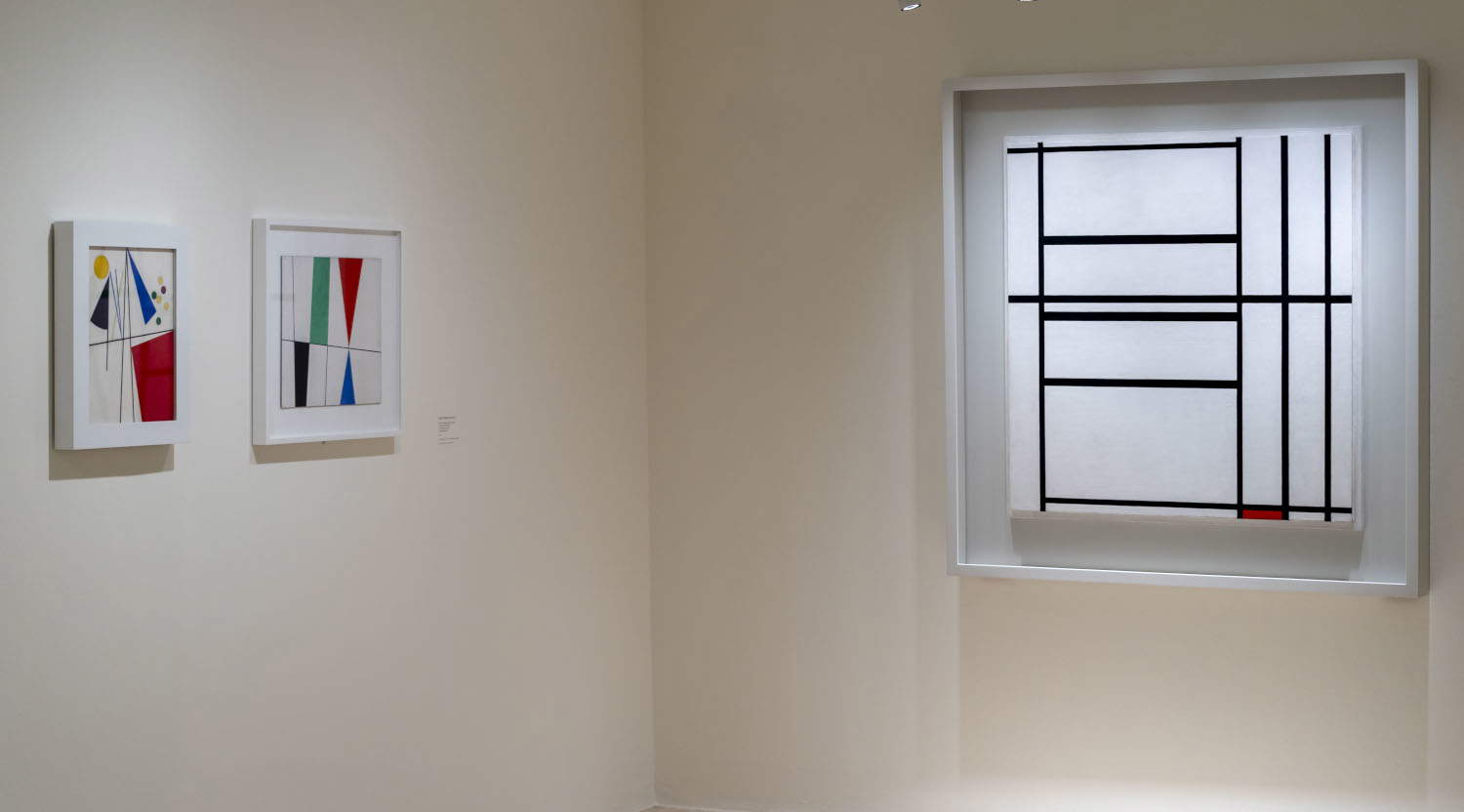
Concluded the lengthy study, research and restoration project devoted to Piet Mondrian’s Composition No. 1 with Gray and Red 1938 / Composition with Red 1939, launched in 2021 by the Peggy Guggenheim Collection’s conservation department. Considered one of the iconic works in the patron’s collection, the painting is now once again on public view as part of the exhibition Peggy Guggenheim in London. Birth of a Collector, open at the Venetian museum until Oct. 19, 2026.
Created between 1938 and 1940, on the eve of World War II, the work represents one of the pinnacles of Mondrian’s neoplastic research. Behind the apparent geometric rigor of the composition, more than five years of interdisciplinary investigation revealed a complex construction of light, surface and space. The study arose from the need to reexamine the effects of the restoration carried out in New York in 1968, when the painting was cleaned, varnished, re-tinted, mounted on a honeycomb mount and placed in a new frame. Interventions that had altered the work’s original appearance, attenuating the delicate relationship between opaque and reflective surfaces and compromising the perception of light and spatiality envisioned by the artist.


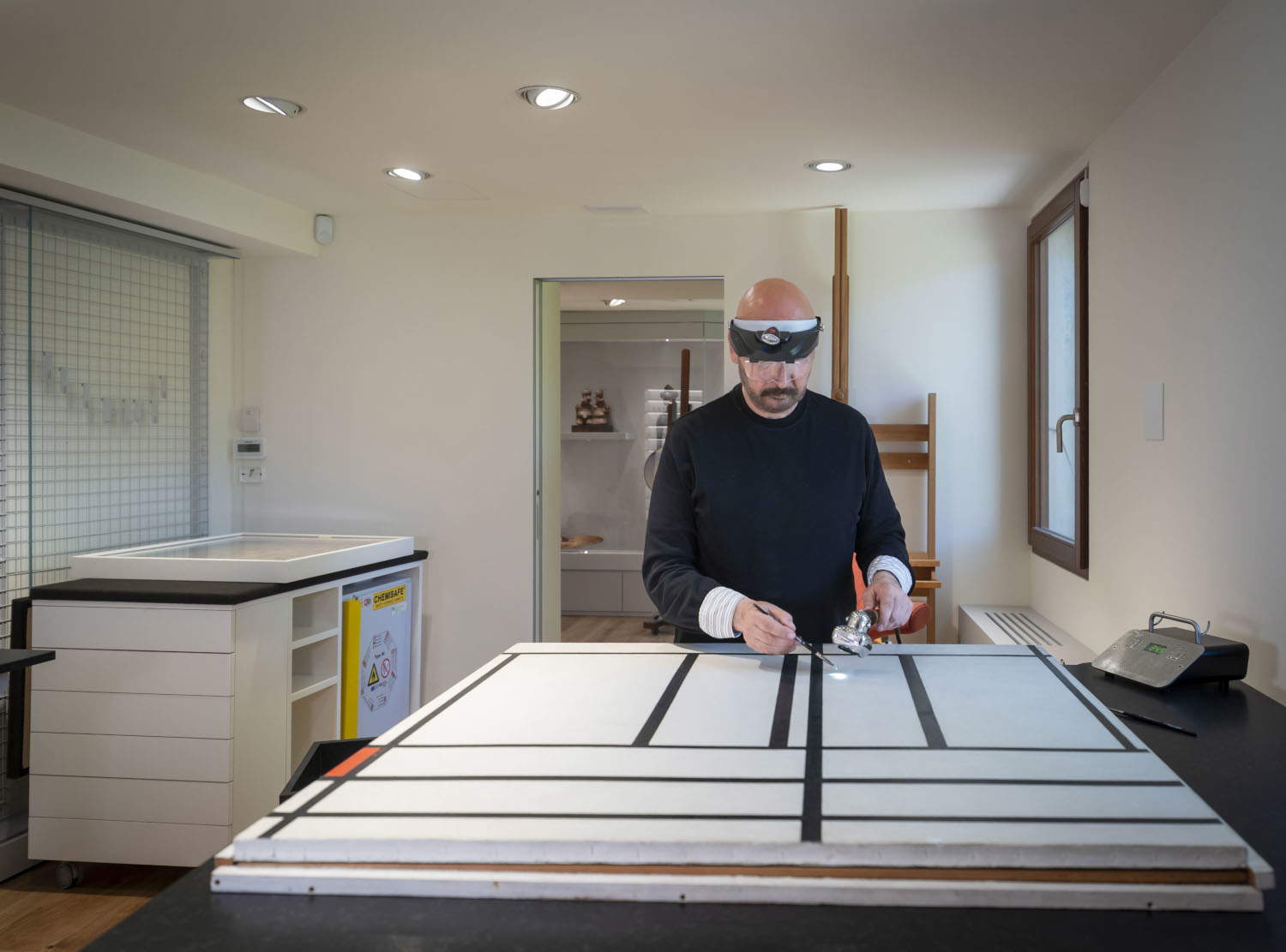
The entire study, research and restoration project was conducted by Luciano Pensabene Buemi, Head of Conservation and Technical Research at the Peggy Guggenheim Collection, in collaboration with the conservation departments of the Solomon R. Guggenheim Museum in New York, along with numerous research institutes, international museums and specialists in Mondrian’s work. The investigation thus took on a strongly interdisciplinary character, interweaving conservation, archival research, scientific analysis and technical-artistic studies, transforming the restoration into an opportunity to deepen the understanding of the painting’s material and spatial conception.
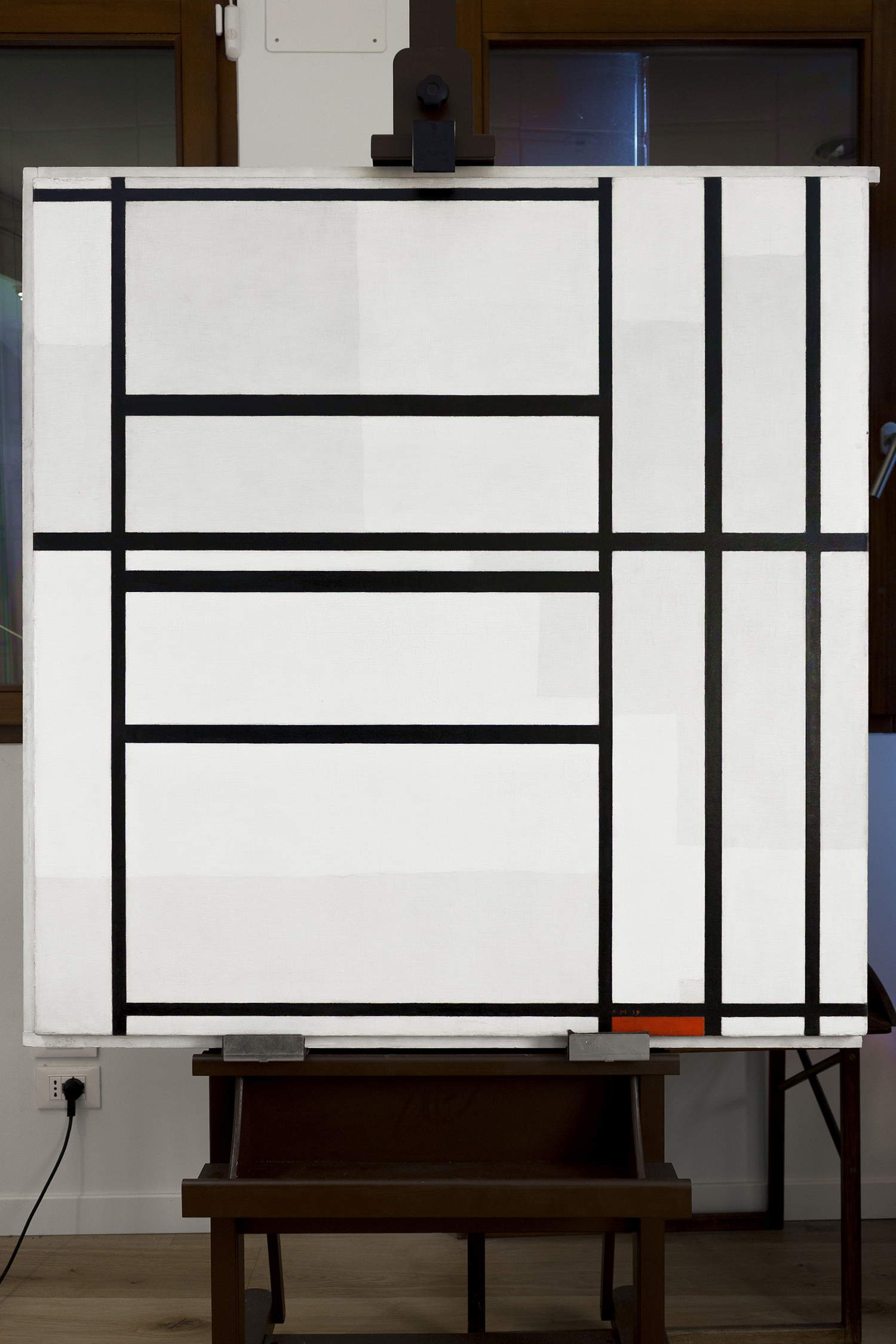
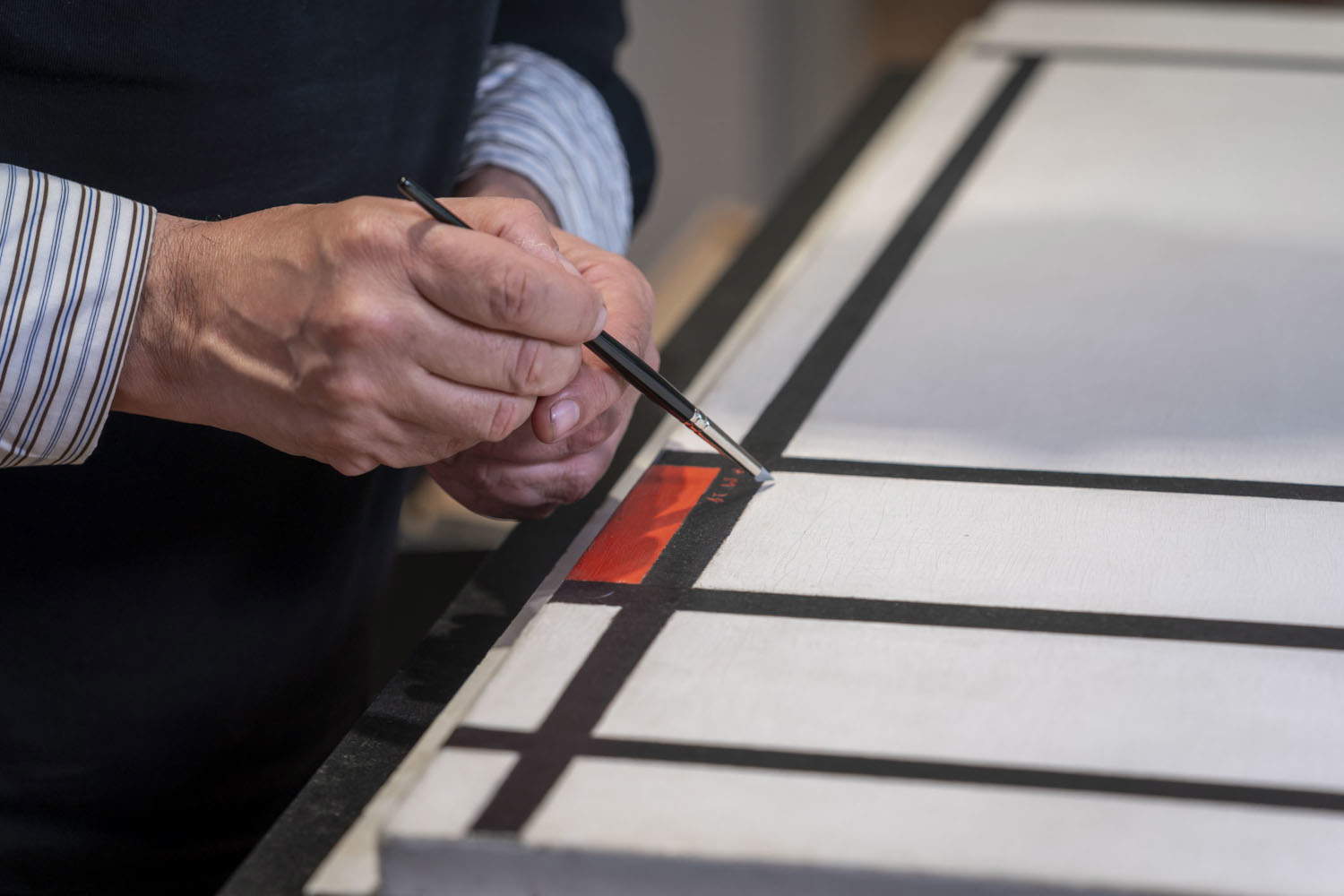
One of the most significant aspects of the research involved Mondrian’s black lines, whose material structure turned out to be much more articulated than it appears. Analyses showed that the artist constructed these surfaces through successive overlays of paint and varnish, returning to the compositions several times to alter proportions, textures and spatial relationships. While the white and colored fields retain visible brushstrokes and opaque surfaces, the black lines were conceived as shiny, optically dynamic elements.
The cleaning phase was one of the central moments of the intervention and was carried out using gelled systems developed as part of the European project GREENART, dedicated to the experimentation of sustainable materials for the conservation of cultural heritage. This work made it possible to recover the delicate original balance between opaque and reflective surfaces, restoring legibility to the sophisticated spatial construction of the work. Also crucial was the contribution of scientific investigations carried out within the European infrastructure IPERION HS, in collaboration with CNR’s ISPC and SCITEC laboratories, part of E-RIHS’s MOLAB platform dedicated to Heritage Science. Using non-invasive diagnostic techniques, scholars have identified compositional changes, traces of previous states, and signs of the artist’s ongoing process of reworking the painting.
Another important core of the research involved acomparison with more than twenty works from Mondrian’s London and transatlantic period preserved in major international institutions, including the Museum of Modern Art in New York, the Tate Modern in London, the Centre Pompidou in Paris, and the Fondation Beyeler. This comparative study provided an in-depth look at the materials used by the artist, surface finishes, framing systems, and the conservation histories of the late works. Finally, special attention was paid to the reconstruction of the framing system originally conceived by Mondrian. Historical research has shown that, from the late 1930s, the artist used backward subframes and painted canvas ribbons as an integral part of the composition, with the intention of eliminating the traditional separation between painting, wall, and surrounding space. The frame applied during the 1968 restoration was therefore removed and replaced with a reconstruction of the original subframe, created in collaboration with Renata Pintus, Luciano Ricciardi and Francesca Bettini of the Opificio delle Pietre Dure in Florence.
The study and restoration project thus returned a reading of the work closer to the complex perceptual and spatial conception imagined by Mondrian. The intervention was made possible thanks to the support of an anonymous donor.
|
| Peggy Guggenheim Collection: over five years of interdisciplinary research and restoration on Mondrian masterpiece |
Warning: the translation into English of the original Italian article was created using automatic tools. We undertake to review all articles, but we do not guarantee the total absence of inaccuracies in the translation due to the program. You can find the original by clicking on the ITA button. If you find any mistake,please contact us.