



by Silvia Mazza 13/10/2026



Categories: News Focus / Disclaimer
The recovery of Renoir’s paintings on the French Riviera has refocused attention on the theft of the Antonello da Messina: the circumstances surrounding the two heists raise questions about the perpetrators’ knowledge of exhibition systems and the possible use of the works as tools of criminal coercion. An article by Silvia Mazza.


The two Renoirs stolen on September 8 from the museum dedicated to the artist in Cagnes-sur-Mer, on the French Riviera, were recovered on October 9—almost exactly one month after the theft. DNA evidence proved decisive. However, identifying the perpetrators and recovering the paintings does not bring the case to a close. Questions remain regarding a level beyond the basic level of the foot soldiers and concerning the motives behind the theft. These motives and dynamics could suggest a possible parallel with the high-profile theft of Antonello’s works from the Regional Museum of Messina on August 15.


There were already those two panels on the shore of the Strait that, rather than having been abandoned in the rush of the escape, appeared to have been carefully placed one on top of the other—not having fallen during the getaway, but propped against the low wall outside the museum. Two of the four Renoirs were also found immediately near the museum’s fence. Are these clues, or merely the result of the criminals’ ineptitude? On this point, let’s be clear when we talk about theft by “amateurs”: the reality of crime can be very different from the cinematic image of the thief in a black jumpsuit, equipped with laser detectors and acrobatic skills. It’s far more mundane—and, precisely for this reason, harder to detect. According to Europol, in art thefts, specialized gangs have been partly replaced by improvised groups recruited through social media. One of those arrested for the theft of jewelry from the Louvre reportedly even told investigators that he didn’t know the location was actually the Louvre. In Messina, one of the two dark T-shirts used to cover the helmets was recovered; meanwhile, in France (where French investigators had already released details of the crime scene—about which *Finestre sull’Arte* can provide some specifics—even before the Renoirs were found), a glove and a small water bottle were recovered not far from where the theft occurred. These items are useful for DNA comparisons, such as the sample taken from the protective cases inside which the two paintings—abandoned during the escape—were immediately found, which matched that of a 29-year-old man involved in the heist, whose trail led to the garage with a wall built specifically from concrete blocks and drywall, where the canvases were hidden.


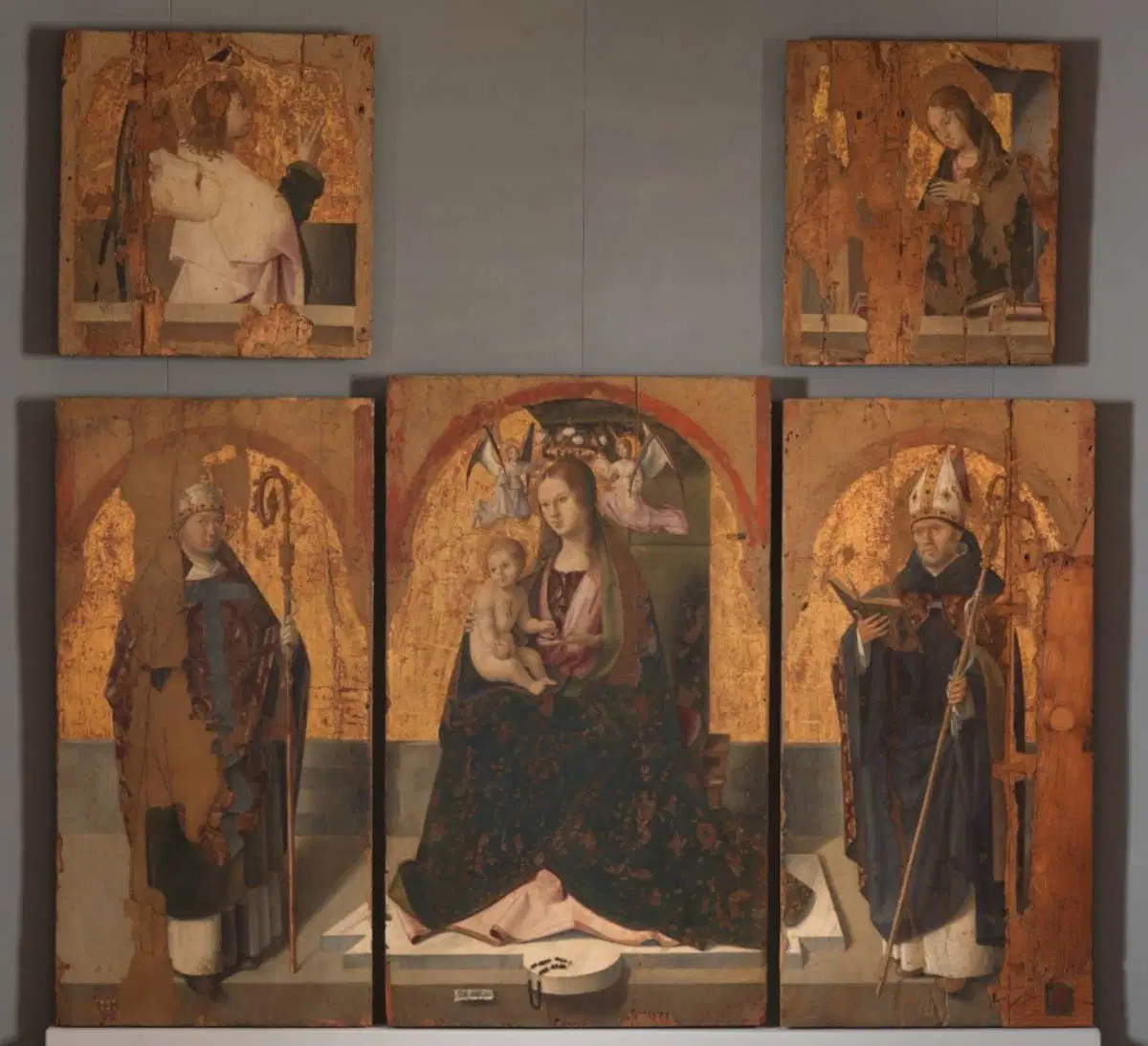

But it is above all the manner in which the works were stolen that suggests a possible parallel. In both cases, there is no sign of the meticulous care one would expect from an operation commissioned by a collector interested in preserving the artwork intact. While the works recovered in France show some damage that will require restoration—damage resulting from the “crude” methods used to remove them from the museum gallery (the protective glass was shattered, the frame of *Femme au puits* was damaged, and the frame of *Femme au puits* was damaged; in Messina, a sledgehammer shattered the display case, risking damage to Antonello’s panel, while the central panel of the *San Gregorio Polyptych* slid to the ground, causing fragments to break off).


While investigations proceed with the utmost discretion in the cities of the Strait, attempting to interpret the theft within the context of a criminal organization (operating at least on a European scale, given the escalation of incidents in just a few months) seems to rule out the initial hypothesis—endorsed by renowned experts— namely, that the works were stolen for their collectible value, in favor of one that appears to point toward a different criminal motive: that of a tool to exert pressure and influence behavior, much like the kidnappings that peaked in Italy between the mid-1970s and 1980s.
Not all recent thefts from European museums, however, seem to fit this pattern. In the cases of the jewelry thefts at the Louvre; the Villena treasure in Spain; the 144 gold coins stolen in Badajoz; and, most recently, the 210-kilogram precious book from Issoire, the stolen items can be dismembered. Gold and precious stones are separated and resold on the black market. Their value may therefore correspond to the intrinsic value of the materials themselves. From the pandemic to the current climate of economic and geopolitical uncertainty, gold and silver have taken on increasing importance as “safe-haven assets.”


In Messina, as on the French Riviera, however, the issue is not merely economic. Prosecutor Antonio D’Amato had already pointed to a possible Mafia connection in the hours following the theft: stealing a panel or a canvas can become a bargaining chip in one of the major international criminal markets, alongside drugs and weapons. In the 1980s, Irish criminal Martin Cahill used a stolen painting as payment for a heroin deal and four others as collateral to obtain money from a diamond dealer. In a note, Matteo Messina Denaro wrote: “We support our family through the trafficking of works of art.”
Let’s return to Messina and that technical detail already discussed in these columns: the mounting system. It is not a device that nails the painting to the wall—which must remain accessible for inspection even from the back for conservation reasons. Rather, it refers to the set of devices (hinges, hooks, joints, supports) that prevent unwanted movements and rotations: a system that is not necessarily visible. Regarding the San Gregorio Polyptych, “it is not possible to detect it by standing in front of the work,” explained, among other things, Roberto Ciabattoni, head of the Physics and Environmental Controls Laboratory at the ICR in Rome and one of the leading experts in exhibition systems and the transport of works of art. “For a polyptych,” he had specified, “there may be various specialized anchoring systems, including crossbars that hold the individual panels together and ensure they remain spaced apart, or sliding systems on metal grids.” The scenario, therefore, can change radically. The thief might find himself facing a single, complex structure of considerable weight. Or he might have to dismantle the panels one by one. Or he might even find himself facing works simply hanging from a hook. “When I inspect exhibition systems—and thus their fastenings—I absolutely must be able to examine the artwork from the back, often by pressing myself against the wall with a flashlight,” notes Ciabattoni.
So, if the system wasn’t visible from the front, how did the thieves know they could operate practically with their bare hands? Exactly 1 minute and 6 seconds to remove five panels in one go. To say, as architect Gianfranco Anastasio—who designed the exhibition system (sequential assembly) of the panels, that it would have been “impossible” to remove the polyptych in just a few moments, means that whoever entered the museum must have had prior knowledge of what they would find. A sledgehammer was used on the display case. As for the panels, however, it was known that no special tools would be needed. For the Renoirs, the thieves had a saw with them to cut the paintings loose.


To understand just how crucial prior knowledge of the mounting system can be, one need only imagine the case of another Antonello, also on panel. If a criminal group decided to target the San Cassiano Polyptych at the Kunsthistorisches Museum in Vienna, it would need tools to cut through the visible cables if those cables secure the work to the tracks located near the ceiling.
According to FBI data, a very high proportion of museum thefts are facilitated by custodians, employees, technicians, and staff who are familiar with the premises. Who knew how the works were installed in Messina? This is why investigators are also looking into the companies that had access to the gallery. This is a particularly significant development in light of the recent renovation work carried out at the museum. A construction site, by definition, increases the number of people entering, exiting, measuring, photographing, dismantling, and reassembling. It also increases the opportunities to see what normally remains hidden.
It was right here in these columns that the renovation project for the exhibition space dedicated to Antonello and Caravaggio was first announced. The project, which has since moved into the implementation phase (funded by the PO-FESR program for projects up to 300,000 euros), was drafted entirely by the museum, with construction management to be contracted out.
Warning: the translation into English of the original Italian article was created using automatic tools. We undertake to review all articles, but we do not guarantee the total absence of inaccuracies in the translation due to the program. You can find the original by clicking on the ITA button. If you find any mistake,please contact us.