





Austrian artist Valie Export, one of the most influential figures in international performance and media art of the second half of the 20th century, has passed away in Vienna at the age of 85. The announcement was released by the foundation that bears her name: the artist passed away on Thursday, May 14, 2026, just days before her 86th birthday. With her radical research on the body, female representation, and visual power structures, Valie Export made a profound mark on the history of contemporary art and became an indispensable reference for international artistic feminism.
Born in Linz on May 17, 1940, as Waltraud Lehner, then Waltraud Höllinger and finally Waltraud Stockinger, the artist grew up in Austria with two sisters, the daughter of a war widow. She attended a convent school before enrolling, from 1955 to 1958, at the Kunstgewerbeschule in Linz. At eighteen she married and in the same year her daughter Perdita was born. After separating from her husband she moved to Vienna in 1960, where she continued her studies at the Höhere Bundes-Lehr- und Versuchsanstalt für Textilindustrie, graduating in 1964 in the field of design. She later entered the film industry working as an editor and extra. The decisive turning point in her artistic life came in 1967, when she made a gesture destined to become emblematic of her poetics: she abandoned both her father’s and her husband’s surnames, choosing to publicly redefine her own identity. Thus was born the name VALIE EXPORT, to be spelled in capitals. The reference was to the Austrian cigarette brand Smart Export, which was popular in those years. The work VALIE EXPORT-SMART EXPORT showed the artist in a rebellious pose holding a modified cigarette pack, on which the original brand name was replaced by her new name and image. The intervention, now housed at the Museum of Modern Art in New York, was a direct critique of the patriarchal and capitalist mechanisms of identity construction and commodification of the individual.
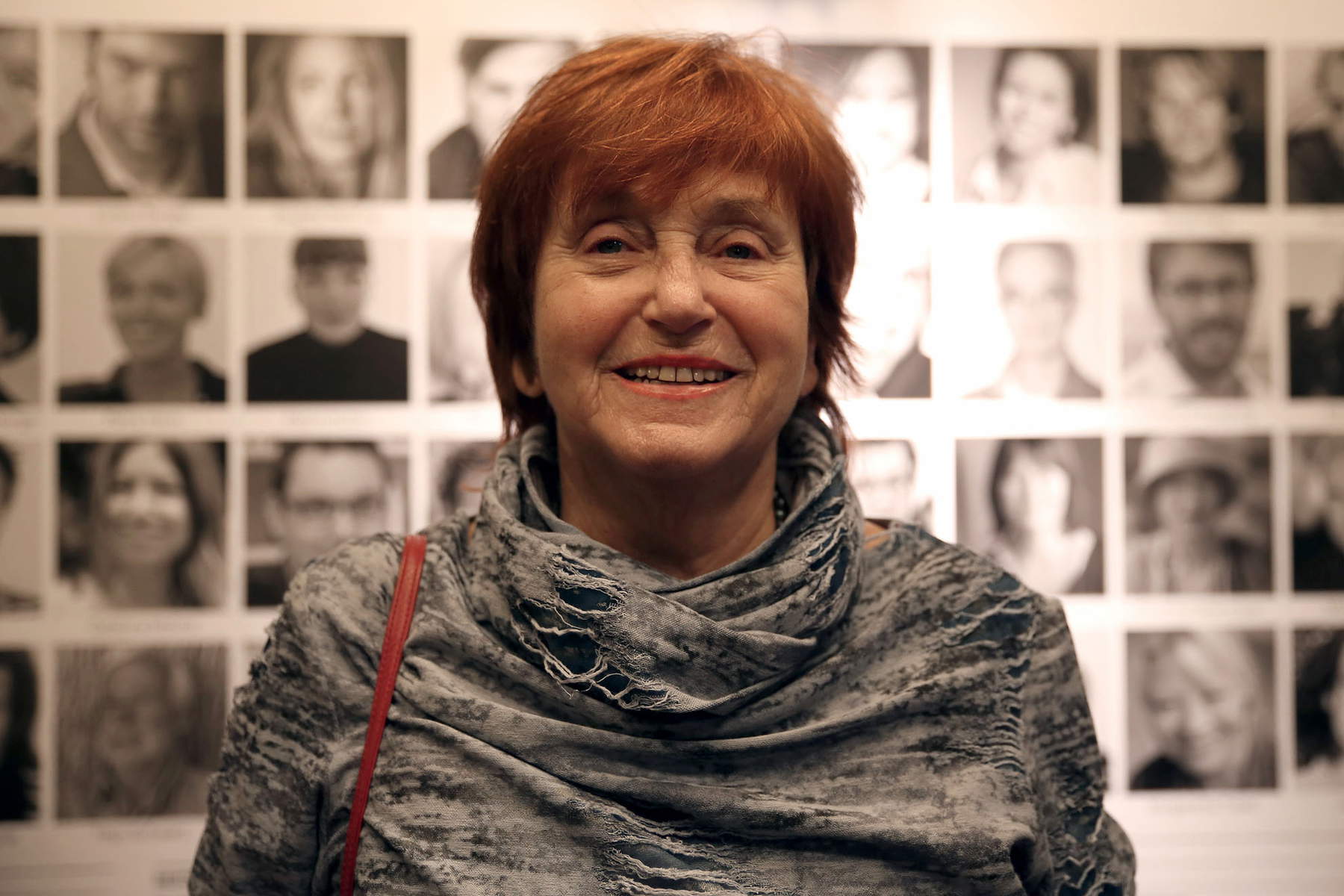
Since the 1960s Valie Export oriented her research toward experimental, performance andExpanded Cinema, developing a language that intertwined feminist activism, media experimentation and political provocation. Her public actions were often conceived as devices of rupture against the dominant male gaze and the social conventions attached to the female body.
Among her most famous works is Tapp- und Tastkino, first made in 1968 during the First European Meeting of Independent Filmmakers in Munich together with Peter Weibel, her partner at the time. During the performance the artist wore a box placed at chest height, with two openings that allowed spectators to touch her breasts for twelve seconds. The rest of her body remained covered by a jacket, while Weibel invited passersby to participate through a megaphone. The work questioned cinematic voyeurism and the passivity of the viewer, transferring the relationship between vision and desire from the screen to real space.
Valie Export later explained that Tapp- und Tastkino was simultaneously street action, feminism, expanded cinema, and performance installation. The artist claimed that anyone could repeat that action, negating the idea of a unique and original work. After that performance she received numerous threats and intimidating letters, a sign of the violent reaction her work provoked in a still strongly conservative society. Also in 1968 he produced another of his best-known actions, Aus der Mappe der Hundigkeit. In this performance Peter Weibel was led on a leash through the streets of Vienna and inside the Galerie nächst St. Stephan, as the artist simulated an everyday normality before the scandalized gaze of the bourgeois public. The work reflected on power dynamics and social conventions, staging a short circuit between human and animal, domination and submission, through a strategy typical of Wiener Aktionismus but reinterpreted in a feminist key.
The following year she presented Aktionshose: Genitalpanik, destined to become one of the most iconic images of twentieth-century body art. Valie Export entered a Munich cinema with her pants open to pubic height and a machine gun in her hand, advancing through the rows of spectators and inviting them to confront a real female body instead of the passive images projected on the screen. The photographic documentation of the performance, depicting her sitting with her legs spread and the weapon pointed at the viewer, became one of the most powerful symbols of radical feminist art.
Over the years, the artist repeatedly pointed out that many of the issues addressed in her works remained unresolved. In an interview she recalled that despite some social changes, deep wage inequalities, violence against women, forced marriages, genital mutilation and rape used as instruments of war persisted. Her thinking always remained closely intertwined with a critique of patriarchal structures and the mechanisms of control exercised over women’s bodies.
Although she is often associated withViennese Actionism, Valie Export always remarked on the differences between her own work and that of the movement’s male protagonists. While sharing some aspects of it related to performative radicalism and the use of the body, the artist rejected the dominant female model present within that context, developing instead an autonomous practice centered on female subjectivity and self-determination.
In 1970 she lost custody of her daughter Perdita, an episode that deeply marked her personal life. In the same year she once again transformed her own body into an artistic surface through Body Sign Action, having a garter belt tattooed on her inner thigh by tattoo artist Horst Streckenbach. In 1971 she produced a new action in which she rolled naked on shards of glass, opposing the traditional male gaze on the female body with a painful and conflicting representation of nudity.
Beginning in the mid-1970s her career took on an increasingly international dimension. He participated in Documenta 6 in Kassel in 1977 and represented Austria at the 1980 Venice Biennale together with Maria Lassnig. In 1985 his film Die Praxis der Liebe was selected in competition at the Berlin International Film Festival for the Golden Bear.
Parallel to his artistic production, Valie Export undertook an intense academic activity. Between 1989 and 1992 he was Full Professor at the University of Wisconsin-Milwaukee, then lecturer in visual communication at the Universität der Künste in Berlin from 1991 to 1995. He then taught multimedia-performance at the Kunsthochschule für Medien in Cologne until 2005. During these years she also met Robert Stockinger, who would become her second husband.
In 2007 she took part in the collateral programs of Documenta 12 and the Venice Biennale, for which she was also co-commissioner of the Austrian Pavilion in 2009. In 2015 the city of Linz acquired her archive and two years later opened the Valie Export Center inside the Tabakfabrik, a former cigarette factory linked precisely to the Smart Export brand from which she had taken her artistic name.
In 2020 he donated his entire film work to the Österreichisches Filmmuseum in Vienna, further solidifying the institutional recognition of a research that had helped redefine the relationships between art, film, and performance.
Even in his later years, Valie Export continued to intervene in the public debate. In 2023, she was among the first signatories of the controversial Manifest für Frieden promoted by Sahra Wagenknecht and Alice Schwarzer on the war in Ukraine, later distancing herself from the document because, in her view, it was “instrumentalized and abused.”
With the death of Valie Export disappears one of the most radical and influential personalities in European art of the second half of the twentieth century. Her work spanned film, photography, installation, performance and critical theory, redefining the role of the female body in public space and opening up new possibilities for reflection on the relationships between identity, power and representation. Even today, her images retain a disturbing and political force capable of interrogating the present, confirming Valie Export’s role as a decisive figure in the history of international contemporary art.
|
| Farewell to Valie Export, pioneer of body art and radical feminism |

Warning: the translation into English of the original Italian article was created using automatic tools. We undertake to review all articles, but we do not guarantee the total absence of inaccuracies in the translation due to the program. You can find the original by clicking on the ITA button. If you find any mistake,please contact us.

























 IT
IT FR
FR DE
DE ES
ES CN
CN


