





Rome has scrapped theBioclimatic Tree project planned for Piazza dei Cinquecento: the large structure that was supposed to be built across from Roma Termini Station will not be constructed. Following technical and economic assessments, Rome City Hall has decided not to proceed with the installation of the structure, which was intended to be one of the most significant innovations in the fight against urban heat islands and the city’s adaptation to climate change. The decision was announced by the Rome City Administration, which explained that the project—proposedby Rome’s LUMSA University (which donated it to the city in honor of the 2025 Jubilee) in collaboration with the Italian Foundation for Bioarchitecture, had been the subject of a thorough review before being definitively shelved.
The initiative had been presented as a contribution to research and innovation in the field of urban sustainability, with the goal of testing new solutions to mitigate the effects of rising temperatures in the capital’s most urbanized areas. Upon completion of the review, however, the City Council decided not to proceed with the project. There are two main reasons behind this decision: the first concerns the cost of the project, which was deemed too high and unsustainable for a public investment of this kind; the second is linked to the political decision to allocate available financial resources to initiatives considered more effective and long-lasting, focusing on expanding urban green spaces rather than constructing the structure. The City of Rome administration emphasizes that the priority remains increasing the city’s tree population, improving the maintenance of existing green spaces, and planting new trees where technical conditions permit.
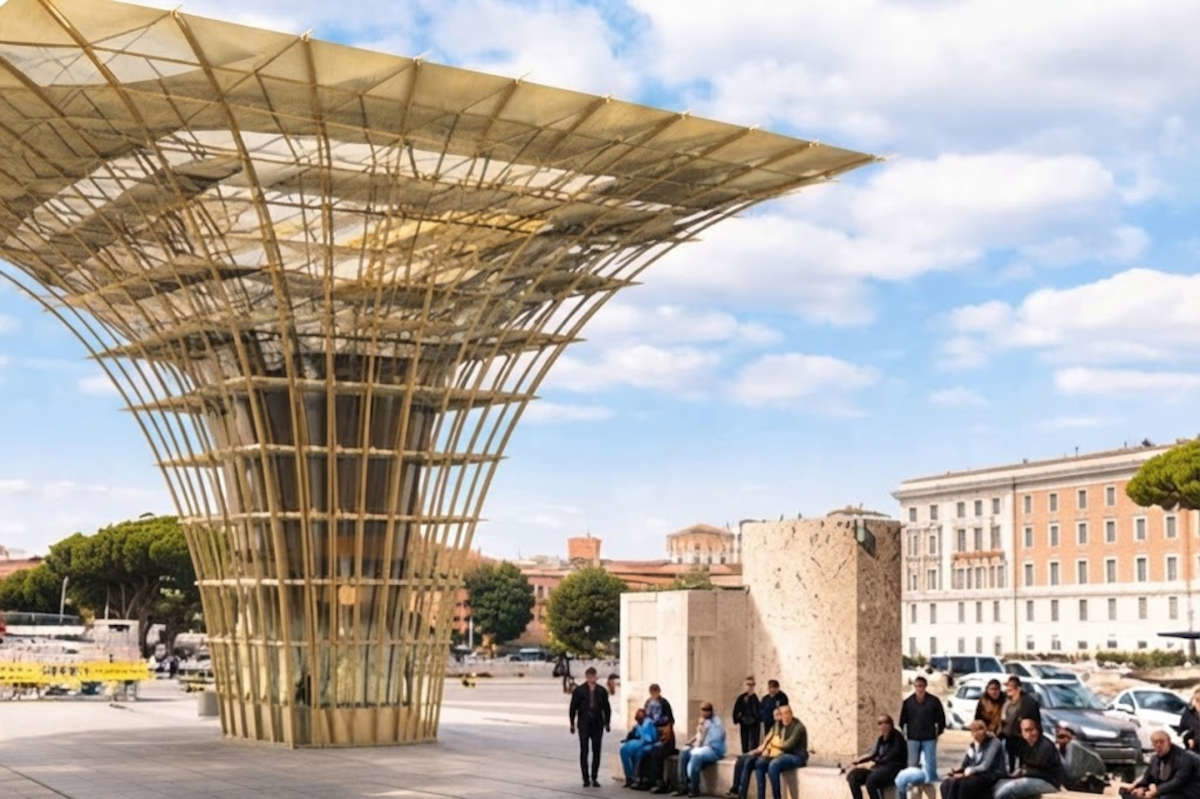
This was reiterated by the Councilor for Agriculture, Environment, and Waste Management of Roma Capitale, Sabrina Alfonsi, who had initially welcomed the project, deeming it particularly innovative and appealing, and praising its “great potential for Rome,” given the issues of global warming and rising temperatures. Rome, the councilor said, “needs more trees, more shade, more green spaces, and public spaces capable of improving citizens’ quality of life. For this reason, the administration will continue to invest in the city’s tree population, in the care of existing green spaces, and in new plantings where technical conditions permit, complementing these efforts with innovative solutions to address climate change. The challenge is to build a greener and more resilient city through effective, sustainable choices that can produce real benefits for Romans.”
This decision comes at the end of a process that, at least initially, seemed headed toward a different outcome. As mentioned, the administration had in fact expressed interest in the initiative, even going so far as to include it in the master plan for the redevelopment of Piazza dei Cinquecento—the area in front of Termini Station that is part of a broader urban transformation program. Previously, Alfonsi herself had described the Bioclimatic Tree as an innovative project and had explained that technical studies were underway, focusing primarily on the project’s costs, estimated at approximately 500,000 euros. It was precisely the outcome of those assessments, concluded on July 9, that led the City of Rome to change its stance.
The Bioclimatic Tree had been proposed as an innovative technological solution capable of helping to cool public spaces through a natural physical principle known as adiabatic cooling: that is, the system would have utilized water evaporation to absorb heat and lower the temperature of the surrounding air, without relying on the traditional electric compressors used in air conditioning systems. This technology was designed to reduce energy consumption and provide relief in urban areas most vulnerable to summer heat.
Although based on contemporary technologies, the project drew on very ancient construction principles already adopted in Egyptian architecture and later used in historic buildings such as the Zisa in Palermo, where the combination of natural ventilation, the presence of water, and spatial design made it possible to improve the thermal comfort of the spaces.
Even though the project will not be carried out, the debate surrounding the proposal has brought the issue of climate adaptation in public spaces—and the need to combat the phenomenon of urban heat islands, which is increasingly evident in large cities—back into the spotlight. The City Council’s decision does not, therefore, appear to represent an abandonment of environmental policies, but rather a different allocation of available resources. The Administration reaffirms its commitment to continuing to invest in initiatives capable of producing concrete and permanent benefits through the expansion of green spaces, protecting the existing tree population, and planting new trees—without ruling out the use of innovative technological solutions when they are economically sustainable and serve the goals of urban resilience.
The decision to abandon the Bioclimatic Tree thus brings to a close a project that had sparked interest due to its experimental nature and the contribution made by university research, but which failed to meet the criteria for economic sustainability. Rome’s strategy will instead continue to focus on strengthening urban green spaces, considered the priority tool for improving citizens’ quality of life and addressing the effects of climate change in the capital.
|
| Rome Scraps Plans for the Bioclimatic Tree in Piazza dei Cinquecento |

Warning: the translation into English of the original Italian article was created using automatic tools. We undertake to review all articles, but we do not guarantee the total absence of inaccuracies in the translation due to the program. You can find the original by clicking on the ITA button. If you find any mistake,please contact us.
























 IT
IT FR
FR DE
DE ES
ES CN
CN


