





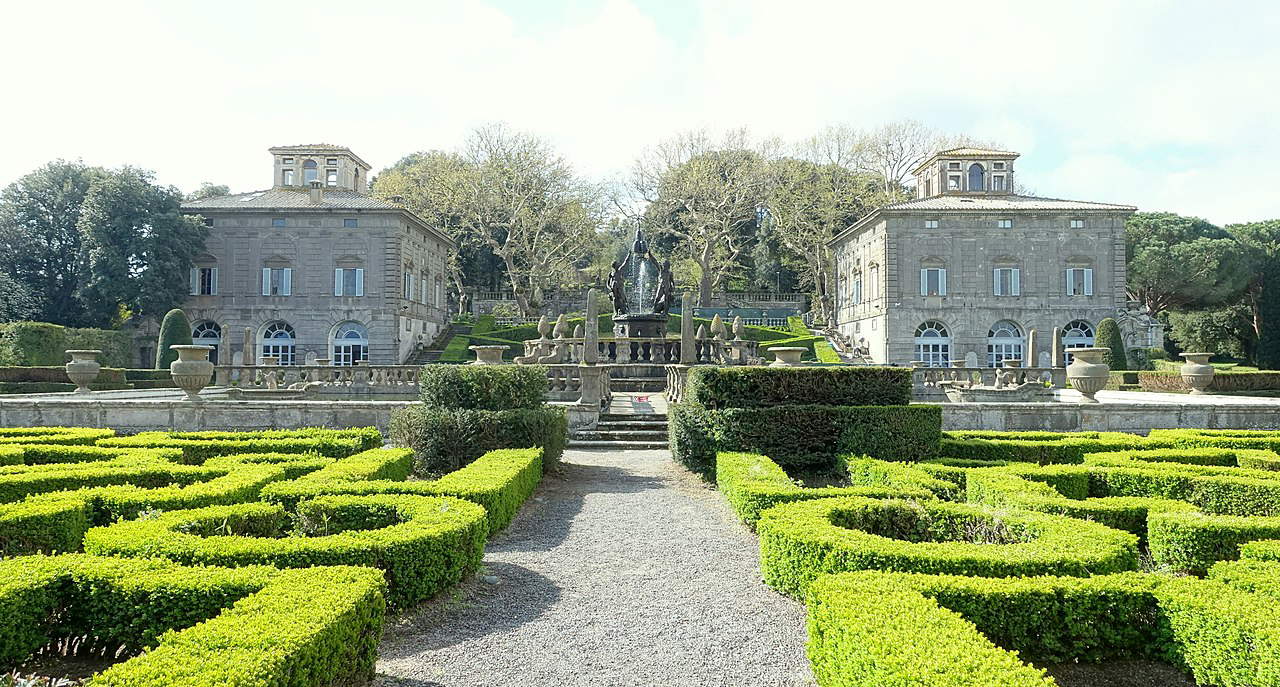
A debate has flared up over the restoration of Villa Lante in Bagnaia (Viterbo)—one of Italy’s most famous historic gardens—following the completion of work funded by the National Recovery and Resilience Plan (PNRR). The doubts and concerns were raised in a letter to the press by art historian Salvatore Enrico Anselmi, who holds a Ph.D. in the history and materiality of works of art. In the letter, he challenges the results of the work, its impact on the conservation of the monumental complex, and certain aspects of how the construction site was managed. At the heart of the criticism is what is described as an excessively invasive cleaning operation on the sculptural decorations of the fountains, believed to be responsible for altering the historical appearance of the stone surfaces. According to Anselmi, the interventions would have removed not only biological growths such as mosses and lichens, but also the so-called historical patina of the stone—an element that can be considered an integral part of the original material and, above all, a protective factor for the peperino, the volcanic rock used for most of the villa’s architectural and sculptural structures. Peperino is, in fact, a particularly porous material, and once stripped of the surface layer that has developed over the centuries, it would be more exposed to the effects of fluctuations in humidity and temperature. Continuous fluctuations in humidity and temperature could, in fact, promote ablation and the gradual erosion of the stone, accelerating the processes of deterioration.
This topic concerns one of the most important monumental complexes of the Italian Renaissance. Villa Lante is universally recognized as one of the finest examples of a 16th-century Italian garden. For centuries, it has been an essential stop on the Grand Tour and continues to attract scholars, art historians, and visitors from around the world thanks to its exceptional balance of architecture, landscape, water features, and sculptural elements. It is precisely the site’s historical and artistic value that makes any conservation work particularly delicate. The letter emphasizes that the work—carried out with total funding of approximately seven million euros under the PNRR—would have altered what is defined as the “iconographic and substantive character” of the sculptural decorations, changing the relationship between the historical surface of the stone and its visual perception.
In addition to strictly conservation-related issues, Anselmi’s complaint also draws attention to the condition of certain areas of the monumental complex. In particular, it highlights the state of disrepair of a section of the so-called “barco,” the path that runs along the side retaining wall of the historic garden. According to reports, this section contains conditions that could pose a safety risk to visitors: rusty gates leading to areas used as storage for debris, accumulations of invasive vegetation, and abandoned stone fragments. Anselmi’s report also addresses the accessibility of the pipes in the water system used to supply and recirculate water to the fountains. Another issue highlighted concerns certain side windows of the right loggia of the Fontana del Diluvio, described as deteriorated and no longer capable of preventing unauthorized access to the historic garden by bypassing the ticket office route.
Anselmi has also launched a petition on Change.org, signed by over a hundred people, calling for the implementation of a program for the continuous monitoring of the fountains and sculptural groups at Villa Lante. The initiative is based on the recognition that the historic garden represents an extremely fragile testament to 16th-century Italian artistic culture and that, following the completion of the restorations, it is necessary to establish constant monitoring of the state of preservation of the stone surfaces. Among the requests put forward by the petition’s organizers is the implementation of permanent monitoring aimed at tracking the progression of biological deterioration in the stone and the effects of humidity fluctuations on the peperino stone, which is constantly exposed to water from the fountains. In addition, the petition proposes periodic decalcification of the water used in the garden’s plumbing system, which is considered essential to limit the corrosive effects of limestone and preserve the functionality of the historic fountains.
Another point concerns the development of a long-term management and maintenance plan, drawn up with the input of conservation specialists, to ensure continuous planning of interventions and sustainable management of the resources allocated to the monumental complex. According to the petition’s organizers, only a system of constant monitoring and scheduled maintenance can ensure the preservation of one of the most important symbols of Italy’s historical and landscape heritage.
In parallel with the petition, art historian Salvatore Enrico Anselmi has compiled a document containing ten questions addressed to those responsible for the restoration work, seeking clarification on the technical and methodological aspects of the restoration. The first question concerns the reasons that allegedly led to such a radical cleaning process as to remove the historical patina from the stone surfaces—a patina considered an integral part of the ancient structure both for its historical significance and for the protective function it provides to the stone.
A second question addresses what is described as a methodological misunderstanding, asking why the necessary removal of moss, lichens, and other forms of biological degradation was accompanied by interventions that also eliminated the stone’s natural oxidation layer—contrary to Brand’s principle of minimal intervention. The document then raises the issue of the perceptual consequences of the intervention, asking how it will be possible to restore the original relationship between the architectural and sculptural volumes, which is considered to have been altered by a chromatic and surface-level standardization that has reduced the sculptural complexity of the works.
Among the questions raised is also that regarding the time required for the peperino to regain a color appearance closer to its historical one, moving beyond what is described as the current “concrete-like” perception of the surfaces. Anselmi also wonders how to explain to scholars and international visitors the rationale behind an intervention that, in his view, has compromised the accurate philological interpretation of the architectural and sculptural decorations.
Another question concerns the choice of cleaning techniques employed. The document asks why Nd:YAG or Erbium:YAG pulsed laser systems were not used—technologies that, it is argued, would allow for the selective removal of biological growths while preserving the historical patina thanks to differential optical absorption.
Attention is also drawn to the possible consequences of removing the patina from a conservation standpoint, with particular reference to increased stone porosity and the acceleration of degradation caused by alternating cycles of moisture and drying.
The final issues address aspects related to safety and site management. In addition to the condition of the barge and the water pipes, the condition of the fixtures of the Fontana del Diluvio is noted, and it is asked whether the new lighting system installed in the complex— which is considered particularly intrusive along the so-called “Catena d’acqua,” was designed with a view to a future extension of the Villa’s opening hours to include the evening.
The observations contained in the letter and the petition thus mark the beginning of a public debate on the delicate balance between restoration, conservation, and the management of historical heritage. This debate concerns not only Villa Lante but, more broadly, the methodologies adopted in interventions on major Italian monumental complexes, especially when they involve sites of exceptional historical, artistic, and landscape value. At this time, the materials released by the initiative’s organizers do not include any responses or statements from the relevant local governments and agencies involved in carrying out the work.
|
| Villa Lante in Bagnaia: Restoration Emergency—A Petition Calling for Monitoring of the Work |

Warning: the translation into English of the original Italian article was created using automatic tools. We undertake to review all articles, but we do not guarantee the total absence of inaccuracies in the translation due to the program. You can find the original by clicking on the ITA button. If you find any mistake,please contact us.





























 IT
IT FR
FR DE
DE ES
ES CN
CN


