





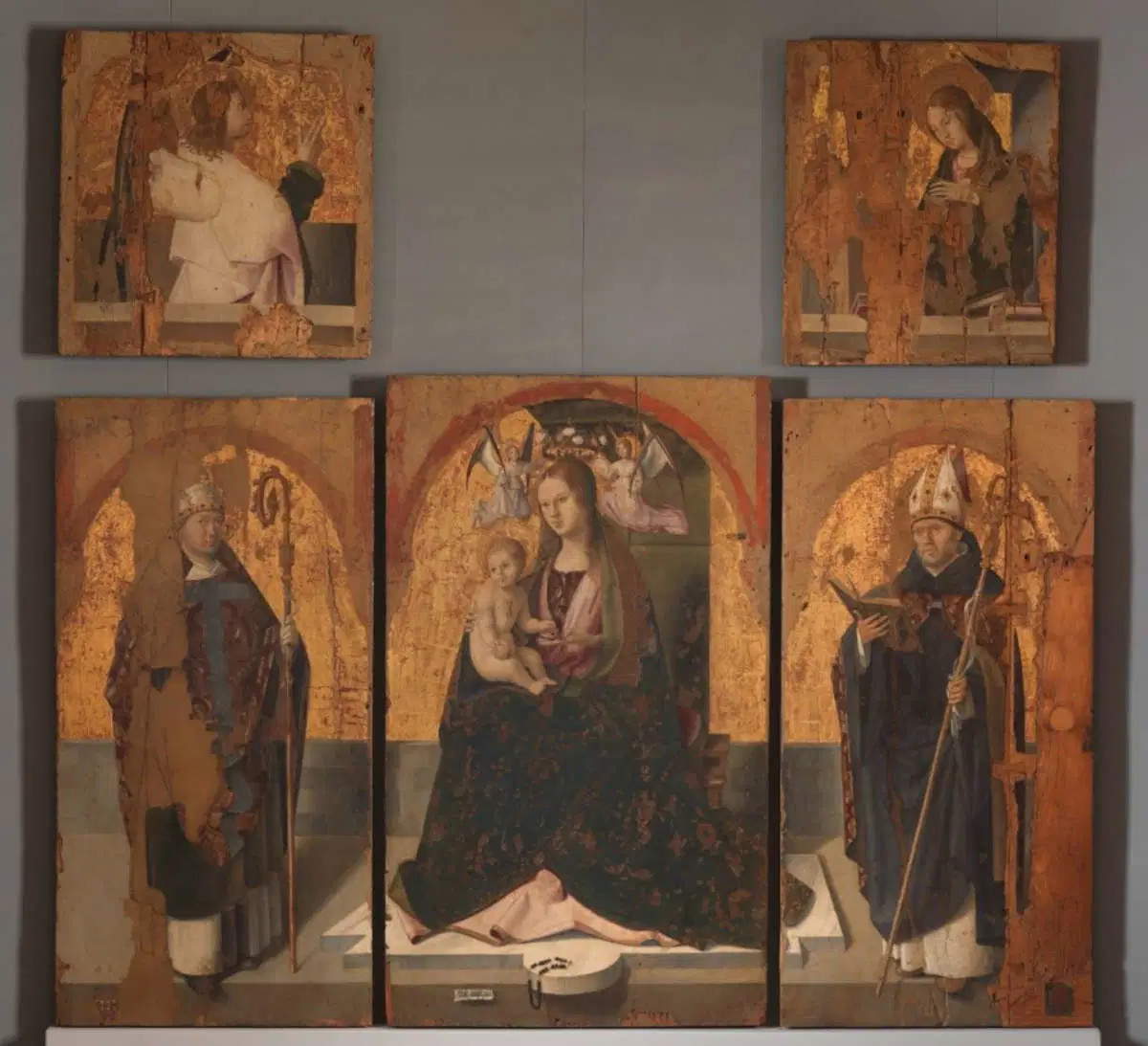
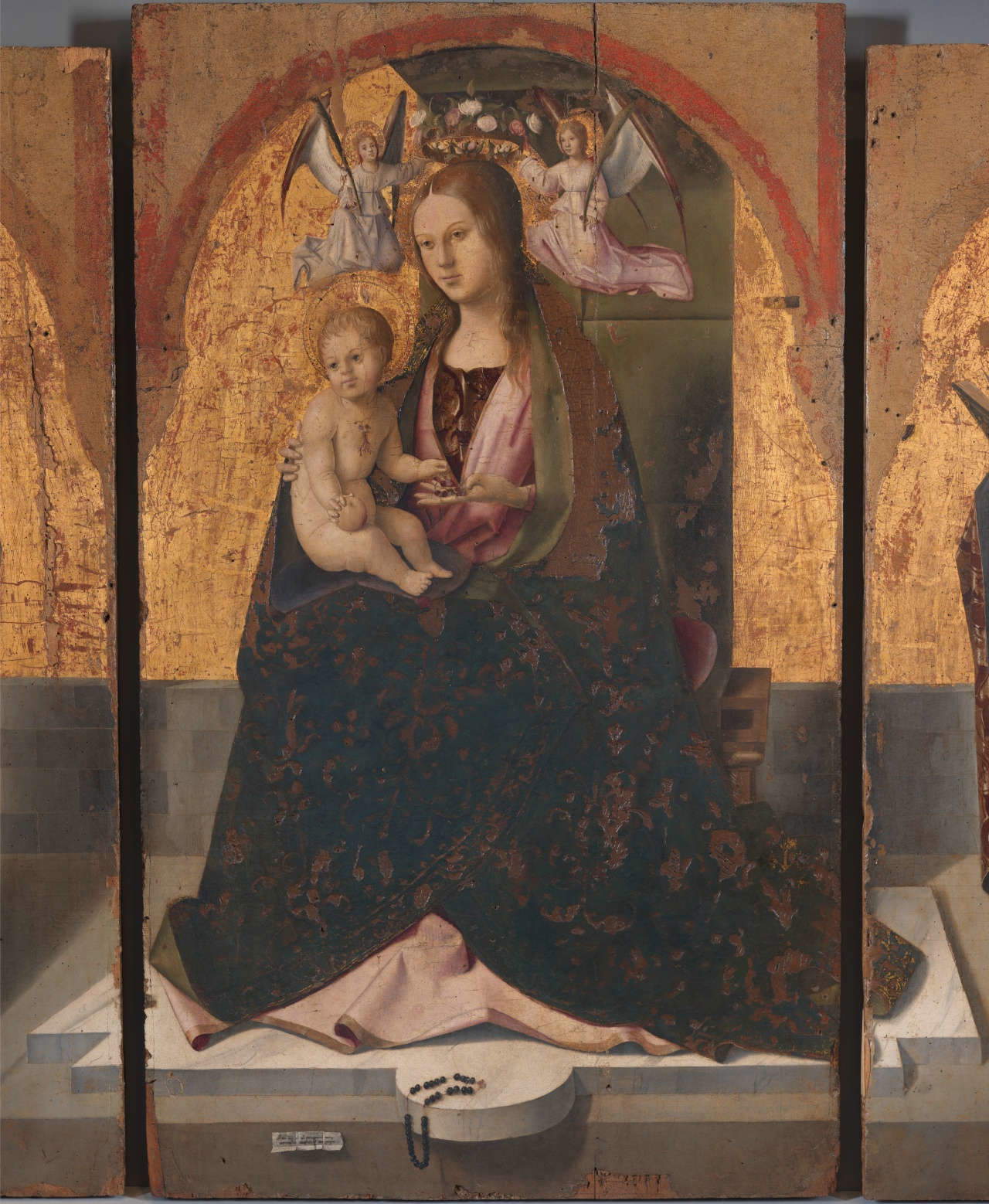
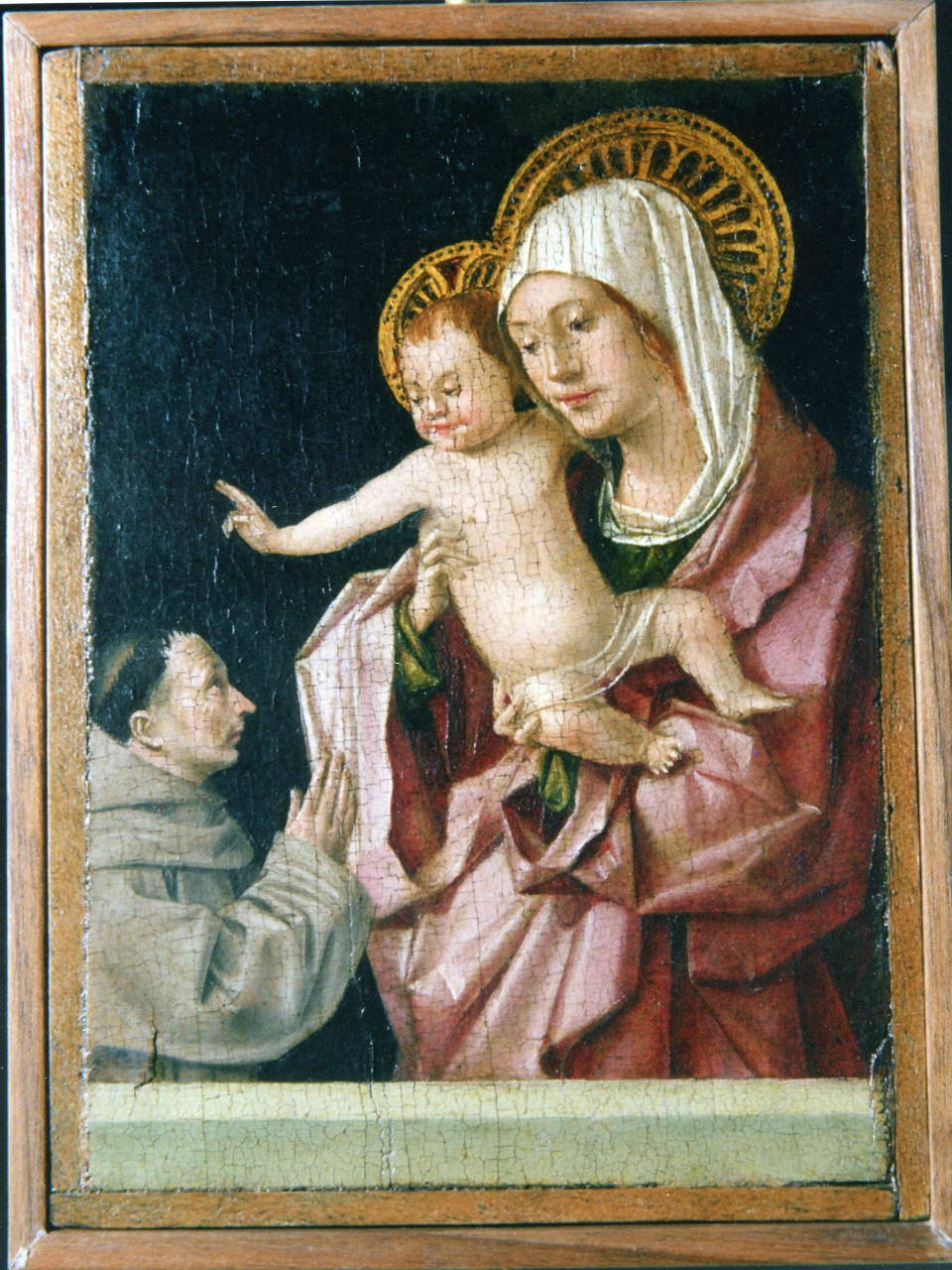
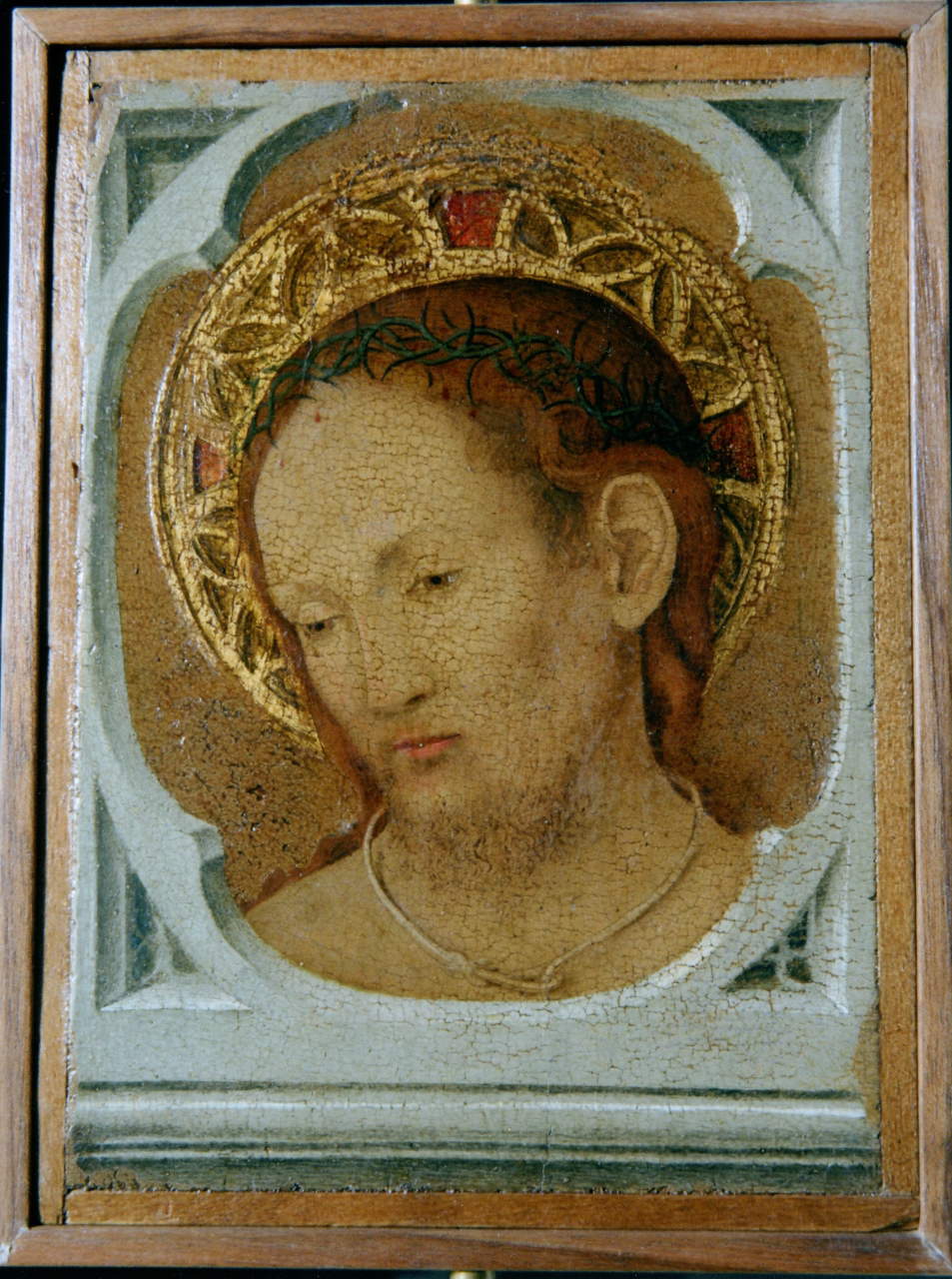
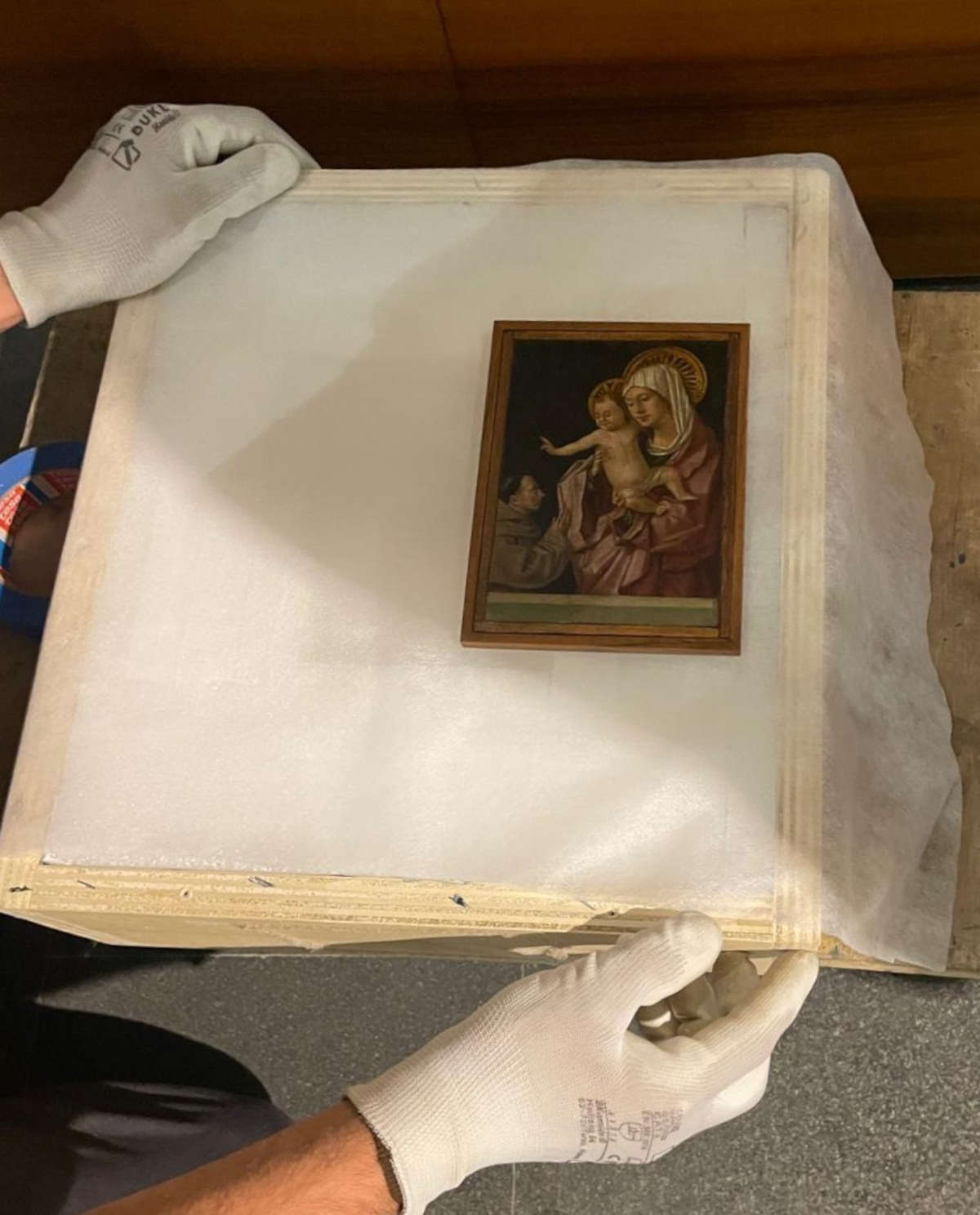
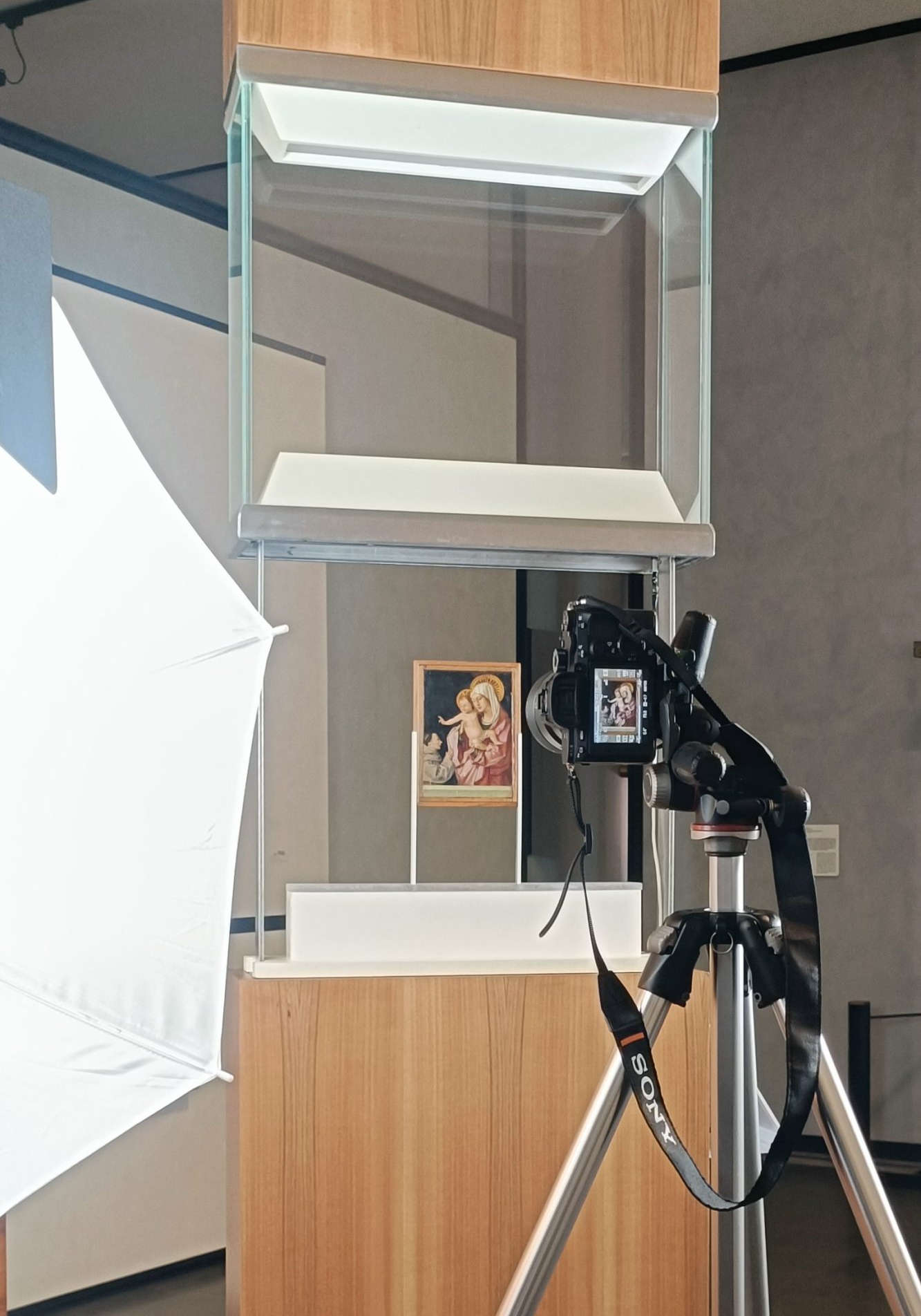
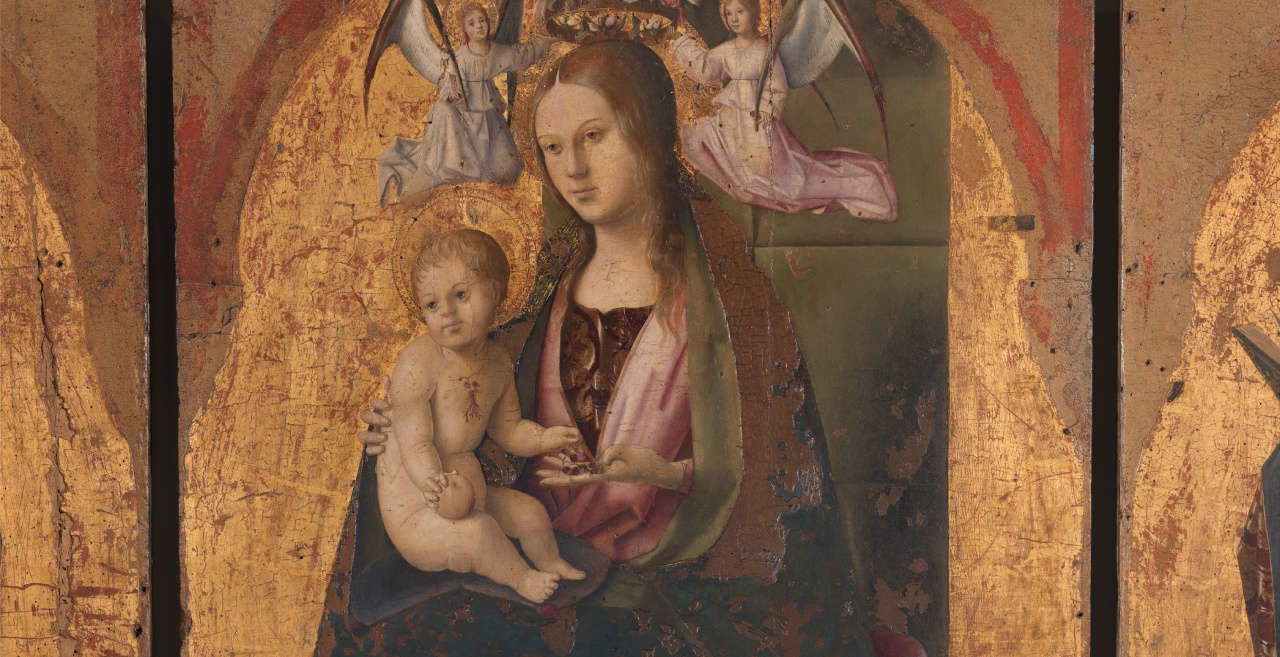
The theft of the two panels by Antonello da Messina from the “Maria Accascina” Regional Museum in Messina—the MuMe—is not merely the theft of two priceless works of art. It is an incident that directly affects an essential part of Western art history, because it involves one of the painters who most profoundly contributed to transforming 15th-century painting. The stolen works are the central panel of the San Gregorio Polyptych, depicting the Madonna and Child Enthroned, and a small double-sided panel showing, on the front, the Madonna and Child Blessing with a Franciscan in Adoration, and on the back, Christ in Piety. The two side panels of the polyptych, depicting Saint Gregory and Saint Benedict, were left behind during the escape and recovered by the authorities. In both cases, these are fundamental works by Antonello: the San Gregorio Polyptych is one of only two known polyptychs by Antonello (the other is the Polyptych of the Doctors of the Church, housed in the Uffizi), while the double-sided panel is an extremely rare example from the early phase of his career—the only one found in Sicily and among the few preserved in Italy.
To understand why this theft is particularly serious, one must therefore look beyond the economic value of the works, which is, in any case, extremely high. Suffice it to say that the double-sided panel was purchased by the Sicilian Region for 257,188.75 pounds (approximately 360,000 euros) at a Christie’s auction in 2003; however, it should be noted that the recently acquired *Ecce Homo*, purchased by the Italian government, cost 14.9 million dollars—or approximately 13 million euros. The market values of works by Antonello—a very rare painter (only slightly more than forty works are known to be attributed to him)—are in fact very high: potentially, the two stolen works would be worth millions of euros, even though they are unsellable on the normal art market, as they are immediately recognizable.
Antonello, however, is not merely one of the most important Italian painters of the fifteenth century: his body of work represents one of the most significant points of convergence between the artistic tradition of central and northern Italy and the figurative cultures of Flanders and Provence. His painting helped introduce a new conception of light, the rendering of materials, space, and the psychological representation of faces into the Italian Renaissance. And it is precisely from this encounter between different cultures that a fundamental part of his originality arises. Antonello da Messina was probably born around 1430–1431 and died in his hometown in February 1479. Relatively little information about his life remains, and even the key dates of his biography have been partially reconstructed by scholars through indirect documents and later accounts. Furthermore, the earthquake that devastated Messina in 1908 wiped out a vast portion of the city’s documentary record, making it even more difficult to reconstruct the artist’s personal and professional history. This scarcity of information, however, does not diminish Antonello’s significance; on the contrary, it makes the works that have survived all the more valuable, as they are among the primary sources through which we can reconstruct his training and artistic development.
His hometown played an important role in the development of his artistic language: in the fifteenth century, Messina was a major port, situated along the major Mediterranean trade routes. The city maintained close ties with Catalonia and the Iberian Peninsula and also served as a stop along the maritime routes connecting Venice to Flanders. Ships bound for the commercial centers of Northern Europe passed through the Strait, carrying goods, people, information, and, indirectly, artistic images and models as well. Antonello likely trained in Naples in Colantonio’s workshop, in an environment deeply influenced by Flemish culture. The collections of the Aragonese court included works from Northern Europe, and artists working in Naples had the opportunity to engage with a pictorial language characterized by an extraordinary attention to light, surfaces, details, and the rendering of materials. It was in this context that Antonello gradually developed a figurative style destined to become both personal and innovative. His early works indeed reveal connections to Franco-Flemish and Provençal painting, yet they already contain the elements of an artistic exploration that would lead the painter toward an original synthesis. Antonello’s most significant contribution lies precisely in his ability to bridge two traditions that are often considered separately. On the one hand, there is Flemish painting, with its focus on light, optical precision, the texture of surfaces, and the meticulous depiction of objects. On the other is Italian Renaissance culture, based on the geometric construction of space, perspective, and the pursuit of a rational and coherent representation of reality. Antonello da Messina is the meeting point between these two worlds.
The artist thus played a role that extended far beyond his personal body of work. His Sicilian experience, enriched by his connections to Naples, Flemish culture, and Venice, helped bridge different artistic worlds. This is another reason why he occupies a central place in the history of Italian art. And among the works that best document this journey is precisely the San Gregorio Polyptych, now at the center of the theft scandal. The painting was commissioned by Abbess Frabia Cirino for the monastery of Santa Maria extra moenia in Messina. The work, dated 1473 and signed by Antonello, originally consisted of six panels. At the center is the Madonna and Child Enthroned, accompanied by angels holding a crown; on either side are Saint Gregory and Saint Benedict. The upper register depicts the Announcing Angel and the Virgin receiving the Annunciation. The central panel of the cimas, likely dedicated to a Pietà with the dead Christ supported by angels, is lost. The polyptych was dismantled, likely as early as the sixteenth century, and its original structure was compromised. The panels were then reassembled in the nineteenth century following a restoration that did not fully resolve all of the work’s issues.
Despite its troubled history, the San Gregorio Polyptych stands as a fundamental testament to Antonello’s artistic maturity. It is a work in which Flemish and Italian Renaissance cultures coexist in a particularly evident manner. One of the most important aspects concerns the way the painter approaches the gold ground, which is still linked to the tradition of medieval altarpieces. Antonello does not eliminate it, but transcends it by constructing a unified space. The masonry balustrade, together with the base of the throne, extends across the various panels, creating visual continuity. The figures of the saints do not appear isolated in separate compartments but share the same space and seem to advance toward the viewer.
At the center, the Madonna dominates the composition with a monumental presence: the surfaces, ornamentation, reflections, and rendering of materials reveal precision of Flemish origin, while the arrangement of the figures and the construction of space reveal the influence of Italian perspective and a dialogue with Piero della Francesca. The missing central panel is therefore not an isolated element: it is the fulcrum of a composition conceived as a unified whole and one of the most important examples of Antonello’s mature work in Messina.
The significance of the second stolen work—the double-sided panel depicting the Madonna and Child and the Pietà—is yet another matter. The work was attributed to Antonello in 2003 and, as mentioned, was acquired that same year by the Sicilian Region at Christie’s, after having been part of Wilhelm Soldan’s collection, where it had been present since at least 1930. Its small size suggests that it was originally intended for private devotion: a small image to be used during personal prayer, not an altarpiece intended for a large public or liturgical space. Scholars generally date it to between 1465 and 1474, based on comparisons with works definitively attributed to Antonello. The reverse side is particularly interesting: the surface on this side is, in fact, more worn, likely due to the image’s devotional use—Christ’s face may have been kissed repeatedly by the faithful. This detail helps us understand a different dimension of art history. In other words, it is not merely a work to be studied for its style or attribution: it is also an object that preserves traces of how it was used, of the tangible relationship established over the centuries between an image and the people who venerated it.
The theft of the two panels is particularly serious because it affects a cultural heritage that has more than just regional significance. Antonello da Messina is part of the history of Italian and Western painting as a whole. His story shows how, in the fifteenth century, Italy was not a collection of rigidly separate artistic cultures, but a territory traversed by artists, merchants, works of art, ideas, and models. Antonello’s Sicily was connected to Aragonese Naples, the Mediterranean, the Italian peninsula, Provence, and Flanders. Venice was then the place where some of the experiences the painter had gained found new expression. His importance lies precisely in his ability to transform these influences into a personal synthesis. Antonello brought to Italian painting a new focus on light and the depiction of reality, while at the same time employing the perspective and geometric composition characteristic of Renaissance culture. The result is not a mere sum of influences, but an autonomous pictorial language.
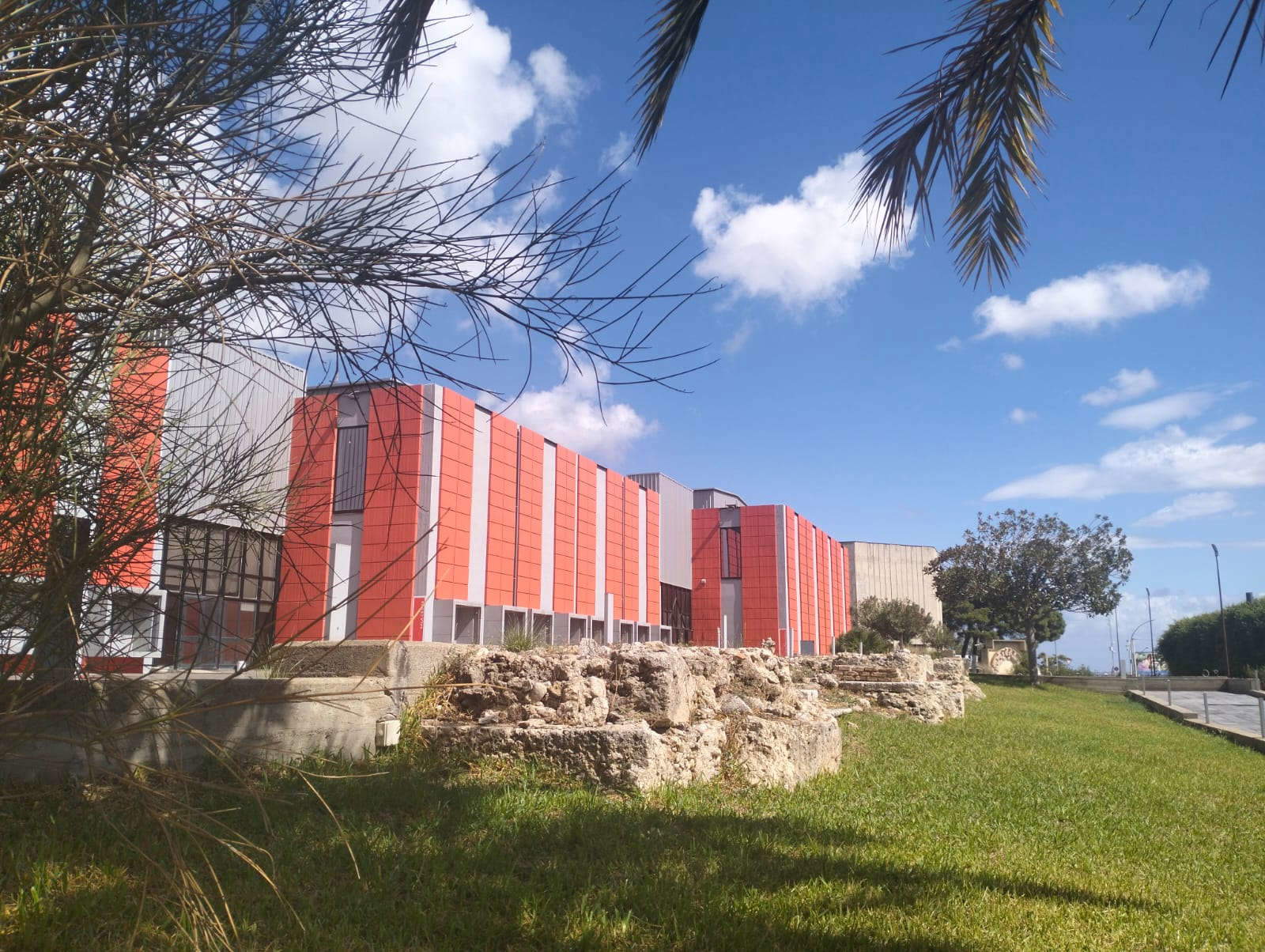
This position makes Antonello a pivotal figure for understanding the birth of modern painting: his work helps explain how Italian painting of the late 15th century was able to develop a new conception of space, light, and human presence. And the fact that two works by this artist were stolen from the very museum in his hometown takes on special significance: the MuMe, in fact, preserves a fundamental part of Messina’s artistic heritage and represents one of the places where the relationship between Antonello and the city can be concretely reconstructed. The recovery of the two side panels of the San Gregorio Polyptych is certainly an important aspect of this story, but it does not diminish the gravity of the theft of the works that are still missing: a painting by Antonello is not an asset that can be replaced based on its economic value. Even if a work could be insured or valued on the market, the issue of theft would still concern the loss of an irreplaceable historical and cultural artifact. Moreover, cultural heritage has a characteristic that distinguishes it from ordinary merchandise: its value also grows through the possibility of being known and contextualized in relation to other works, documents, and contexts. A work housed in a museum belongs to the history of a community and, at the same time, becomes part of a shared body of knowledge. For this reason, the theft of the two panels by Antonello da Messina cannot be viewed merely as a crime story: it is a blow to our understanding of 15th-century painting and to our ability to reconstruct one of the most significant artistic experiences in Italian and Western history.
 |
| Why the theft of Antonello da Messina’s panels is such a huge loss |

Warning: the translation into English of the original Italian article was created using automatic tools. We undertake to review all articles, but we do not guarantee the total absence of inaccuracies in the translation due to the program. You can find the original by clicking on the ITA button. If you find any mistake,please contact us.





















 IT
IT FR
FR DE
DE ES
ES CN
CN


