





Despite appeals, articles and choruses of authoritative voices against it, yesterday the Madia bill was approved in the Senate and thus became law. Of course, it is a proxy law and, to see it in full operation, it will be necessary to wait for the government’s implementing decrees, although hopes for a reversal of the law’s text are, in fact, nil: it is difficult to expect the government to issue decrees that go against a government-initiated law. And it is useless to hide the fact that the news disappointed all the nearly twenty-five thousand signatories, including us, of the petition "This is no way to kill Article 9 of the Constitution," signed by, among others, personalities such as Dario Fo, Massimo Bray, Andrea and Vittorio Emiliani, Carlo Ginzburg, Salvatore Settis, Sergio Staino, Tomaso Montanari, Francesco Caglioti, Maria Pia Guermandi, Stefano Rodotà .... and by a great many citizens who have profound contempt for the culturaphobia, to use the apt term proposed by Luca Rota, demonstrated by the actions of this government, light years away from its own words.
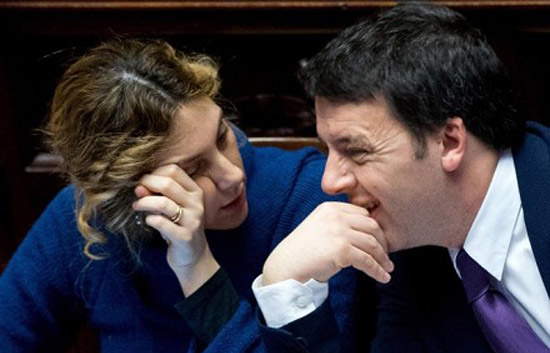 |
| Marianna Madia and Matteo Renzi. Image by Business Online distributed under a Creative Commons license. |
Why does the petition speak of “violation of Article 9 of the Constitution” and the “most serious attack on the system of landscape and cultural heritage protection ever perpetrated by a Government of the Italian Republic”? We have talked about the Madia decree in recent days, but it is good to recap what are the measures, now approved, that closely affect the protection of art and landscape:
In short: we can say that civil service reform undermines the protection of our heritage, which is what is most precious to us. And this blatant attack on protection comes from a government that, a case probably unique in the world, leads the fight against inefficiency by deregulation, rather than by sensible measures aimed at reducing waste, fostering transparency and encouraging the speeding up of processes. A government wanted by no one, which is not even an expression of an election result, since it is composed of elements who, at the last elections, were militating on opposing fronts. A government that is therefore not an expression of any popular will and that is presided over by a premier who, to announce the approval of the reform, launches a tweet imbued with the infantilism that has often connoted his communicative style. And a government that, we repeat in case it had escaped notice, with the reform on public administration has in fact given the green light to the cementing and dismantling of the superintendencies: could it be that, as many have noted, rather than inefficiency the government wants rather to hit those who have so far strenuously opposed the aims of the ultras of land speculation? In any case, all that remains is to trust in one last element that could turn the tables: a possible declaration of unconstitutionality.

The author of this article: Federico Giannini
Nato a Massa nel 1986, si è laureato nel 2010 in Informatica Umanistica all’Università di Pisa. Nel 2009 ha iniziato a lavorare nel settore della comunicazione su web, con particolare riferimento alla comunicazione per i beni culturali. Nel 2017 ha fondato con Ilaria Baratta la rivista Finestre sull’Arte. Dalla fondazione è direttore responsabile della rivista. Nel 2025 ha scritto il libro Vero, Falso, Fake. Credenze, errori e falsità nel mondo dell'arte (Giunti editore). Collabora e ha collaborato con diverse riviste, tra cui Art e Dossier e Left, e per la televisione è stato autore del documentario Le mani dell’arte (Rai 5) ed è stato tra i presentatori del programma Dorian – L’arte non invecchia (Rai 5). Al suo attivo anche docenze in materia di giornalismo culturale all'Università di Genova e all'Ordine dei Giornalisti, inoltre partecipa regolarmente come relatore e moderatore su temi di arte e cultura a numerosi convegni (tra gli altri: Lu.Bec. Lucca Beni Culturali, Ro.Me Exhibition, Con-Vivere Festival, TTG Travel Experience).
Warning: the translation into English of the original Italian article was created using automatic tools. We undertake to review all articles, but we do not guarantee the total absence of inaccuracies in the translation due to the program. You can find the original by clicking on the ITA button. If you find any mistake,please contact us.





















 IT
IT FR
FR DE
DE ES
ES CN
CN


