





Yesterday, an Instagram “ ” story (“stories” —which must strictly be used in the plural even when the post appears to be a single item: after all, we’re used to scrolling through them with a certain frenzy, so they’ve become ingrained in our brains as pluralia tantum) where someone—I don’t remember who—shared a little thought, I don’t remember whose (the reader would be right to take offense at such sloppiness, but I think they’ll understand: Instagram’s “ ” stories are the junk food of the digital realm, and as a result, no one can take them seriously—except for culture and entertainment reporters and literary festival organizers—with the result that, if you don’t take notes right away, you very easily and very quickly tend to forget who said it), regarding the technical malfunction that has recently deprived the Uffizi of air conditioning just as temperatures in Florence were nearing forty degrees. I don’t remember the exact phrase, but it concerned the visitor restrictions the museum was forced to implement to address the problem, and it went something like, “Finally, you can breathe at the Uffizi,” suggesting that the Vasari complex—for one or two days, thank goodness, free of the crowds that usually throng in front of the *Venus* and *Spring*—had regained an unexpected, tolerable, temporary livability. Amid all this haziness of memory, however, the verb “to breathe” has remained firmly and vividly etched in my mind, because of the paradox—probably unintentional—expressed in the form of nonsense: aside from the fact that the Uffizi is not exactly the place where someone not born on the other side of the Atlantic would want to find themselves breathing on a summer afternoon—and this holds true even when indoor temperatures are kept well below the danger threshold— it seems to me that rejoicing in the fact that the breakdown of the air-conditioning system caused the crowds to disperse is a modest exercise in intellectual indolence. Not least because I doubt that the tourist who stepped off a plane from Kansas City or Shanghai, upon hearing the news of the restrictions caused by the breakdown, returned to his hostel to meditate on the transience of existence: more likely, they would have headed straight to the Accademia Gallery, and their bodies would have crowded in front of the David rather than in front of the Tondo Doni.
Rather, it is curious to note the effect this biting heat has had on the museums—this white, foggy, and sinister heat that snatches and chews, that breathes down your neck, that clouds your eyes, that crushes your guts. So if Florence is baking tourists (those few not affected by red alerts, reduced hours, or restrictions) and museum staff inside the wings of the Uffizi or beneath the equally scorching stone blocks of Palazzo Vecchio, in other Italian cities where museums are less subject to the constant turnover of exhibitions and where the air-conditioning systems are more robust and better designed, the galleries with their hanging paintings are offered to the public as an alternative to swimming pools, the beach, and senior centers. The museum, therefore, as a utilitarian substitute. Of course, one might argue that enticing the public to visit the museum simply because it is an air-conditioned space is a form of propaganda that isn’t exactly brilliant, especially if admission is charged: in short, there’s not much difference between a museum director or curator inviting the public to see the current exhibition because temperatures inside the museum are about ten degrees lower than the outdoor average and, say, the actors in France, in the midst of a canicule ( which even forced the Louvre to move up its closing times and make reservations mandatory), who urge the public on social media to attend their theater performances because “inside, we’ve got AC.” And then people will say there’s nothing systematic about it: for years, during these heat waves (though by now, rather than waves, they resemble giant swells, typhoons, or perpetually stormy seas— perhaps it’s time to revise the terminology, since above-average temperatures have now become the norm), museums have been operating somewhat on their own, with everyone fending for themselves.
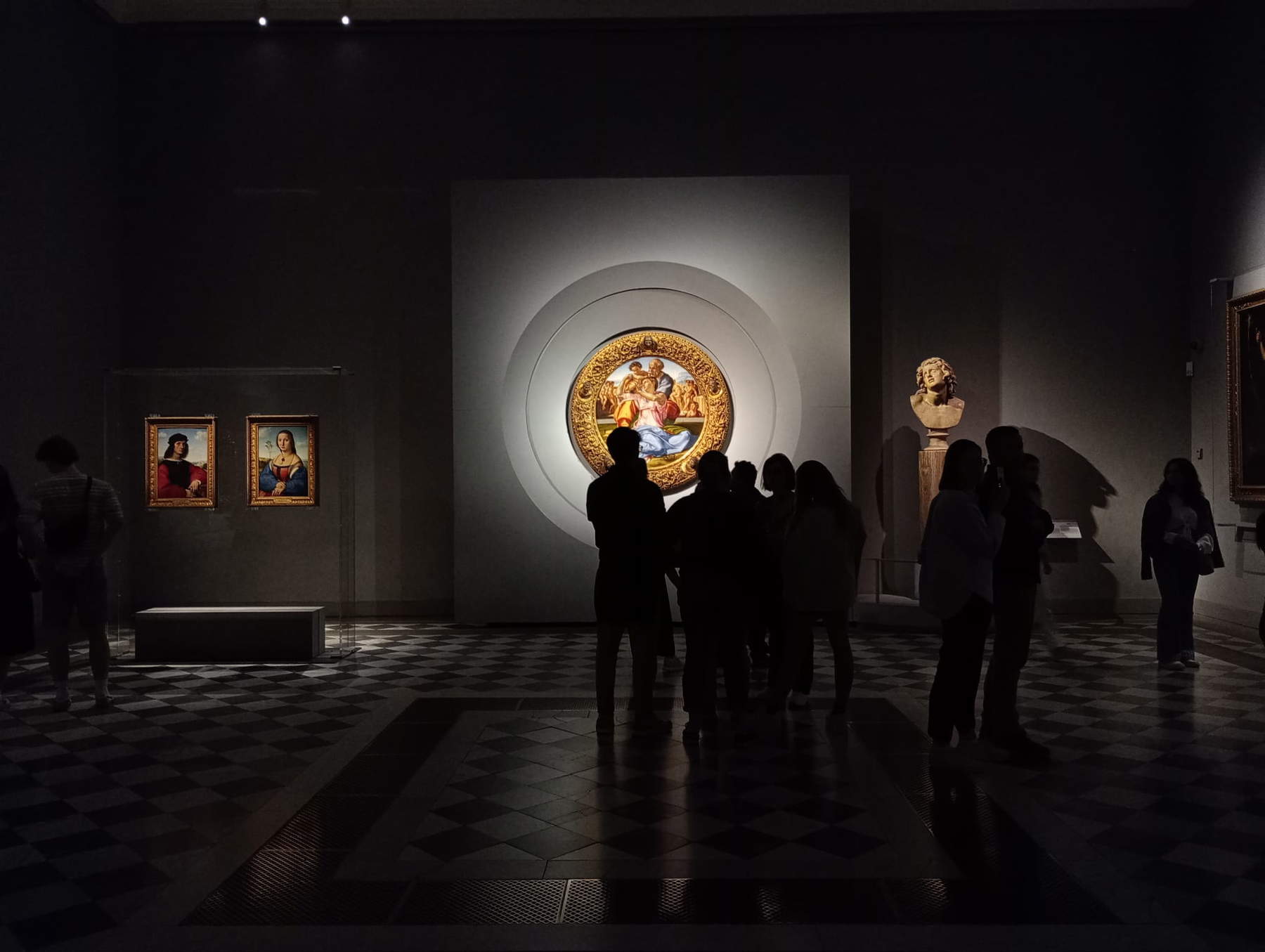
Rimini is among the few cities—perhaps even the only one—that has decided to open its museums free of charge to everyone on an exceptional basis. In Genoa, on the other hand, all museums have air-conditioned spaces, but at Palazzo Rosso and Palazzo Bianco, for example, admission is free only for residents of the city and province, and only during the last daily admission slot (so you can cool off at the museum only today and only if you enter around six in the afternoon, after which they kick you out at seven because the museum closes, and since it’s been a scorching 38 degrees even at aperitif time these days, the problem can’t really be considered solved). In Venice and Milan, museums are transformed into well-decorated retirement homes: in Venice, to encourage residents (who automatically enjoy free admission to municipal museums) to cool off at Ca’ Pesaro or the Correr, the city organizes free guided tours for people over 75 who live within the city limits. In Milan, free admission to certain municipal museums is available from June 30 to September 15 for those over 65: if you’re 62 years old or if you decide that your “social refrigerator” must be Palazzo Reale, then relief from the heat is guaranteed only upon payment of an admission fee. In short, the right not to collapse currently still seems to be governed by age brackets and assorted fees.
“Better than nothing,” the reader might say, and besides, most city councilors still present these measures more as services provided to citizens than as a sneaky marketing ploy designed to lure the public with free air conditioning: after all, it’s only been five or ten years since people started talking about climate change, and museums therefore still have plenty of time to work toward universal thermal welfare, to extend free admission to other groups, or to realize, for example, that the heat is suffocating even in the evening and at night, and that the heat wave knows no bureaucracy, with the unfortunate consequence that it doesn’t decide to subside at sunset simply because the city lacks the resources to cover the overtime pay for the custodians who would have to stay inside the galleries until two or three in the morning. Not to mention that, in such weather, some people might find it far more adventurous to go to the museum around noon or 1:00 p.m., and would therefore appreciate continuing to have the opportunity to engage in this “extreme sport.” But one might still argue that, for residents, the problem doesn’t arise. Meanwhile, even where museums remain stubbornly reluctant to waive admission fees for everyone in case of inclement weather, if you don’t have air conditioning at home, the money spent on a ticket could be put to better use by purchasing a reasonably powerful fan, to point at your face in order to at least get through the most difficult moments (and thus offset the risk of fainting while trying to reach the nearest museum). And besides, residents have extensive access to public cooling spots that are even more satisfying than museums—and, above all, free: libraries, community centers, parish halls, and shopping malls—which even spare you the obligation to remain silent—as well as various bars and cafes where, unlike in museum galleries, you can even play a game of briscola. No, it’s other groups that concern me.
The first category—very selfishly and very timidly—is that of journalists forced by their jobs to visit exhibitions opening in the middle of summer: it’s true that the galleries are often air-conditioned, but just as often the walk to the air-conditioned gallery isn’t, and the real problem is those five to ten minutes, which you have to endure in a shirt and jacket (no tie, since the tie is now a obsolete accessory, reserved only for heads of state and TV news anchors), that separate the museum from the parking lot or the bus or subway stop (no, a taxi won’t solve it: we’re a nation of taxi riders only when the fare is on the house, so that wouldn’t work). Most people, having long since abandoned all formality due to this gloomy and unhealthy heat, have tried to tackle the problem by donning T-shirts, shorts, and flip-flops, but often—even when dressed like kids at summer camp—they still arrive at their destination out of breath and overheated: well, if only to avoid these shameful displays of square kilometers of sweat-drenched skin, we propose a moratorium on all daytime press conferences—or even an outright ban on organizing summer exhibitions held in locations more than five kilometers from the coast— since near the sea, at least the twilight breezes manage to offer some timid resistance to the heatwave’s onslaught, whereas inland not even this laughable form of relief is granted. Let us, therefore, restore a modicum of professional dignity. The second category is that of the tourist. It is not natural to drag oneself, say, between the Uffizi and Palazzo Vecchio without finding the comfort of a blast of cool air just past the entrance, nor is it normal to find the entrance barred because the cooling systems in the galleries have overloaded a week after the directorhad his triumphant photo taken in the newly rearranged Botticelli galleries (though if visitor limits are to be imposed, let them be permanent and remain in effect even when the air conditioning is running at full capacity: at most, the most popular museums will become like da Vinci’s Last Supper or the Scrovegni Chapel). Residents can work around this—as they’re already doing—by imposing a sort of self-imposed climate lockdown on themselves, but tourists aren’t granted this option, and tourists have every sacrosanct right to see the Venus and the Spring when they plan to. Not least because the Italian intellectual who, in his social media stories, rejoices at a less crowded museum (though no less hellish—it’s just a different circle) would, in all likelihood, be the first to protest (and the first to rush to MoMA) if, on his first trip to New York, he encountered an identical situation at the Metropolitan. So, let’s not forget the tourist, who is often no more of a beast than the person observing them from their couch at home.

The author of this article: Federico Giannini
Nato a Massa nel 1986, si è laureato nel 2010 in Informatica Umanistica all’Università di Pisa. Nel 2009 ha iniziato a lavorare nel settore della comunicazione su web, con particolare riferimento alla comunicazione per i beni culturali. Nel 2017 ha fondato con Ilaria Baratta la rivista Finestre sull’Arte. Dalla fondazione è direttore responsabile della rivista. Ha scritto i libri Vero, Falso, Fake. Credenze, errori e falsità nel mondo dell'arte (Giunti editore, 2025) e Immagini del potere. Arte e propaganda da Augusto a Trump (Giunti editore, 2026). Collabora e ha collaborato con diverse riviste, tra cui Art e Dossier e Left, e per la televisione è stato autore del documentario Le mani dell’arte (Rai 5) ed è stato tra i presentatori del programma Dorian – L’arte non invecchia (Rai 5). Al suo attivo anche docenze in materia di giornalismo culturale all'Università di Genova e all'Ordine dei Giornalisti, inoltre partecipa regolarmente come relatore e moderatore su temi di arte e cultura a numerosi convegni (tra gli altri: Lu.Bec. Lucca Beni Culturali, Ro.Me Exhibition, Con-Vivere Festival, TTG Travel Experience).
Warning: the translation into English of the original Italian article was created using automatic tools. We undertake to review all articles, but we do not guarantee the total absence of inaccuracies in the translation due to the program. You can find the original by clicking on the ITA button. If you find any mistake,please contact us.




























 IT
IT FR
FR DE
DE ES
ES CN
CN


