




by Federica Schneck 27/06/2026



Categories: Opinions / Disclaimer
Blockbuster exhibitions are not just cultural events, but the result of a complex network of loans between museums, international agreements, and economic strategies. The works travel, become tools for building relationships, and create symbolic, political, and economic value. But they are also based on a paradox. An article by Federica Schneck.
A painting crosses the ocean, changes continents, moves from one room to another, from one light to another. For a few months, it finds itself far from the place where it is normally kept, surrounded by other works, woven into a new narrative. Visitors encounter it there, in that temporary setting, often without wondering how it came to be there. Yet it is precisely in that movement that a fundamental aspect of its contemporary existence lies hidden. So-called blockbuster exhibitions—those built around names like Vincent van Gogh, Pablo Picasso, or Caravaggio—are based on this principle of mobility: works that normally belong to permanent collections are temporarily uprooted and relocated elsewhere to create high-impact exhibition events. The result is an intense, concentrated, and often once-in-a-lifetime experience. But behind this apparent immediacy lies a complex system of negotiations, balances, and strategies.
At the heart of this system lies the issue of inter-museum loans, often governed by agreements between public institutions or directly between nations. The transfer of a work of art is never a simple matter: it involves strict conservation conditions, high-value insurance, and highly specialized transportation. But above all, it involves a decision: to temporarily part with something that is, by definition, permanent. This decision is rarely unilateral, as loans are part of a system of reciprocity. A museum lends an important work and, in exchange, receives—either immediately or over time—another loan, a collaboration, or a strengthening of its position within the international system. In some cases, these exchanges take on an almost diplomatic dimension, helping to build relationships between institutions and countries.


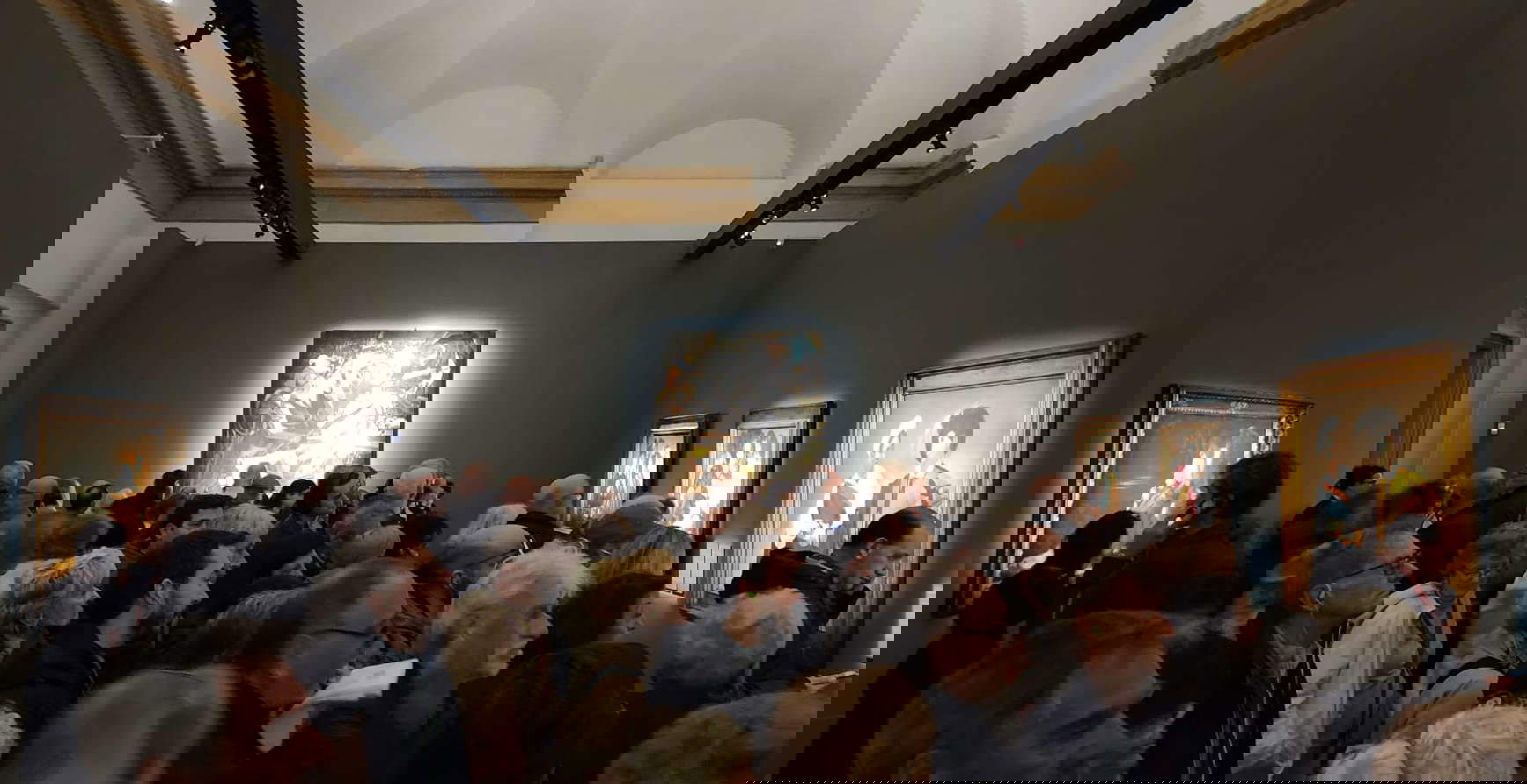
Blockbuster exhibitions are where these dynamics come to the surface. Bringing together works from different collections means orchestrating a network of agreements that extends far beyond the exhibition space. The exhibition thus becomes the visible result of an invisible structure, in which every participant seeks a balance between openness and control, between sharing and self-interest. But who benefits from this system?

The first level is that of the host museum. A major exhibition generates a surge in visitors, increases revenue, and strengthens the institution’s image. The museum establishes itself as a central hub of a global cultural network, capable of attracting works and attention, and the exhibition becomes a vehicle for visibility, as well as a curatorial project.
Alongside the museum, a broader economic system is set in motion: sponsors, foundations, and private partners contribute to the financing of exhibitions, gaining a form of symbolic legitimacy in return. In this context, art becomes a tool for cultural positioning and reputational building.
Cities also come into play. A high-profile exhibition can become an event capable of attracting tourism, generating economic spinoffs, and strengthening urban cultural identity. Art thus becomes part of broader strategies in which symbolic value intertwines with economic value.
The institutions that lend the works, in turn, are not left out of this cycle. The benefit is not always direct, but manifests itself in the form of relationships, prestige, and future opportunities. Lending an important artwork means actively participating in an international network, strengthening alliances, and building symbolic capital that can be tapped into over time. In this scenario, the artwork takes on a new status, shifting from that of a static object, housed in a specific location, to that of a mobile element, integrated into flows of exchange. Its value does not change; it expands: it concerns not only what it represents but also what it triggers—namely, relationships, movements, and narratives.
And here the paradox emerges. Blockbuster exhibitions are presented as opportunities for access—moments when the public can engage with extraordinary works without having to travel. And while this is true, at the same time these exhibitions are based on a logic of exceptionality: for a limited time, they bring together works that are normally scattered, creating events that exist precisely because they are not permanent. In this balance, the public occupies a central yet ambiguous position. It is the recipient of the experience—the one who makes the exhibition possible through its presence—but it is also part of the economic mechanism that sustains the entire system. Its participation is both cultural and economic.
There is also a more subtle dimension concerning the way these exhibitions are experienced: the concentration of masterpieces, the influx of visitors, and the media coverage of the event can transform the viewing experience. Time is compressed, the gaze accelerates, the artwork risks being merely passed by rather than observed, and the intensity of the offering can lead to a form of saturation.
This does not imply an unambiguous critique of blockbuster exhibitions, since their existence responds to real needs: making art accessible, creating connections, and sparking interest. However, viewing an exhibition also means questioning the conditions that make it possible, the dynamics that sustain it, and the balances at play within it.
The system of state loans, in this sense, is not merely a technical or administrative matter; it is a lens through which to observe how art functions in the present. It reveals how works exist within complex networks, how cultural value intertwines with symbolic and economic value, and how every exhibition is the result of a series of decisions.
Perhaps the experience of the exhibition changes precisely when one becomes aware of this. The artwork is indeed what one sees, but it is also what moves, what is negotiated, what is made possible. And the museum, once a neutral space, reveals itself for what it is: a place where culture, politics, and economics meet and continually redefine themselves.
Warning: the translation into English of the original Italian article was created using automatic tools. We undertake to review all articles, but we do not guarantee the total absence of inaccuracies in the translation due to the program. You can find the original by clicking on the ITA button. If you find any mistake,please contact us.