





The news had already been circulating for a few days: in Cologne, one of Germany’s most culturally vibrant cities, the number of coronavirus positives is steadily increasing and people are beginning to speak fearfully of a third pandemic wave. So the city is running for cover: it is imposing a requirement to present anticovid tests with negative results if one wants to access places designated for leisure, as culture is considered. Let’s go in order: all over Germany museums are closed from November 4, 2020, and very strong restrictions have also been implemented for libraries and art galleries until December 16, when the whole country goes into lockdown and closes everything. Numbers continue to climb, vaccines are delayed, and politics are in chaos.
It is only as of March 8 (for libraries as of March 16) that the first glimmers of a reopening can be seen (again based on what they call 7-Tage-Inzidenz, which is the value representing cases per 100,000 population in the last 7 days). Restrictions on access to museums, libraries and archives change from Land to Land, from region to region, and the one I report in this article is the situation regarding the city of Cologne where the Museum Ludwig with the most important Pop Art collection in Europe and in the world, if we exclude the works stored publicly and privately in the United States, is based. The museum is complemented by a marvelous art history library, a veritable treasure trove for all art researchers who come there from neighboring areas as well as from neighboring Holland and Belgium to consult (and photograph and scan free of charge) the desired texts. When it reopened after March 16, access to the Ludwig Museum was very controlled: the permanent collection cannot be visited, of the temporary exhibitions only the one dedicated to Andy Warhol inaugurated in December(Andy Warhol Now) can be seen. Access is limited, timed (2 hours maximum), you have to book your visit, and you can only do this from week to week, which is why the number of available admissions runs out within two minutes (I still haven’t managed to see the exhibition).
 |
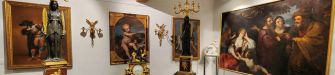
| A room at the Museum Ludwig in Cologne |
For the library, the restrictions are even more important: compulsory advance reservation, advance request for the texts to be consulted, and maximum consultation time allowed of no more than three and a half hours. Based on what was my personal experience (I managed to consult, scan, photograph more than twenty requested books in those three and a half hours) there were no more than five people in the time slot I reserved. I had no contact of any kind, books were already there when I arrived, distance of more than 2 meters with other researchers, in short, almost impossible contagion.
Why, then, further harm the local cultural world (the converse can be applied in general) by requiring a negative anticovid test performed in the twenty-four hours prior to my arrival at the museum or library if the conditions of contagion are minimal? Why make the situation in the cultural sector even more complex than it is after months of downtime? Why continue to harm independent workers in this sector (guides, security personnel, staff who are dedicated to pedagogical activities?) Why is it thought that culture is leisure time, that people do not need it, that being a researcher, even in highly civilized and avant-garde Germany, is a hobby and not a job? Why allow German vacationers to fill Lufthansa and Eurowings flights to Majorca (yes, you read that correctly!)? The impression one continues to give, especially to the younger generation, is that of culture (theaters, museums, libraries, archives, cultural centers of any kind) is on the one hand something one can do without, on the other hand, that it is the favorite incubation place of the coronavirus: at least the virus knows that culture is contagious and that it serves a purpose!

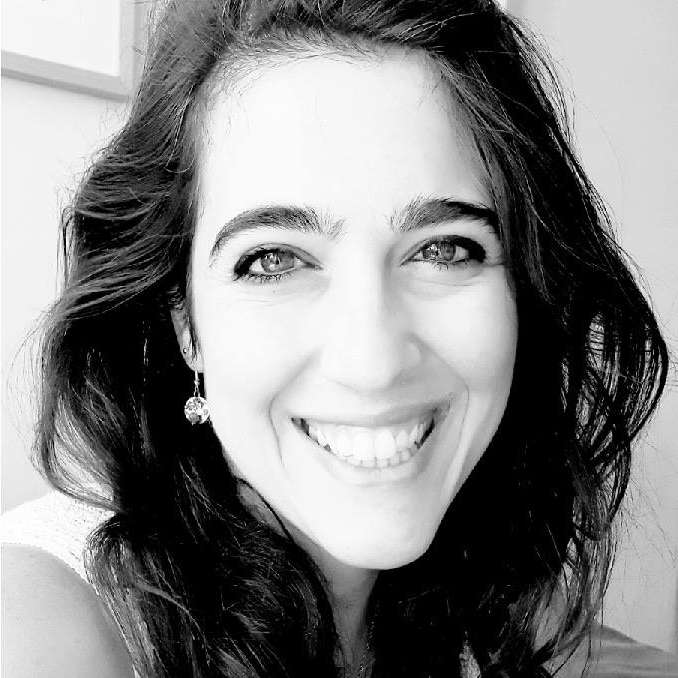
The author of this article: Francesca Della Ventura
Ha studiato storia dell'arte (triennale, magistrale e scuola di specializzazione) in Italia e ha lavorato per alcuni anni come curatrice freelancer e collaboratrice presso il Dipartimento dei Beni Storici, Artistici ed Etnoantropologici del Molise (2012-2014). Dal 2014 risiede in Germania dove ha collaborato con diverse gallerie d'arte e istituzioni culturali tra Colonia e Düsselorf. Dallo stesso anno svolge un dottorato di ricerca in storia dell'arte contemporanea all'Università di Colonia con una tesi sul ritorno all'arte figurativa negli anni Ottanta in Germania e Italia. Nel 2018 è stata ricercatrice presso l'Universidad Autonoma di Madrid. Ha scritto sull'identità tedesca e italiana nell'arte contemporanea e nella politica, sul cinema tedesco e italiano del dopoguerra e grazie a diverse borse di studio D.A.A.D. ha presentato la sua ricerca a livello internazionale. Attualmente i suoi temi di ricerca riguardano l’arte degli anni Ottanta, in particolar modo quella femminista. Dal 2020 è entrata a far parte del gruppo di ricerca dell’Universitá di Bonn “Contemporary Asymmetrical Dependencies” con un progetto di ricerca sulla costruzione dei nuovi musei e delle condizioni di dipendenza asimmetrica dei lavoratori migranti nell’isola di Saadyat ad Abu Dhabi. Nell'ottobre 2020 ha fondato inWomen.Gallery, galleria online, sostenibile e per artiste. Dal 2017 lavora come giornalista d'arte per la rivista online e cartacea Finestre sull'Arte.Warning: the translation into English of the original Italian article was created using automatic tools. We undertake to review all articles, but we do not guarantee the total absence of inaccuracies in the translation due to the program. You can find the original by clicking on the ITA button. If you find any mistake,please contact us.



















 IT
IT FR
FR DE
DE ES
ES CN
CN


