





Ferrara is a magnificent and enchanting city: it never fails to offer new thrills to visitors who tirelessly plan their returns to the historic realm of art’s embrace, where they are enveloped by the continuous, almost miraculous resurgence of the treasures of a civilization that is constantly reawakening and renewing itself. Today’s truly sensational example is the revival of Palazzo Prosperi Sacrati: a revival that engulfs the entire city and that—with the joyful astonishment of a long-awaited gift—offers fulfillment to both reason and the senses. But why is Ferrara so beautiful? Our constant longing answers this question: because it is a city that nourishes all our aspirations and every sense of satisfaction we feel at finding ourselves in an ideal place. Regarding the rebirth of Palazzo Prosperi Sacrati—which this summer crowns decades of commitment with civic pride—a brief overview of the city’s history will be helpful.
The year was 1490, and Duke Ercole I, of pure Este lineage, decided on an extraordinary expansion of his city of Ferrara—one so vast, well-planned, and organized that it would profoundly transform the ducal capital and ultimately earn it the title of “first modern city in Europe.” In reality, the Addizione Erculea stands even today as a monumental testament to urbanization, capable of exemplifying every aspect of the social distribution of space and of anticipating the very conditions of residential and functional settlements. Here, a broad civic and popular commitment underpins the planning of traffic flow, transportation, and urban green spaces, yet the indispensable architectural vistas—both functional and aesthetically pleasing—are clearly present, as are the landmarks that lend the city its noble character. All of this was masterfully conceived and defined by the brilliant mind of architect Biagio Rossetti.
The crossroads between Via degli Angeli (now Corso Ercole I) and the key stretch of Via dei Prioni, running from Porta Po to Porta a Mare, remains famous to this day. Note the offset of Piazza Estense—now Piazza Ariostea—which allows the crossroads itself to serve as a focal point without being overshadowed by imposing, obstructing facades. A brand-new cultural ethos capable of inspiring excellent designs imbued with a vibrant energy. Such are the Palazzo dei Diamanti and the Palazzo Prosperi Sacrati; and the Palazzo Turchi di Bagno itself is also part of this movement. The aspiration to a level of royalty began in the Este lineage precisely with the marriage of Ercole I to Eleonora, whose father was King of Aragon and held the crown of Naples. Isabella d’Este, their eldest daughter, who married Gianfrancesco, Marquis of Mantua, in 1490, never forgot her highest and most cherished title: “niece of the King of Aragon.”
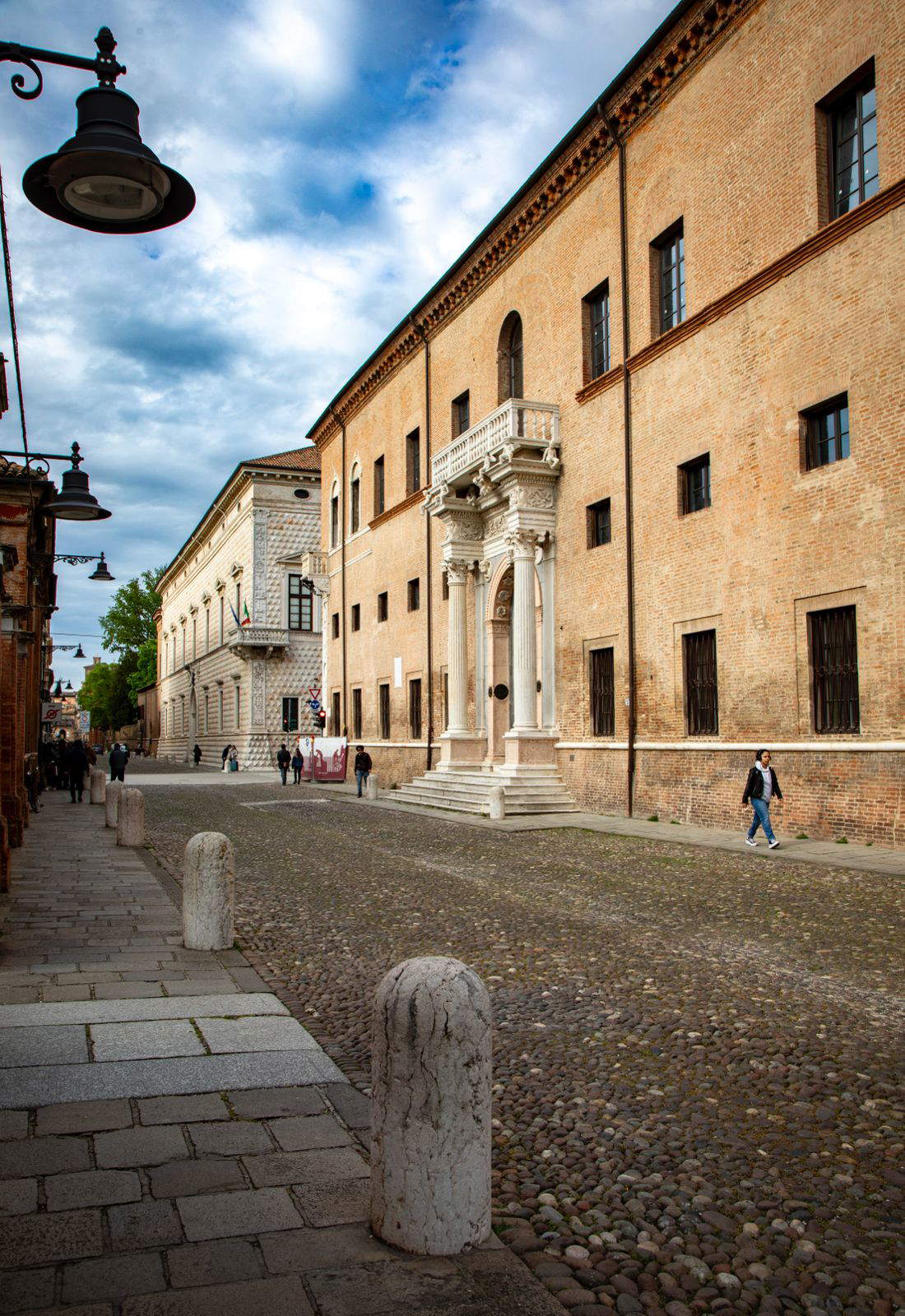
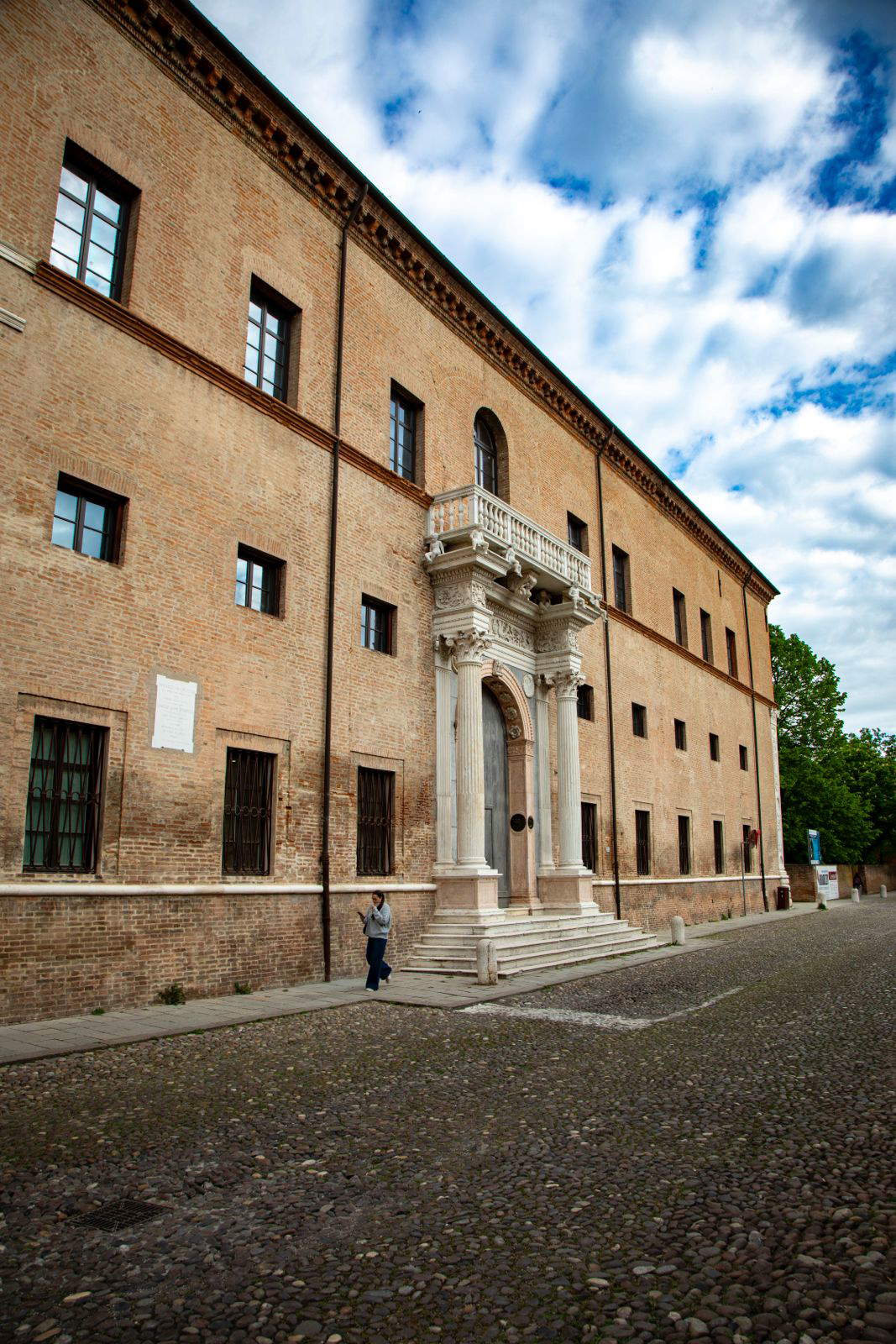
The vision and initiative behind the unique and sublime Palazzo dei Diamanti (1493–1503) came from Ercole I’s brother, Marquis Sigismondo (1433 –1507), who had the freedom and the means to make the glittering mass of a building—entirely clad in “marble diamonds,” which truly “micant ubique” (sparkle everywhere)— triumph over the great crossroads , a structure whose splendor forever proclaims the regal stature of a dynasty. But almost as prodigious was the contemporary construction of the Palace for the Ducal Archiater (today the Prosperi-Sacrati), as it was certainly a lavish residence that rightly sought to reflect a freer, more airy culture, one eager for poetry. And if we consider that Biagio Rossetti (1444–1516) was a close friend of the playwright and Count Nicolò II da Correggio—master of “courtly delights” and cousin of Duke Ercole I, then we can understand the two contrasting aspects of the character of the man who served as the architect—in both concept and execution—for both of these creations. In other words, we realize that the dramatic atmosphere—in the fullest sense of the word—is diametrically opposed and strikingly distinct between a “royal” palace and one dedicated to an open, theatrical, and poetic culture. Here, in the enigmatic juxtaposition of the two palaces, we can grasp the vastness of Rossetti’s Renaissance thought, which found in Ferrara a crucible of the highest-level research and of varied, precise creations.
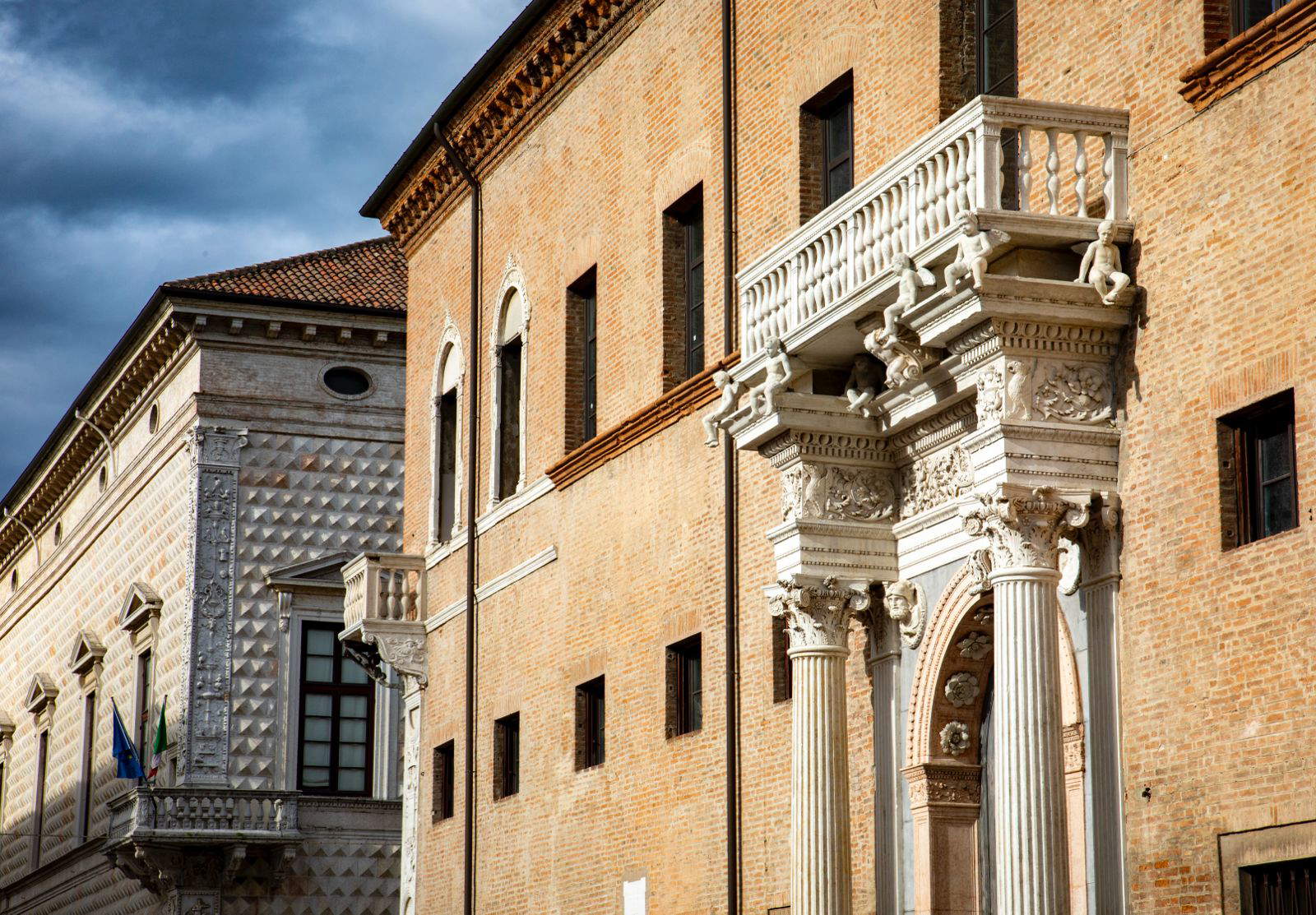
The palace for the court physician Francesco Castelli was begun around 1493 by Biagio Rossetti and partially renovated by him in the first decade of the sixteenth century. Bruno Zevi’s study, in his extensive monograph on Rossetti (Einaudi, 1960), highlights the two distinct characteristics: the dazzling brilliance of the diamond-cut marble gems on the side marking the arrival of a symbolic path, all balanced within a celebratory urban vision, and that continuity of a distinct humanistic imprint—medical and corporeal science—which was meant to accompany and almost underpin the highest note ofthe pristine appearance of one of history’s greatest architectural masterpieces. Thus, Palazzo Prosperi-Sacrati stands with an opaque stereometry, entirely dedicated to terracotta, softening the visual path toward the Porta degli Angeli, yet at the same time offering the surprising wonder of its own portal. Regarding the windows and that sense of incompleteness that persists on the façade, we must remember that the patron died very soon after, in 1511, and work was suspended.
The marble portal stands as a magnificent creation, presenting an entrance that exceeds all expectations and never fails to enchant visitors. This harmonious blend of noble marbles and classical architectural forms—a blissful invitation—reaches out onto the street and surpasses all expectations in the most delightful way. It is the ever-fascinating union between the sermo umilis of the brick facade—which connects to the city—and the joyful soaring of the white Apuan marble, inspired by Venice yet rooted in the commanding spirit of the Renaissance. The distant echo of the lagoon inspired Agnelli’s phrase, echoed by Paolo Ravenna (1926–2012), the great lover of Ferrara’s beauties, when he said that one should always imagine arriving by gondola around the carved steps of this entrance, on a starry night, amid the lapping of the waters. So here too, “theater,” as Nicolò always proposed and as Ferrara always demands.
We should not, therefore, overlook even a simplified examination of what is, without exaggeration, one of the most beautiful portals in the world. The entire conceptual framework revolves around the theme of triumph: yet it is a joyful and shared triumph, a celebration of life that begins with a gentle allusion, with a hint of wise and friendly spirits, and which ultimately turns our gaze toward a sky filled with celestial inhabitants, among whom we ourselves may be welcomed to contemplate the currents of life, between an earthly path and a heavenly one, just as the magnificent builders intended.
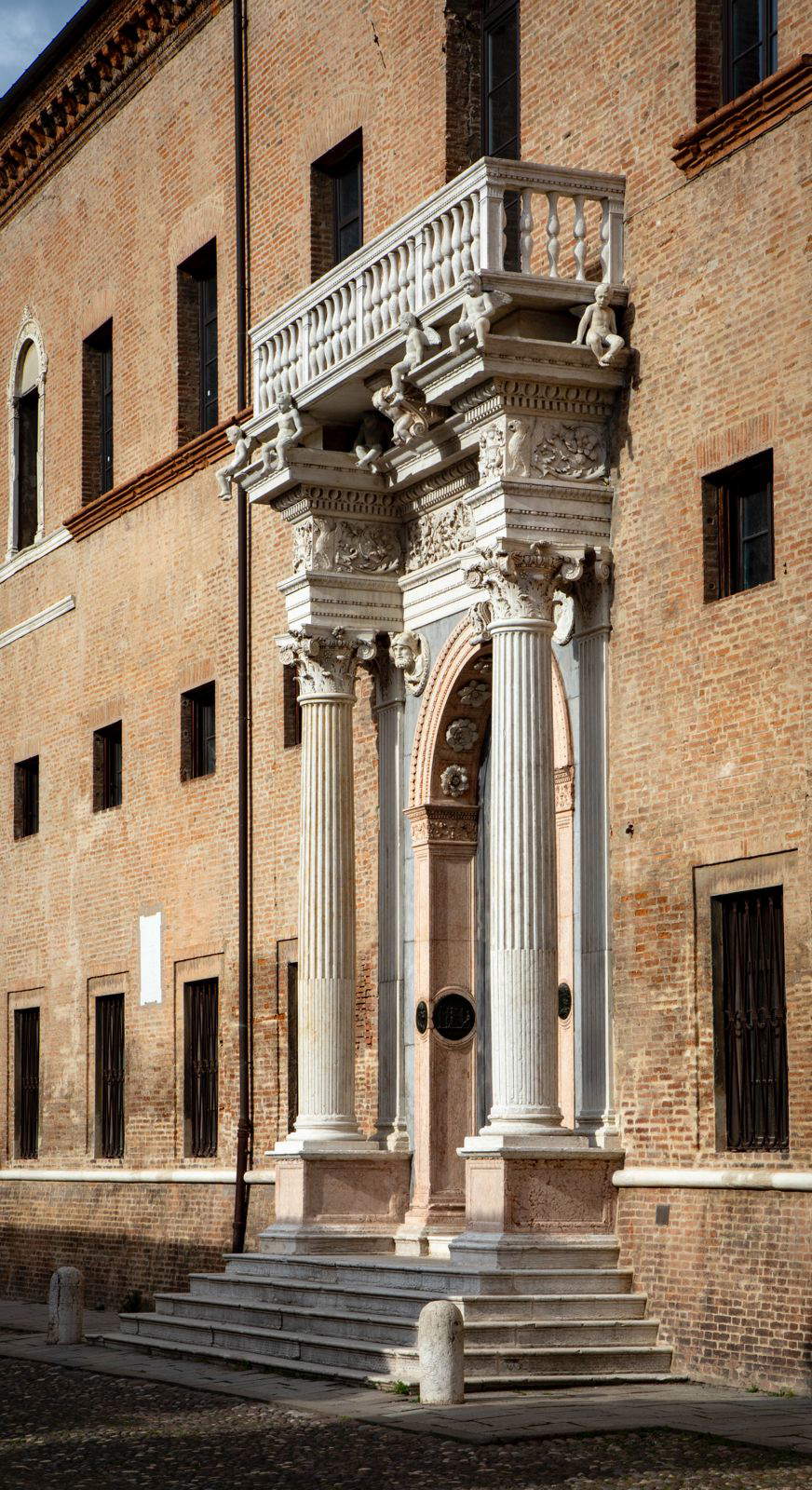
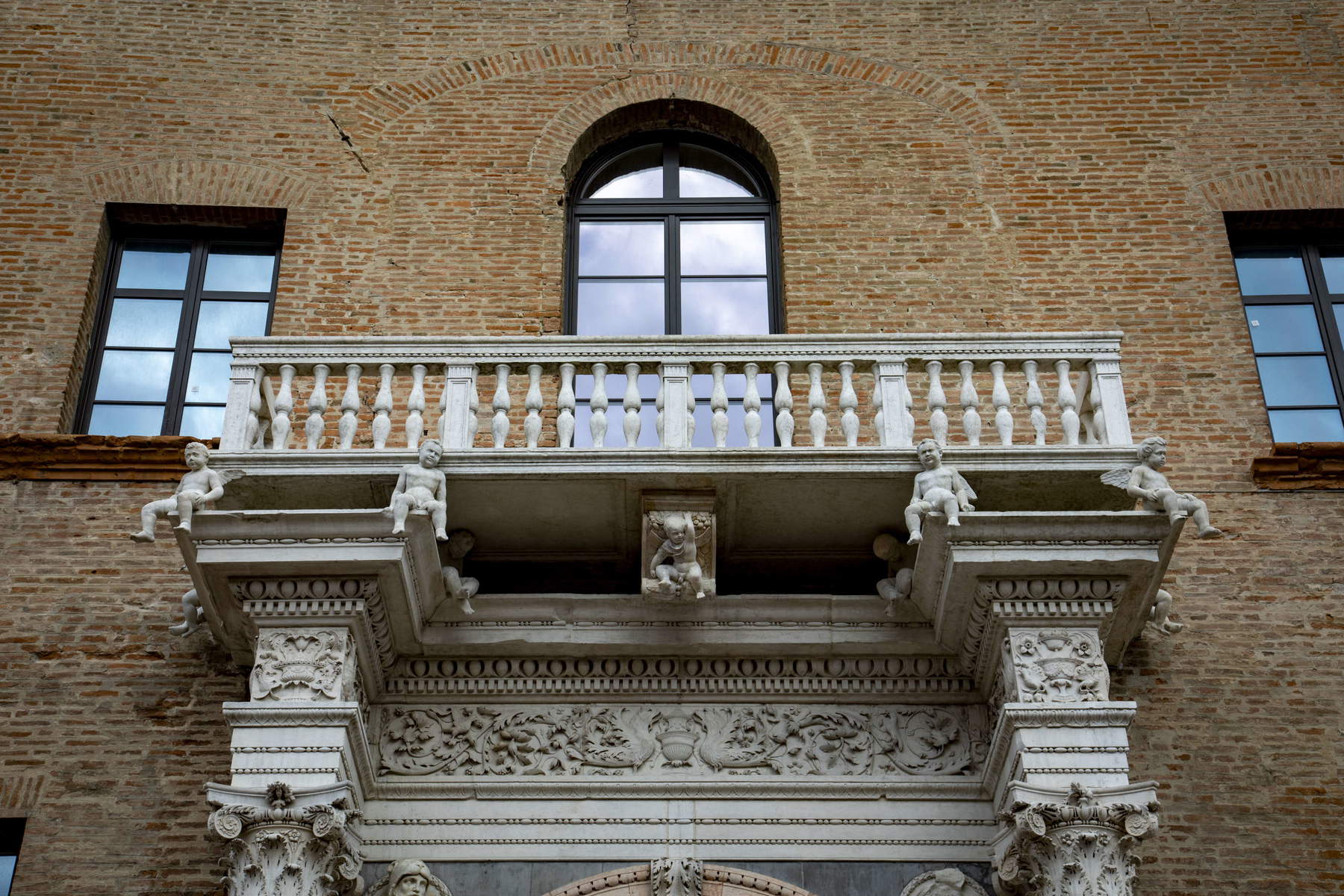
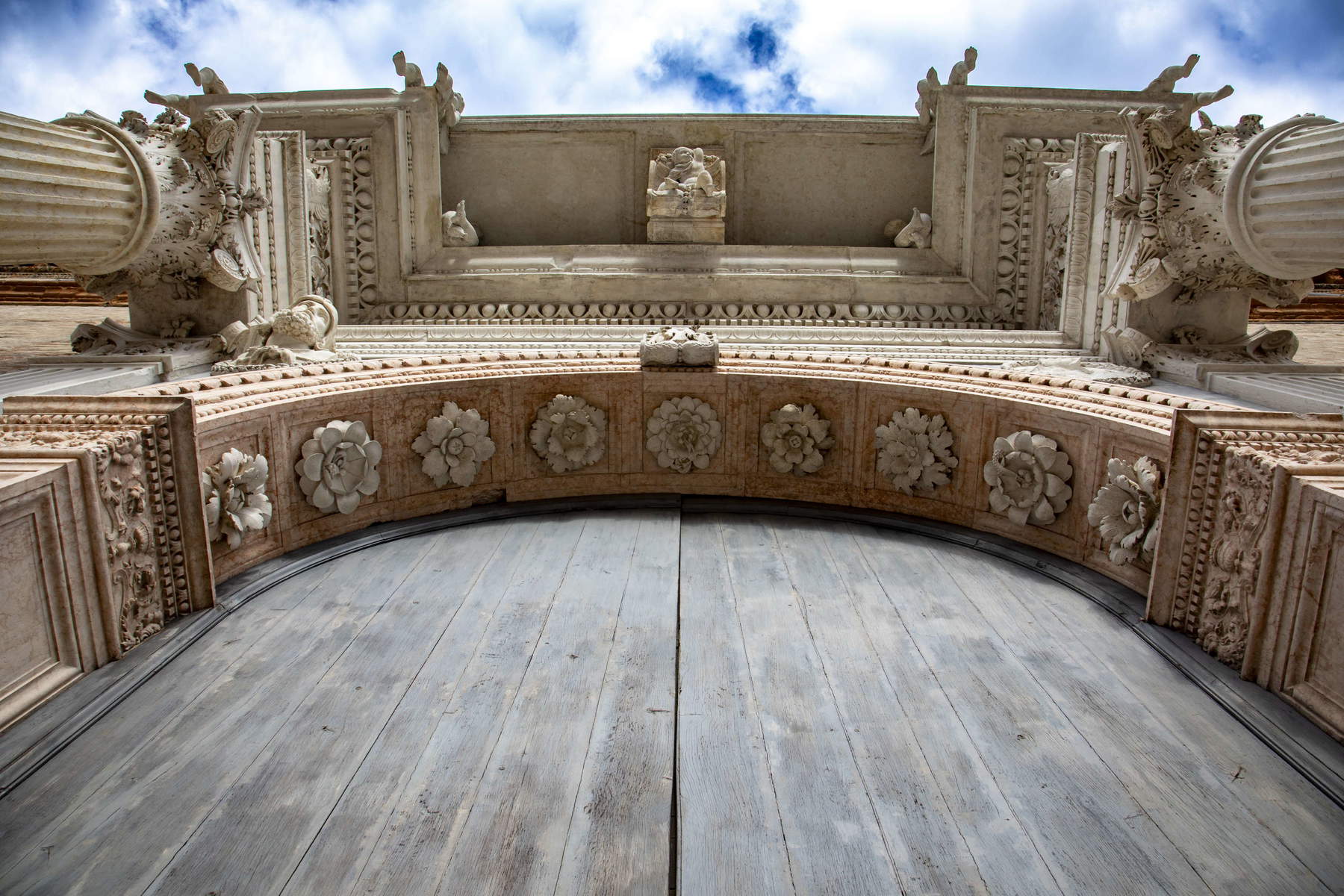
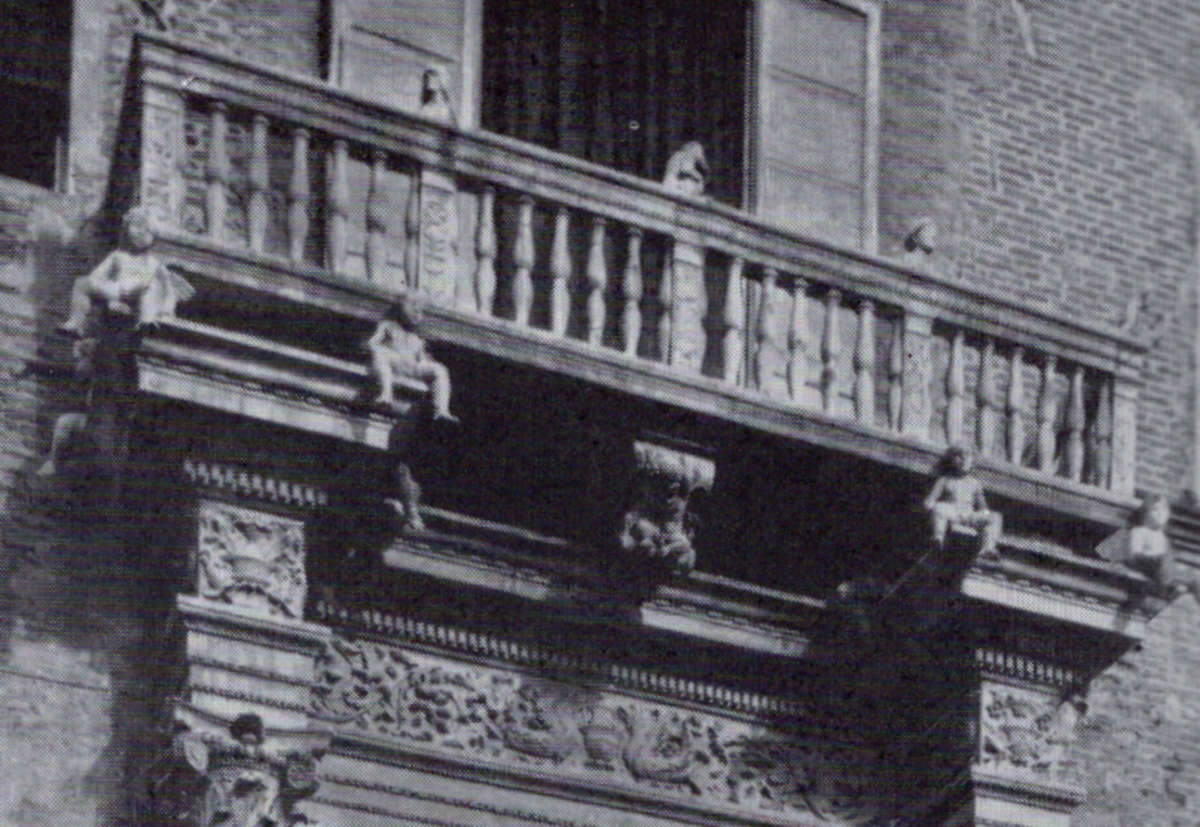
And now it is up to the visitor to appreciate the entire restoration project, led for years by a mayor like Alan Fabbri and carried out by the architectural firm Zermani e Associati, where all the expertise and meticulous attention to detail required by such an undertaking were applied. A masterful restoration that culminated in the achievement of that renewed functionality (the term is key) that was intended to be vibrant. A restoration worthy of applause for a revival that has traversed every stage of the palace’s architectural and organic history, from the genius of Biagio Rossetti to the interventions of subsequent centuries (so many and of such significance in the interior, including the spiral staircase, monumental) right down to the exquisite garden that truly does justice to the poetic Ferrarese character of the entire complex.
Starting today, the Palace—equipped with all lighting and thermo-hygrometric systems, and functioning as an exhibition space in its own right—becomes a multifaceted venue for any cultural event or exhibition. Thus, Ferrara is increasingly establishing itself as a premier venue for genius and art, at the highest European level.

The author of this article: Giuseppe Adani
Membro dell’Accademia Clementina, monografista del Correggio.Warning: the translation into English of the original Italian article was created using automatic tools. We undertake to review all articles, but we do not guarantee the total absence of inaccuracies in the translation due to the program. You can find the original by clicking on the ITA button. If you find any mistake,please contact us.




















 IT
IT FR
FR DE
DE ES
ES CN
CN


