




When one thinks of Michelangelo Buonarroti ( Capri, 1475 – Rome, 1564), one’s imagination inevitably turns to the great masterpieces that have shaped the history of Western art. The Vatican Pietà housed in St. Peter’s Basilica, the David sculpted for Florence and now in the Accademia Gallery, the frescoes in the Sistine Chapel, and the monumental architectural works he designed in the final decades of his life: all masterpieces that have helped shape the image of an almost superhuman artist, a divine creator, recognized as such even by his contemporaries—a genius capable of mastering marble, painting, and architecture as few others in history have done. Yet, alongside this monumental and extraordinary dimension, there existed—as we can well imagine—an everyday Michelangelo, shaped by simple habits, household chores, and practical necessities. This is the side of Michelangelo that emerges from his private correspondence. However, it is not just his letters. A document as humble as it is precious also reveals this lesser-known side of the artist: a shopping list written in his own hand over five hundred years ago.
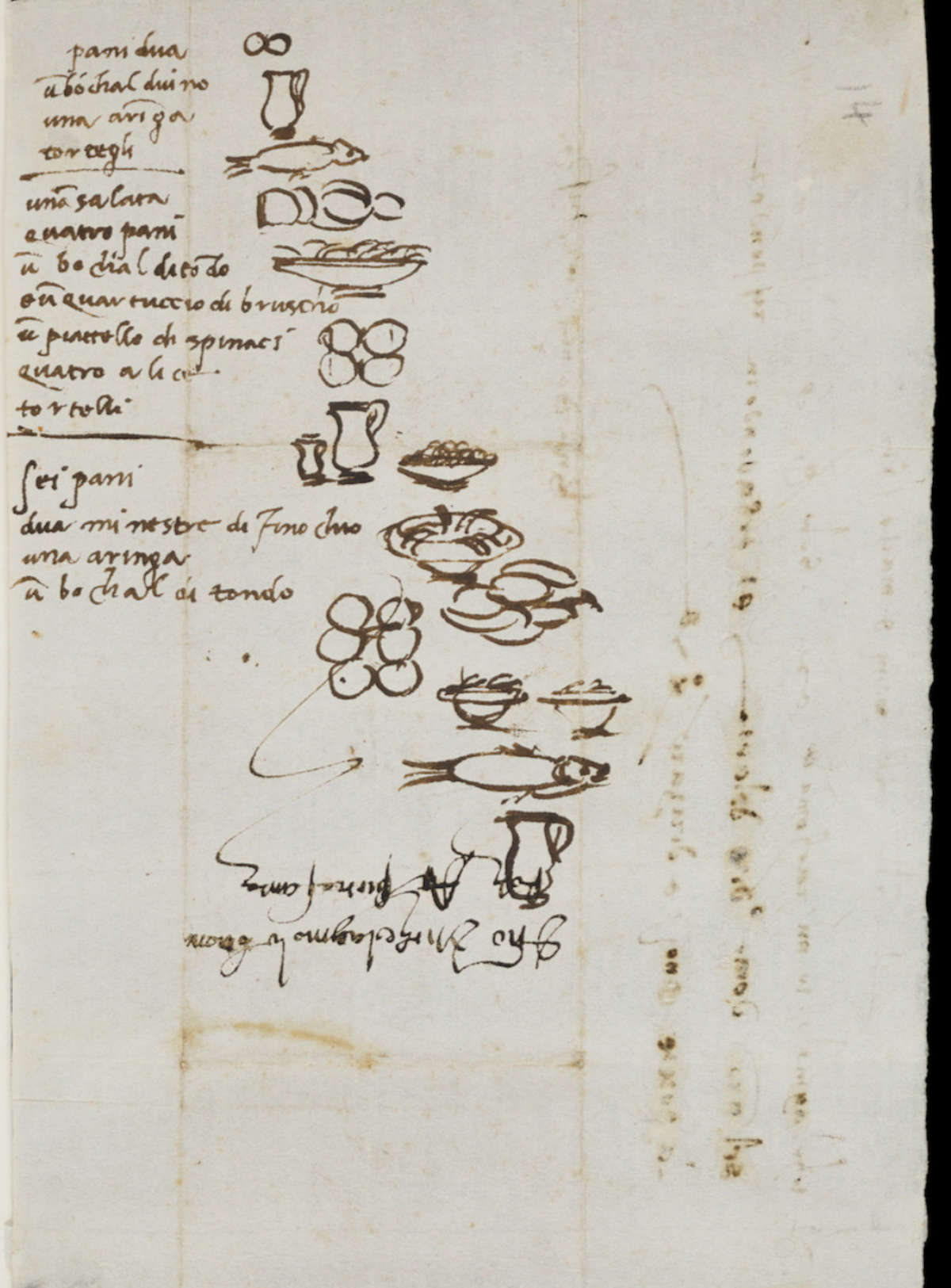
The manuscript containing this curious—and, incidentally, illustrated—shopping list is preserved in Florence, at Casa Buonarroti, among the papersof the Buonarroti Archive, one of the most important private archives related to a Renaissance artist that has survived to this day. Its archival reference is AB, X 578v. It is an apparently ordinary sheet of paper, written on the back of a letter received from a nobleman with whom he corresponded, Bernardo Niccolini, on May 13, 1517, and used by Michelangelo in 1518 to jot down a list of food items to purchase.
Despite its simplicity, the document is an exceptional historical record. Very few great Renaissance artists have left us such direct and spontaneous traces of their daily lives: while letters, contracts, and official documents allow us to follow Michelangelo’s major professional endeavors, this shopping list, on the other hand, offers a glimpse into a private and domestic dimension that is rarely documented.
The extraordinary wealth of Michelangelo’s correspondence allows scholars to follow many phases of the artist’s life almost day by day. Through letters, notes, receipts, and various annotations, we see not only events related to his works but also his financial concerns, family relationships, administrative matters, and the most ordinary aspects of life; we can even gain insight into Michelangelo’s temperament, which was certainly not the easiest to deal with. The shopping list belongs precisely to this category of seemingly marginal documents which, when examined closely, allow us to better understand the concrete reality experienced by the artist.
At the time the document was written, Michelangelo was engaged in one of the most ambitious undertakings of his career: the design of the façade of the Basilica of San Lorenzo in Florence. The work had been commissioned by Pope Leo X, a member of the Medici family, and was intended to transform the Medici church into one of the most extraordinary monuments of the Renaissance. Although the project was never completed, it kept the artist occupied for several years, forcing him to travel frequently between Florence, Rome, and the marble quarries along the Tuscan coast. It was precisely during this intense and complex period that Michelangelo jotted down on a sheet of paper a list of food items necessary for running his household. The text lists bread, wine, fish, vegetables, and other everyday items, offering a rare firsthand account of the artist’s dietary habits: “Two loaves of bread / A jug of wine / A herring / Tortelli / A salad / Four loaves of bread / A jug of tondo / A small quart of bruscho / A small plate of spinach / Four anchovies / Tortelli / Six loaves of bread / Two bowls of fennel soup / A herring / A jug of white wine.”
And what truly makes this document famous is a particular detail. Next to the names of the foods, Michelangelo drew small sketches depicting the listed items. Bread, fish, bottles, and other foods are rendered with just a few quick pen strokes. These are, of course, not elaborate drawings or ones intended to be preserved, but rathersimple, functional images. According to scholars, the presence of these sketches could be explained by the need to make the list understandable to a servant who was illiterate or had little familiarity with writing. Through the drawings, the recipient could easily recognize the items to be purchased without having to interpret the written words. This hypothesis makes reading the document even more interesting, since Michelangelo uses here the language he knows best—that of images—even to solve a practical problem of daily life. Drawing, which in his hands was a tool for artistic design and a means of expression of the highest order, becomes here a simple aid to domestic communication. One might also add that even in such an informal context, the artist’s extraordinary graphic skill nevertheless shines through. The small figures sketched on the sheet of paper, in fact, reveal a capacity for synthesis and a confidence in the line that immediately betray the hand of a skilled draftsman.
The content of the list is equally interesting. Translated, the list would read roughly as follows in modern Italian: “two loaves of bread, a mug of wine (a quarter of wine), a herring, tortelli, a salad, four loaves of bread, a quarter of mellow wine, a quarter of dry wine, a plate of spinach, four anchovies, tortelli, six loaves of bread, two bowls of fennel soup, a herring, a quarter of mellow wine.” The repetitions are likely due to the way the list is organized—perhaps a sequence that could correspond to different meals or to several consecutive days. Scholars have noted that the sheet does indeed appear to be divided into distinct sections, probably referring to different times of food procurement.
An analysis of the contents, however, reveals a diet characterized by simple foods typical of early 16th-century Tuscan tradition. Bread plays a central role, as it did in most Italian households of the time. It is accompanied by wine ( of two varieties: “tondo,” a full-bodied wine, and “brusco,” a dry wine), preserved fish, vegetables, and stuffed pasta dishes (tortelli, already widespread at the time). Particularly significant isthe complete absence of meat. This detail has often been interpreted as confirmation of Michelangelo’s proverbial frugality, as described by numerous biographers and contemporaries. However, historians have proposed a more precise explanation: the list was in fact compiled during the Lenten season. In 1518, Easter fell on April 4, and the religious rules in effect at the time imposed dietary restrictions that severely limited meat consumption. In this context, the inclusion of herring and anchovies is perfectly consistent with the dietary customs of Lent. The document thus also contributes to the reconstruction of the religious and social practices of the time: through a simple shopping list, it is possible to grasp the significance of liturgical traditions in people’s daily lives, including those in the most prestigious circles of Renaissance culture.
Michelangelo’s reputation as an austere man, therefore, finds partial confirmation in this document. Numerous accounts, in fact, describe the artist as someone not inclined toward luxury or excess. Despite his professional success and the substantial earnings he accumulated over the course of his career, Michelangelo often maintained a relatively frugal lifestyle, and his shopping list seems to reflect this inclination. None of the items listed can be considered particularly expensive or refined. Rather, they are common foods, easily available and suitable for a simple diet. This is not, however, a rare document: while we do not have many records of Michelangelo’s eating habits, some do exist. For example, there is a note in which Michelangelo writes, likely addressing one of his collaborators: “have them give me a nice, ripe Chotognia pear / bring a little brown sugar / four loaves of bread from the baker / two libras of castrone.” Furthermore, on the back of a letter from 1557, Michelangelo writes that he ate herring, rolls, wine, salad, spinach, anchovies, tortelli, and fennel soup. “The simplicity of food, the natural act of eating—provided it does not go too far and turn into conviviality,” noted the writer Filippo Tuena in his book on Michelangelo, “is always present in the correspondence.”
It should also be noted that, despite appearances, the document suggests a more complex reality. The quantity of goods purchased and the variety of foods indicate, in fact, a considerable level of financial means. Michelangelo was by then an established artist, in demand at the most important Italian courts and by the popes. The expenses recorded on the sheet also suggest the presence of a small household community consisting of servants and collaborators who lived alongside the artist (and the illustrations are particularly revealing in this regard). It is precisely this combination of simplicity and economic well-being that makes the document particularly significant. Michelangelo does not appear as an ascetic isolated from the world, but as a man who manages a household, organizes supplies, and deals with practical matters on a daily basis.
There are, however, those who have offered a different interpretation and viewed this list as a much more sophisticated document than one might think—an almost ironic piece of paper. According to literary scholar Leonard Barkan, these three “menus” are too fragmentary and informal to be considered practical, and in his view, Michelangelo would have recorded his expenses much more rigorously. Barkan, in particular, focused on the context of the list—the back of a letter that has an official, pompous tone, written in elaborate handwriting (one need only look at how the word “Pietrasanta” is written, the place where he was quarrying the marble needed for the San Lorenzo project—a place he had, moreover, gone to reluctantly and almost under duress, since he preferred the quarries of Carrara), and he observed that transforming the back of that letter into a shopping list might have been an ironic gesture—a sort of response that reduces the solemnity of the order to the most basic necessities of daily life. “The shift from a royal summons to a shopping list, from a princely realm of excess to a shop selling basic necessities,” writes Barkan, “might seem an appropriate response when it is not possible to write a direct reply.” And further: “The entire sequence concludes when the final image (the third and largest wine jug, rendered with particularly heavy strokes) overlaps the pre-existing text. In a sense, this collision may signal the artist’s definitive gesture of contempt toward his bureaucratic correspondent.”
Even the illustrations, according to Barkan, are not annotations intended for an illiterate servant—not least because drawings like those on the list would have made it difficult to convey, for example, the quality of the wine. Not to mention that neither words nor drawings can reproduce the taste of bread or wine. “A goal beyond the reach of both pictura and poesis, ” writes Barkan, “in a place where the body possesses its own untranslatable discourse.” It could therefore be, in his view, a reflection on the limits of language and also on those of the image.
From a historical perspective, the manuscript belongs to that vast category of everyday documents that fill the Buonarroti Archive. Far removed from the grandeur of preparatory drawings and official documents, these materials—however one may interpret their meaning—constitute an irreplaceable source for understanding the artist’s real life. Art history often tends to focus exclusively on finished works, major projects, and creative endeavors. Documents such as a shopping list, however, allow us to rediscover a more human and concrete dimension, reminding us that behind every masterpiece stood a person immersed in the same daily necessities shared by people of every era. For this reason, the small sheet of paper preserved at Casa Buonarroti continues to fascinate scholars and visitors alike. In those few lines scribbled hastily and in those simple sketches, a surprising closeness between the present and the past becomes evident. The Michelangelo who orders bread, wine, spinach, and herring suddenly seems less distant from our world than the titan who painted the ceiling and walls of the Sistine Chapel.

Warning: the translation into English of the original Italian article was created using automatic tools. We undertake to review all articles, but we do not guarantee the total absence of inaccuracies in the translation due to the program. You can find the original by clicking on the ITA button. If you find any mistake,please contact us.



















 IT
IT FR
FR DE
DE ES
ES CN
CN


