



by Federico Giannini, Ilaria Baratta 12/06/2026



Categories: Works and artists / Disclaimer
In the basilica of San Pietro in Ciel d'Oro in Pavia, the Ark of St. Augustine, a masterpiece of Gothic sculpture, raises a monument to the saint with more than four hundred carved figures and raccpmta a history marked by enigmas, displacements and rediscoveries. The article by Federico Giannini and Ilaria Baratta.

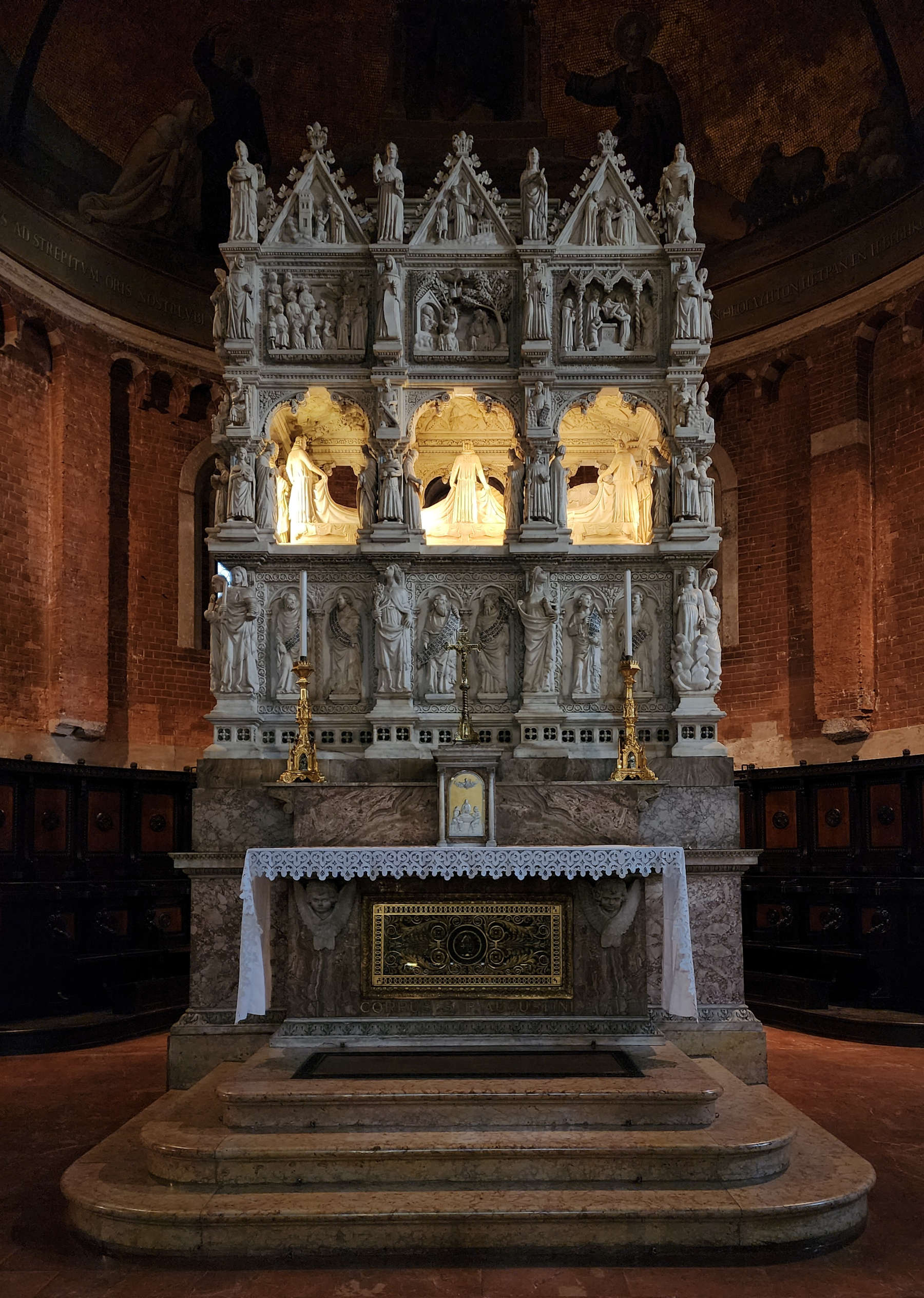
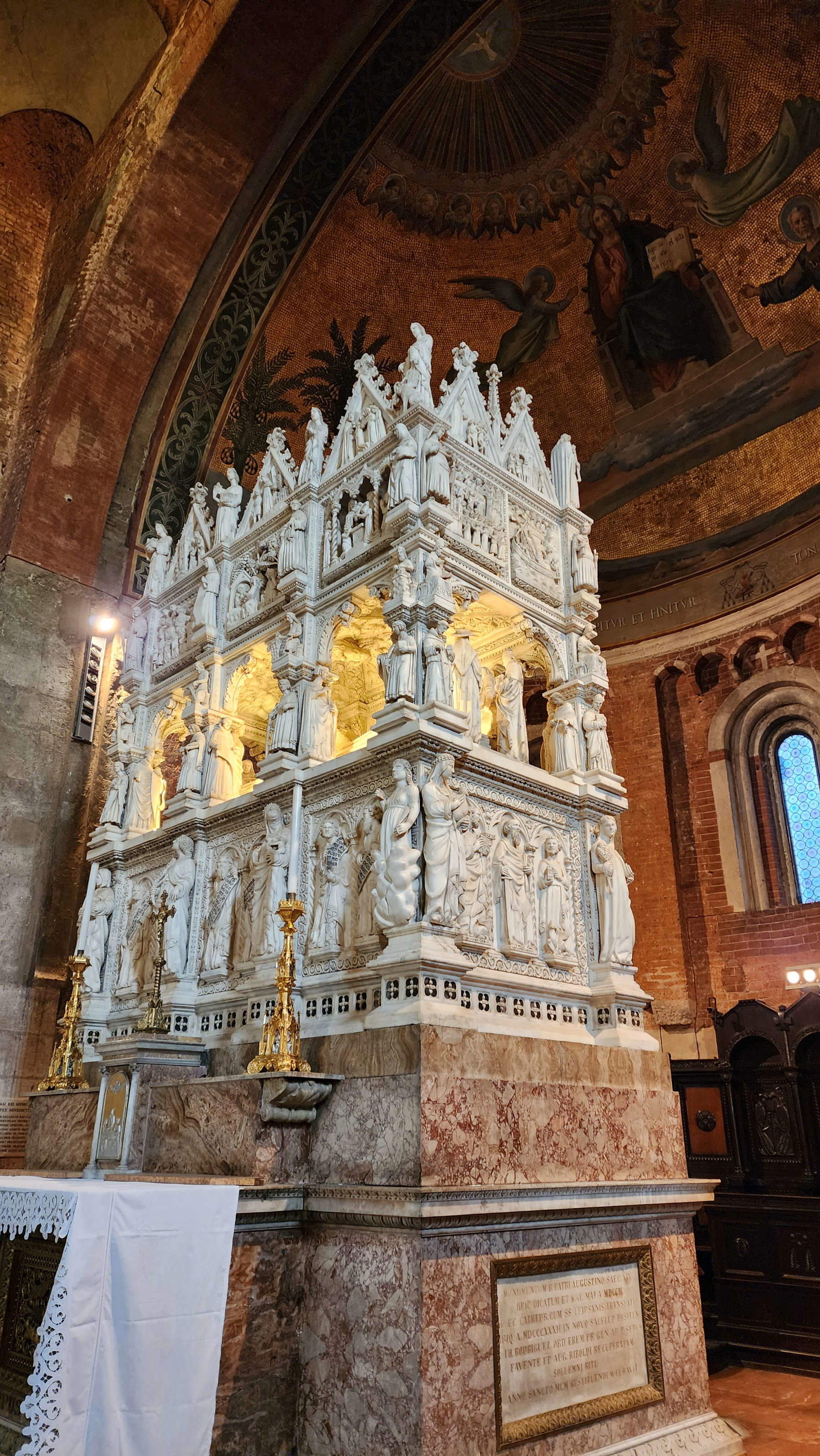
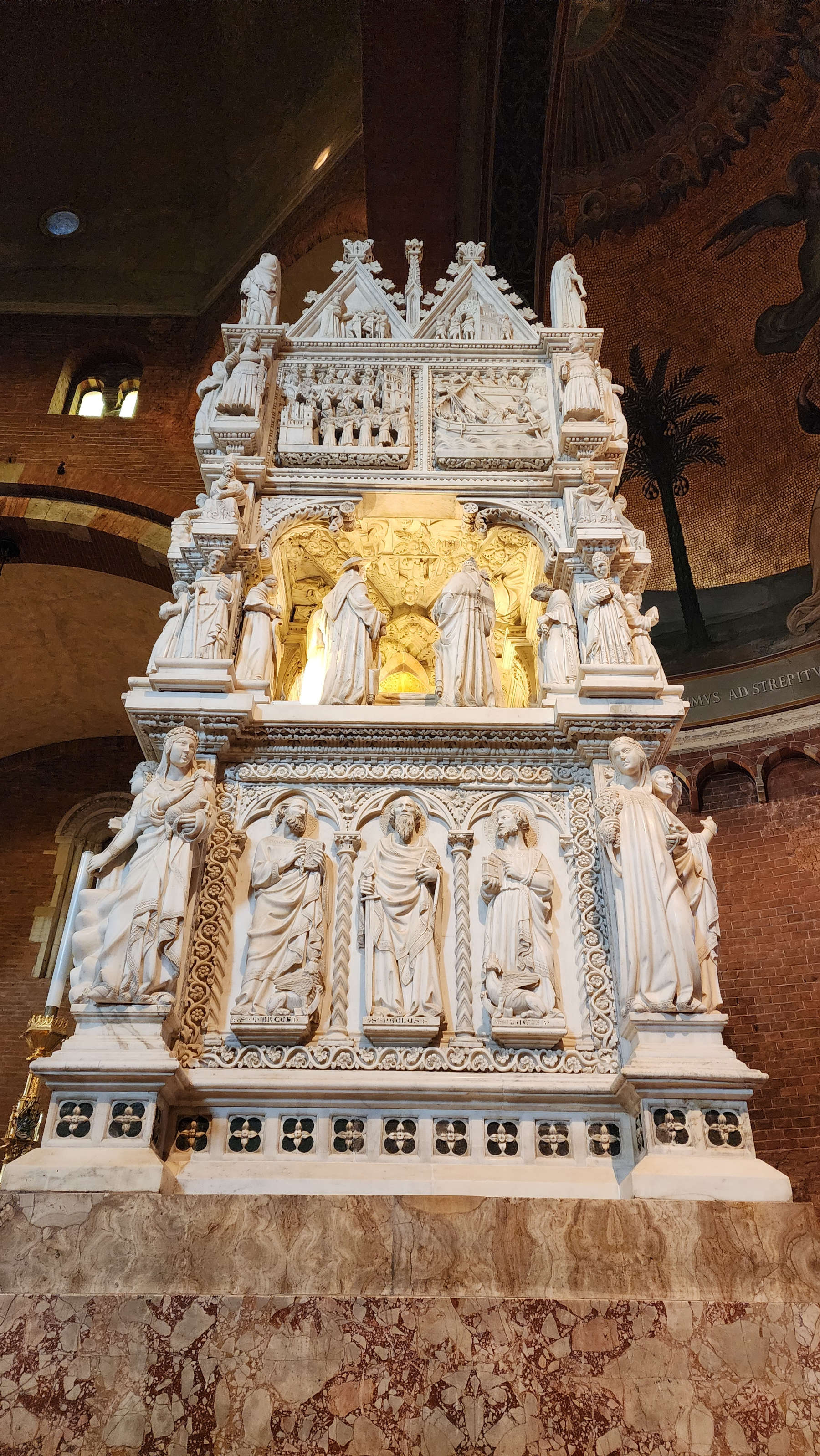
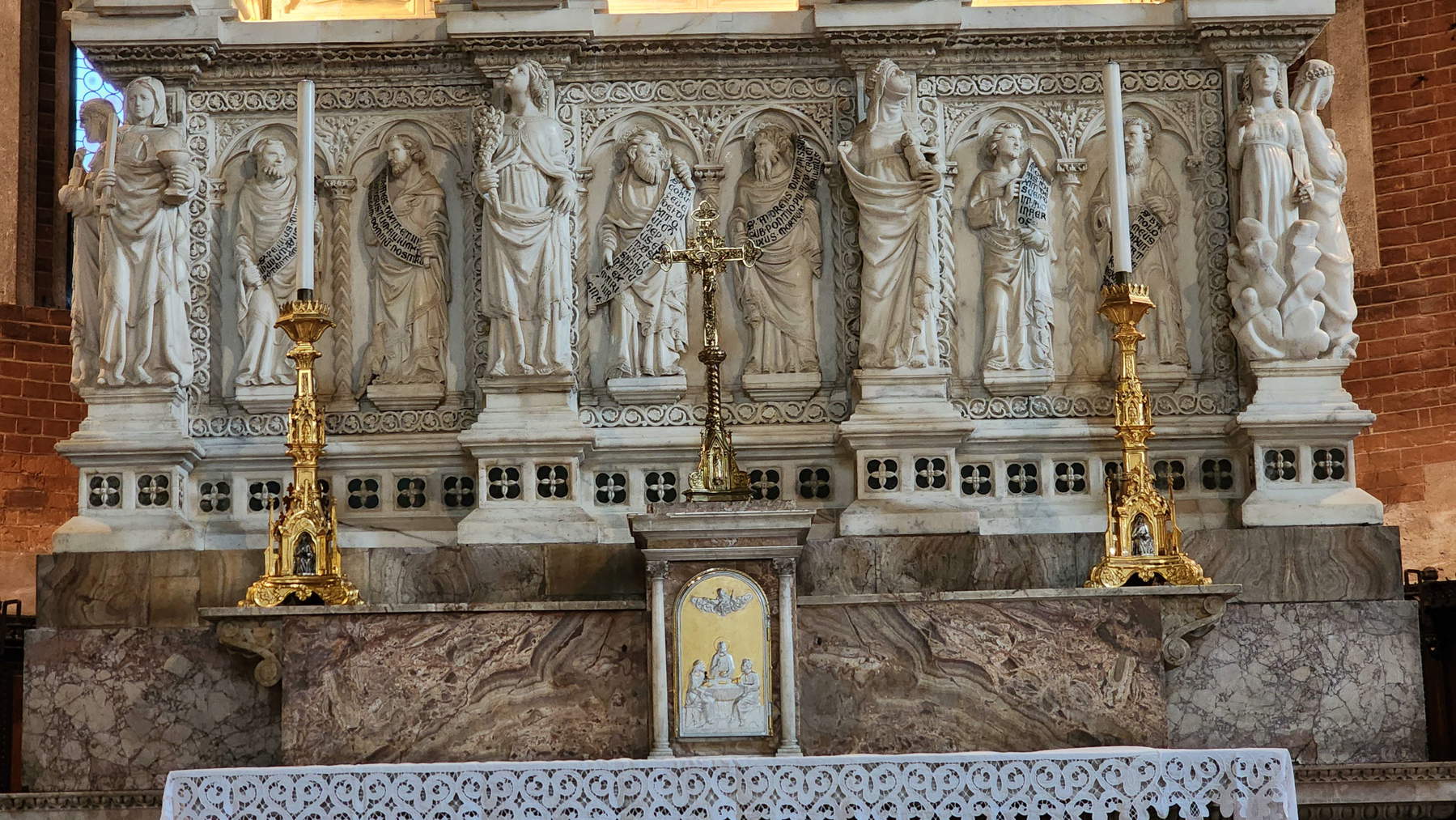
Located in Pavia, inside the basilica of San Pietro in Ciel d’Oro, is one of the pinnacles of Italian Gothic sculpture: theArk of St. Augustine. This imposing cenotaph (i.e., a funerary monument not intended to hold the remains of the deceased, as it should more properly be called, since at the time of the commission the memory of the location of the remains of St.Augustine), made of fine white Carrara marble and Candoglia marble, is not only a large shrine where the saint’s remains are kept, but can be considered a kind of visual encyclopedia celebrating the life and thought of the Doctor of the Church. It is located in the chancel of this basilica that is a symbol of Lombard Pavia but also of Visconti Pavia, in a position that dominates the sacred space, although its current placement above the high altar is the result of an eighteenth-century sensibility that has partly altered the way the Ark was originally seen, raising it to an elevation that makes it difficult to observe the most minute details: the large base on which the Ark stands was in fact commissioned in 1738 and made in Rome.

The work stands as a complex, isolated sculptural machine designed to be admired from all sides, breaking with the tradition of tomb monuments leaning against walls. With its monumental dimensions of more than three meters in height, the Ark houses a universe of more than four hundred figurative elements, including ninety-five statues and fifty bas-reliefs, depicting not only Augustine’s biography but also the system of Christian virtues and angelic hierarchies. Every centimeter of marble has been worked with a technical skill that alternates smooth surfaces with details chiseled with millimeter precision, originating passages of light and shadow, sometimes soft and gradual and sometimes sudden and sharp, which gives a high dynamism to the inert material. The monument develops on several narrative registers, soaring from earth to heaven in a symbolic progression that guides the faithful from the earthly dimension of virtues to heavenly glory. Its original function was to commemorate the figure of the saint, whose remains had been moved to Pavia by King Liutprand in the 8th century, but for long periods the Ark remained a purely celebratory monument, since, as mentioned above, the memory of the exact location of the relics was lost until their fortuitous rediscovery in 1695 (at the time of the translation, the place where the remains were placed was kept secret to prevent theft). Today the Ark also represents an ongoing challenge for art critics, remaining at the center of debates over chronology and attribution that continue to stimulate new research.


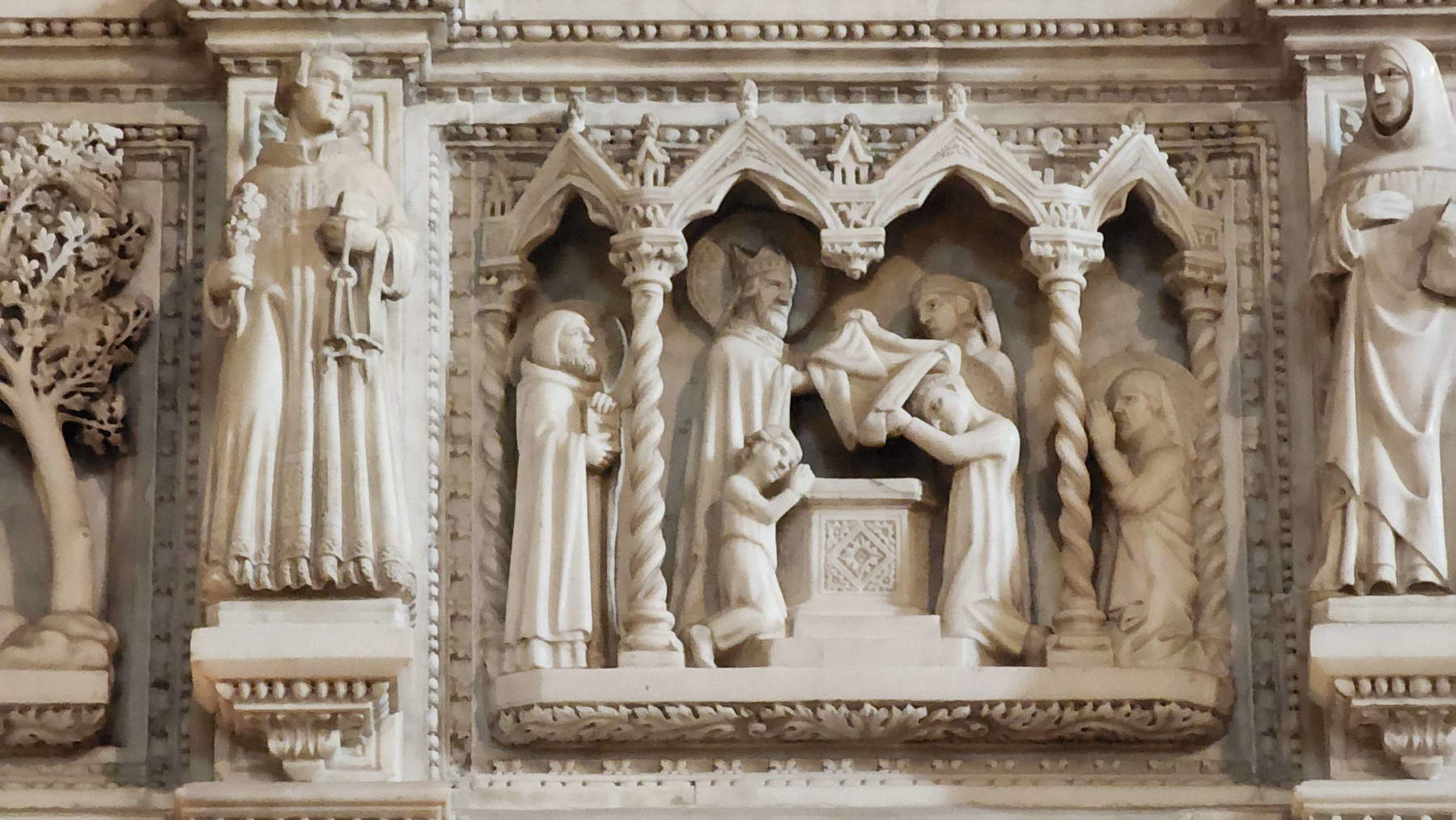
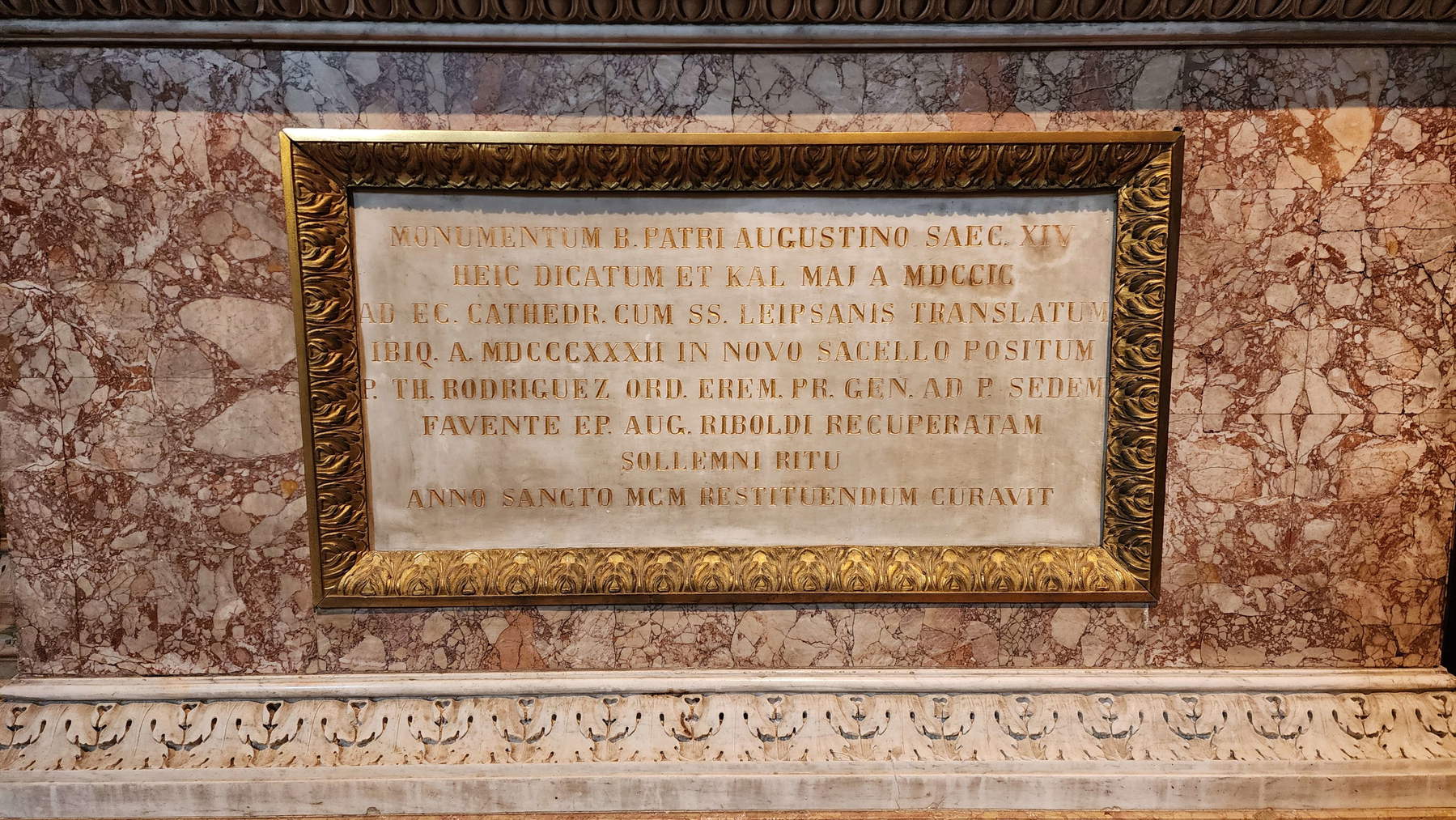
The origins of the Ark of St. Augustine date back to the 14th century: the commission is attributed to the Augustinian hermits, who settled in the basilica in 1327 and desired a monument that could legitimize their bond with the founding saint as opposed to the regular canons already present in the monastery. The main creator of the iconographic program was probably Bonifacio Bottigella, prior of the order and an influential intellectual linked to the Visconti court, and the beginning of the undertaking can be traced back to 1362 on the basis of the inscription on the monument, although a document from 1578, written by a certain friar Antonio da Tortona and centered precisely on the history of theArk (a source judged “very reliable” by Francesca Girelli, a scholar who dedicated a detailed essay to the Ark of St. Augustine in 2020), would seem to fix the beginning of the work around 1350, twelve years earlier than that 1362 mentioned in the inscription. Galeazzo II Visconti, lord of Pavia, would also have been involved in the undertaking, and his involvement was not only political but also financial: the move of the court from Milan to Pavia in 1365 made the basilica of San Pietro in Ciel d’Oro a prestigious burial church for the dynasty, prompting the lord to finance a work that would surpass in splendor the Ark of St. Peter Martyr that had been sculpted in Milan some 20 years earlier (today it can be admired in the Basilica of Sant’Eustorgio). In any case, around 1365 the work must have already been finished at least in large part, according to the sources (a relevant chronological deadline is August 20, 1365, the day on which the base of the Ark would have been transported to the sacristy, indicating that the lower part was finished). Still on the subject of Friar Anthony’s document, that “1350” is not necessarily to be interpreted in another way: the source is in fact known to us only from nineteenth-century transcriptions, and it cannot be ruled out that the friar, by citing a “journal,” that is, a register of payments, beginning in 1350, alludes instead to 1380, the date from which the entries in the surviving volume of accounts actually begin. One can therefore imagine that the operations around the Ark must have lasted until 1380, when the work was completed with the gilding and gates protecting the Ark.
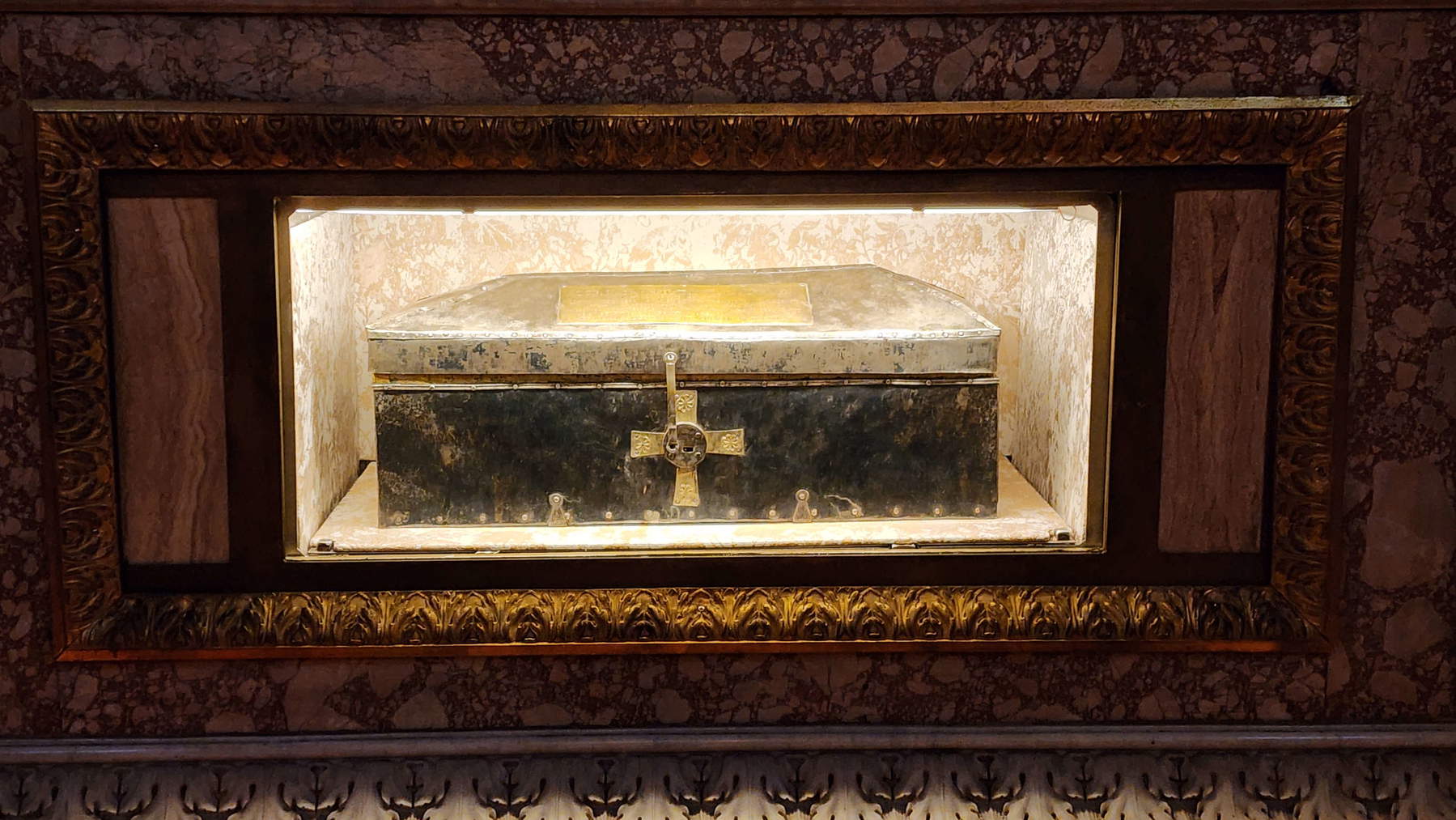
The history of the artifact has been marked by continuous displacements that have endangered its integrity. Initially placed, beginning in 1382, in the lost sacristy of the Hermits, the Ark remained there until 1738, when it was moved to the presbytery. However, the deconsecration of the basilica by decree of Joseph II of Habsburg-Lorraine in 1781 marked the beginning of a troubled period: the Augustinian order had to repair to Milan, and the work was disassembled and transported first to the Gesù church and later to Pavia Cathedral. During these passages, the monument also suffered periods of neglect in municipal warehouses, risking the dispersion of the materials. Only in 1900, after the basilica’s restoration was completed, did the Ark make its triumphal return to San Pietro in Ciel d’Oro, where it was relocated to the position it still occupies today. Particularly significant is the story of Augustine’s relics: hidden for fear of theft in a secret place in the crypt, they were found only on October 1, 1695 during some restoration work. The discovery sparked a long dispute between the Canons and the Hermits over the authenticity of the remains, which was officially resolved only in 1728 by Pope Benedict XIII (today the remains are placed inside a 19th-century urn placed in the basement). The monument we observe today bears the signs of this complex history, including sixteenth- and nineteenth-century restoration interventions that sometimes altered the original arrangement of some statuettes and the physiognomy of certain faces.
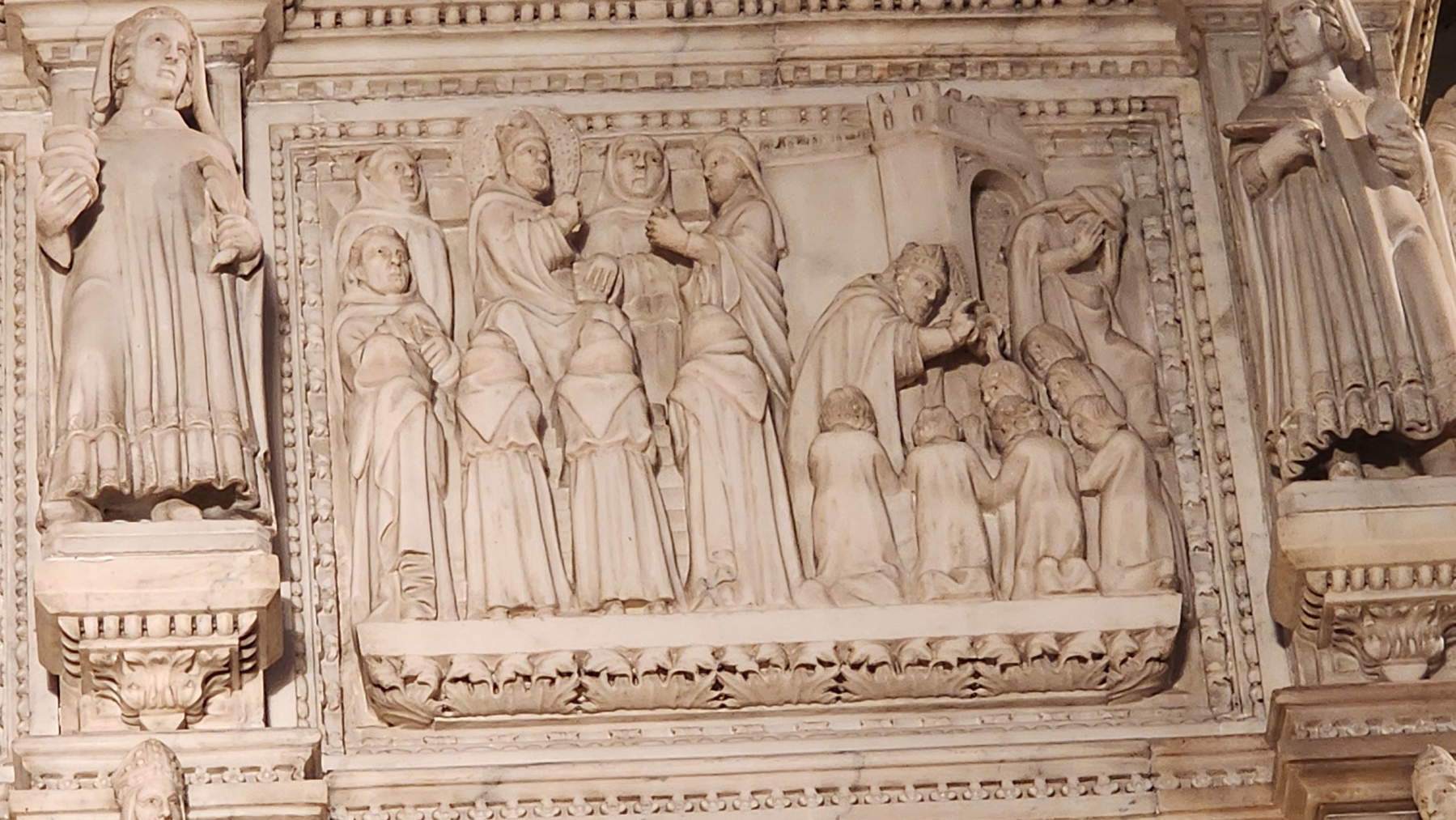
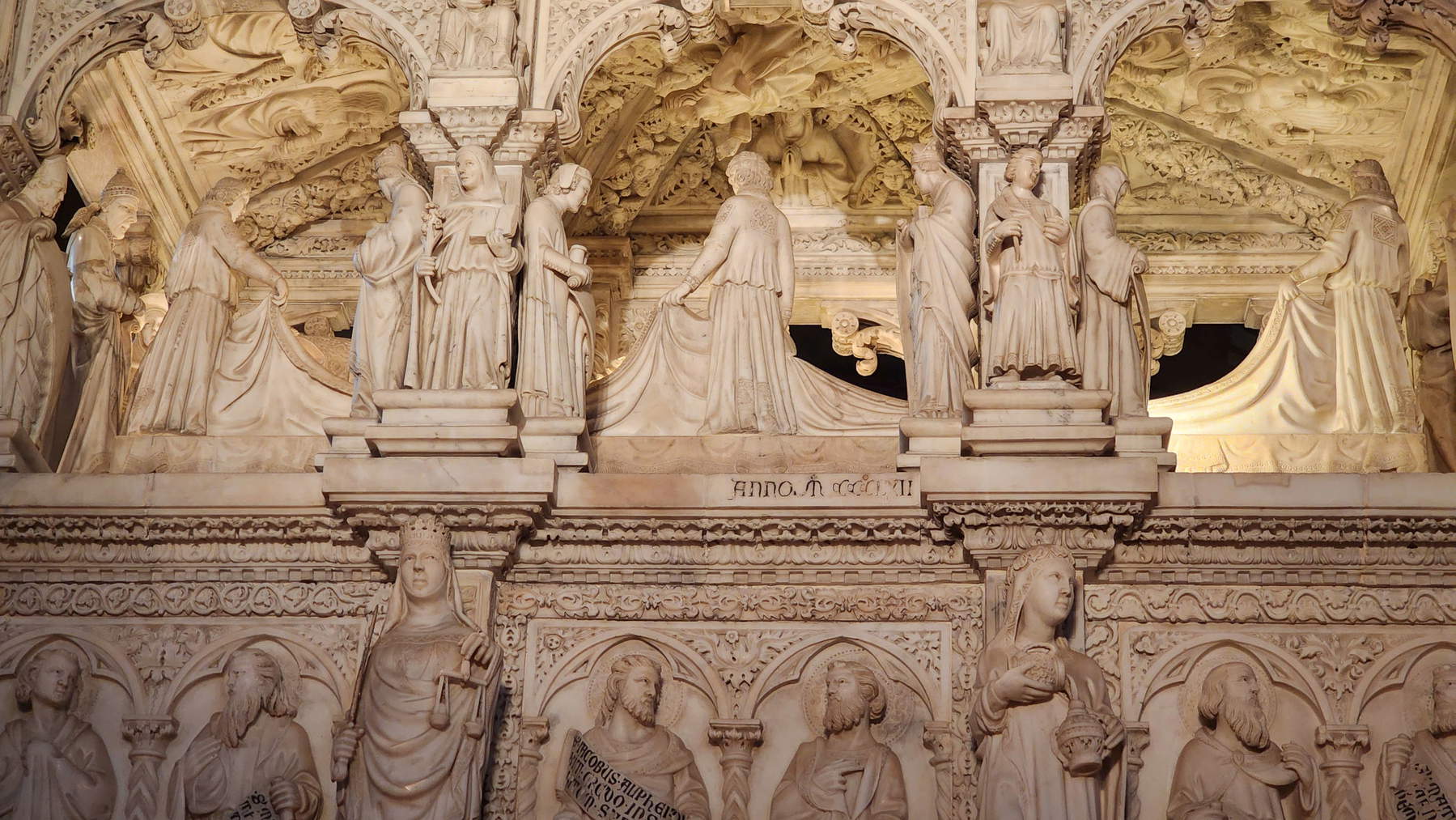
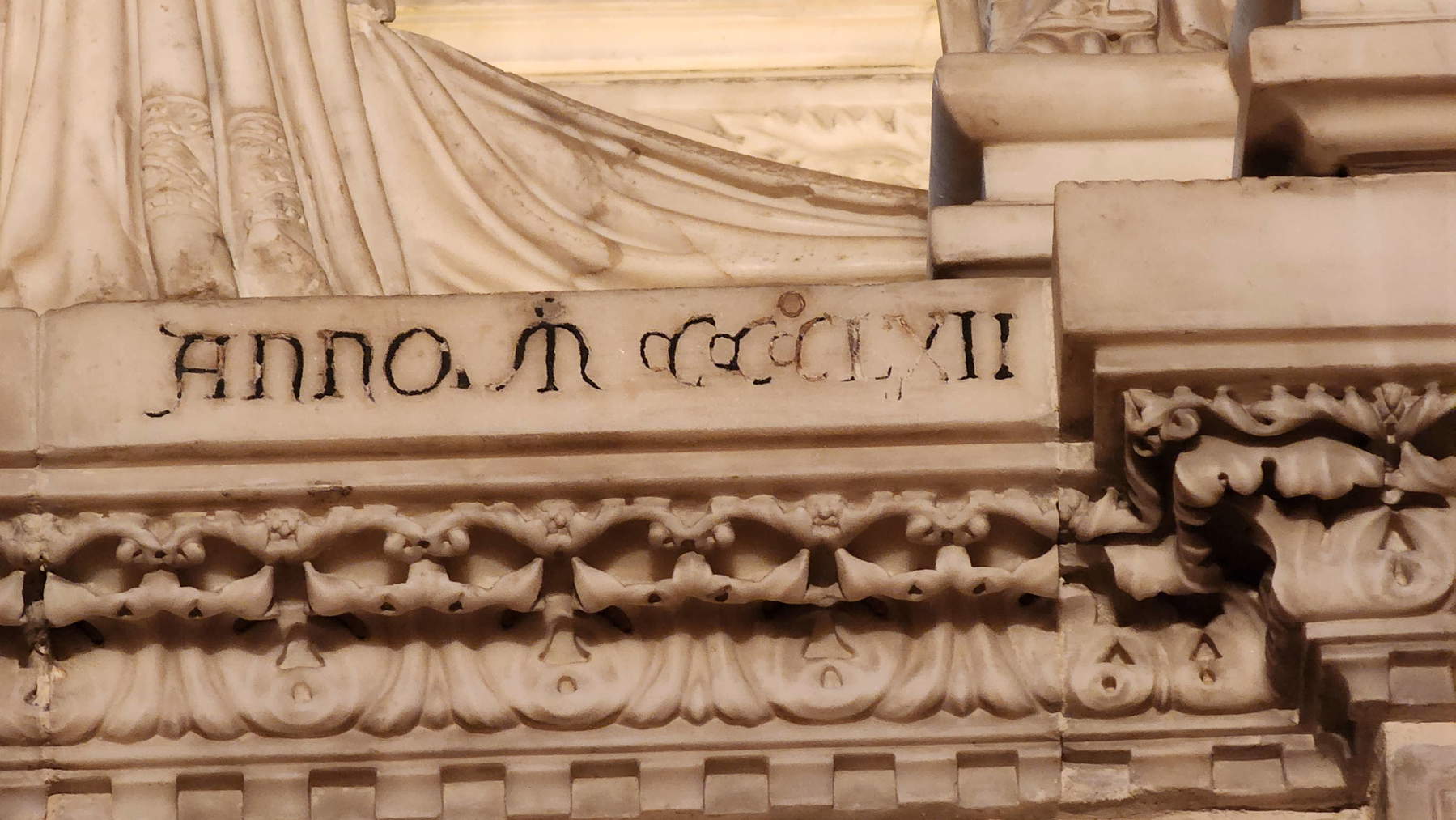
Theattribution of the Ark remains one of the most debated enigmas of 14th-century sculpture. In the absence of direct contractual documents, critics have been divided between those who recognize the work of the Campionese Masters and those who claim authorship by the Pisan Giovanni di Balduccio (Pisa, c. 1300 - 1365). Although the Campionese culture was dominant in Lombardy at that time, recent studies, starting with that of Girelli, tend to confirm the hypothesis that the overall design and direction of the work belonged to Giovanni di Balduccio and his workshop. This conviction is based on stringent stylistic comparisons with the Ark of St. Peter Martyr in Milan, signed by the Pisan master, whose typological layout and many compositional schemes, as well as spatial conception, the Pavia monument traces: “a completely anti-naturalistic and still medieval way of thinking about space, in which,” writes Girelli, “what is behind is displaced above, and the figures scale in height instead of depth, squeezed between an invisible frontal plane and a neutral background that is completely blind and lifeless. The latter differs both from the magmatic one of Giovanni Pisano’s reliefs - from which the figures enter - no and exit in a continuous generation and disintegration of forms - and from the atmospheric and nuanced one of Giovanni d’Agostino; but it also differs from the empirical pro - spective of Andrea Pisano.” Giovanni di Balduccio, documented in Milan until 1349, would continue to work in Lombard territory until at least the mid-1460s, acting as the director of a complex building site. Technical analysis reveals typically Balduccan details, such as the use of filling irises with lead to lend vividness to the gaze and the extensive use of the drill to carve beards and hair, visible, for example, in the figure of the Apostle Philip (“a purely technical means that contributes to the achievement of stylistic effects proper to Pisan and specifically Balduccan sculpture”). However, it can be assumed that the work is the result of the collaboration of several workers coordinated by a single site manager, which would explain the slight qualitative variations between the different registers. While the figures of the Virtues at the base indeed show a refinement that refers directly to the master, some parts of the upper reliefs betray the intervention of helpers, including locally trained lapicides. The Campionese theory, advocated in the past by scholars such as Pietro Toesca, clashed with the Ark’s blatant adherence to the Tuscan language introduced by Balduccio, who was able to combine the lesson of Giovanni Pisano with the needs of the Visconti patronage. The choice of Carrara marble also speaks in favor of the Pisan sculptor, who had the necessary supply channels for such a quantity of fine material. Although Giovanni di Balduccio was now elderly during the final realization, the unity of the architectural design and the overall stylistic coherence make it difficult to imagine an alternative author with such a defined personality.
In any case, the realization probably went on for several decades: in 1399 Gian Galeazzo Visconti ordered in his will that the work be completed, suggesting that some parts, such as the upper crowning, were still unfinished (and indeed even today the crowning is missing). Stylistic analysis of the triangular cusps does not reveal elements typical of the early 15th century, suggesting that the original design from the 1960s was faithfully followed even in the final stages. It is likely that the death of the original site manager slowed down the work, leaving some of the faces of the upper reliefs only sketched out, as is evident from close analysis of some of the miracle scenes. Structural discrepancies between the bases of the columns and the cornice moldings indicate an assembly phase that was perhaps rushed or lacking the supervision of the main author. Ultimately, the most credited time frame for the main construction is between 1362 and 1365, with subsequent completion and finishing work extending into the early 15th century, when the Ark was described as a sublime work (“opus egregium”) at the funeral of Gian Galeazzo Visconti in 1402.
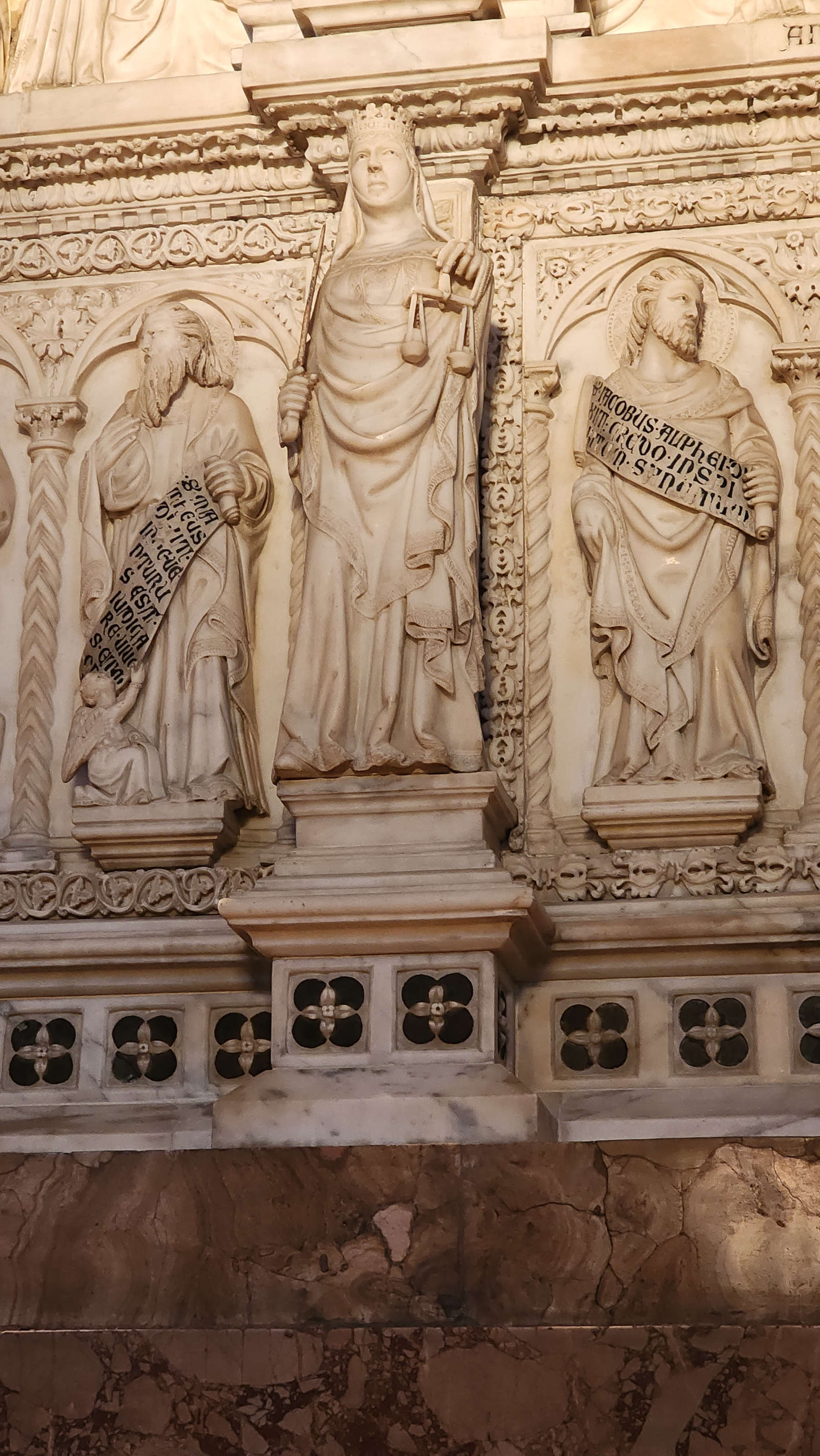
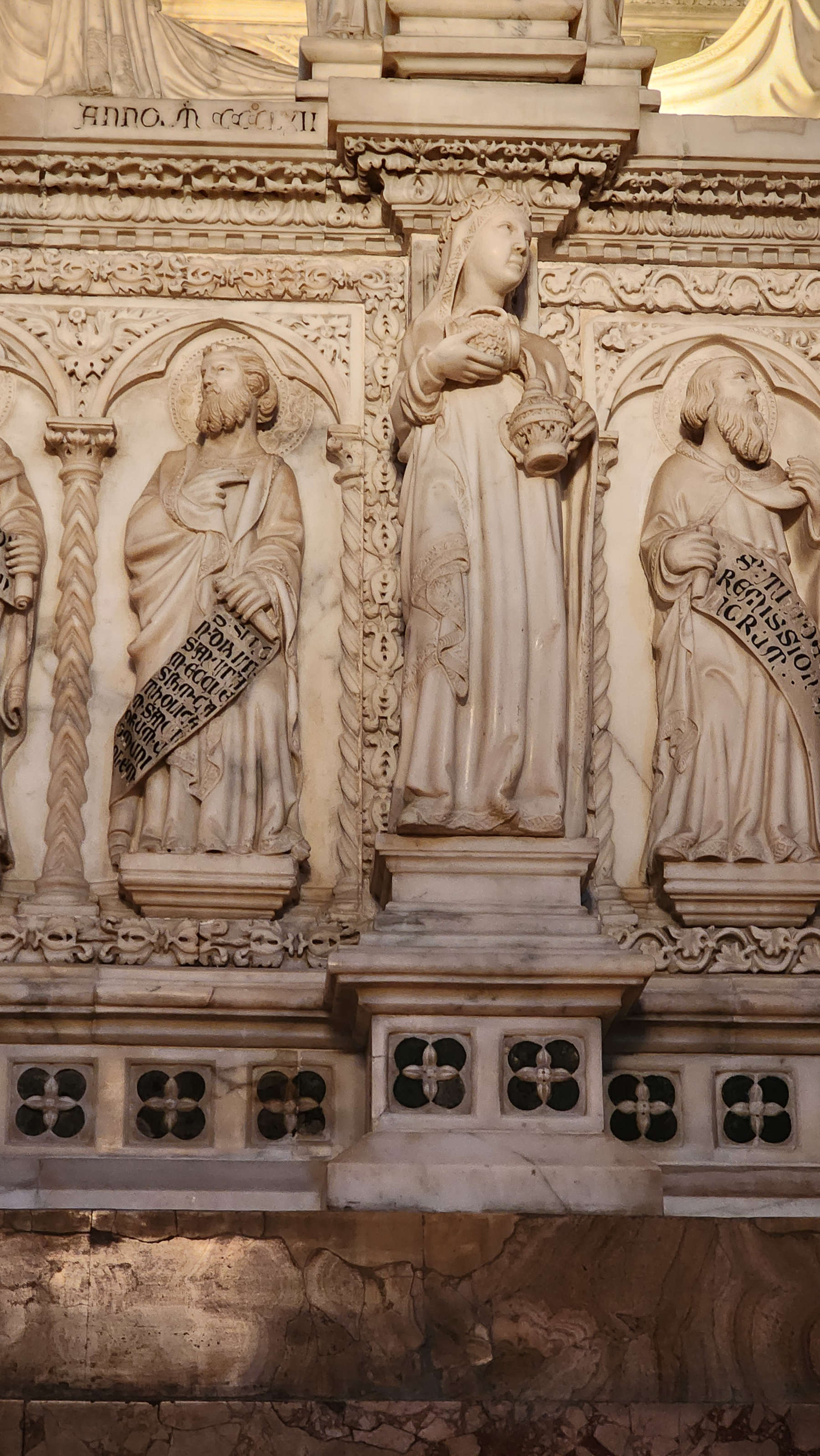
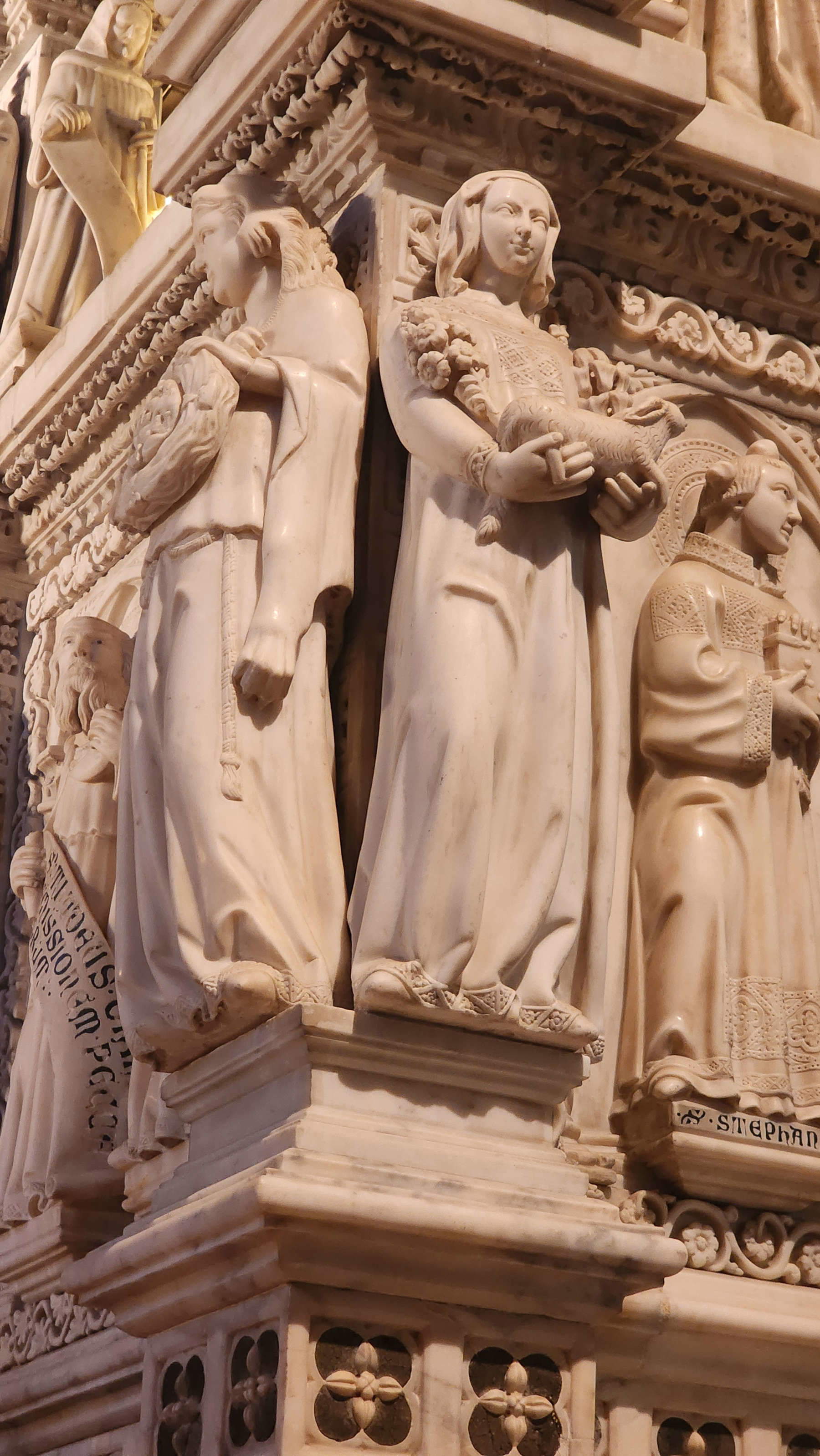
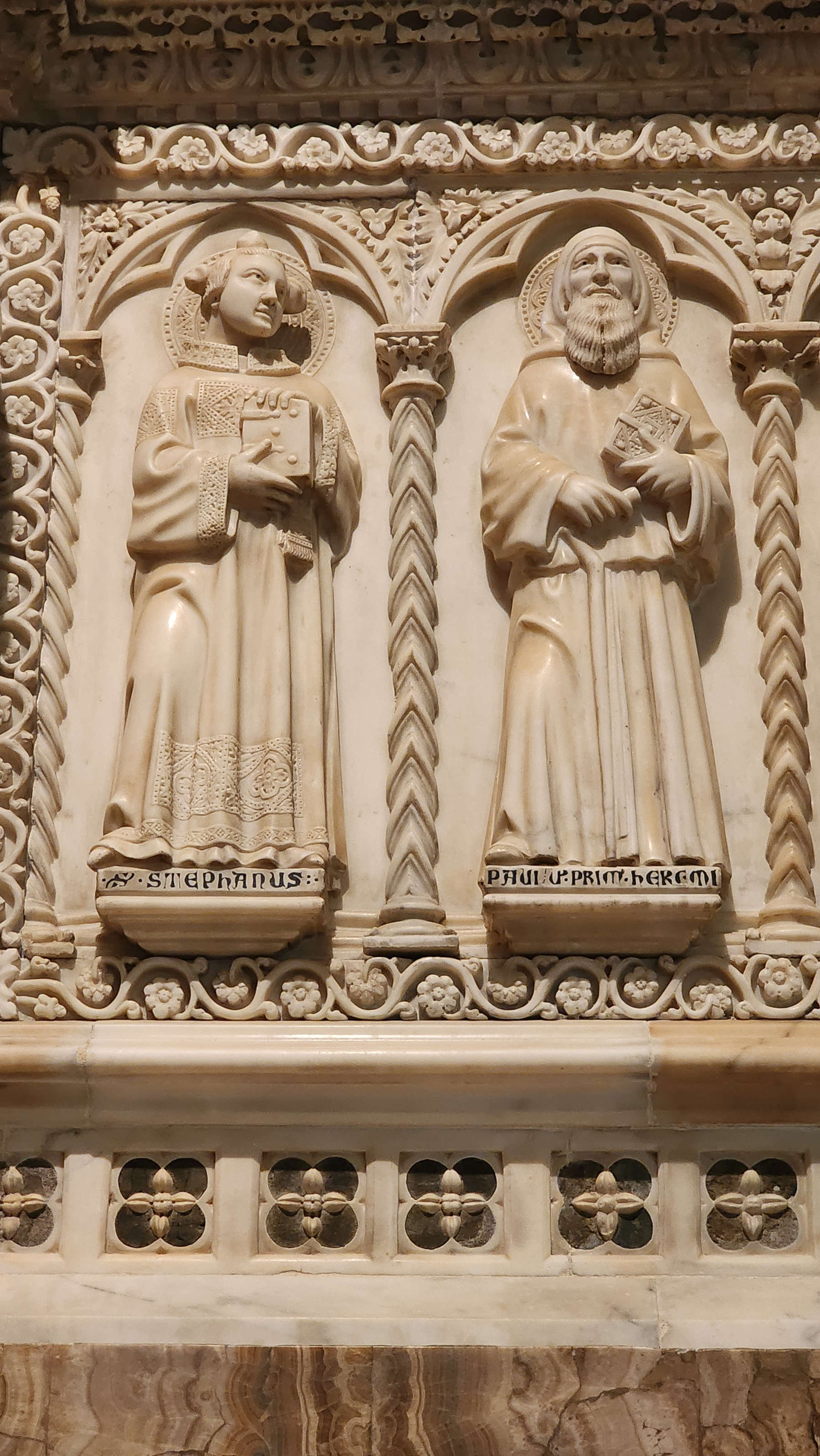
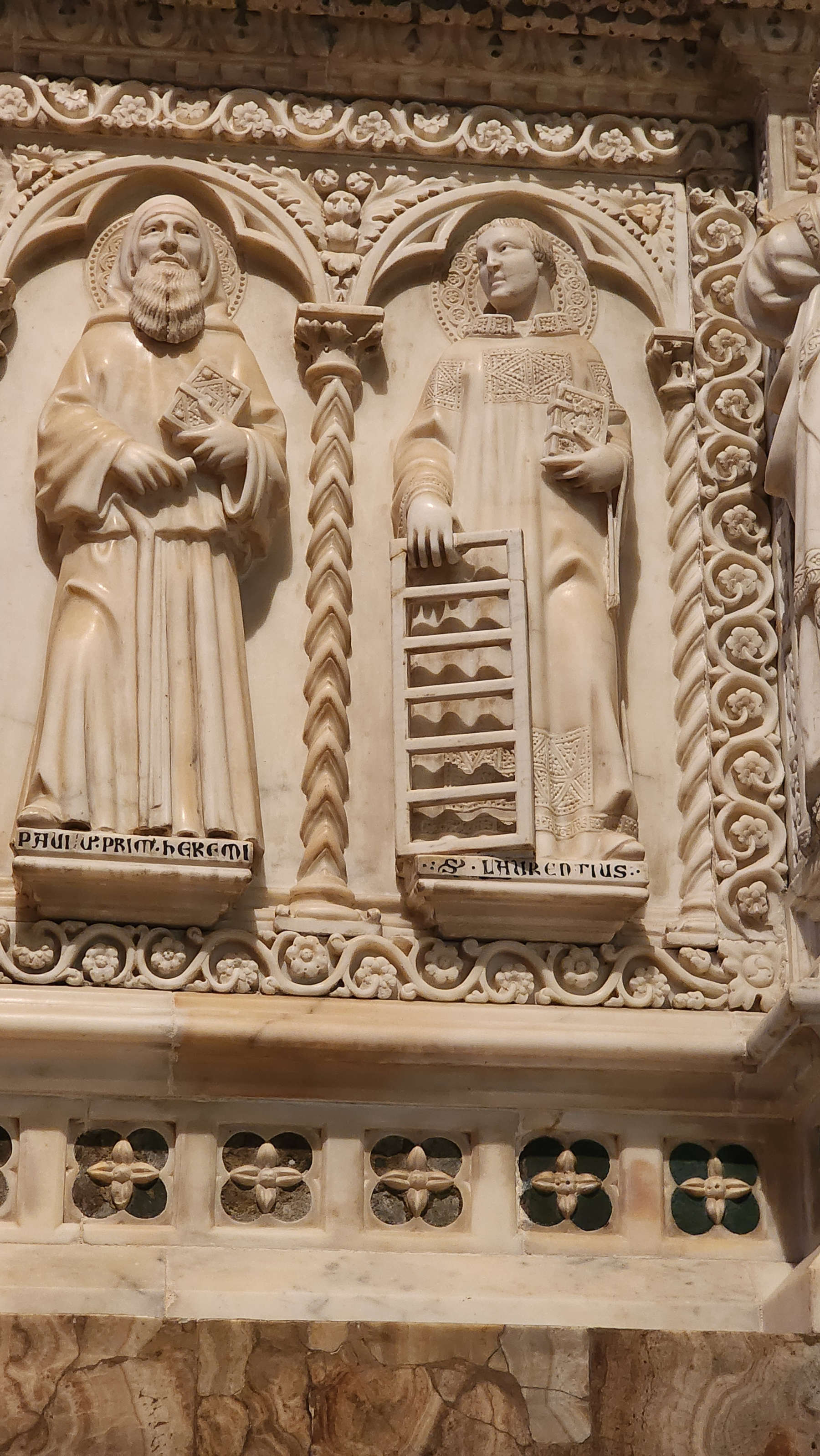
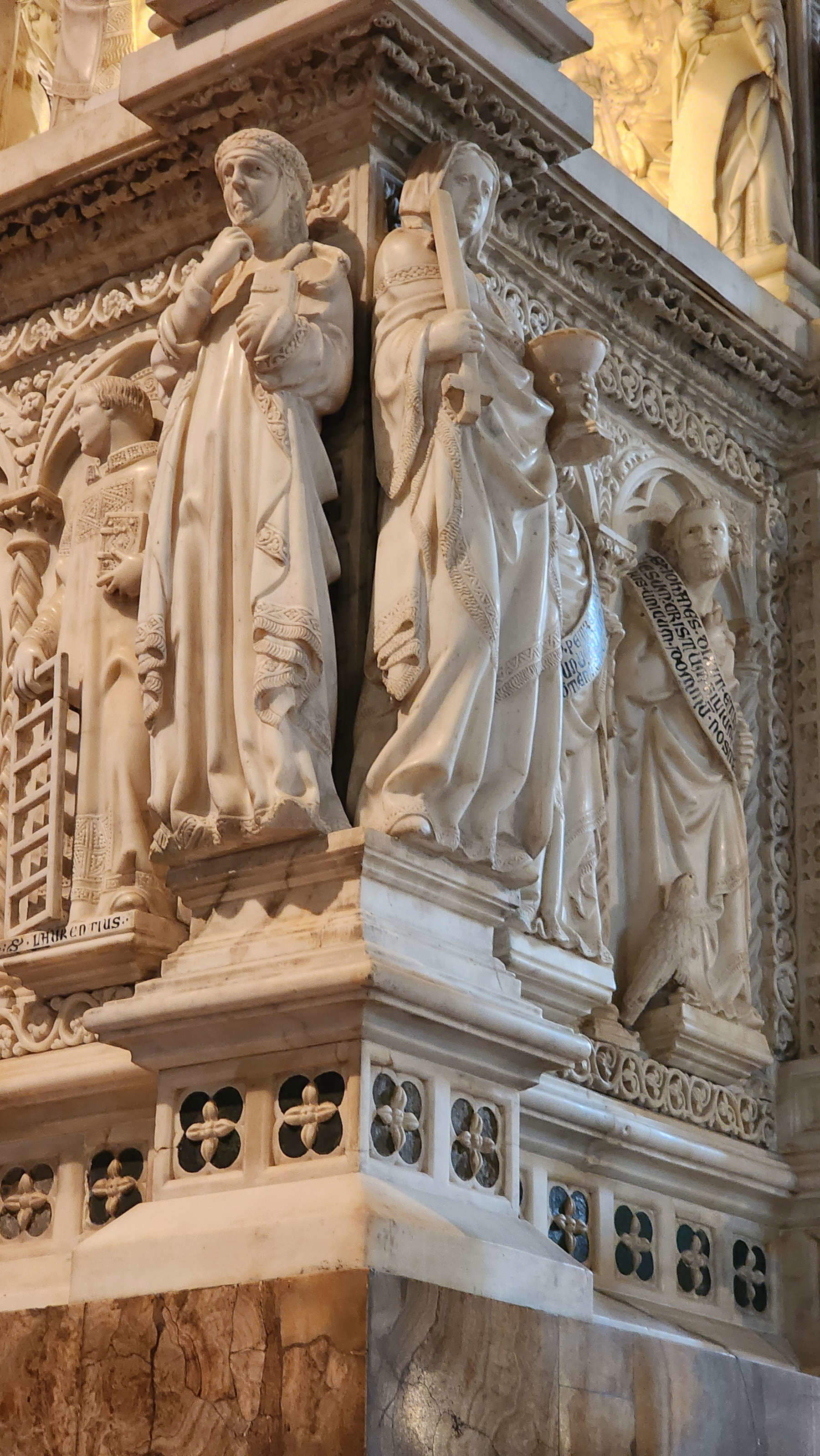
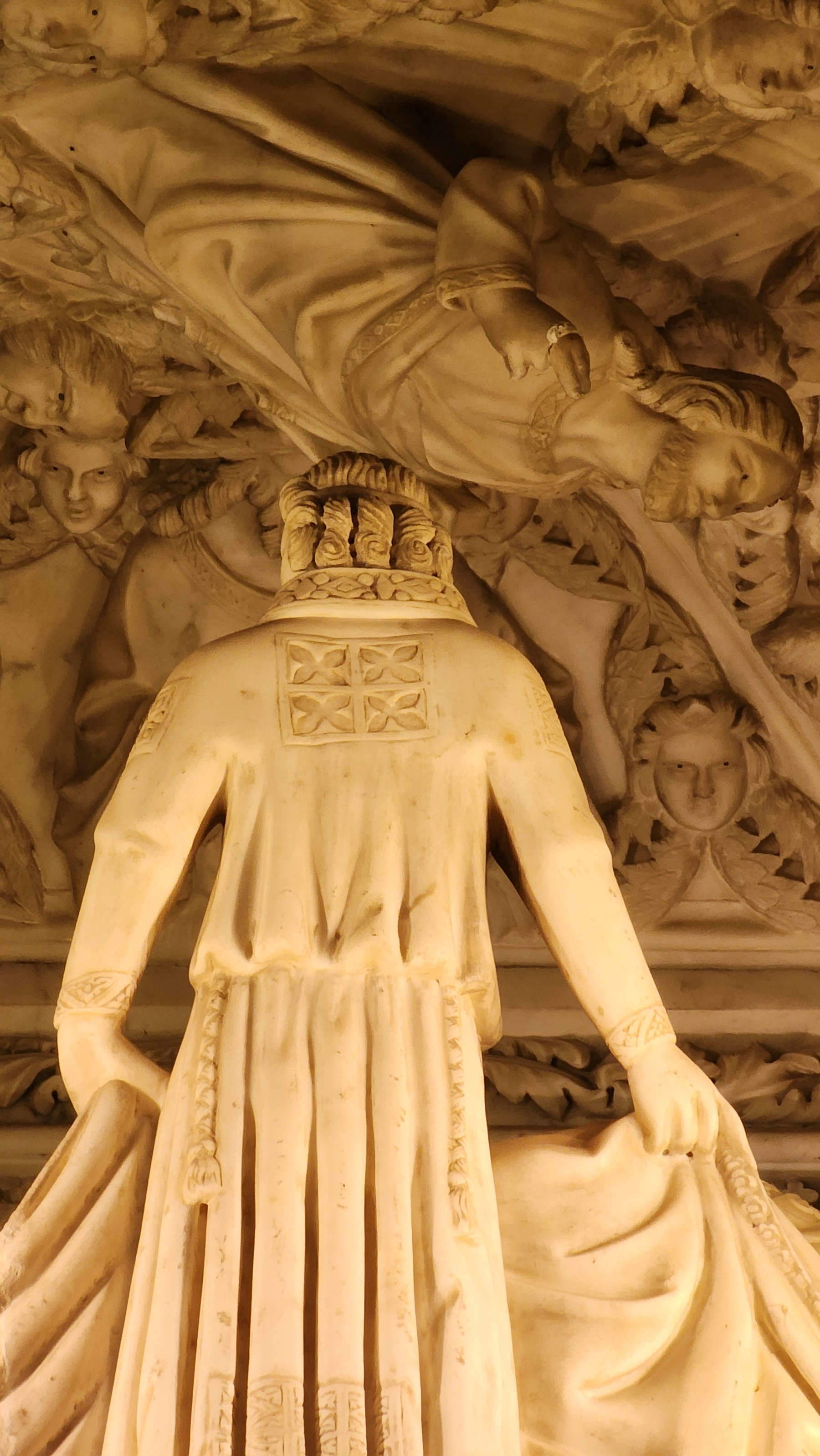
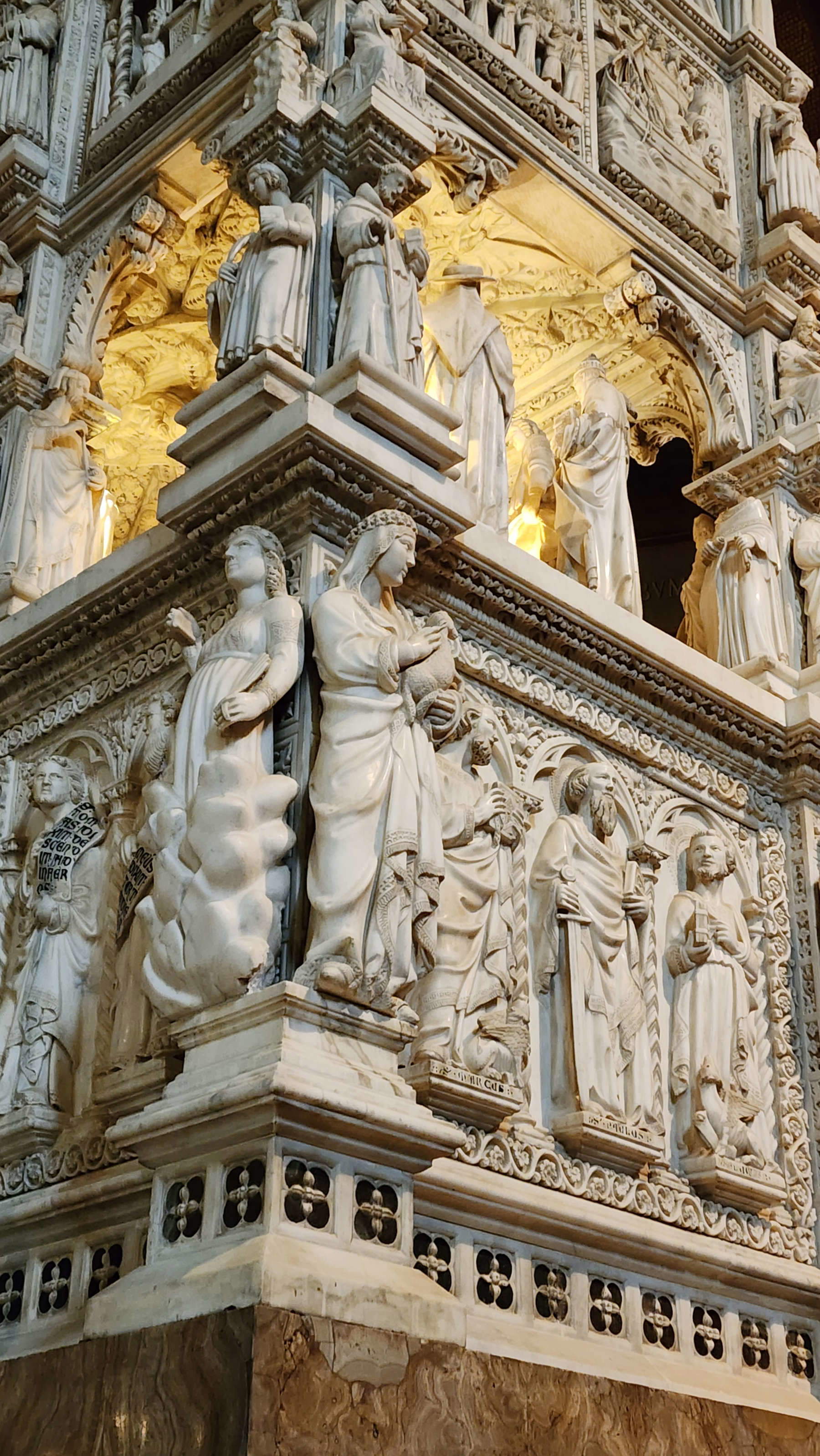
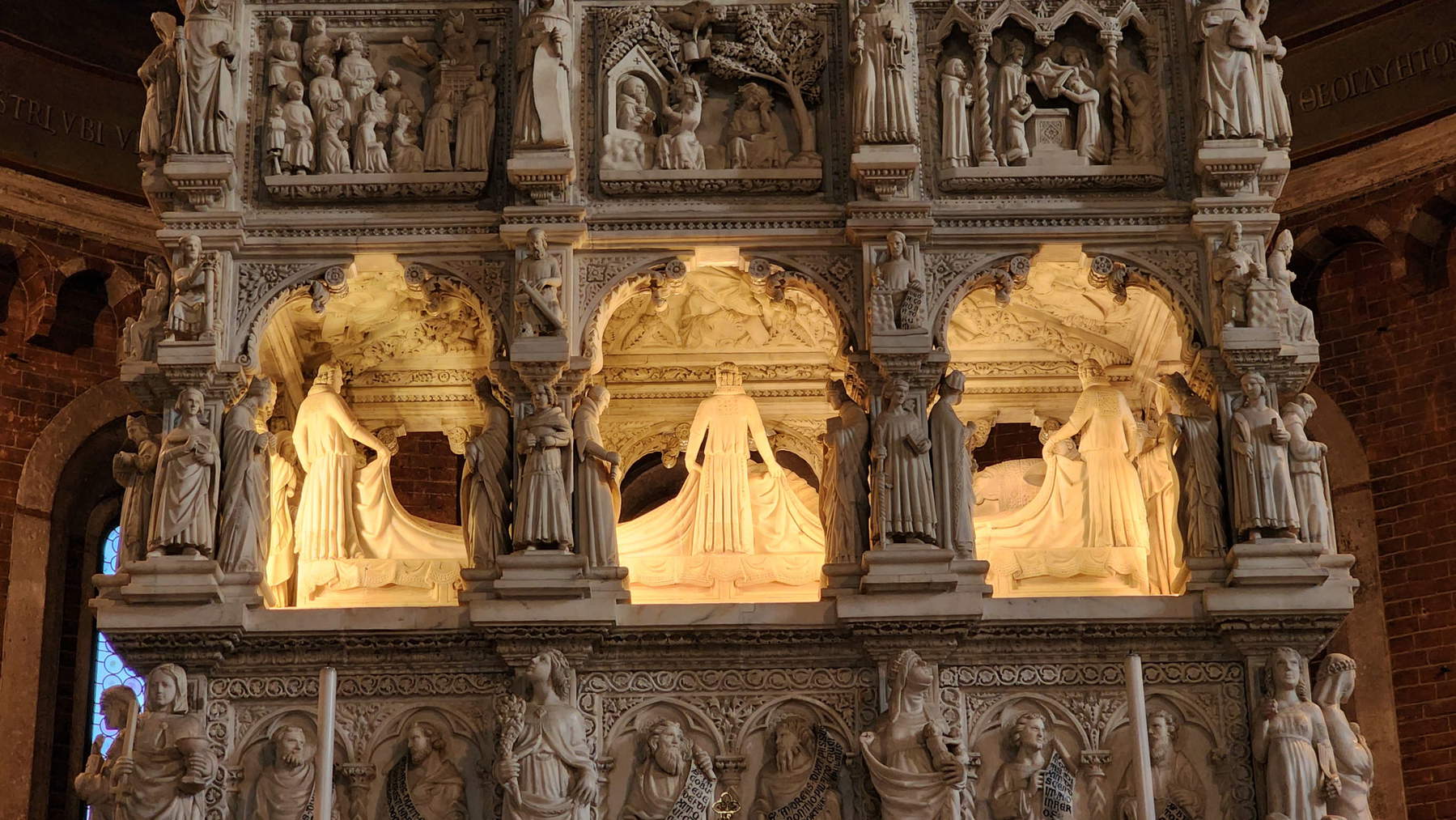
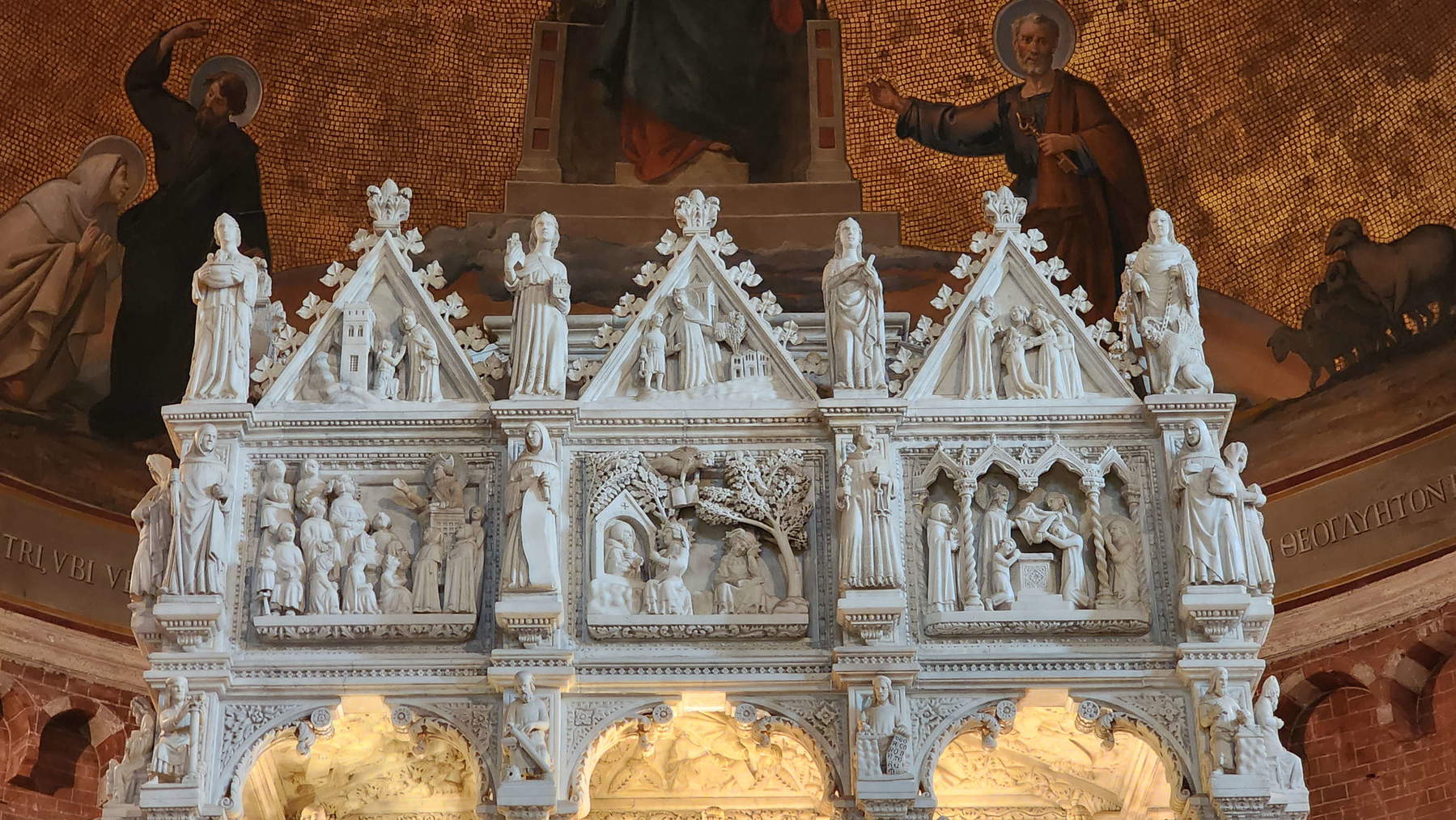
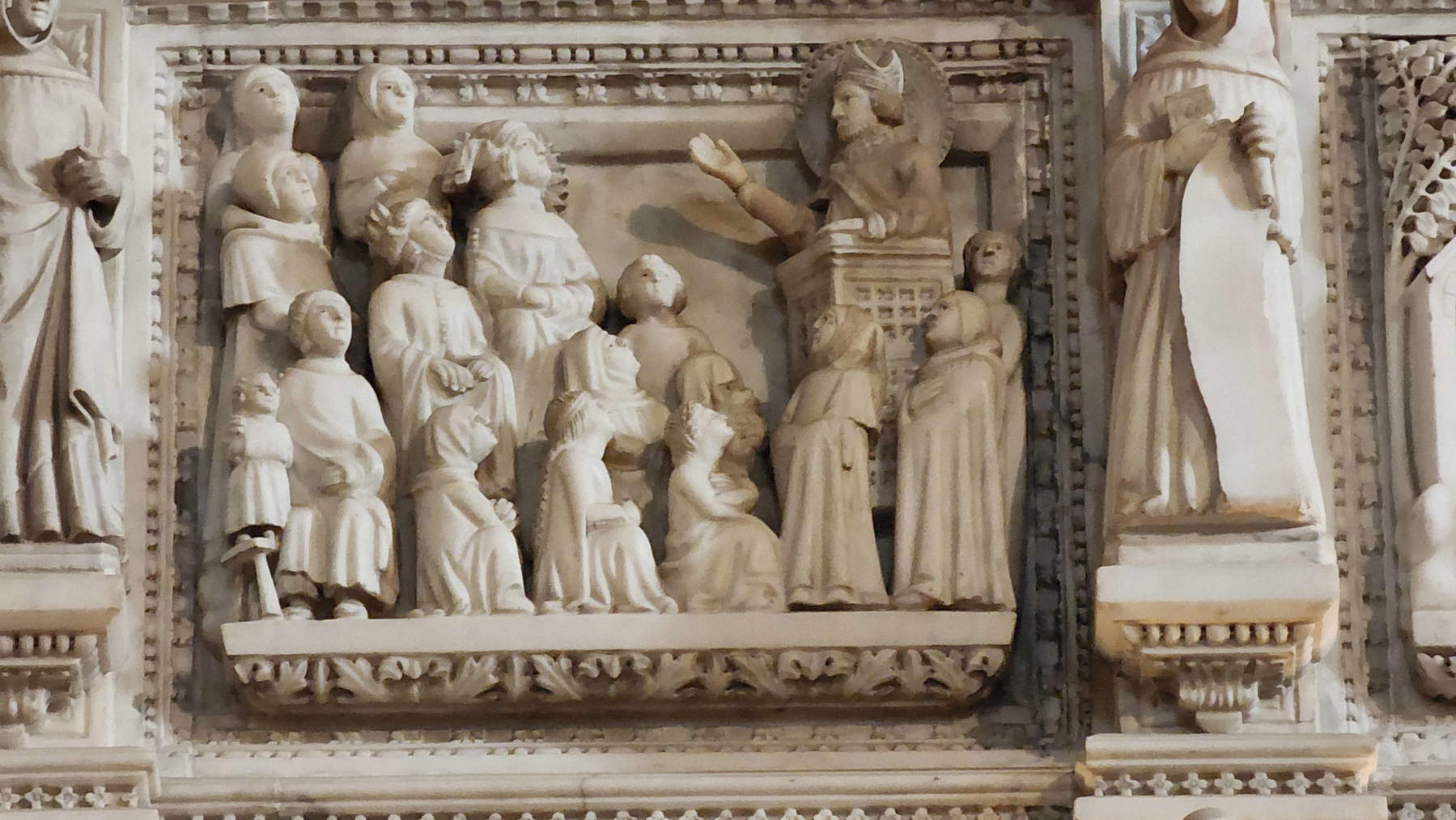
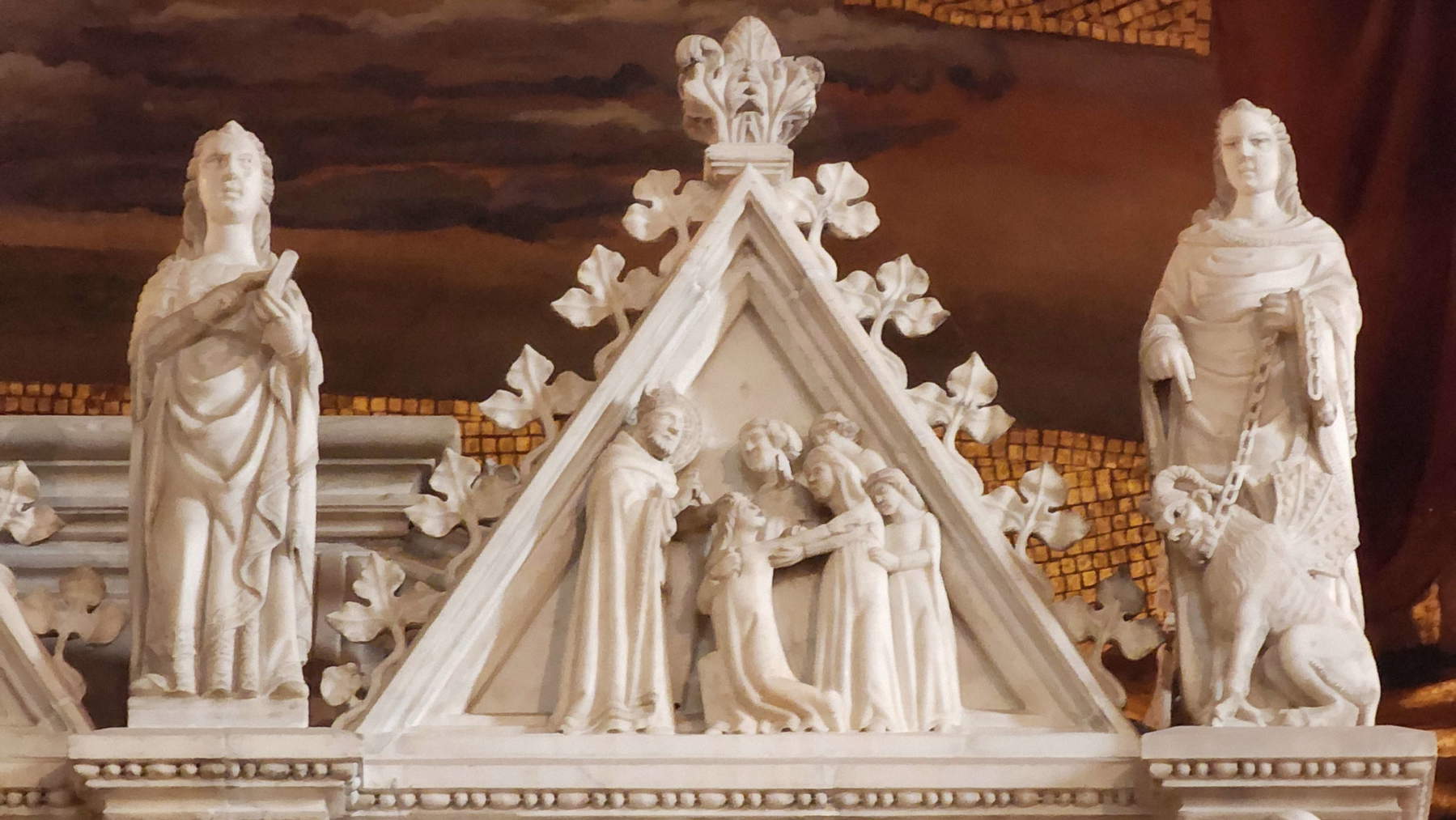
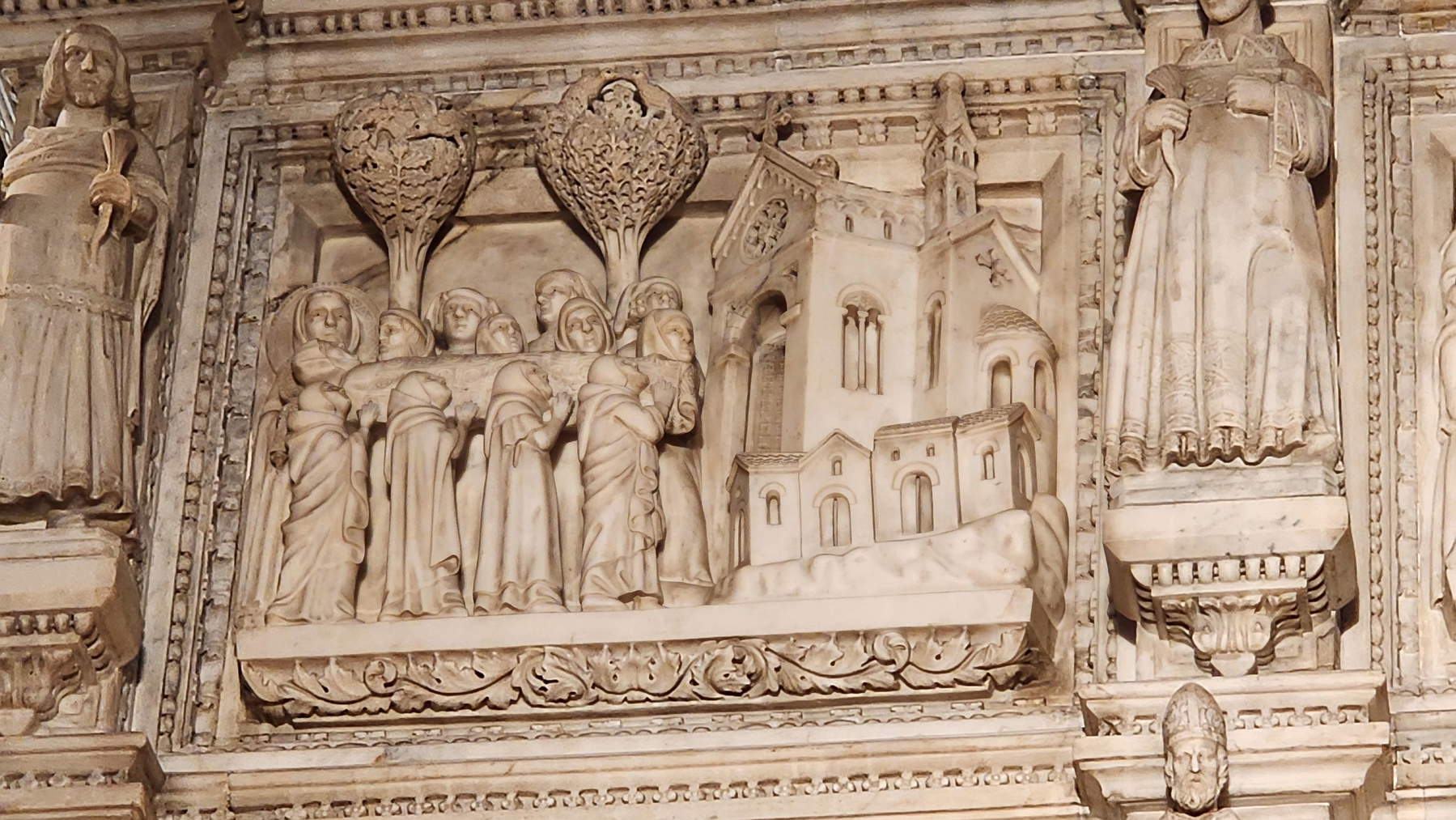
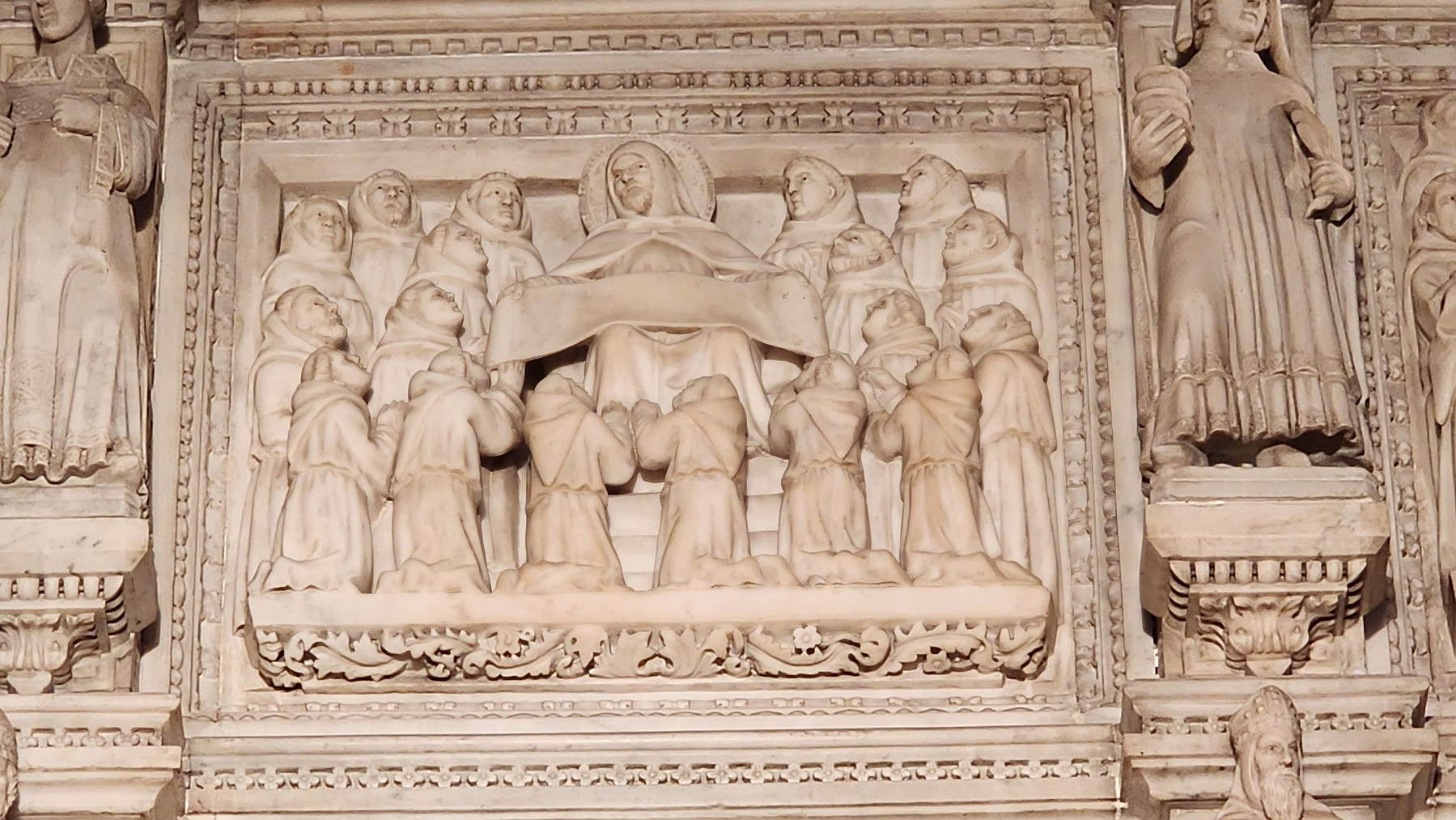
Today, what stands out in the eyes of visitors to the basilica of San Pietro in Ciel d’Oro is one of the most spectacular monuments of Lombard Gothic sculpture. The architecture of the Ark of St. Augustine is a tripartite system of extraordinary formal complexity that develops vertically. The first register serves as a plinth: here, statues of the twelve apostles alternate with representations of the theological and cardinal Virtues, which protrude as supporting pillars. The Virtues are characterized by two modes of expression: some have crested draperies with sharp shadows that emphasize plastic vigor, as in the figure of Justice, while others show broad smooth backgrounds that create delicate light passages. The second register consists of a cell opened by arches, supported by slender columns, inside which lies the sleeping figure of the saint. Augustine is depicted as gisant, that is, lying supine, in the act of sleeping, with extreme care for pontifical robes and chiseled gloves, surrounded by six deacons symbolically lifting the burial shroud. The ceiling of this burial chamber is a cross vault entirely covered with cherubim and busts of saints, with the figure of Christ in the center within a mandorla that receives the soul of the deceased. The style of these central figures has been likened to the sensibility of Matteo da Campione for the fineness of the marble carving. The third register houses ten narrative panels with scenes from the saint’s life, where space is conceived, as mentioned, in an anti-naturalistic manner: the figures overlap vertically to indicate depth, according to a still medieval language that favors didactic clarity over scientific perspective. The episodes narrate the life of St. Augustine: we see the saint as he listens to the sermon of St. Ambrose, the episode of his conversion, his baptism by Ambrose, and then, with a temporal leap, the arrival of St. Augustine’s remains in Pavia and his entry into St. Peter in Ciel d’Oro in the retinue of Liutprand, King Liutprand along with Bishop Peter carrying the saint’s body, and, continuing backward, the funeral of St. Monica (mother of St. Augustine), the establishment of the Augustinian order, and two episodes with Augustine caught imparting his teachings. The top of the monument is crowned with a cymatium composed of triangular tympanums illustrating Augustine’s posthumous miracles (the liberation of a prisoner from Pavia who had begged him to lead him out of prison, the healing of ademoniac, a miraculous apparition to a group of pilgrims on their way to Rome, and a discussion with three theologians believed to be heretics) and with the scene of his death, alternating with statues of angelic hierarchies. A revealing detail of Balduccio’s expertise is the mismatch between the pillars and cornices, an irregularity that testifies to the craftsmanship and lively nature of the building site. The constant use of white Carrara marble allows us to appreciate the variety of finishing techniques: some surfaces appear perfectly polished, while others maintain a more opaque surface, probably intentional to differentiate the planes of the narrative. The work is then readable as a large marble encyclopedia where the full-length sculpture dialogues with the high relief, creating a devotional path that culminates in the angelic choirs of the highest part.
It is precisely the highest part that remains one of the worst visible parts of the monument. Then, in recent years, the difficulty of directly observing the details of the Ark because of its elevated position prompted theUniversity of Pavia to undertake a futuristic digitization project. Under the guidance of Professor Virginio Cantoni and with the collaboration of students in the Computer Vision course, a complete three-dimensional model of the entire monument was created. This research work, which resulted in a 2022 publication, used digital technologies to enable an innovative enjoyment of the Gothic masterpiece, finally making visible elements that for centuries remained hidden from the human eye. The reconstruction required considerable effort to manage the lighting and refraction of the marble surfaces, simplifying the models to ensure a faithful rendering of the decorative apparatus. Each order of the Ark was modeled individually, allowing the virtues of the basement, the figures within the cella, and the dense narrative texture of the upper bas-reliefs to be analyzed separately.
Thanks to these models, it is possible to take a complete virtual tour that allows a close look at the carving of cherubs on the vault of the cella or the expressions of the heretical theologians carved with claw feet in the miracle reliefs. The project is not only of academic value, but is a fundamental tool for conservation and restoration, allowing the state of the surfaces to be mapped precisely and any signs of decay not discernible from a distance to be identified. This digital archaeology operation, if you want to call it that, was intended to restore the Ark to its original function as a “stone book,” making the complex iconographic program conceived by Bonifacio Bottigella for the edification of the faithful accessible once again. The integration between the craftsmanship of the 14th century and the information technology of the 21st century then ends up opening up new avenues for the enhancement of Pavia’s artistic heritage, which finds in the Ark of St. Augustine a living organism, capable of dialoguing with modernity.
Warning: the translation into English of the original Italian article was created using automatic tools. We undertake to review all articles, but we do not guarantee the total absence of inaccuracies in the translation due to the program. You can find the original by clicking on the ITA button. If you find any mistake,please contact us.