




by Redazione 31/05/2026



Categories: Ancient art / Disclaimer
Presented at the National Museum of Medieval and Modern Art in Arezzo is the restoration of glazed terracotta by Andrea della Robbia and workshop. The intervention, supported by the Inner Wheel Arezzo Club, enhances one of the masterpieces of the artist's mature production.
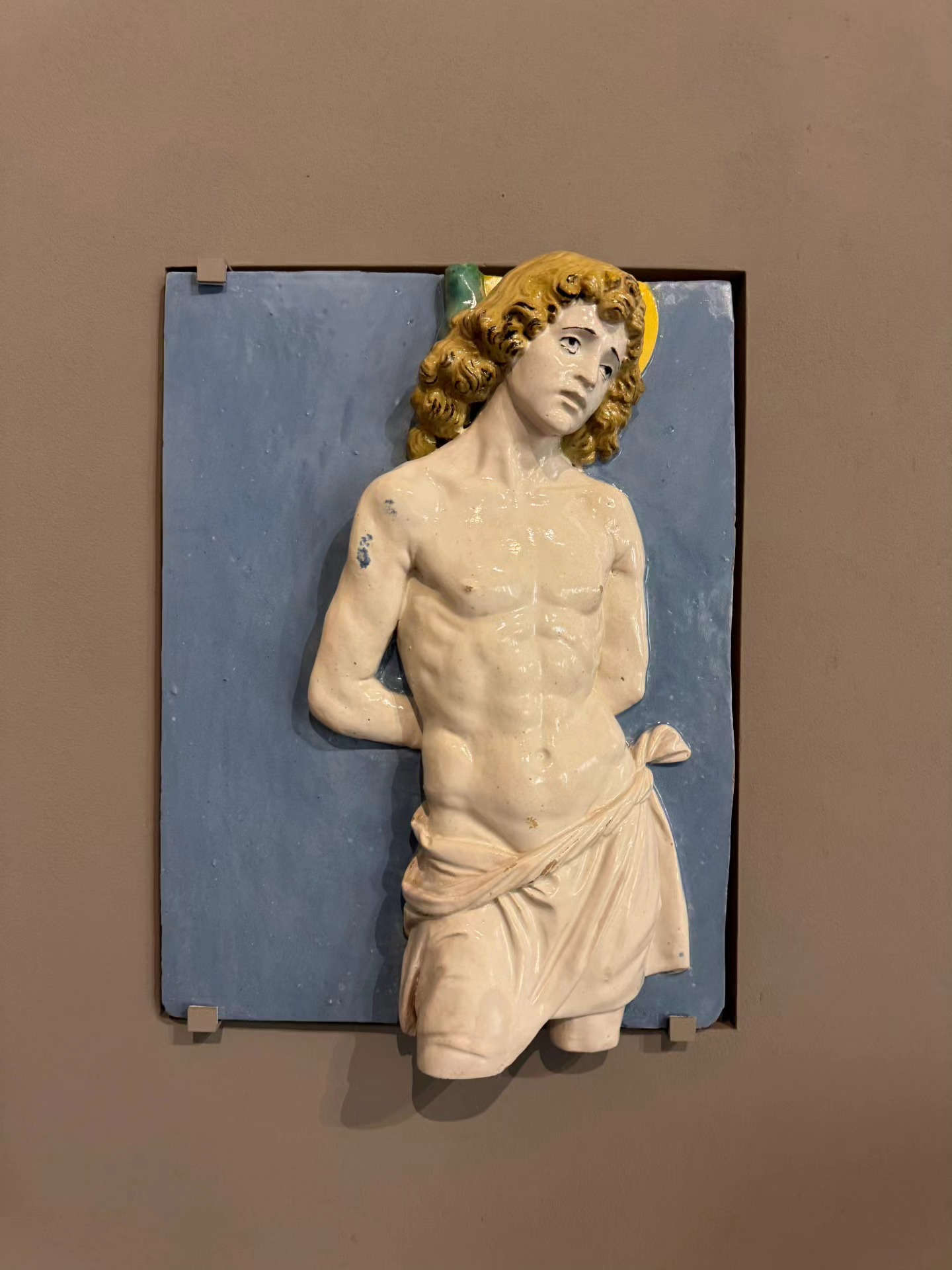
The National Museum of Medieval and Modern Art in Arezzo was presented with the restoration of Saint Sebastian, a refined glazed terracotta attributed to Andrea della Robbia (Florence, 1435 - 1525) and his workshop, datable to the early 16th century. The conservation work, carried out thanks to the support of the Inner Wheel Arezzo Club, has made it possible to fully recover the work’s legibility and aesthetic unity, returning to the public one of the significant examples of the Florentine artist’s mature production. The presentation was held in the presence of Carlotta Paola Brovadan, regional director of National Museums Tuscany of the Ministry of Culture, Luisa Berretti, director of the National Museum of Medieval and Modern Art in Arezzo, and Antonella Semoli, president of the Club Inner Wheel Arezzo, a reality that has financially supported the recovery project.
The intervention was entrusted to restorer Silvia Gualdani and consisted of several operational phases. The work first included a thorough cleaning of the surface, essential to eliminate deposits and alterations that had compromised the reading of the work over time. Next came the structural consolidation, necessary to ensure the stability of the artifact, followed by theintegration of the ceramic gaps using materials compatible with the original ones. The restoration concluded with a final pictorial retouching, aimed at restoring visual coherence, legibility and aesthetic unity to the sculpture.


The work represents a significant example of the famous glazed terracotta technique, one of the most important artistic innovations of the Italian Renaissance. Its origin is linked to the ingenuity of Luca della Robbia who, around 1440, developed a revolutionary procedure destined to profoundly change the language of Western plastic arts. Through a long phase of experimentation with materials, the artist developed a particular mixture composed of tin, antimony, minerals and glazes that, once fired in a kiln, was able to protect the surface of the terracotta and give it extraordinary resistance to atmospheric agents. The innovative scope of this discovery was such that it was also celebrated by Giorgio Vasari, who in the second edition of the Lives described the Della Robbia technique as a “useful and beautiful new art.” The historian and artist from Arezzo recalled how Luca della Robbia, after numerous experiments, had discovered that the application of a glazed blanket obtained through the use of tin, terra ghetta, antimony and other minerals made it possible to make terracotta works “almost eternal.”
Vasari’s definition was not just rhetorical praise. Indeed, glazed terracotta represented a perfect synthesis of sculpture and color, capable of offering visual effects hitherto unthinkable. Surfaces acquired a special luminosity, colors were intense and brilliant, and the work retained an extraordinary integrity over time. Cobalt blues, tin whites, greens obtained from copper, yellows derived from antimony and manganese browns constituted a limited but extremely effective palette that became the hallmark of Della Robbia’s production.
If Luca della Robbia was the inventor of the technique, however, it was his nephew Andrea who ensured its extraordinary diffusion. Described by Vasari as an “excellent sculptor of earth and marble,” Andrea picked up his uncle’s legacy by transforming the workshop in Via Guelfa in Florence into one of the most important production centers of the Renaissance. Under his leadership glazed terracotta crossed the borders of Tuscany and reached many regions of the peninsula, from Umbria to the Aragonese south. The quantity of works produced was such that Vasari unhesitatingly called it “infinite.”
Alongside the geographical spread, Andrea introduced a new narrative and spiritual intensity into the family tradition. His works are characterized by a greater attention to the emotional and religious dimension, transforming glazed terracotta into a privileged tool for communicating faith. The luminosity of the glazed surfaces and the contrast between the white of the figures and the blue of the backgrounds helped create images of strong devotional impact, capable of speaking directly to the faithful.
The restored St. Sebastian in Arezzo belongs precisely to this mature phase of Andrea della Robbia’s production and fully reflects the cultural and spiritual climate that characterized the last decades of the 15th century and the first years of the 16th century. In particular, the work testifies to the influence exerted by the preaching of Girolamo Savonarola on the Della Robbia circle. The relationship between the Della Robbia family and the Dominican friar was in fact particularly intense: the workshop was among the artistic realities closest to Savonarola’s ideas, and the involvement did not remain limited to the cultural level. Two of Andrea’s sons, Francesco and Marco Giovanni, in fact entered the Dominican order at the convent of San Marco in the years when Savonarola was exerting his spiritual influence on Florence. Particularly significant is the figure of Marco Giovanni, who took the name Fra’ Mattia in 1496. To him is attributed the famous polychrome terracotta bust depicting Savonarola now preserved in the Museum of San Marco, also belonging to the Regional Directorate National Museums Tuscany. The work is considered by scholars to be the only three-dimensional effigy capable of rendering the preacher’s real likeness.
This adherence to the religious demands promoted by Savonarola left a clear mark on Andrea della Robbia’s artistic production. The mature works gradually abandoned the decorative exuberance that had characterized part of the Renaissance season to favor a language marked by moral rigor, evangelical simplicity and spiritual introspection.
The recently restored St. Sebastian is an emblematic example of this transformation. The composition renounces the most spectacular ornamental elements and focuses attention on the figure of the saint, constructed through a formal sobriety that enhances the inner dimension of the subject.Devotion is manifested not through decorative richness but through the purity of expression and the psychological strength of representation. The intense introspection that characterizes the saint’s face and attitude directly recalls that quest for spiritual authenticity that was one of the cornerstones of Savonarola’s preaching. The sacred figures thus become instruments of meditation and reflection, freed from all worldly complacency and oriented toward a more austere and profound religiosity.
The recovery of the work is part of a broader cultural strategy promoted by the Regional Directorate National Museums Tuscany. In fact, the intervention does not represent only a material conservation operation, but is part of a heritage enhancement project based on collaboration between institutes, the sharing of scientific expertise and the construction of common paths of research and protection.
The initiative also acquires special value in light of the deep connection between Arezzo and the Della Robbia tradition. In fact, the National Museum of Medieval and Modern Art preserves one of the most important Italian collections of Renaissance majolica, a heritage that dialogues directly with the Della Robbia family’s production. Added to this is a large glazed terracotta altarpiece by Andrea della Robbia that represents one of the masterpieces of the museum collection. The importance of this heritage had already been emphasized in 2009 by the major exhibition I Della Robbia - Dialogue between the Arts in the Renaissance, curated by Liletta Fornasari and Giancarlo Gentilini. The exhibition contributed in a decisive way to relaunch the studies dedicated to the famous Florentine workshop and to renew public interest in an artistic event that continues to occupy a central place in the history of Italian art.
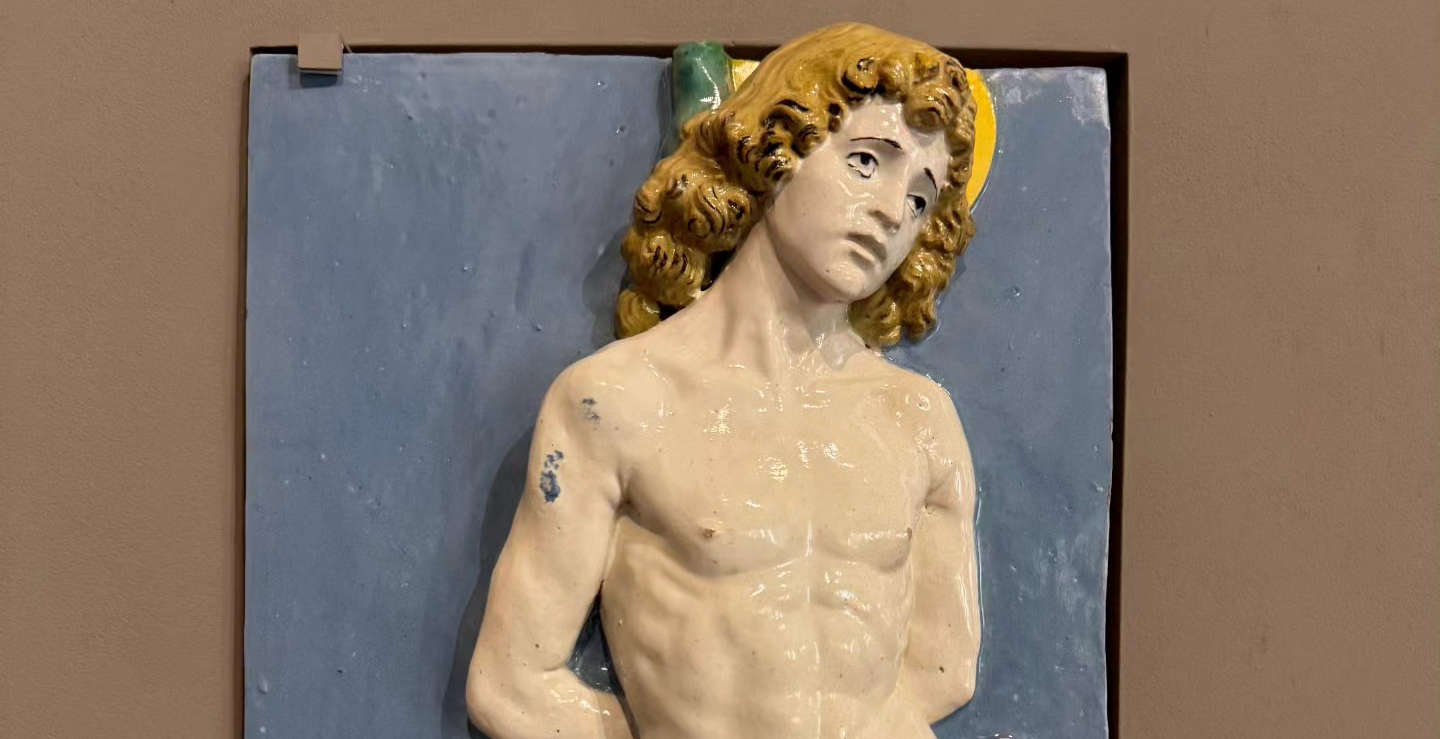 |
| Arezzo, Andrea della Robbia's St. Sebastian restored |
Warning: the translation into English of the original Italian article was created using automatic tools. We undertake to review all articles, but we do not guarantee the total absence of inaccuracies in the translation due to the program. You can find the original by clicking on the ITA button. If you find any mistake,please contact us.