




by Redazione 01/06/2026



Categories: Ancient art / Disclaimer
Giovanni Bellini's Pietà returns home to the City Museum of Rimini after being displayed at the Morgan Library & Museum. At the end of June it will be featured in an exhibition that will compare it with Andrea Mantegna's St. Sebastian at the Ca' d'Oro in Venice.

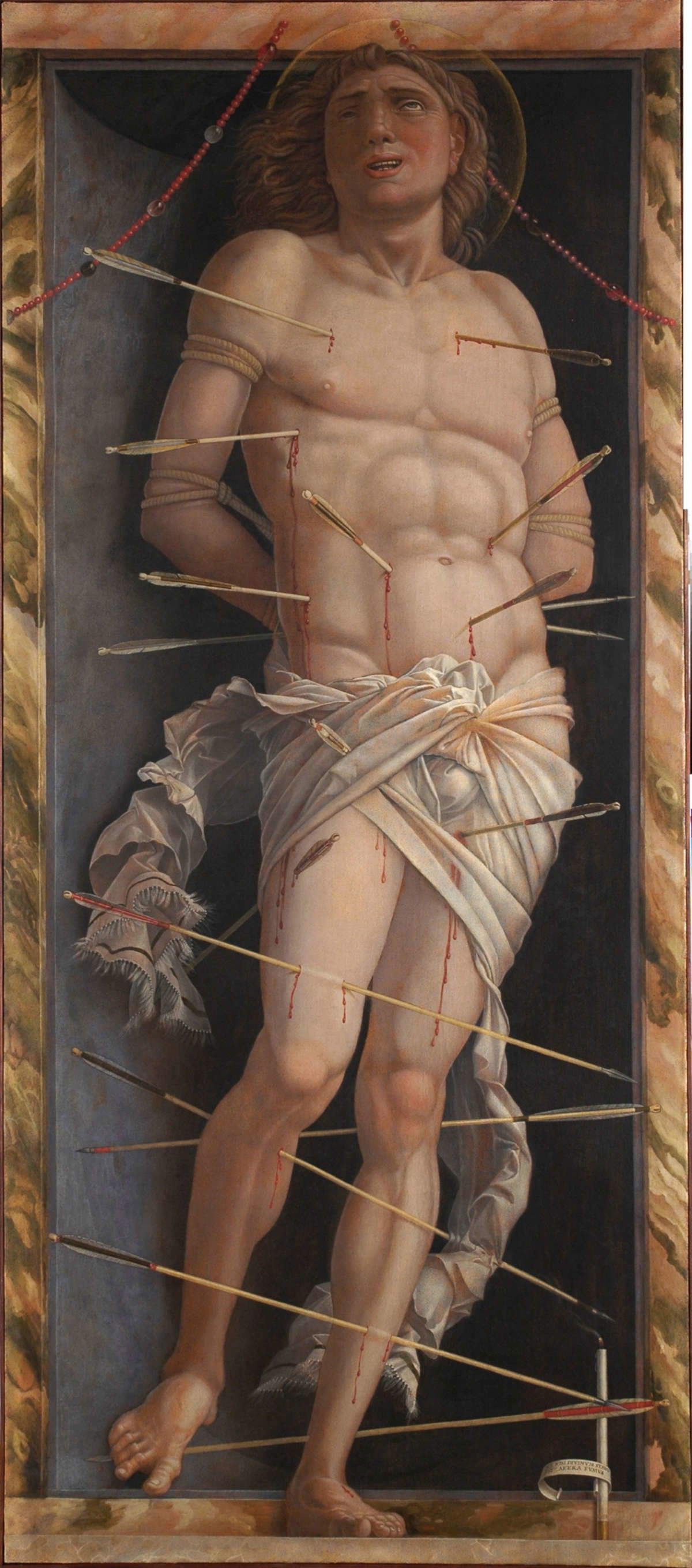
The Pietà by Giovanni Bellini (Venice, c. 1430 - 1516) is returning to its native Rimini after winning over international audiences in the United States. In fact, the famous painting housed at the Museo della Città “Luigi Tonini” is returning to Italy at the end of an exhibition experience that saw it featured at the Morgan Library & Museum in New York, one of the most important cultural institutions in the American metropolis. The return of the work represents one of the most significant events ofRimini’s cultural summer of 2026 and is part of an exhibition program that aims to enhance the city’s artistic heritage through dialogue between great protagonists of art history. Bellini’s masterpiece will in fact be at the center of the exhibition The Passion Code. Bellini and Mantegna in the Mirror, scheduled at the City Museum starting at the end of June. The exhibition will offer the public the opportunity to admire Bellini’s panel once again and compare it with Andrea Mantegna ’s famous St. Sebastian (Isola di Carturo, 1431 - Mantua, 1506), from the Giorgio Franchetti Gallery at Ca’ d’Oro in Venice, where Bellini’s Pietà was the focus of a dossier exhibition between late 2025 and early 2026, just before he left for America, and where it had always been placed in dialogue with the St. Sebastian. The comparison, then, is now renewed.
The stay at the Morgan Library & Museum marked a particularly significant moment in the painting’s history. For the first time, the work crossed the Atlantic, becoming part of an important project dedicated to the great Italian painting of the Renaissance: the work was in fact restored, with an intervention supported by Venetian Heritage, an international nonprofit organization with offices in Venice and New York that has been promoting projects for the protection and enhancement of the artistic heritage of the Veneto for twenty-seven years. The conservation intervention restored full legibility to the work, allowing its pictorial quality, chromatic delicacy and emotional depth to be appreciated once again. It was precisely these aspects that contributed to its success in New York, where the painting was considered one of the most significant presences in the entire exhibition. At the Morgan Library the panel was located inside the historic studio of financier, collector and patron J. Pierpont Morgan. In this prestigious setting the Pieta dialogued with Renaissance works from the museum’s permanent collection and other works from important Italian institutions. These included Pietro Perugino ’s Pieta granted by the Galleria Nazionale dell’Umbria and Caravaggio ’s famous Ragazzo con cesto di frutta from the Galleria Borghese.



The Rimini exhibition will provide an opportunity to further explore the historical and artistic significance of the work by relating it to one of Andrea Mantegna’s most celebrated masterpieces. The dialogue between Bellini and Mantegna is not just a curatorial suggestion, but finds solid roots in history. Indeed, the two artists were linked by family relationships: Andrea Mantegna had married Nicolosia Bellini, Giovanni’s sister. This relationship fostered a cultural and artistic exchange that profoundly influenced the development of Italian painting in the second half of the 15th century. The exhibition will allow a close look at similarities and differences between two extraordinary artistic personalities. On the one hand, the luministic sensitivity and deep humanity of Bellini’s painting; on the other hand, the plastic rigor, monumentality and dramatic tension that characterize Mantegna’s work. The comparison between the Pietà and the Saint Sebastian promises to offer new keys to understanding the theme of suffering, sacrifice and redemption.
The Rimini panel occupies a special place within Giovanni Bellini’s production. Coming from the Malatesta Temple, it is generally considered one of the works of the artist’s early maturity and is often placed chronologically close to the famous Pietà preserved in Milan, at the Pinacoteca di Brera. The story of the commission has been the subject of a long historiographical debate. Giorgio Vasari recalled the work as being commissioned by Sigismondo Pandolfo Malatesta, lord of Rimini. However, the death of the condottiero in 1468 makes this attribution problematic from a chronological point of view. Several scholars have therefore proposed identifying the patron as Carlo Malatesta, son of Roberto Malatesta and illegitimate grandson of Sigismondo. Carlo Malatesta was a condottiero in the service of the Serenissima until 1480 and, like Bellini, belonged to the Scuola Grande di San Marco. A particularly important document is Pandolfo Malatesta’s will of 1499, which describes a work that scholars identify precisely with the Pietà now preserved in Rimini.
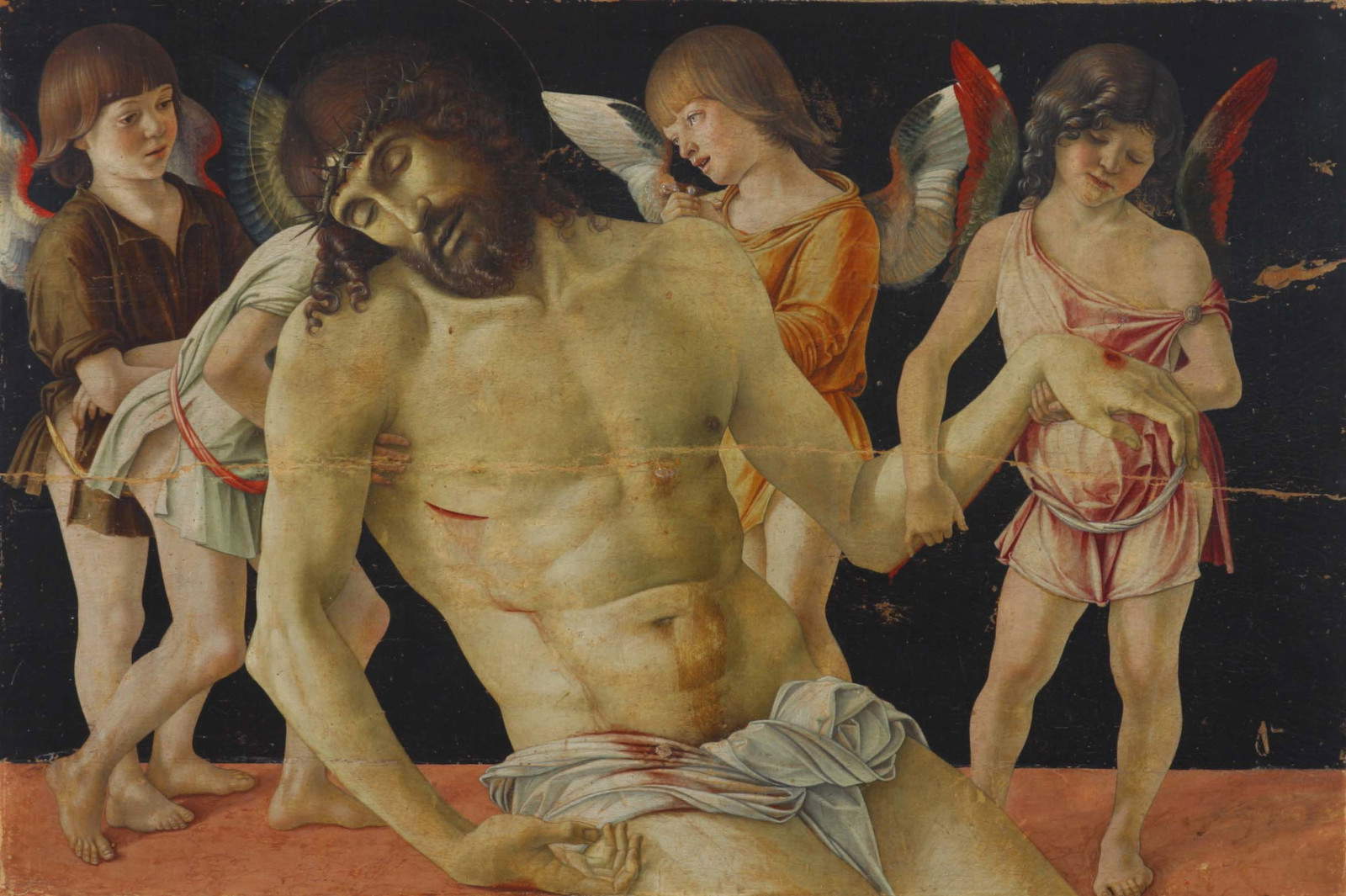
The dating of the painting has also been the focus of much debate. Some scholars have proposed a later chronology, close to the making of the Pesaro Altarpiece, while others continue to place the work before 1468 or at any rate shortly before the great Pesaro altarpiece. Comparisons with other works by Bellini, such as the Dead Christ supported by two angels in Berlin, the one preserved in London, the upper compartment of the Polyptych of San Vincenzo Ferrer, and the Pietà of Brera itself, have not allowed a definitive chronological sequence to be defined. However, contemporary critics tend to place the painting around 1474.
From an iconographic point of view, the panel presents particularly original features. In fact, Bellini reworks the traditional scheme of theImago Pietatis, transforming it into a scene depicting the dead Christ being laid on the anointing stone in preparation for burial. The peculiarity lies in the fact that Christ’s body is not supported by human figures, but by four angels. The choice gives the composition a suspended dimension between reality and vision, accentuating the meditative character of the scene. Art historian Roger Fry, already in the late 19th century, observed how the painting almost produced the impression of a bas-relief. Indeed, the dark background highlights the delicacy of the figures, while the composition recalls, according to some scholars, the tradition of reliefs by Donatello, Agostino di Duccio, and Desiderio da Settignano.
Unlike the better-known Brera Pietà, where grief is entrusted to the composed expression of the figures flanking Christ, in the Rimini work the emotional tension is concentrated in the angels. Their expressions do not manifest despair, but a melancholy awareness of the meaning of sacrifice and future resurrection. The body of Christ is depicted with the usual elegance that characterizes Bellini’s painting. The wounds of the crucifixion are described with extreme delicacy and the blood is rendered through measured details, never emphatic. The softness of the angels’ robes, characterized by pinkish and mauve hues achieved through the use of oil paint, contributes to an atmosphere of intense spirituality. The arrangement of the gazes also takes a key role in the construction of the composition. Each angel directs attention to a different element: Christ’s face, the wound on his left hand, or an undefined space beyond the scene, suggesting a meditation on the mystery of death and resurrection.
Giovanni Bellini, who was born around 1430 and died in 1516, is considered one of the absolute protagonists of the Italian Renaissance and one of the artists who contributed most to the evolution of Venetian painting. The Rimini Pietà represents one of the highest expressions of his reflection on the pain, spirituality and humanity of the protagonists of the Gospel story.
|
| Giovanni Bellini's restored Pietà returns to Rimini after New York exhibition |
Warning: the translation into English of the original Italian article was created using automatic tools. We undertake to review all articles, but we do not guarantee the total absence of inaccuracies in the translation due to the program. You can find the original by clicking on the ITA button. If you find any mistake,please contact us.