





Aniconic work of 17th-century European reality painting is entering a public collection. Woman Begging with Two Children, a masterpiece by the so-called Master of the Denim Canvas, has been donated to the Pinacoteca Züst in Rancate, Switzerland, by the Dr. Joseph Scholz Foundation of Zurich: the donation has thus ensured the public accessibility of a work of extraordinary art-historical significance. Announcing the acquisition is Galerie Canesso in Paris, which had put the work on the market.
The entry of the work into a museum represents a significant moment not only because of its pictorial quality, but also because of its role in defining an entire artistic corpus. Indeed, it was around this composition that scholar Gerlinde Gruber brought together, between 2006 and 2007, a group of paintings attributed to an anonymous master active in the late seventeenth and early eighteenth centuries. The subsequent exhibition The Master of the Blue Jeans. A New Painter of Reality in Late 17th-Century Europe, organized between Paris and New York by Galerie Canesso in 2010-2011, definitively consecrated the figure of this artist, inserting him fully into the history of European art. Defined by Stefano Frangi and Alessandro Morandotti as “a great and moving narrator of the sufferings of the humble,” the Master of the Denim Canvas stands out for his ability to represent marginality with an empathetic gaze devoid of rhetoric. His works are in the groove of reality painting, a particularly fertile strand in 17th-century northern Italy, and ideally dialogue with those of artists such as Giacomo Ceruti, while partly anticipating their outcomes.
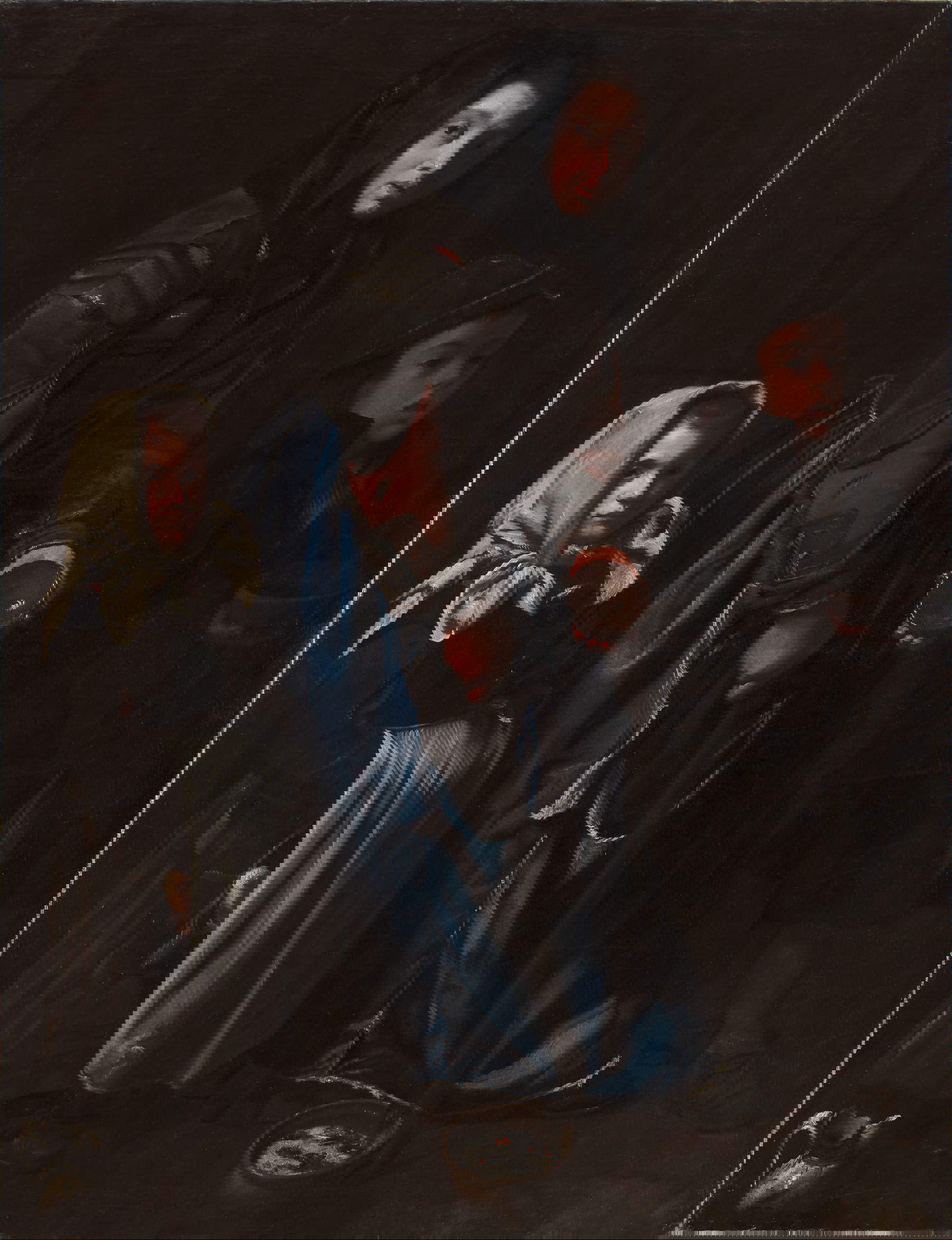
The painting that has just entered the Pinacoteca Züst is also of special importance for the material and cultural history of jeans. It is in fact the first known pictorial representation of this fabric, a blue moleskin of Genoese origin that was widely spread in Europe as early as the 16th century. The rediscovery of this group of paintings allows us to draw attention to the Genoese origin of this material, which was widely used from the 16th century onward and soon spread internationally through export, particularly to England, where, in 1614, the accounting records of a Lancashire tailor attest to the use of Genoese moleskin (Gênes in French), written as “Geanes,” and later “jeans.”
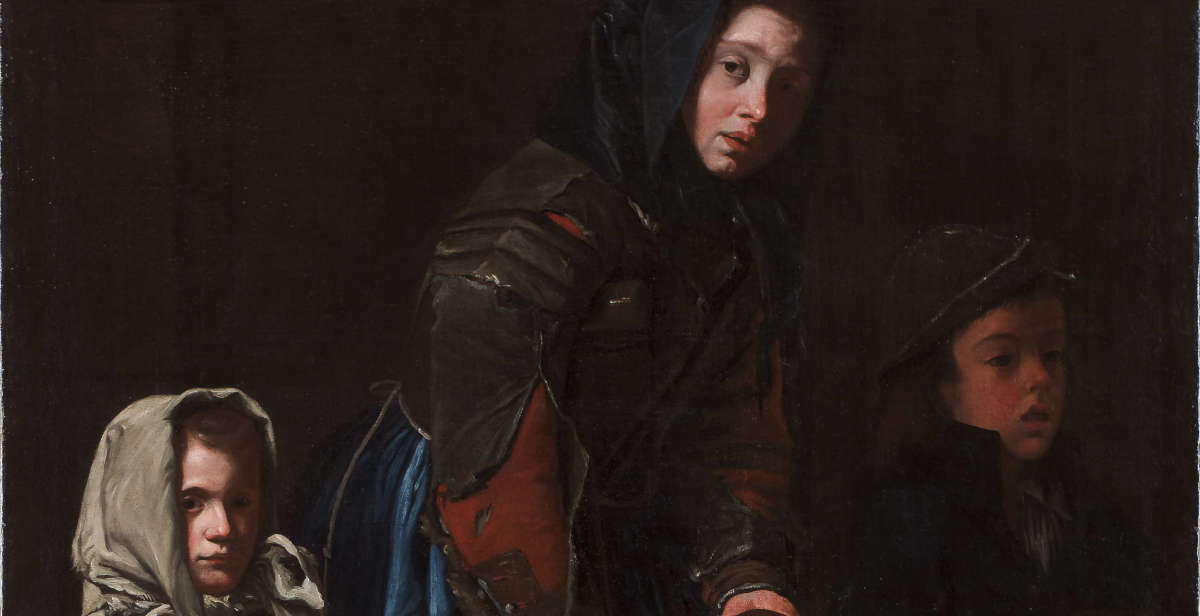
The scene depicted in the painting unfolds in an undefined space dominated by dark tones and controlled light. The mother, still young, leans on a cane and is dressed in the magnificent indigo blue, more or less faded, that tints her apron. The vertical seam reveals typical topstitching, of the kind still found on jeans today. In her right hand she holds an alms bowl, apparently a cup with handles, the bottom of which is turned toward the viewer, like the woman’s gaze. Taken together, this group of figures poses a question for us: are they really begging? Their dignified expressions, their endurance in a cold season (as suggested by their postures and the fact that they are completely covered), their clean appearance, despite probably being dressed in second-hand clothes, distract us from a simple begging scene. Defining a context for the creation of these works is not easy: each image depicts everyday life with some level of destitution and seems to describe the same family, as the characters sometimes repeat themselves from one painting to the next.
In the European context of seventeenth-century realist painting, the Master of the Jeans Canvas stands out for his portrayal of humble individuals dressed in Genoese moleskin, the blue fabric of more or less intense hue that, as mentioned above, is known today by the more common name of jeans. Although this hardy fabric was favored for dressing the more modest classes, its history is inseparable from this particular shade of blue and, consequently, from the history of dyeing, a dual narrative that concerns both the fabric and the pigments used by the Master of the jeans cloth. Analyses of the blue paint used by our anonymous artist have made it possible to identify the recurring pigment in each of these paintings: it is indigo, a dye of plant origin, the same one used to dye the fabric of the jeans. To achieve a relatively dark indigo blue, the painter mixed it with lead white (for lighter shades) or carbon black (for darker ones). The denim blue stands out particularly well in these compositions, contrasting with the browns and gray-browns of the dark backgrounds or other clothing.
The artist specialized in scenes of everyday life; his characters, often gathered around a frugal meal, are beggars, women sewing, or, in one case, a hairdresser at work, and he clearly belonged to the “reality painters” movement, of which Lombardy was a true melting pot. The artist was part of this particularly prolific current, or was even one of its pioneers, between the second half of the 17th century and the early 18th century, as exemplified by Giacomo Ceruti in the first half of the 18th century. Stylistically, the work reveals affinities with several protagonists of seventeenth-century European painting. In addition to the aforementioned Ceruti, one can identify references to Michael Sweerts and Eberhard Keilhau, known as Monsù Bernardo, both of whom were active in Italy, as well as to masters such as Diego Velázquez, Georges de La Tour, and the Le Nain brothers, who had already explored the theme of poverty with a realistic and intensely human language.
From a historical perspective, the provenance of the work is well documented. The painting can be traced to the Villa Airoldi, also known as Villa San Valerio, in Albiate, Lombardy, where it could be identified with the “Three pitocchi standing large picture” mentioned in the 1692 inventory of the Airoldi family. Subsequently passed to the Caprotti family in the late 19th and 20th centuries, it was inherited in 1999 by Guido and Ida Caprotti and then placed on the antiques market, passing between several collectors and dealers, including Cesare Lampronti and Luigi Koelliker’s collection.
Over the years, the painting has been shown in important exhibitions, such as Da Caravaggio a Ceruti. La scena di genere e l’immagine dei pitocchi nella pittura italiana, held in Brescia at the Museo di Santa Giulia from November 28, 1998 to February 28, 1999, and then again Maestri del ’600 e del ’700 Lombardo nella Collezione Koelliker (Milan, Palazzo Reale, 2006), The Master of the Blue Jeans. A new painter of Reality in late 17th century Europe (Paris, Galerie Canesso, September 16 to November 6, 2010, and then New York, Galerie Didier Aaron, January 20 to February 4, 2011), Jeans (Utrecht, Centraal Museum, November 22, 2012 to March 10, 2013), Thread (Denver, Art Museum, June 9 to September 22, 2013), and most recently to the two important exhibitions Giacomo Ceruti nell’Eighteenth-Century Europe, Misery & Nobility, also held at the Santa Giulia Museum in Brescia, from February 11 to May 28, 2023(our review here) and Pietro Bellotti and Seventeenth-Century Painting in Venice. Awe, Reality, Enigma at the Gallerie dell’Accademia in Venice, from September 19, 2025 to January 18, 2026(here is our review).
The donation to the Pinacoteca Züst thus marks a fundamental step in the history of this painting. Not only does it ensure its preservation and public accessibility, but it also confirms the institutional recognition of an artist who has long remained in the shadows. Seeing the work that gave its name to an entire group enter a museum represents, in this sense, a coherent and significant outcome that returns an important piece of European art history to the community.
 |
| Masterpiece by Master of denim canvas goes public: acquired by Swiss museum |

Warning: the translation into English of the original Italian article was created using automatic tools. We undertake to review all articles, but we do not guarantee the total absence of inaccuracies in the translation due to the program. You can find the original by clicking on the ITA button. If you find any mistake,please contact us.



















 IT
IT FR
FR DE
DE ES
ES CN
CN