





A painting by Rembrandt Harmenszoon van Rijn (Leiden, 1606 – Amsterdam, 1669) that has remained in the shadows for nearly four centuries is about to make its triumphant debut on the international art market. On July 1, Sotheby’s will offer for sale in London, during its Old Masters auction, a work by the young Dutch master that was completely unknown to the academic world until just a few years ago: *Let the Little Children Come to Me*, an oil on canvas dating from 1627, estimated at between 8 and 12 million pounds, equivalent to between 9.3 and 13.9 million euros. A work that, in addition to its extraordinary artistic value, tells an intimate and almost symbolic story: that of a prodigal son who returns home and, through his brush, proves to his parents that talent is worth more than any bourgeois career.
In 1620, Rembrandt had dropped out of the University of Leiden, dashing his family’s hopes of seeing him pursue a stable profession. In the years that followed, he had strained the family budget with the costs of his apprenticeships under master painters. Then, in 1627, at just twenty years old, he returned to Leiden after a stay in Amsterdam, and with this painting based on a Gospel story, he proved that the money spent on his training had not been wasted. The painting, which had been overlooked until the late 2000s, is now recognized as a significant addition to the catalog of the painter’s Leiden period, shedding new light on his working method and enriching the body of his self-portraits.
The painting first appeared on the modern art market on May 17, 2014, sold by the Lempertz auction house in Cologne as lot number 1174, cataloged simply as “Dutch School, mid-17th century.” It was purchased for 1.5 million euros on behalf of the current owner. Only later, thanks to thorough technical and art-historical investigations, did the true identity of the work emerge clearly. In 2019 and 2020, the painting was exhibited at the Museum De Lakenhal in Leiden and the Ashmolean Museum in Oxford, both as part of an exhibition dedicated to the young Rembrandt, where it was assigned catalog number 65.
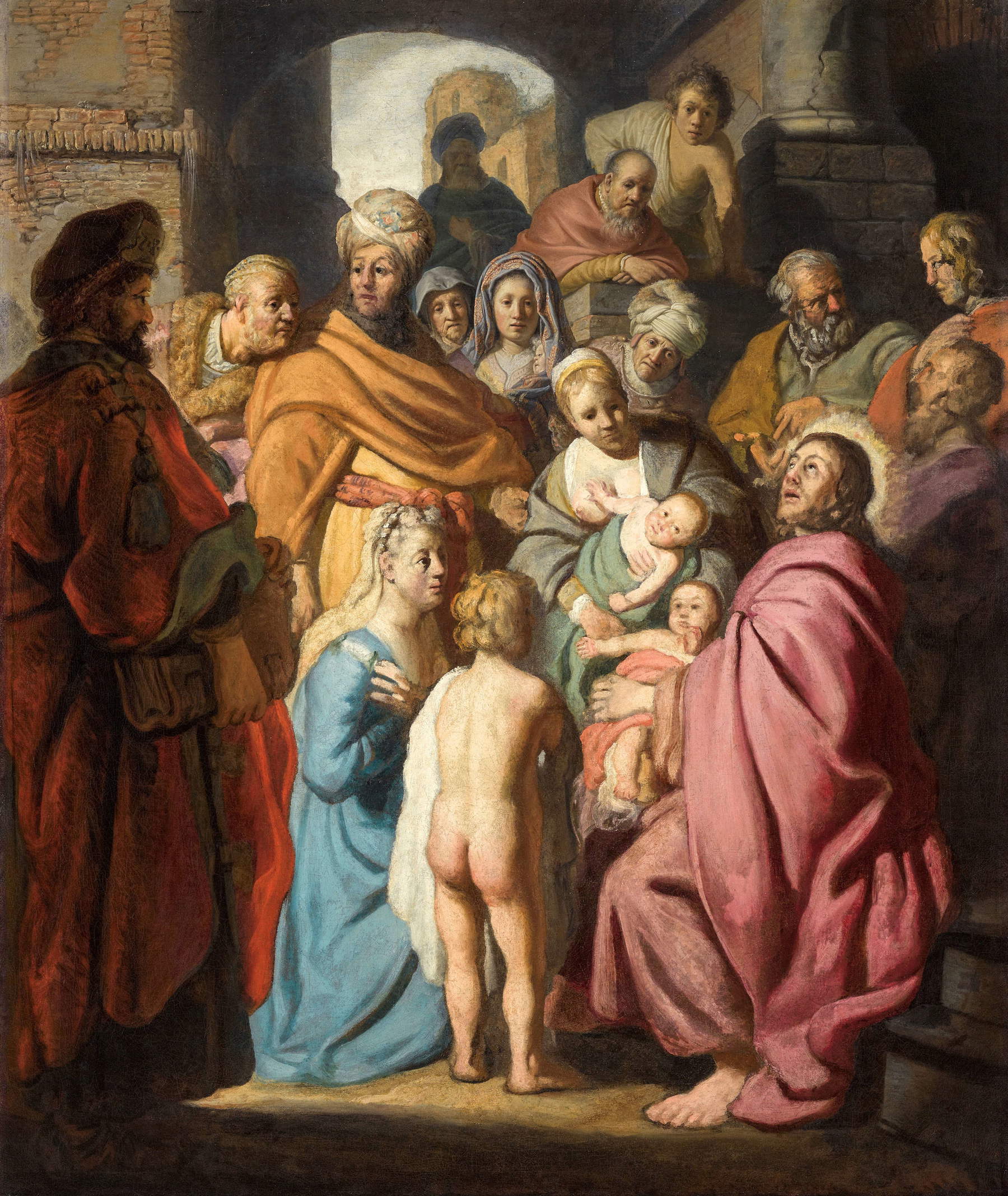
The painting depicts the Gospel scene recounted in the Gospels of Mark, Matthew, and Luke, in which Jesus invites the children to come to him, rebuking the disciples who were trying to send away the parents who were bringing their children to him. The composition depicts the moment immediately following: Christ blesses the children by laying his hands on them, while the disciples to his right gaze in astonishment at what is happening—an outcome they had not anticipated. The figure in red on the left, clearly separated from the rest of the characters, bears the inscription “·1·8·” or “·2·8·” on his turban: if the latter is correct, it could be a reference to chapter 28 of the Gospel of Luke, and the figure, who is looking directly at the miraculous scene, could represent Saint Luke himself, with his Gospel clutched under his right arm.
What makes this work exceptional is not only its subject matter but also its material history and the complexity of its creation. Rembrandt began the painting in Leiden, probably in 1627, but left it unfinished: the lower part of the canvas is only sketched with broad brushstrokes of color, while the upper sections—including the architecture and six figures, among them a self-portrait of the master and portraits of people close to him—are rendered in full detail. This peculiarity offers scholars a rare and valuable window into Rembrandt’s working method: in his history paintings, at least until the 1650s, the master systematically proceeded from the background toward the foreground, and this technique is never more evident than in this canvas.
After Rembrandt moved to Amsterdam, around 1631–1632, the painting was taken up again and completed rather haphazardly by another artist. This later intervention, which was of unsatisfactory quality, was removed during a restoration that restored the work to its original form: a partially unfinished painting, but entirely by Rembrandt’s hand, perfectly preserved in its autograph parts. The removal of the overpainting also made it possible to determine, thanks to the presence of traces of dirt between the distinct layers of paint, that the completion work took place several years after the master had abandoned the painting.
Technical investigations conducted on the work have confirmed its authenticity with a body of evidence that leaves little room for doubt. The painting underwent X-ray and infrared reflectography examinations in 2014, even before the removal of the overpainting began. Pigment sample analyses conducted by Nicholas Eastaugh revealed that the canvas has a double ground: the lower layer is dark red, composed primarily of iron-rich earth pigments with the addition of white lead and bone black; the upper layer is gray, with a higher proportion of white lead and bone black along with some brown earth pigments. The report compiled by Art Access & Research in 2014 concludes that the type of canvas, the ground, the materials, and the techniques identified correspond well with what is known about other works by Rembrandt and his circle. Rembrandt began the work with an initial monochrome sketch, then outlined the architecture while leaving spaces for the figures, and finished the architectural structure before completing the heads—a clear indication that the precise positioning of the figures was determined progressively during the execution of the painting.
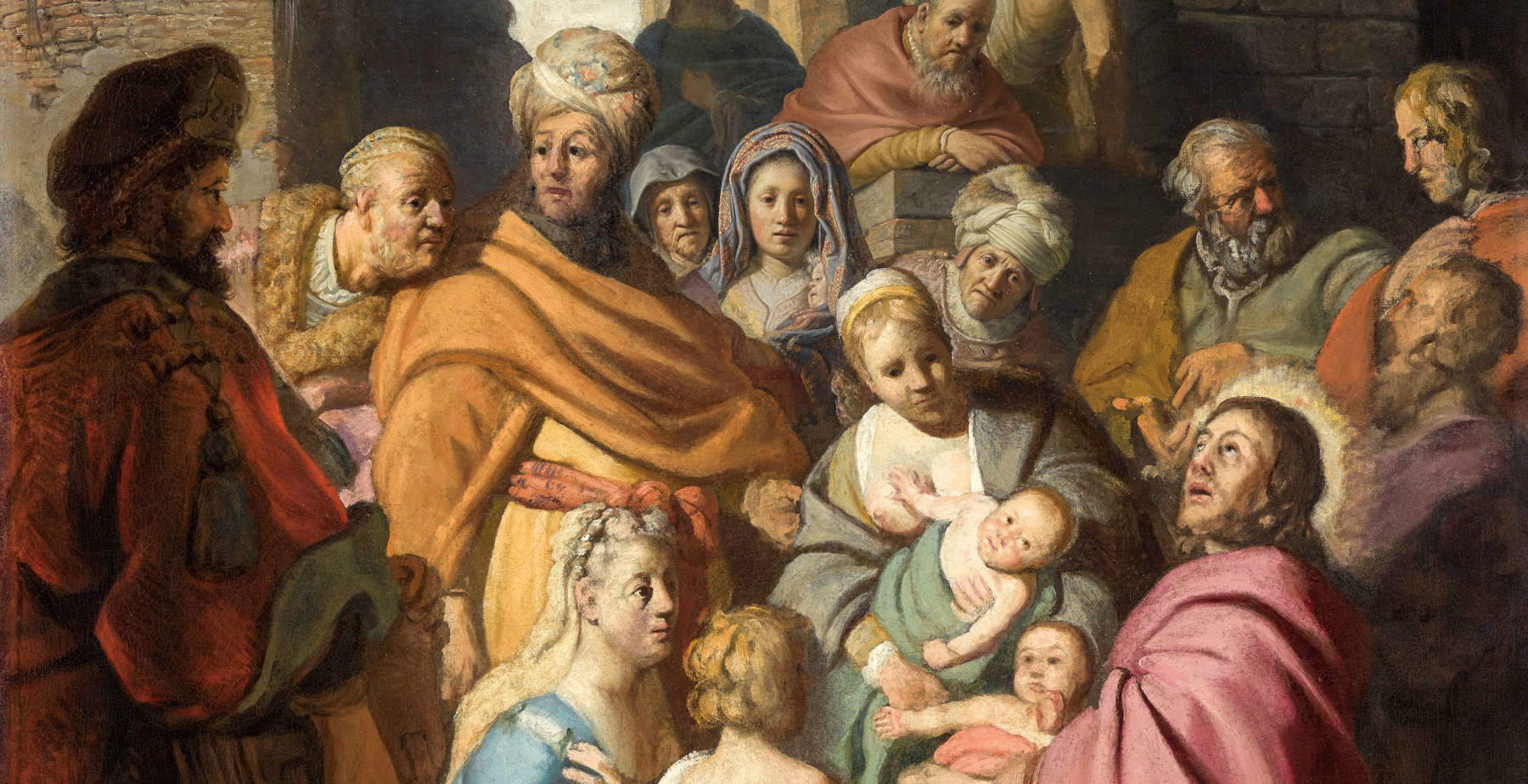
One of the most interesting elements of the work is the presence of a self-portrait of the master, placed high in the composition. The young man with his left shoulder and arm bare, who seems to be leaning forward to follow the miraculous event unfolding, yet looks directly at the viewer, is Rembrandt himself. The recognition is immediate for anyone familiar with his early self-portraits, whether engraved, drawn, or painted: the face is the same as that appearing in his early etchings and in the small self-portraits painted around 1628, such as the one with the face in shadow or the one with the ruff. During his years in Leiden, Rembrandt was in the habit of including his self-portrait in history paintings, beginning with *The Stoning of Saint Stephen* and *The Musical Allegory*. The painter abandoned this practice when he resumed painting historical subjects in Amsterdam in the mid-1630s.
Below Rembrandt’s figure are three women with veiled heads. The eldest, on the left, has features well known to scholars from drawings, etchings, and paintings, and is generally identified as the painter’s mother, Cornelia van Zoutbrouck (1568–1640), although there is no definitive proof of this. At the time the painting was created, she would have been about sixty years old. She first appears as the figure of Anna in Rembrandt’s painting *Tobias Accusing Anna of Stealing the Kid*, dated 1626, then in *Simeon in the Temple * (circa 1628), andin the aforementioned*Musical Allegory *. Rembrandt painted her portrait around 1627–1629 and engraved her image several times between 1628 and 1632. His friend Jan Lievens portrayed her in three-quarter profile in a painting housed at Burghley and in a portrait in Dresden, as well as in a drawing from life in which her features appear less marked by the passage of time, though the skin on her chin is very similar to that of the figure in this painting, who plausibly appears to be a woman of about sixty years of age. Even if she were not Cornelia van Zoutbrouck, she would still be someone who lived in Leiden and whose distinctive facial features are captured in numerous works by Rembrandt, Lievens, and Dou—people who knew her very well. The identification with Rembrandt’s mother is not the result of a later romantic fantasy: his close friend Clement de Jonghe, a print dealer portrayed by Rembrandt himself in an engraving from 1651, listed in 1679 among the 74 plates in his possession one depicting “Rembrandt’s mother.”
Next to the mother is a young woman wearing an embroidered headdress, holding a newborn baby in her arms. It is unclear who she is, but it is very likely that she is a member of the painter’s family or household circle. Rembrandt’s sisters had no children, but she could be the orphan whom his father had taken into the home as his goddaughter, or perhaps a wet nurse. As for the painter’s father, Harmen Gerritszoon van Rijn, who died in 1630 at the age of about sixty, Rembrandt preserved his likeness in a drawing depicting him asleep, on which he had inscribed his father’s name. The figure appearing in the arch in the background—the silhouette of an old man shrouded in deep shadow—seems to match those features, although his head is enveloped in darkness and the identification is not entirely certain. The old man with the bushy beard to the right of the young woman with the child—with his long, straight nose and the two deep furrows above the bridge of his nose—seems, on the other hand, to be a recurring type in Rembrandt’s oeuvre, appearing in numerous works from both his Leiden and Amsterdam periods.
From a compositional standpoint, the work reveals extraordinary refinement and mastery for a painter of only twenty years of age. The figure in red dominating the foreground on the left serves as a repoussoir—that is, it anchors the composition and guides the viewer’s eye toward the center of the scene, where the New Testament story unfolds as if on a brightly lit stage. Christ looks upward toward a source of light that is at once celestial, thus suggesting that his command to the disciples comes directly from God the Father. This theological concept is original, and the consistency in the distribution of light and shadow demonstrates that the painter had fully developed the lighting scheme as early as the initial sketching phase.
The painting’s color palette is typical of Rembrandt’s Leiden period up to 1627–1628, dominated by strong, luminous colors such as red, purple, orange, yellow, blue, and green, in sharp contrast to the darker, more subdued palette that characterizes his later works. The partial incompleteness of the foreground makes this color choice even more evident, as the sketched figures reveal the areas of color in their essential simplicity, lacking the finishing touches that would have given them the usual richness of embroidered fabrics and precious details. The only hint of that final refinement is the embroidered headdress of the young woman with the infant, rendered with care and precision even in the completed sections. The dating to 1627 is supported by several converging stylistic and iconographic elements. Perhaps the most precise is the flame-shaped halo of Christ, identical to that found in other works of the period.
As for its provenance, the painting has a documented history that potentially dates back to the Dutch 17th century, although the connections between individual inventory entries and the present canvas remain hypothetical in the absence of definitive evidence. Floris Soop’s inventory, dated May 3, 1657, mentions “a large painting depicting Christ calling little children to him.” Soop died without a will, and his estate was inherited by his relative Petrus Scriverius, then divided between his two sons. The inventory of one of them, Wilhelmus Scriverius, dated October 26, 1661, lists a work by Rembrandt intended to decorate a fireplace, and on August 8, 1663, Scriverius himself sold twenty-four paintings at auction, including two large works by the master. There is no definitive proof that the painting currently on sale at Sotheby’s is the one mentioned in these three inventories, but the hypothesis is plausible, especially since no other work by Rembrandt on the same subject—whether large or small—is known to exist. If the two were indeed one and the same, this would also demonstrate that an early work such as this, completed by another hand, was nonetheless considered part of Rembrandt’s recognized body of work while the painter was still alive and working in his late style.
As for the artist responsible for the later completion, the most widely accepted theory points to Claes Corneliszoon Moeyaert (1592–1655), a painter who, like Rembrandt, had trained in the workshop of Pieter Lastman and worked in Amsterdam. The scholar Christiaan Vogelaar has noted that Moeyaert’s painting on the same subject, now in Karlsruhe and executed around 1635, bears so many similarities to this canvas that its author must have been directly familiar with this composition. Similar parallels can be found in another painting by Moeyaert, formerly in Düsseldorf and known only from a poor-quality black-and-white photograph.
Before its rediscovery in 2014, the painting had been shown to Ernst Heinrich Zimmermann, director of the Gemäldegalerie in Dahlem, Berlin, who on December 7, 1954, had written an expert report attributing it to Govert Flinck, a pupil of Rembrandt, dating it to the 1630s and noting its surprisingly vivid coloration. The stretcher bears the ink inscription “Von Gellhorn,” in a handwriting style characteristic of the late 18th or 19th century. That a work so intimately linked to Rembrandt’s Leiden period—which includes a recognizable self-portrait and portraits of his family members—remained unidentified until 2014 remains a mystery that is difficult to explain.
 |
| Rembrandt Rediscovered: A Masterpiece by the Young Master, Featuring a Self-Portrait, to Be Auctioned in London |

Warning: the translation into English of the original Italian article was created using automatic tools. We undertake to review all articles, but we do not guarantee the total absence of inaccuracies in the translation due to the program. You can find the original by clicking on the ITA button. If you find any mistake,please contact us.

























 IT
IT FR
FR DE
DE ES
ES CN
CN


